Niclosamide: The Antiparasitic That Does More Than Kill Tapeworms
SafeRxPills Pharmacy Team
Editorial team at SafeRxPills. Articles are written and checked against regulatory drug labelling (DailyMed, FDA, EMA) and published literature.
Niclosamide: The Antiparasitic That Does More Than Kill Tapeworms | SafeRxPills - pharmacy guide
Niclosamide has been quietly treating tapeworm infections since 1960. For most of that time, it sat in the shadow of praziquantel, which eventually became the dominant tapeworm drug. But niclosamide is experiencing a significant scientific revival. Researchers studying cancer, COVID-19, metabolic disease, and antibiotic-resistant bacteria have found that this old antiparasitic has properties that nobody expected. This guide covers its established antiparasitic uses, correct dosing, and what the emerging research actually shows.
What Is Niclosamide?
Niclosamide is a synthetic anthelmintic drug that has been used to treat intestinal tapeworm infections in humans since the early 1960s. It was historically considered the drug of choice for tapeworm infections before praziquantel became widely available. According to a 1981 clinical review (PMID:7355683), niclosamide was among the antiparasitic drugs of choice for tapeworm infections, alongside mebendazole for roundworm and hookworm.
Unlike most antiparasitic drugs, niclosamide is not significantly absorbed from the gastrointestinal tract. It acts locally within the intestinal lumen, which is both its strength (minimal systemic side effects) and a limitation (it cannot reach tissue-invasive parasites). SafeRxPills carries Niclosamide 500mg tablets from WHO-GMP certified manufacturers.
How Does Niclosamide Work?
Niclosamide kills tapeworms through a mechanism called uncoupling of oxidative phosphorylation. In simple terms, it disrupts the energy production machinery inside parasite cells by interfering with the mitochondrial electron transport chain. The parasite's ability to generate ATP (its energy currency) collapses. It becomes paralysed, releases its grip on the intestinal wall, and is digested and expelled before it can cause further harm.
This mechanism of uncoupling oxidative phosphorylation is precisely why niclosamide has attracted such intense scientific interest beyond parasitology. Researchers publishing in peer-reviewed journals have noted (PMID:28389414) that this same mechanism may be effective against cancer cells, bacteria, viruses, and even metabolic diseases, all of which share vulnerabilities related to cellular energy metabolism and specific signalling pathways that niclosamide can modulate.
What Tapeworm Infections Does Niclosamide Treat?
Niclosamide is effective against intestinal tapeworm infections only. It does not treat tissue-invasive infections like neurocysticercosis (brain tapeworm) or hydatid disease, because it does not reach systemic circulation in meaningful concentrations. For those conditions, albendazole is required. See our Zentel albendazole guide for details.
Conditions niclosamide treats:
- Taenia saginata (beef tapeworm) - the most common tapeworm infection globally
- Taenia solium (pork tapeworm) - intestinal stage only. For neurocysticercosis from T. solium larvae reaching the brain, albendazole is needed
- Diphyllobothrium latum (fish tapeworm) - can grow up to 10 metres in the intestine
- Hymenolepis nana (dwarf tapeworm) - the most common tapeworm infection in children in some regions
A 1984 review (PMID:17762788) confirmed that most human intestinal cestode infections can be treated with either a single oral dose of praziquantel or niclosamide. The choice between them generally comes down to local availability and cost, as efficacy is comparable for intestinal tapeworm infections.
Niclosamide Dosage
Niclosamide is typically taken as a single dose. Tablets should be chewed thoroughly or crushed and mixed with water before swallowing, as they are not well-absorbed in their intact form and need to be distributed evenly throughout the intestinal contents to kill the tapeworm effectively.
Adult Dosage
- Beef tapeworm (T. saginata), Pork tapeworm (T. solium intestinal), Fish tapeworm (D. latum): 2g (four 500mg tablets) as a single dose
- Dwarf tapeworm (H. nana): 2g on day 1, then 1g daily for 6 days
Children's Dosage
- 34 to 75kg: 1.5g (three 500mg tablets) as a single dose
- 11 to 34kg: 1g (two 500mg tablets) as a single dose
A light meal 2 hours before taking niclosamide is often recommended. Some prescribers suggest a laxative 2 hours after the dose to expel the dead tapeworm rapidly, reducing the theoretical (though very low) risk of eggs being released from the dying worm.
Safety and Side Effects
Niclosamide has an excellent safety record built over six decades. Because it is not systemically absorbed, it does not cause the liver toxicity or bone marrow suppression seen with some other antiparasitic drugs. Side effects are almost entirely gastrointestinal and transient:
- Nausea (most common, usually mild)
- Abdominal discomfort or cramping
- Vomiting (uncommon)
- Diarrhoea
- Dizziness (rare)
It is generally considered safe for children over 2 years old. Data on use in pregnancy is limited, so it should only be used during pregnancy when clearly necessary and after medical consultation.
Niclosamide vs Praziquantel for Tapeworms
Both drugs are effective for intestinal tapeworm infections. The key practical differences:
- Niclosamide: Chewable tablets, single dose for most infections, not systemically absorbed, excellent tolerability. Historically the gold standard before praziquantel.
- Praziquantel (Biltree): Swallowable tablets, also single-dose for most infections, slightly better evidence for H. nana and some other species. Systemically absorbed, meaning it works for tissue-invasive infections too. See our antiparasitic medicine guide for a broader comparison.
Neither is clearly superior for straightforward intestinal tapeworm infections in adults. Availability tends to determine which is used in practice.
The Emerging Research: Niclosamide Beyond Parasitology
This is where niclosamide gets genuinely interesting. A growing body of peer-reviewed research is investigating its potential across multiple serious disease areas. This is not fringe science. It is published in mainstream journals and backed by multiple clinical trials.
Cancer Research
A 2022 review (PMID:36479072) described niclosamide as a potential "magic bullet" in oncology. Niclosamide inhibits multiple cancer-driving signalling pathways simultaneously, including Wnt/beta-catenin, Ras, STAT3, Notch, NF-kB, and mTOR. It also activates tumour suppressor pathways including p53, PP2A, and AMPK. Most cancer drugs target a single pathway. Niclosamide's ability to hit multiple pathways while sparing normal cells (due to its mitochondrial uncoupling mechanism, which preferentially affects cells with abnormal metabolic profiles) has made it attractive for repurposing.
Niclosamide's reformulation challenges have historically limited its clinical use in cancer, since it needs to reach tumour tissue systemically, which oral niclosamide does not do well. Researchers are actively developing prodrug and nanoparticle formulations to solve this.
Antiviral Activity (COVID-19 and Others)
A 2022 review (PMID:35348204) outlined niclosamide's antiviral properties, including potent activity against SARS-CoV-2 in preclinical studies. Multiple clinical trials investigated niclosamide nasal sprays and nebulised formulations as early-treatment and preventative options for COVID-19. The rationale is its anti-inflammatory, antibacterial, and bronchodilatory effects alongside direct antiviral properties.
Metabolic Diseases
Research published in peer-reviewed journals (PMID:28389414) notes that niclosamide's mitochondrial uncoupling mechanism has shown effects on Type 2 diabetes, non-alcoholic steatohepatitis (NASH), and non-alcoholic fatty liver disease (NAFLD) in preclinical models.
A 2023 mechanistic review (PMID:37544514) argued that niclosamide's fundamental mode of action, targeting all cell membranes through its protonophore mechanism, positions it as a candidate for numerous diseases where cellular energy dysregulation plays a role, including Parkinson's disease, COPD, and rheumatoid arthritis.
To be clear: these are areas of active research. Niclosamide is not approved for any of these conditions. For its established use in tapeworm infections, however, its safety and efficacy are well-established.
A Note on Niclosamide and Taenia Solium
One important caveat when treating pork tapeworm (T. solium) intestinal infections: avoid antiemetics and take care to prevent vomiting after dosing. If the dying worm's eggs are regurgitated into the stomach and then enter the intestine, they could theoretically cause cysticercosis (larval infection of tissues). This risk is theoretical and rare, but it is why some practitioners prefer praziquantel for T. solium intestinal infections. If neurocysticercosis is a concern (brain involvement), albendazole is the drug of choice, not niclosamide.
Where to Buy Niclosamide Online
Niclosamide is not readily available at most local pharmacies in the US, UK, or Australia. It was discontinued by major Western manufacturers as praziquantel took over the tapeworm treatment market. International pharmacies remain the primary source for patients who need it.
SafeRxPills stocks Niclosamide 500mg tablets with delivery to the USA, UK, Australia, and Canada. Our supply chain operates under WHO-GMP and ISO-certified manufacturing conditions through Actiza Pharmaceutical. For a full overview of antiparasitic options, see our guide to buying antiparasitic medicines online and our intestinal worm treatment guide.
Key Takeaways
- Niclosamide is a 60-year-old antiparasitic drug for intestinal tapeworm infections, with an excellent safety profile
- Standard adult dose is 2g (four 500mg tablets) as a single oral dose; tablets must be chewed
- It works locally in the gut and is not significantly absorbed systemically, which minimises side effects
- It does not treat tissue-invasive infections like neurocysticercosis; use albendazole for those
- Emerging research is investigating niclosamide for cancer, viral infections, and metabolic diseases, but these uses are not yet clinically approved
- It is difficult to find in local pharmacies; international online pharmacies are the primary access point
Medical disclaimer: This article is for informational purposes only and does not constitute medical advice. Niclosamide is a prescription medication in most countries. Always consult a qualified healthcare provider for diagnosis and treatment of any parasitic infection. Do not self-treat without a confirmed diagnosis.
Related Products
- Niclosamide 500mg - tapeworm treatment and emerging antiparasitic
- Biltree 600mg (Praziquantel) - praziquantel for tapeworm and flukes
- Flagyl 400mg (Metronidazole) - for giardia, amoeba and bacterial infections
Medical References
- Systematic review of the effectiveness of selected drugs for preventive chemotherapy for Taenia solium taeniasis. PLoS Negl Trop Dis. 2020. PMID 31945055
- Measures for the prevention and control of Taenia solium taeniosis and cysticercosis. Acta Trop. 2003. PMID 12781388
- DailyMed: Niclosamide product labeling. U.S. National Library of Medicine
Sources: U.S. National Library of Medicine (PubMed, DailyMed). Last reviewed August 2026.
?Frequently Asked Questions
What is niclosamide used for?
Niclosamide is used to treat intestinal tapeworm infections including beef tapeworm (T. saginata), pork tapeworm (T. solium intestinal stage), fish tapeworm (D. latum), and dwarf tapeworm (H. nana). It acts locally in the gut and is not suitable for tissue-invasive infections like neurocysticercosis.
What is the correct niclosamide dosage?
For most intestinal tapeworm infections in adults, the dose is 2g (four 500mg tablets) as a single oral dose. Tablets must be chewed thoroughly or crushed before swallowing. For dwarf tapeworm, 2g on day one followed by 1g daily for 6 days is required.
Does niclosamide have serious side effects?
Niclosamide has an excellent safety profile. Because it is not absorbed into the bloodstream, it does not cause systemic side effects like liver toxicity. The most common effects are mild nausea, stomach discomfort, and occasionally vomiting or diarrhoea. Serious side effects are rare.
Is niclosamide better than praziquantel for tapeworms?
Both are equally effective for most intestinal tapeworm infections. Praziquantel (Biltree) has slightly broader coverage and is systemically absorbed, making it suitable for tissue-invasive infections too. Niclosamide is an older, very well-tolerated alternative. Availability usually determines which is used.
Can niclosamide treat neurocysticercosis?
No. Niclosamide is not absorbed systemically so it cannot reach brain tissue. Neurocysticercosis (brain tapeworm cysts from T. solium larvae) requires albendazole, which penetrates the blood-brain barrier. Niclosamide only treats the intestinal stage of tapeworm infections.
Where can I buy niclosamide online?
Niclosamide is not stocked by most local pharmacies in the US, UK, or Australia as major manufacturers discontinued it when praziquantel became the standard. SafeRxPills supplies Niclosamide 500mg tablets for international delivery to the USA, UK, Australia, and Canada from WHO-GMP certified sources.
SafeRxPills Pharmacy Team
SafeRxPills Editorial Team
Editorial team at SafeRxPills. Articles are written and checked against regulatory drug labelling (DailyMed, FDA, EMA) and published literature.
Comments (0)
Leave a Comment
No comments yet. Be the first to share your thoughts!
Related Articles
Wormentel Duo (Ivermectin + Albendazole): The Combination Antiparasitic Explained
August 22, 2026
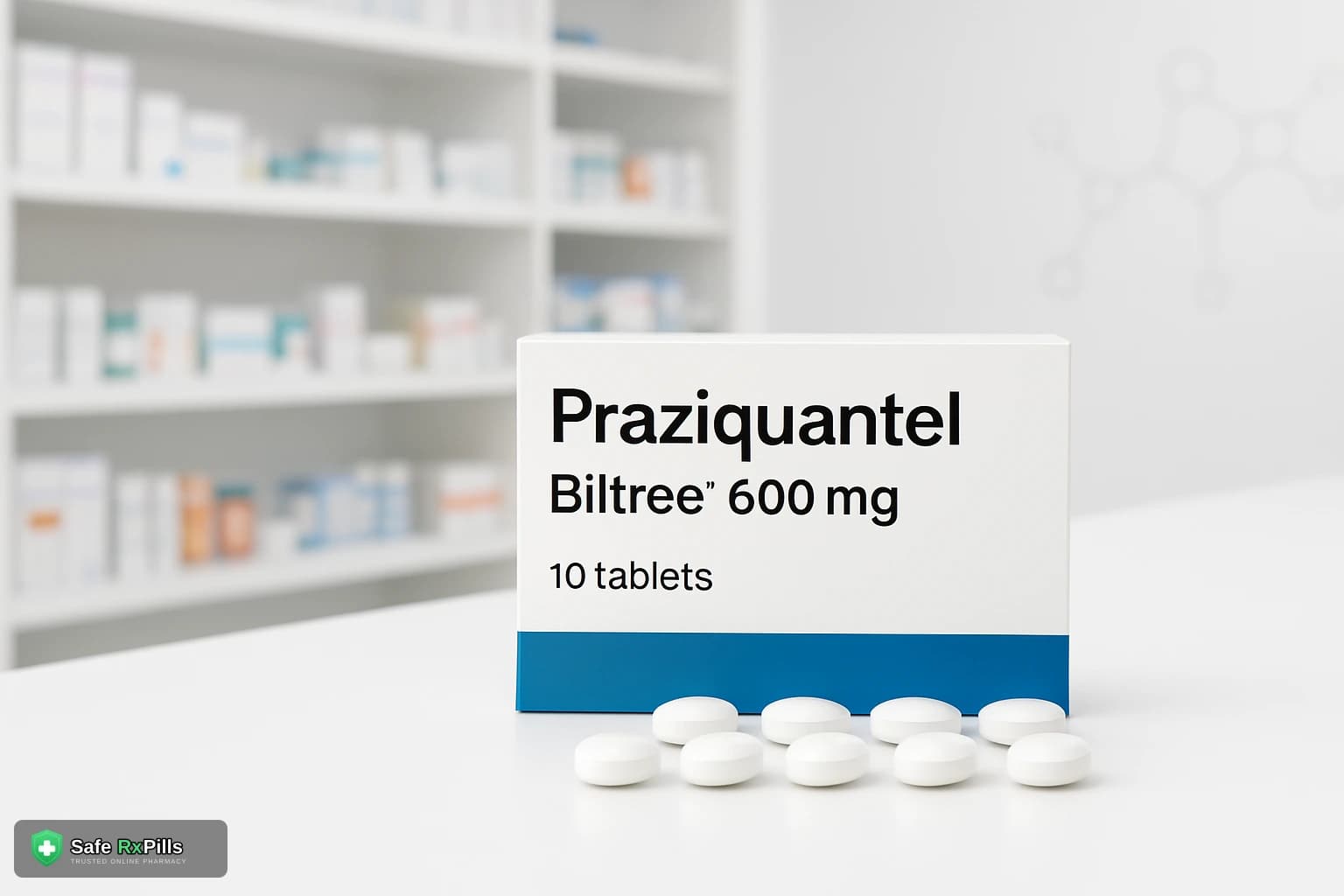
Buy Praziquantel (Biltree 600mg) Online in the USA: 2026 Tapeworm Treatment Guide
July 6, 2026