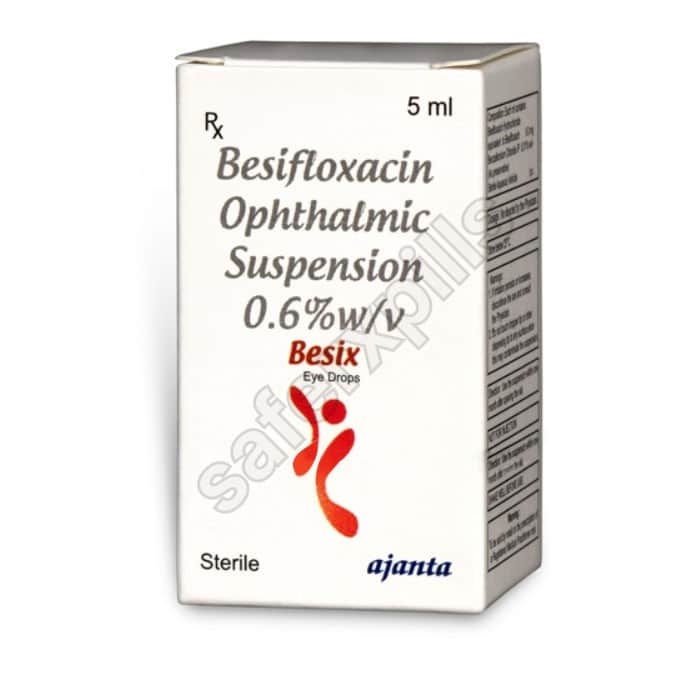
Besix Eye Drops
Generic: Besifloxacin
Select pack size
1 bottle
About Besix Eye Drops
Besix Eye Drops are Ajanta Pharma's besifloxacin 0.6% w/v antibiotic eye drop, a suspension in a 5 mL bottle, made for the Indian market. Besifloxacin is the same active ingredient, at the same strength, as Besivance, the US brand made by Bausch & Lomb. The US label covers one use only: bacterial conjunctivitis caused by susceptible bacteria. We sell Besix as 1, 3 or 6 bottles, from $6.00 a bottle in the 6 bottle pack, before shipping.
Three things to know before you order. First, most red, sticky eyes in adults are not bacterial: the CDC says most cases of acute infectious conjunctivitis in adults are viral and get better on their own, and the NHS says antibiotics will not work for viral or allergic conjunctivitis. Second, our delivery takes 7 to 14 business days, so this is not a way to treat an eye infection you have today; a painful red eye, light sensitivity or a change in vision needs to be seen the same day (see "When to get urgent help"). Third, besifloxacin eye drops are prescription medicines in the US, Canada and Australia, and a doctor should confirm that your infection is bacterial. Clinical details on this page come from the current US besifloxacin label (Bausch & Lomb, January 2026), listed under Sources.
Besix Eye Drops at a glance
| Active ingredient | Besifloxacin 0.6% w/v (6 mg per mL), a fluoroquinolone antibiotic, as an eye suspension. 5 mL bottle (carton in our product photo; Tata 1mg, PharmEasy, Apollo Pharmacy and Truemeds listings). |
| Brand and maker | Besix, Ajanta Pharma Ltd, Mumbai (carton in our product photo; all four Indian listings) |
| Labelled use | US: bacterial conjunctivitis caused by susceptible bacteria (label section 1). Australia: severe, confirmed bacterial conjunctivitis in adults and children 12 months and older (healthdirect). |
| Regulatory status | Besifloxacin 0.6% is licensed in the US (Besivance, FDA approved 2009), Canada (Besivance, DIN 02336847) and Australia (Besivance, Schedule 4). We found no besifloxacin product on the UK emc. The Indian pack we sell is not registered with the FDA, MHRA, TGA or Health Canada. |
| Usual dose (US label) | Shake once, then one drop in the affected eye(s) 3 times a day, 4 to 12 hours apart, for 7 days (section 2) |
| Half-life | About 7 hours in blood, where levels after eye use were very low (peak under 1.3 ng/mL; section 12.3) |
| Packs | 1, 3 or 6 bottles |
| Price per bottle | $6.00 to $8.00 before shipping; $10.17 to $33.00 with shipping |
| Delivery | 7 to 14 business days to the US, UK, Australia and Canada; $25 shipping under $149, free from $149 |
Price per bottle
Prices as of November 2026; the pack selector shows the current price. No pack reaches the $149 free shipping level on its own, so each includes the $25 shipping charge below unless you add other items. Per mL figures use the 5 mL bottle size on the carton and the Indian listings.
| Pack | Price | Per bottle | Per mL | Shipping | Order total | Per bottle with shipping |
|---|---|---|---|---|---|---|
| 1 bottle | $8.00 | $8.00 | $1.60 | $25 | $33.00 | $33.00 |
| 3 bottles | $21.00 | $7.00 | $1.40 | $25 | $46.00 | $15.33 |
| 6 bottles | $36.00 | $6.00 | $1.20 | $25 | $61.00 | $10.17 |
How many bottles you need. The US product is supplied as a single 5 mL bottle (label section 16), and the labelled course is 7 days. Once opened, a bottle should be used within 4 weeks: Tata 1mg says to use it within 4 weeks of opening, PharmEasy says to discard it 4 weeks after opening, and the Australian Besivance information says "Discard 4 weeks after opening" (healthdirect). So one bottle covers one labelled course, and the 3 and 6 bottle packs are more than any labelled course. Please do not keep spare bottles to treat a future red eye yourself: many red eyes are viral or allergic, and an antibiotic will not help them (NHS).
Compared with besifloxacin and other antibiotic eye drops in the US
Besivance (NDA 022308) was approved by the FDA on 28 May 2009, and Drugs@FDA lists no other company's besifloxacin eye drop (openFDA, queried 4 November 2026). Since January 2026 Besivance has also been sold under a new Bausch & Lomb Americas product code (NDC 82260-466-05). NADAC lists that code under the name "besifloxacin" and classes it as generic for rate setting, but the FDA lists it as Besivance under the same approval. There is no generic besifloxacin eye drop from another company in the US. The figures below are what US pharmacies paid according to NADAC, per-NDC rows in the 2026 file as of 4 November 2026. They are pharmacy acquisition costs, not the price at the counter.
| Product | Maker | FDA approved | US pharmacy cost per mL | Per 5 mL bottle |
|---|---|---|---|---|
| Besivance 0.6%, 5 mL (NDC 24208-446-05) | Bausch & Lomb | Yes | $44.10 ($44.10026), effective 21 October 2026 | About $220.50 |
| Besivance 0.6%, 5 mL, newer product code (NDC 82260-466-05; NADAC name "besifloxacin") | Bausch & Lomb Americas | Yes | $33.68 ($33.67760), effective 21 October 2026 | About $168.39 |
| Generic ofloxacin 0.3% eye drops, 5 mL (a different antibiotic) | Several | Yes | $1.23 ($1.22968), effective 21 October 2026 | About $6.15 |
| Besix Eye Drops, Indian pack (this page), 5 mL | Ajanta Pharma | No (not registered with the FDA) | $1.20 to $1.60 from us, before shipping | $6.00 to $8.00 before shipping; $10.17 to $33.00 with shipping |
Plainly: besifloxacin is an expensive drop in the US, and even one Besix bottle with shipping ($33.00) costs far less than a US pharmacy pays for one bottle of Besivance under either product code. But besifloxacin is not the only antibiotic for bacterial conjunctivitis. Generic ofloxacin and other older antibiotic drops cost US pharmacies a few dollars a bottle, and you get them the same day. We have not found anything in the labels that makes besifloxacin the better choice for an ordinary case of bacterial conjunctivitis; which drop to use is your doctor's call (our view). If you are in the US and have a prescription, compare US cash prices and your insurance cover first.
Besix is a different product from a different maker. The US product is made with a thickening vehicle called DuraSite (polycarbophil) and contains benzalkonium chloride 0.01% as a preservative (label section 11). We have not seen Ajanta's ingredient list: Apollo Pharmacy names benzalkonium chloride, the other listings name no preservative, and the side panel in our product photo is not readable. We know of no published study comparing Besix with Besivance. Read the carton.
Besix and related products
Besifloxacin eye drops come in one strength (0.6%), so there is no strength to choose. The real questions are whether you need an antibiotic eye drop at all, and which one.
| Product | What it is | When it fits |
|---|---|---|
| Besix Eye Drops (this product) | Besifloxacin 0.6% suspension, 3 times a day for 7 days (US label) | Bacterial conjunctivitis diagnosed or judged likely by a doctor, optometrist or pharmacist |
| Oflox Eye Drop | Ofloxacin 0.3% solution (Cipla), another fluoroquinolone | Bacterial conjunctivitis; the US ofloxacin label also covers corneal ulcers under an eye doctor's care |
| Toba Eye Drop | Tobramycin 0.3%, an aminoglycoside antibiotic | External bacterial eye infections, as prescribed |
| Zaha Eye Drop | Azithromycin eye drop | Bacterial conjunctivitis, as prescribed |
None of these treats viral or allergic conjunctivitis. Steroid and antibiotic combination drops are different products for different problems; do not use one in place of an antibiotic drop unless an eye doctor tells you to (our advice).
How to use Besix eye drops
Use the schedule your doctor gives you. The US label (section 2) says: "Invert closed bottle and shake once before use. Instill one drop in the affected eye(s) 3 times a day, 4 to 12 hours apart for 7 days."
- Wash your hands. Turn the closed bottle upside down and shake it once before each use (US label 2 and 17). It is a suspension, so shaking matters.
- Tilt your head back, pull the lower lid down gently and put one drop into the pocket.
- Do not let the dropper tip touch your eye, lids, fingers or anything else. The US label says to avoid contaminating the applicator tip with material from the eye, fingers or other source (17).
- Space the three doses through the day, at least 4 hours apart, for the full 7 days (US label 2).
- If you use another eye medicine, leave a few minutes between drops (our advice; the label gives no interval).
- It is for use on the eye only. The US label says it is not for injection into the eye (5.1).
- If the eye gets worse, or has not improved after a few days, stop and see a doctor (our advice). The label warns that long use can let organisms that do not respond, including fungi, overgrow; if that happens, the drops should be stopped and another treatment used (5.2).
- Use an opened bottle within 4 weeks (Tata 1mg; PharmEasy; Australian Besivance information via healthdirect), even if some is left.
Contact lenses. The US label says patients "should not wear contact lenses if they have signs or symptoms of bacterial conjunctivitis or during the course of therapy" (5.3, 17). The Apollo Pharmacy and PharmEasy listings for Besix say the same, and the NHS says do not wear contact lenses until your eyes are better. The CDC says contact lens wearers with bacterial conjunctivitis are at higher risk of bacterial keratitis (a corneal infection) and should be promptly seen by an eye doctor. Our advice: leave lenses out for the whole course, and if you wear lenses and have a painful red eye, get seen the same day rather than waiting for a delivery.
Groups who need extra care
- Babies under one year. The US label says safety and effectiveness in infants below one year of age have not been established; effectiveness was shown in children one year and older (8.4). The Australian product is for adults and children 12 months and older (healthdirect). A baby under 30 days old with red, sticky eyes needs an urgent appointment (NHS).
- Children's joints. The US label says there is no evidence that quinolone eye drops affect weight-bearing joints, although some quinolones taken by mouth or injection have caused joint damage in young animals (8.4).
- Pregnancy. The US label says there are no human data, but systemic exposure after eye use is low, and oral besifloxacin in pregnant rats did not harm the young at clinically relevant exposures (8.1). Tell your doctor if you are pregnant.
- Breastfeeding. There are no data on besifloxacin in breast milk; the US label says to weigh the benefits of breastfeeding, the mother's need for the drops, and any possible effect on the baby (8.2).
- Older adults. No overall differences in safety or effectiveness were seen compared with younger patients (US label 8.5).
- Long or repeated use. Overgrowth of organisms that do not respond, including fungi, is possible with prolonged use (US label 5.2). Do not use it beyond the course your doctor sets.
Medicines to mention to your doctor: the US label has no drug interaction section. Blood levels after eye use were very low: in adults using the drops in both eyes three times a day, the peak level was under 1.3 ng/mL in every patient (12.3). Still tell your doctor about all medicines you use, including other eye drops.
Side effects
The US label's side effect data come from about 1,000 patients aged 1 to 98 with bacterial conjunctivitis (section 6):
| Reaction | How often (US label, section 6) |
|---|---|
| Redness of the eye (conjunctival redness) | About 2%, the most frequent |
| Blurred vision | About 1% to 2% |
| Eye pain | About 1% to 2% |
| Eye irritation | About 1% to 2% |
| Itchy eye | About 1% to 2% |
| Headache | About 1% to 2% |
The label does not list allergic reactions. Allergy to any medicine is still possible, so the allergy advice below is general safety advice (ours), not label content.
What the trial showed. In the US label's trial (patients aged 1 to 98, drops 3 times a day for 5 days), the infection had cleared clinically in 45% (90 of 198) of people on besifloxacin against 33% (63 of 191) on the inactive vehicle drop; bacteria were cleared in 91% against 60% (section 14). Two points from those numbers (our reading): a third of people with confirmed bacterial conjunctivitis got better on the vehicle drop alone in that trial, and the antibiotic helped more people clear it, but not everyone. The label adds that clearing the bacteria "does not always correlate with clinical outcome".
When to get urgent help
- Eye pain, sensitivity to light, changes in vision or a very red eye: ask for an urgent GP appointment or get help from NHS 111 (NHS), or see an eye doctor or emergency department the same day elsewhere. A white spot on the clear front of the eye, especially if you wear contact lenses, can be a sign of a corneal infection and needs same-day eye care (our advice; the CDC says lens wearers with bacterial conjunctivitis are at higher risk of bacterial keratitis).
- A baby less than 30 days old with red, sticky eyes: get an urgent appointment (NHS).
- Allergy signs (rash, hives, swelling of the eyelids, face, lips, tongue or throat, wheezing, trouble breathing or swallowing): stop the drops and call emergency services (911 in the US and Canada, 999 in the UK, 000 in Australia) for severe signs (our advice).
- The eye gets worse, or a new infection appears during treatment: stop and see a doctor (our advice; the US label says to stop and use another treatment if a superinfection occurs, 5.2).
- Someone swallows the drops: contact a doctor or poison control (US Poison Help 1-800-222-1222; Australian Poisons Information Centre 13 11 26) (our advice).
Tell the doctor or emergency staff what was used (besifloxacin 0.6% eye drops), how much and when.
Who should not use Besix eye drops
Contraindications: the US label lists none (section 4).
Do not use it without a doctor's advice if:
- You have had an allergic reaction to besifloxacin, to another quinolone antibiotic (for example ofloxacin, ciprofloxacin or moxifloxacin), or to any ingredient of the drops (our advice; the US besifloxacin label does not address this).
- The red eye may be viral or allergic: antibiotics will not work for these (NHS).
- The child is under one year old: safety and effectiveness have not been established (US label 8.4).
- You have eye pain, reduced vision, light sensitivity or a white spot on the eye: these need an eye examination first, and the US label covers conjunctivitis only, not corneal infections (section 1).
- You wear contact lenses and would keep wearing them: the label says not to wear them during treatment (5.3).
- You are pregnant or breastfeeding: talk to your doctor first (see "Groups who need extra care").
Prescription and legal status
Besifloxacin eye drops are prescription medicines in the US (Besivance "Rx only", Drugs@FDA marketing status Prescription), Canada (Besivance, DIN 02336847, prescription, marketed since January 2010, Health Canada Drug Product Database) and Australia (Besivance, Schedule 4: Prescription Only Medicine, healthdirect). We found no besifloxacin product on the UK emc (searched 4 November 2026); the emc is not the full MHRA register, so we cannot rule out a UK licence, but we know of none. Our carton photo carries the Rx symbol, and Tata 1mg, Apollo Pharmacy and Truemeds mark Besix as a prescription medicine in India. The Indian pack we sell is not registered with the FDA, MHRA, TGA or Health Canada, and the FDA says personal importation of unapproved medicines is illegal in most circumstances. Check the rules where you live.
Buying genuine Besix
The MHRA warns: "Any medicine not authorised for sale in the UK can be unsafe or ineffective and there is no way of knowing what is in them or the negative health effects they can have." That warning covers this Indian pack. The MHRA also advises: "Only use UK-registered pharmacies, including online pharmacies displaying the official green cross logo." When your order arrives, check that the carton and bottle say Besix and besifloxacin ophthalmic suspension 0.6% w/v, name Ajanta, carry a batch number and an expiry date, and that the seal is intact. These checks cannot prove a bottle is genuine, because counterfeiters copy packaging. Eye drops must be sterile: do not use a bottle with a broken seal. If a batch causes symptoms, seek medical advice and report it to your medicines regulator (the MHRA Yellow Card scheme in the UK, FDA MedWatch in the US, the TGA in Australia or Health Canada) as well as to us.
Delivery
We ship Besix Eye Drops to the US, UK, Australia and Canada in plain packaging with tracking. Standard delivery takes 7 to 14 business days, which is too slow for an infection you have now. Shipping costs a flat $25 on orders under $149 and is free from $149. No label or listing we checked asks for refrigeration. The US label says store at 15°C to 25°C and protect from light (section 16); Apollo Pharmacy and PharmEasy give 15°C to 25°C and say do not refrigerate; Truemeds and Tata 1mg say store below 25°C (a Tata 1mg FAQ says below 30°C). We cannot control the temperature in transit; store the bottle as the carton says once it arrives. See our shipping page and refund policy.
Related guides
- Antibiotic eye drops: when pink eye needs them, US options, doses and cost
- Moxifloxacin eye drops (Vigamox): dosage, side effects and US cost
- Ofloxacin eye drops: dosage, side effects and US cost
- Eye drops recall list and how to check your bottle
Sources
- Besivance (besifloxacin ophthalmic suspension) 0.6%, US prescribing information, Bausch & Lomb Americas Inc., NDA 022308, DailyMed setid ff971287-5610-4f15-8392-fc974e6ff646, version 1, effective 12 January 2026: sections 1, 2, 4, 5.1 to 5.3, 6, 8.1, 8.2, 8.4, 8.5, 11, 12.3, 14, 16, 17. DailyMed
- US Food and Drug Administration, Drugs@FDA and NDC Directory via openFDA: Besivance NDA 022308 (original approval 28 May 2009, prescription), no other besifloxacin applications, queried 4 November 2026. Drugs@FDA
- Centers for Medicare and Medicaid Services. National Average Drug Acquisition Cost (NADAC), besifloxacin and ofloxacin eye drop per-NDC rows, 2026 file as of 4 November 2026 (rates effective 21 October 2026). data.medicaid.gov
- Health Canada Drug Product Database: Besivance (DIN 02336847, besifloxacin 0.6%, Bausch & Lomb Inc, prescription, marketed), accessed 4 November 2026. Health Canada DPD
- healthdirect Australia: Besivance (besifloxacin 0.6% eye drops), Schedule 4, indication, storage and discard period, accessed 4 November 2026. healthdirect
- emc (UK electronic medicines compendium) search for besifloxacin: no results, 4 November 2026. emc
- CDC. Clinical Overview of Pink Eye (Conjunctivitis), last reviewed 15 April 2024. CDC
- NHS. Conjunctivitis, page last reviewed 23 April 2024. NHS
- Tata 1mg, PharmEasy, Apollo Pharmacy and Truemeds. Besix 0.6% eye drops 5 ml listings, accessed 4 November 2026. Tata 1mg, PharmEasy, Apollo Pharmacy, Truemeds
- MHRA. 20 million illegal erectile dysfunction pills seized as MHRA warns against risky online buys, 13 February 2026. GOV.UK
- US Food and Drug Administration. Personal Importation. FDA
This page is for information and is not medical advice. Besifloxacin eye drops are a prescription medicine; a doctor should confirm that you have a bacterial eye infection and set your treatment.
Key Information
- ✓Active Ingredient: Besifloxacin
- ✓Category: Eye Care
- ✓Form: Eye Drop
- ✓Brand: Ajanta Pharma Ltd
- ✓Manufacturer: Ajanta Pharma Ltd
Frequently Asked Questions
What is Besix Eye Drop?
Besix is Ajanta Pharma's besifloxacin 0.6% w/v antibiotic eye drop, a suspension sold in India in 5 mL bottles. Besifloxacin is a fluoroquinolone antibiotic. The US label covers bacterial conjunctivitis caused by susceptible bacteria. It does not treat viral or allergic red eyes, which are more common: the CDC says most acute infectious conjunctivitis in adults is viral.
Is Besix the same as Besivance?
It has the same active ingredient and strength (besifloxacin 0.6%) as Besivance, the US, Canadian and Australian brand from Bausch & Lomb. It is a different product from a different maker, and we know of no study comparing the two. The US product uses a polycarbophil (DuraSite) vehicle and benzalkonium chloride 0.01%; we have not seen Ajanta's full ingredient list (Apollo Pharmacy names benzalkonium chloride). The Indian pack is not registered with the FDA, MHRA, TGA or Health Canada.
How much does Besix Eye Drop cost?
As of November 2026, $8.00 for 1 bottle, $21.00 for 3 ($7.00 each) and $36.00 for 6 ($6.00 each), plus $25 shipping on orders under $149, so $33.00 to $61.00 an order. A US pharmacy pays about $168.39 to $220.50 for a 5 mL bottle of Besivance, depending on the product code (NADAC, effective 21 October 2026), but only about $6.15 for generic ofloxacin eye drops. The pack selector shows the current price.
How do I use besifloxacin eye drops?
Follow your doctor's instructions. The US label says: turn the closed bottle upside down and shake it once before each use, then put one drop in the affected eye or eyes 3 times a day, 4 to 12 hours apart, for 7 days. Do not let the dropper tip touch your eye, fingers or anything else.
How long should I use it, and how many bottles do I need?
The US label course is 7 days. The US product is supplied as one 5 mL bottle, and an opened bottle should be used within 4 weeks (Tata 1mg, PharmEasy, and the Australian Besivance information). So one bottle is one course; the 3 and 6 bottle packs are more than any labelled course. Please do not keep spare bottles to treat a future red eye without a diagnosis.
How well does besifloxacin work?
In the US label's trial (5 days of drops, patients aged 1 to 98 with bacterial conjunctivitis), the infection had cleared clinically in 45% of people on besifloxacin against 33% on an inactive drop, and the bacteria were cleared in 91% against 60%. If your eye is getting worse, or has not improved after a few days, see a doctor rather than carrying on (our advice).
Can I wear contact lenses while using Besix?
No. The US label says not to wear contact lenses if you have signs or symptoms of bacterial conjunctivitis or during the course of treatment. The CDC says lens wearers with bacterial conjunctivitis are at higher risk of a corneal infection and should be seen promptly by an eye doctor. A painful red eye in a lens wearer needs same-day care, not a postal order.
What are the side effects of besifloxacin eye drops?
In about 1,000 patients in the US label's data, the most common reaction was eye redness (about 2%). Blurred vision, eye pain, eye irritation, itchy eyes and headache each affected about 1% to 2%. The label lists no allergic reactions, but stop the drops and get urgent help for rash, swelling of the face, lips or throat, or trouble breathing (our advice).
Who should not use Besix eye drops?
The US label lists no contraindications. Do not use it without a doctor's advice if you have had an allergic reaction to besifloxacin or another quinolone antibiotic, if the red eye may be viral or allergic, for a baby under one year (safety not established), or if you have eye pain, reduced vision or light sensitivity, which need an eye examination first. Talk to your doctor if you are pregnant or breastfeeding.
Do I need a prescription for besifloxacin eye drops?
Yes in the US (Rx only), Canada (prescription, DIN 02336847) and Australia (Schedule 4). We found no besifloxacin product on the UK emc. Our carton photo carries the Rx symbol, and Tata 1mg, Apollo Pharmacy and Truemeds mark Besix as a prescription medicine in India. The Indian pack is not registered with the FDA, MHRA, TGA or Health Canada, and the FDA says personal importation of unapproved medicines is illegal in most circumstances.
How long does delivery take?
7 to 14 business days to the US, UK, Australia and Canada, in plain packaging with tracking. That is too slow for an eye infection you have now, so see a doctor or pharmacist locally for a current infection. Shipping is $25 on orders under $149 and free from $149. Store the bottle at 15°C to 25°C, protected from light (US label), or as the carton says.
Medical References
- 1.BESIVANCE (besifloxacin ophthalmic suspension) 0.6%, US prescribing information, Bausch & Lomb Americas Inc. (DailyMed, version 1) — 2026
- 2.Drugs@FDA: Besivance, NDA 022308 (approved 28 May 2009)
- 3.healthdirect Australia: Besivance (besifloxacin 0.6% eye drops), Schedule 4
- 4.Health Canada Drug Product Database: Besivance, DIN 02336847
- 5.CDC: Clinical Overview of Pink Eye (Conjunctivitis) — 2024
- 6.NHS: Conjunctivitis — 2024
- 7.US FDA: Personal Importation
Sources: U.S. National Library of Medicine (DailyMed, PubMed), openFDA
Related Products
View all

Customer Reviews
No reviews yet. Be the first to review Besix Eye Drops.
Related Articles
Health guides about Besifloxacin, written by pharmacists
Olopatadine Eye Drops (Pataday, Patanol): 0.1% vs 0.2% vs 0.7%, How to Use, Side Effects and US Cost
Olopatadine eye drops relieve allergic eye itch and have been sold over the counter in the US since 2020 as Pataday Twice Daily Relief (0.1%, formerly Patanol), Pataday Once Daily Relief (0.2%) and Pataday Extra Strength (0.7%, formerly Pazeo). This guide covers the label directions for each strength, contact lenses, side effect rates from the prescription labels, age limits, pregnancy, the 0.7% trial results, olopatadine vs ketotifen and cromolyn, when an allergy drop is the wrong choice, and what a bottle costs US pharmacies.
Tobramycin Eye Drops and Tobradex: Dosage, Side Effects, Steroid Warnings and US Cost
Tobramycin ophthalmic solution 0.3% is a prescription aminoglycoside eye drop for bacterial infections of the outer eye and eyelids, and Tobradex combines it with the steroid dexamethasone. This guide gives the US label dose for each, side effects, the steroid warnings on eye pressure, cataract and viral or fungal infection, Tobradex vs Tobradex ST vs Zylet, use in pregnancy and children, contact lenses, how tobramycin compares with fluoroquinolone drops, which brands are discontinued, and what a bottle costs US pharmacies.
Moxifloxacin Eye Drops (Vigamox): Dosage, Side Effects, Babies, Ointment and US Cost
Moxifloxacin ophthalmic solution 0.5% (Vigamox and generics) is a prescription fluoroquinolone eye drop for bacterial conjunctivitis. This guide gives the US label dose, the twice daily Moxeza formula and its status, how to use the drops, side effects and warnings, use in pregnancy and in newborns, why the drops carry no boxed warning while moxifloxacin tablets do, how moxifloxacin compares with other fluoroquinolone drops, the eye ointment question, and what a bottle costs US pharmacies.
Related Health Guide
Understanding Eyelash Growth & Eye Conditions: Complete Guide