
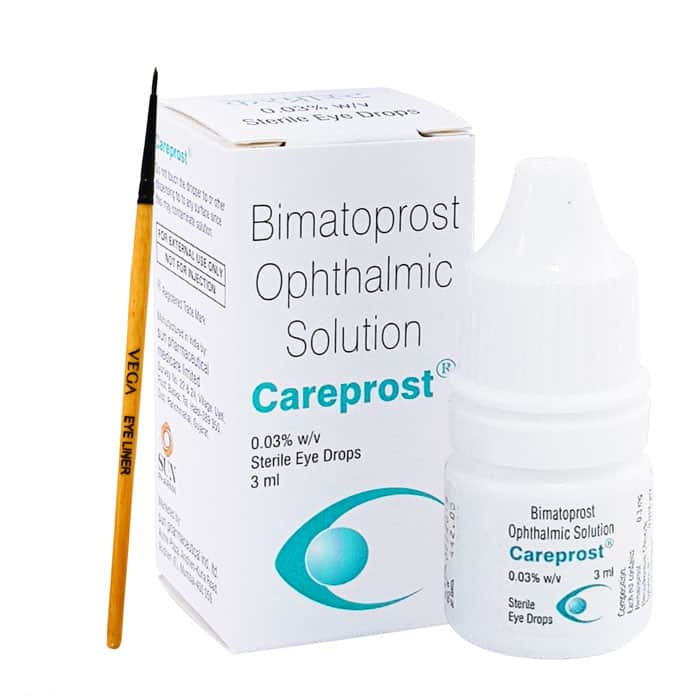
Careprost 3ml Eye Drops
Generic: Bimatoprost 0.03%
$42.00
About Careprost 3ml Eye Drops
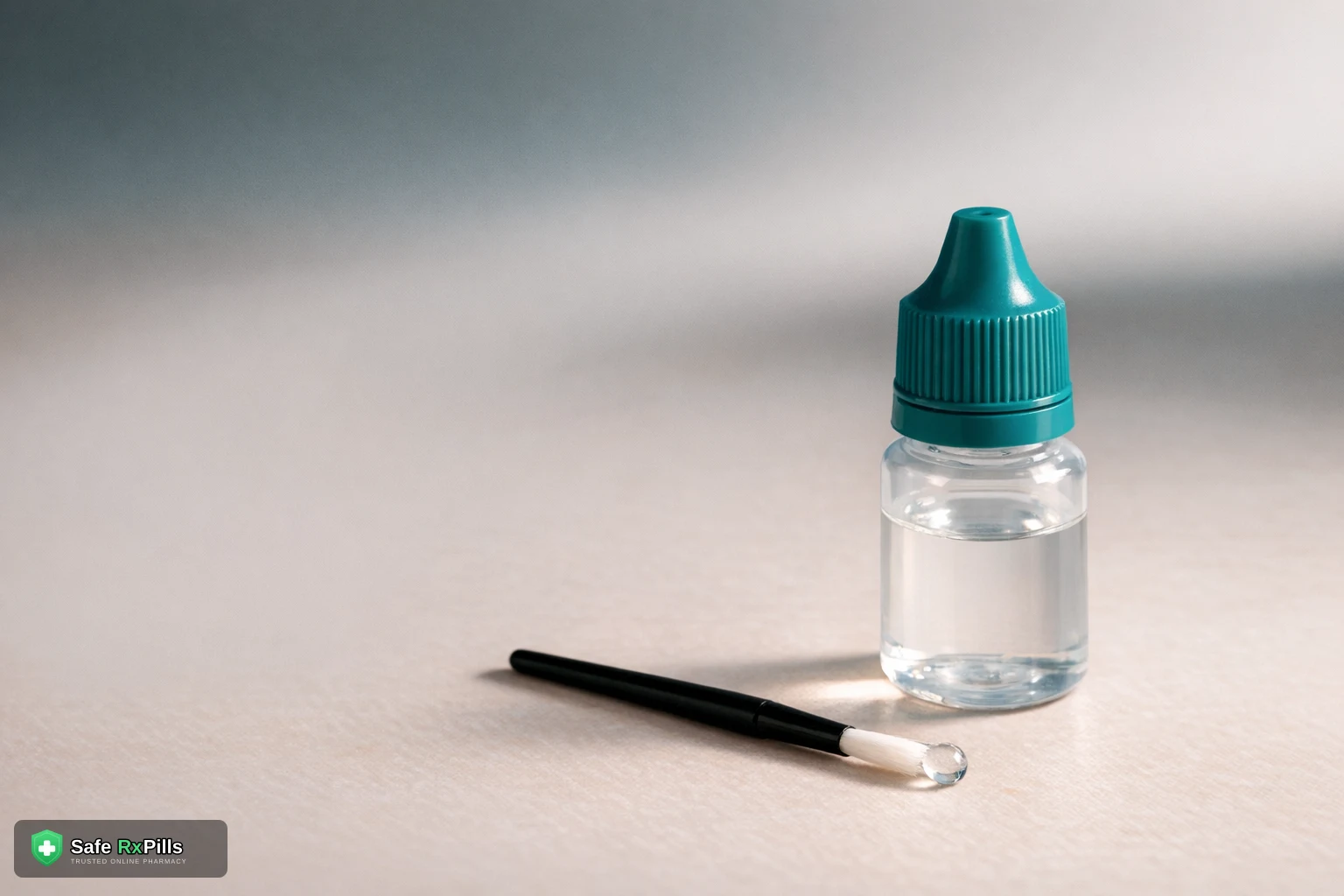
Careprost is a 3 mL bottle of bimatoprost 0.03% eye drops made in India by Sun Pharma for glaucoma. People buy it for their eyelashes because bimatoprost at the same 0.03% strength is the active ingredient in Latisse, the FDA-approved treatment for thin or short lashes. We sell Careprost for $9 a bottle.
This page covers the price, how to apply it to your lashes following the Latisse method as closely as possible, what the trials found about results and side effects, who should not use it, and how delivery works. Clinical figures come from the US prescribing information for Latisse and the studies listed at the end.
Careprost at a glance
| Active ingredient | Bimatoprost 0.03% (0.3 mg per mL), 3 mL bottle |
| Maker | Sun Pharmaceutical Industries, India |
| Labelled use | Glaucoma and high eye pressure. Using it on the lashes follows the Latisse method, which Careprost's own pack does not describe. |
| Regulatory status | Not approved by the FDA, MHRA, TGA or Health Canada. The same strength of bimatoprost is FDA approved for lashes as Latisse and its generics. |
| How to use on lashes | One drop on a sterile single-use applicator, drawn along the upper lash line, once a night |
| When results show | Little change in the first month; visible around week 8; full effect around week 16 |
| Applicators | Not included in the standard pack. The Latisse label allows only its own supplied applicators; a sealed sterile single-use applicator is the nearest substitute. |
| Delivery | 7 to 14 business days to the US, UK, Australia and Canada; $25 shipping under $149, free from $149 |
Price
Careprost costs $9 per 3 mL bottle (September 2026; the price above always shows the current figure). Shipping is a flat $25 on orders under $149, so it is cheaper per bottle to order several at once or combine Careprost with other items. The Latisse 3 mL pack is sized for 35 nights on both upper lids; at a similar rate, 16 weeks would take about 3 to 4 bottles.
| Product (3 mL) | Approved for lashes | Cost |
|---|---|---|
| Careprost (Sun Pharma) | No | $9 from us, plus shipping |
| Latisse (AbbVie) | Yes (FDA, 2008) | About $123 paid by US pharmacies |
| Generic bimatoprost 0.03% eyelash solution | Yes (FDA generics) | About $79 paid by US pharmacies |
The Latisse and generic figures are what US pharmacies paid for 3 mL in September 2026 according to the Medicaid NADAC survey; the price at the counter is higher, and Latisse is usually not covered by insurance because it is a cosmetic treatment. Our Latisse cost guide has more detail.
Careprost, Latisse and Lumigan
All three contain bimatoprost. Latisse (Allergan, now AbbVie) was approved by the FDA on 24 December 2008 for hypotrichosis of the eyelashes. Lumigan is Allergan's bimatoprost glaucoma drop; the US version is now 0.01%, and 0.03% is still sold in some countries. Careprost is Sun Pharma's 0.03% glaucoma drop, the same strength as Latisse. It was not the product used in the Latisse trials; what it shares is the active ingredient and its strength, which is why following the Latisse method as closely as possible is the nearest you can get to the conditions behind the published results. See Lumigan vs Careprost and Careprost vs Latisse.
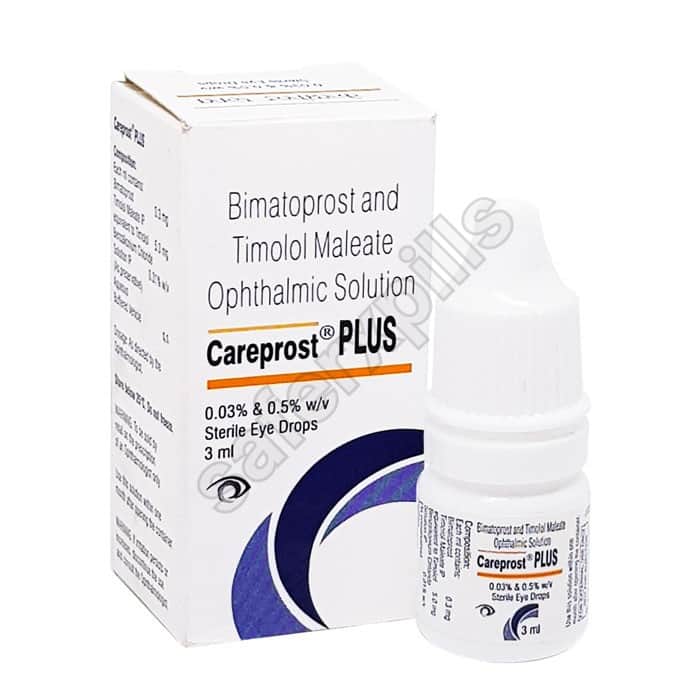
Careprost Plus is a different product: bimatoprost with timolol, a beta blocker, for glaucoma only. It is not a lash product, and timolol is unsuitable for people with asthma, severe COPD, a slow heart rate or certain heart conditions.
How to apply Careprost to your lashes
- At night, wash your face, remove all makeup and take out contact lenses. Lenses can go back in 15 minutes after applying.
- Put one drop of Careprost on a sterile single-use applicator, just behind the tip. Do not let the bottle nozzle touch anything.
- Draw the applicator along the base of the upper lashes, from the inner corner to the outer corner. The lid should feel lightly moist, not wet.
- Blot any solution that spreads beyond the lash line with a tissue.
- Throw the applicator away and use a new one for the other eye.
Do not apply it to the lower lash line, and do not use more than one drop per eye or apply it more than once a day: the label says extra applications do not increase growth, and runoff can darken skin or grow hair where it lands. If you miss a night, just apply as usual the next evening. Our step by step Careprost application guide explains the reason behind each rule.
How long until you see results
In the 278-patient trial behind the Latisse approval, only 15% of people on bimatoprost had a visible improvement at week 4, against 8% on the inactive vehicle solution. By week 8 it was 50% against 15%, and by week 16, 78% against 18%.
| Week of nightly use | Bimatoprost 0.03% | Vehicle |
|---|---|---|
| Week 4 | 15% | 8% |
| Week 8 | 50% | 15% |
| Week 12 | 69% | 20% |
| Week 16 | 78% | 18% |

At week 16, average lash length rose by 25% (1.4 mm) against 2% on vehicle, fullness by 106% against 12%, and darkness by 18% against 3%. These are averages; some people see more and some see little.
What happens when you stop
The change is not permanent. The Latisse label says lashes are expected to return to their previous state after treatment stops. In a 12-month trial, results held for about 2 months after stopping and had largely faded 4 to 6 months later: 78% still had at least a 1-grade improvement two months after stopping, 47% at four months and 35% at six months. Our Careprost results week by week guide covers keeping results over time.
Side effects
In the 4-month Latisse trial, the most common side effects were itchy eyes, red eyes, skin darkening, eye irritation, dry eye symptoms and redness around the eye, each in under 4% of patients. In a 12-month trial of 118 people with naturally sparse lashes, red eyes were reported by 8.5%, itchy eyelids by 5.9% and red eyelids by 5.1%. The label also warns about:
- Brown darkening of the iris, which is likely to be permanent.
- Darkening of the eyelid skin, reversible after stopping in most people.
- Hair growth outside the lash line wherever the solution repeatedly touches skin.
- Infection from reused applicators or a contaminated bottle tip.
- Uneven lashes between the eyes in length, thickness, colour, number or direction, usually reversible after stopping.
Since approval there have also been reports of fat loss around the eye that deepens the lid crease or causes a drooping lid, temporary lash loss, and eyelid swelling. Our bimatoprost safety guide covers these in more depth.
Who should not use Careprost
- Anyone allergic to bimatoprost or any ingredient, including the preservative benzalkonium chloride. This is a contraindication in the label.
- Anyone using glaucoma or eye pressure drops, or with a history of abnormal eye pressure, except under close supervision of their eye doctor with eye pressure checks. With prostaglandin drops such as Lumigan or latanoprost, extra bimatoprost can blunt the pressure-lowering effect.
- Anyone with active inflammation inside the eye such as uveitis, or at risk of macular oedema.
- Anyone pregnant or breastfeeding: there are no adequate studies, and the label says to use it in pregnancy only if the benefit justifies the risk.
Stop and see a doctor for eye pain, discharge, persistent redness, eyelid swelling, a rash or other signs of an allergic reaction around the eye, a change in iris colour or any change in vision, and before any eye surgery. Tell whoever checks your eye pressure that you use bimatoprost on your lashes.
Prescription and legal status
Bimatoprost is a prescription medicine in the US, UK, Australia and Canada. Careprost is not licensed by the FDA, the MHRA, the TGA or Health Canada, and in the US the FDA says personal importation of unapproved medicines is illegal in most circumstances. See Is Careprost legal in the USA? We recommend seeing a doctor or optometrist before you start, especially if you have any eye condition.
Storage and checking your bottle
The Latisse label says to store bimatoprost between 2°C and 25°C; keep the cap on between uses and never let the nozzle touch anything. Follow any discard-after-opening period printed on your Careprost pack. When your order arrives, check that the carton names Sun Pharma and shows the strength, a batch number and an expiry date. These checks cannot prove a bottle is genuine on their own, because counterfeiters copy packaging. If a bottle causes unusual symptoms, stop using it, seek medical advice, and report it to your medicines regulator (the MHRA Yellow Card scheme in the UK, FDA MedWatch in the US, the TGA in Australia or Health Canada) as well as to us.
Delivery
We ship Careprost to the US, UK, Australia and Canada in plain packaging with tracking. Standard delivery takes 7 to 14 business days to most countries. Bimatoprost does not need a cold chain. Shipping costs a flat $25 on orders under $149 and is free from $149. See our shipping page for times by region.
Related guides and products
- How to apply Careprost to your eyelashes
- Careprost results week by week
- Careprost vs Latisse
- Lumigan vs Careprost
- Bimatoprost for eyebrows
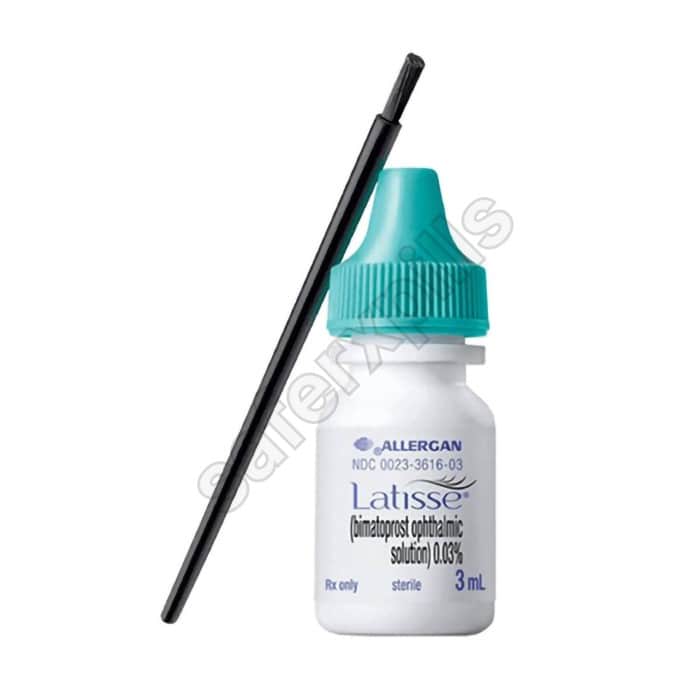
Other bimatoprost 0.03% products we stock: Latisse Generic 0.03% and Lashisma. These are also made in India and are not FDA-approved products.
Sources
- LATISSE (bimatoprost ophthalmic solution) 0.03%, US prescribing information and patient information, sections 2, 4, 5, 6, 8, 14, 16 and 17. DailyMed
- Drugs@FDA: LATISSE, NDA 022369, approved 24 December 2008.
- Glaser DA et al. Long-term safety and efficacy of bimatoprost solution 0.03% application to the eyelid margin for the treatment of idiopathic and chemotherapy-induced eyelash hypotrichosis: a randomized controlled trial. Br J Dermatol 2015;172(5):1384-94. PMID 25296533.
- Centers for Medicare and Medicaid Services. National Average Drug Acquisition Cost (NADAC), 2026 file, as of 23 September 2026. data.medicaid.gov
- GANFORT (bimatoprost/timolol) EPAR product information, section 4.3. European Medicines Agency.
- US Food and Drug Administration. Personal Importation. FDA
This page is for information and is not medical advice. Bimatoprost is a prescription medicine; talk to a doctor, optometrist or pharmacist before using it.
Key Information
- ✓Active Ingredient: Bimatoprost 0.03%
- ✓Category: Eye Care
- ✓Form: bottle
- ✓Brand: Careprost
- ✓Manufacturer: Sun Pharmaceutical Industries
Frequently Asked Questions
What is Careprost?
Careprost is a 3 mL bottle of bimatoprost 0.03% eye drops made in India by Sun Pharma for glaucoma. It is used on the lashes because Latisse, the FDA-approved eyelash treatment, contains bimatoprost at the same 0.03% strength.
Is Careprost the same as Latisse?
It contains the same active ingredient at the same strength. It is not the same product: Latisse is FDA approved for eyelash hypotrichosis and comes with sterile applicators, while Careprost is a glaucoma drop that is not approved by the FDA, MHRA, TGA or Health Canada and has no applicators.
How much does Careprost cost?
$9 per 3 mL bottle as of September 2026, plus $25 shipping on orders under $149. Latisse's 3 mL pack is sized for 35 nights, so 16 weeks would take about 3 to 4 bottles. US pharmacies paid about $123 for 3 mL of Latisse and $79 for a generic eyelash solution in September 2026.
How do I apply Careprost to my eyelashes?
Once a night on a clean face, put one drop on a sterile single-use applicator and draw it along the base of the upper lashes. Blot any runoff, then use a new applicator for the other eye. Never apply it to the lower lash line or more than once a day.
Does Careprost come with applicator brushes?
The standard pack is the bottle with a dropper and no applicators. The Latisse label allows only the applicators supplied with Latisse. A sealed sterile single-use applicator for each eye each night is the nearest substitute, but it is outside the label. Never reuse one or share it between eyes.
How long does Careprost take to work?
In the trial behind the Latisse approval, 15% improved by week 4, 50% by week 8 and 78% by week 16, against 8%, 15% and 18% on the inactive solution. Most visible change comes between weeks 4 and 12.
What happens if I stop using Careprost?
Lashes return to how they were. In a 12-month trial, results held for about 2 months after stopping and had largely faded 4 to 6 months later.
What are the side effects of Careprost?
The common ones are red or itchy eyes, eye irritation, dryness and darkening of the eyelid skin. The label also warns of brown darkening of the iris, which is likely to be permanent, hair growth where the solution touches skin, uneven lashes between the eyes, and infection from reused applicators.
Who should not use Careprost?
Anyone allergic to bimatoprost or its preservative, anyone with inflammation inside the eye or at risk of macular oedema, and anyone pregnant or breastfeeding. People using glaucoma drops should use it only under close supervision of their eye doctor. Careprost Plus, which adds timolol, is not a lash product.
Do I need a prescription for Careprost?
Bimatoprost is a prescription medicine in the US, UK, Australia and Canada. Careprost is not licensed in those countries, and US personal importation of unapproved medicines is illegal in most circumstances. We recommend seeing a doctor or optometrist first.
How long does delivery take?
Standard delivery takes 7 to 14 business days to the US, UK, Australia and Canada, in plain packaging with tracking. Bimatoprost does not need a cold chain. Shipping is a flat $25 on orders under $149 and free from $149.
Medical References
Sources: U.S. National Library of Medicine (DailyMed, PubMed), openFDA
Related Products
View all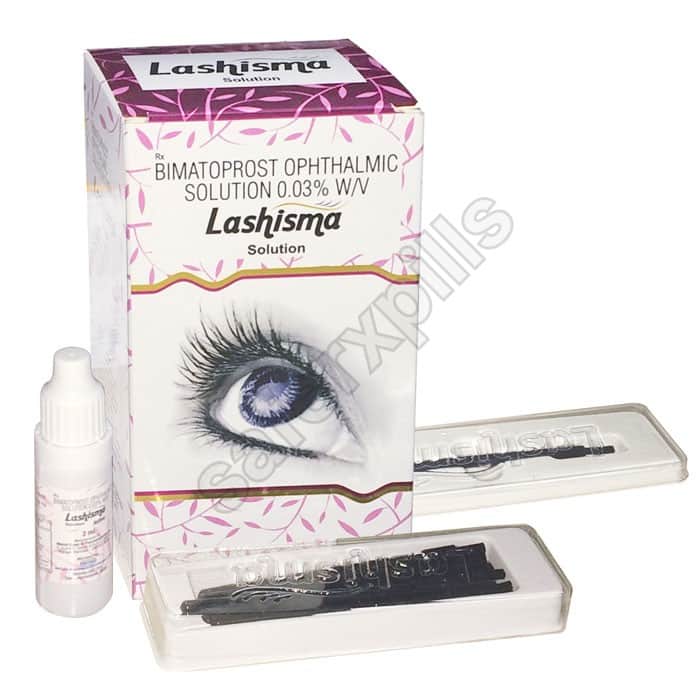

Customer Reviews
No reviews yet. Be the first to review Careprost 3ml Eye Drops.
Related Articles
Health guides about Bimatoprost 0.03%, written by pharmacists
Lumigan vs Careprost: Same Bimatoprost, Different Strengths and What That Means
Lumigan and Careprost share an active ingredient, bimatoprost, but US Lumigan is now 0.01% while Careprost is 0.03%. This guide covers what the strength difference means for eye pressure and redness, how bimatoprost ranks among glaucoma drops, 2026 US pharmacy costs, Medicare, eyelash use and why switching needs an eye doctor.
Careprost vs Latisse: Same Bimatoprost 0.03%, What Differs and What It Costs
Careprost and Latisse share the same drug and strength, bimatoprost 0.03%. This guide compares approval, applicators, the Latisse trial results, 2026 US pharmacy costs including cheaper FDA-approved generics, whether insurance or Medicare pays, side effects and who should not use either.
How to Apply Careprost to Eyelashes: The Label Method, Step by Step
How to apply Careprost (bimatoprost 0.03%) to your lashes using the method from the Latisse label: applicators, one drop per eye, upper lid only, contact lenses, missed nights, when results appear, what happens when you stop, and side effects.
Bimatoprost for Eyebrows: What the Trials Show About Off Label Use
Bimatoprost is FDA approved for eyelashes, not eyebrows, so brow use is off label and rarely discussed properly. A Phase 3 trial and three smaller randomised studies say it works. This guide covers the evidence, a realistic timeline, how brow application differs from lashes, and the risks worth taking seriously.
Latisse vs Bimatoprost Difference: What US Patients Need to Know
Latisse and bimatoprost 0.03% contain the same active ingredient at the same concentration. The latisse vs bimatoprost difference is essentially branding and price. US patients can access generic bimatoprost at significantly lower cost with identical clinical results.

Bimatoprost Eyelash Serum Safety: What You Need to Know Before Using It
Bimatoprost eyelash serum safety is well-established when used correctly, but real risks including permanent iris pigmentation and periorbital skin changes deserve careful attention. This guide covers exactly how the drug works, which side effects are reversible, who should avoid it, and how US patients can access it responsibly.
Related Health Guide
Understanding Eyelash Growth & Eye Conditions: Complete Guide