Is Careprost Legal in the USA? FDA Status, Prescription Rules and Counterfeit Risk
Lokesh Maurya
B.Pharm, M.Pharm, Rajiv Gandhi University. Writes on ophthalmic and dermatological generics for SafeRxPills.
Is Careprost Legal in the USA? FDA Status, Prescription Rules and Counterfeit Risk | SafeRxPills — pharmacy guide
Short answer: Careprost is not an FDA approved product in the United States, and its active ingredient, bimatoprost, is prescription only for every use including cosmetic eyelash growth. The FDA says that a drug approved in another country but not in the US is illegal to import. Its personal importation policy only describes when the agency may choose not to act, so it is not a right, and a shipment can be refused or destroyed at the border. The prescription requirement is not paperwork for its own sake: bimatoprost can permanently darken the iris and change the contour of the eye socket, which is why a prescriber is meant to look at your eyes before you start.
What Careprost actually is
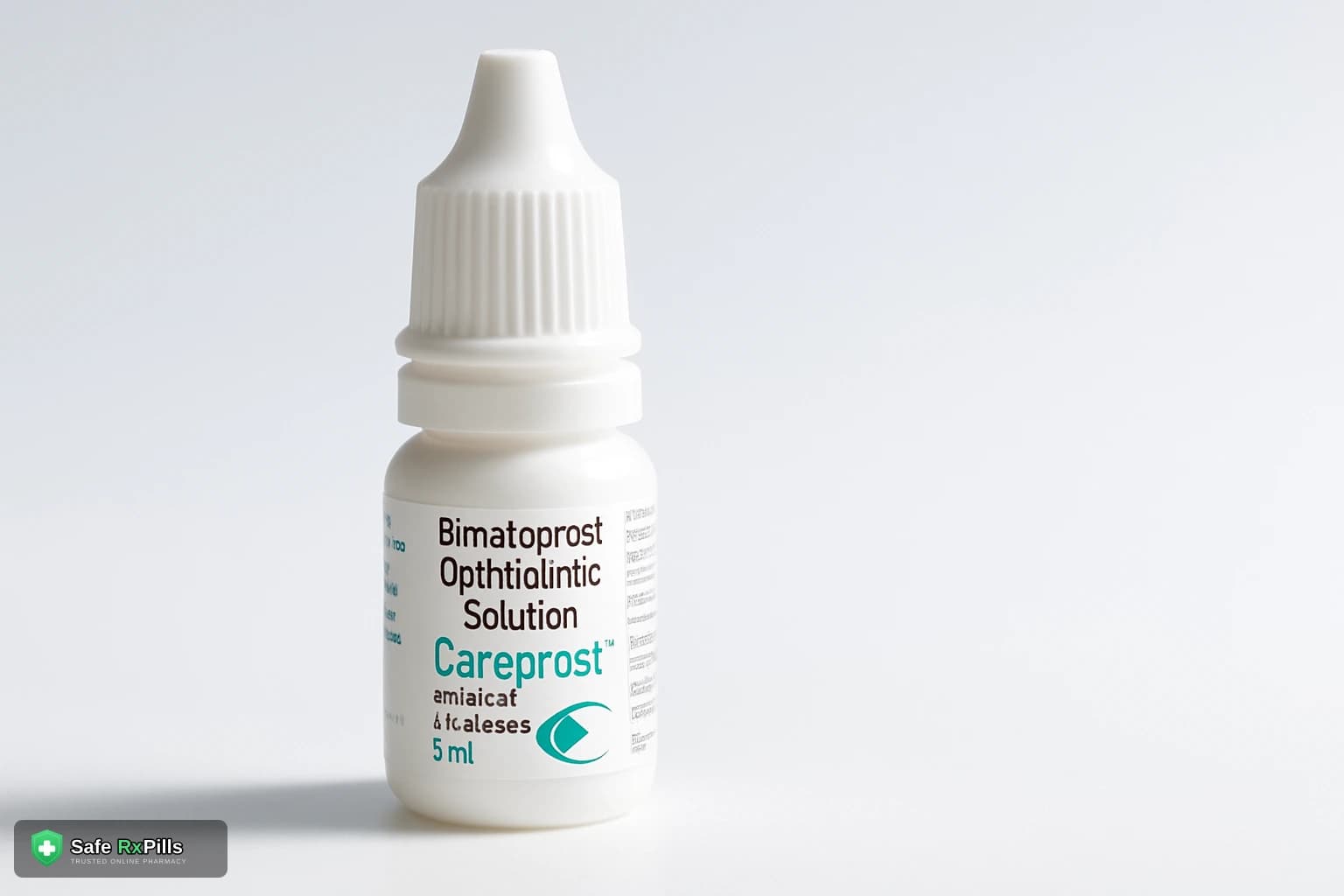
Careprost is a brand name for bimatoprost ophthalmic solution 0.03%, manufactured by Sun Pharmaceutical Industries in India. The bottle contains bimatoprost at 0.3 mg/mL. Chemically, bimatoprost is a synthetic prostamide analog with a molecular weight of 415.58, described in the FDA label as a white to off white powder formulated into a sterile eye drop.
The important thing most eyelash content skips: bimatoprost was never designed as a cosmetic. It is a glaucoma drug. The FDA approved label indication is the reduction of elevated intraocular pressure in patients with open angle glaucoma or ocular hypertension. It works by increasing the outflow of aqueous humor through both the trabecular meshwork and the uveoscleral routes, which lowers pressure inside the eye.
The eyelash effect was discovered as a side effect. Glaucoma patients using prostaglandin analog drops kept turning up with longer, thicker, darker lashes. Bimatoprost extends the anagen phase, the active growing stage of the lash follicle, and increases the number of follicles in that phase at any given time. Allergan then developed a separate product specifically for that effect, applied to the lash line rather than dropped into the eye.
Careprost is the same molecule at the same concentration, packaged for the Indian market and sold in its standard pack without the sterile single-use applicators that come with Latisse. If you want the mechanical and packaging differences spelled out, we cover them in detail in Lumigan vs Careprost: are they really the same drug.
Careprost, Latisse and Lumigan are not the same thing legally
People conflate these three constantly, and the confusion is what produces bad legal advice. Same molecule does not mean same regulatory status.
| Product | Manufacturer | US regulatory status | Approved use |
|---|---|---|---|
| Lumigan 0.01% (the 0.03% version is discontinued in the US) | Allergan | FDA approved | Elevated intraocular pressure in open angle glaucoma or ocular hypertension |
| Latisse | Allergan | FDA approved (December 2008) | Hypotrichosis of the eyelashes (cosmetic lash growth) |
| Generic bimatoprost (US ANDA) | Various US filers | FDA approved | Matches the reference product it was filed against |
| Careprost | Sun Pharmaceutical Industries | Not FDA approved, no US application on file | Approved and marketed in India, not in the US |
This is the distinction that matters. There is a legal generic bimatoprost in the United States. It is an approved abbreviated new drug application dispensed by US pharmacies with a prescription. Careprost is not that. Careprost is a foreign brand that has never been through the US approval process, which is a different category entirely from a US generic.
So when a website tells you Careprost is "the generic version of Latisse", that is true pharmacologically and false legally. Both statements matter, and only one of them determines what happens when a package crosses the border. Our full side by side sits in Careprost vs Latisse: which bimatoprost formula works best.
Why bimatoprost is prescription only in the US
Bimatoprost is Rx only in the United States for every indication. There is no over the counter bimatoprost, no cosmetic exemption, and no strength at which it becomes a general sale item. Using it on your lashes rather than dropping it in your eye does not change its classification, because it does not change its pharmacology.
Three clinical reasons sit behind that rule, and they are more substantial than most people assume.
It lowers eye pressure, including in people who need that pressure measured accurately
This is the reason almost nobody discusses. Bimatoprost reduces intraocular pressure. If you use it cosmetically and later have your eye pressure checked, the reading can look normal when it is not. That can delay a glaucoma diagnosis in exactly the demographic most likely to be developing it. A prescriber who knows you are using bimatoprost interprets your pressure readings differently. A prescriber who does not know may miss something.
It acts on pigmented tissue and some of that is permanent
The FDA label warns that pigmentation of the iris, the periorbital tissue and the eyelashes can all occur, and that iris pigmentation is likely to be permanent. Eyelash and eyelid skin changes are usually reversible on stopping. Iris colour change generally is not. People with mixed colour irises, hazel or green or blue brown, carry the clearest risk of visible change.
Existing eye conditions change the risk calculation
The label carries warnings for intraocular inflammation and for macular edema, including cystoid macular edema. Those risks are not evenly distributed. They concentrate in people who are aphakic, pseudophakic with a torn posterior lens capsule, or who have existing risk factors for macular edema. A prescriber screens for those. A checkout page does not.
The only contraindication listed on the label itself is hypersensitivity to bimatoprost or any ingredient in the formulation, but a short contraindications list is not the same thing as a short list of things that can go wrong.
What personal importation really means
This is where most content on the topic is either wrong or deliberately vague, so here is the accurate version.
The FDA maintains a Personal Importation Policy, set out in Chapter 9 of its Regulatory Procedures Manual. It is a statement of enforcement discretion. It describes conditions under which the agency may choose not to act against a personal shipment of an unapproved drug. It does not create a right, it does not grant permission, and it can be applied inconsistently without anyone being in the wrong.
The conditions the policy generally describes include the following: the product is intended for a serious condition for which effective treatment is not available in the United States, it is not being commercially promoted to US residents, it presents no unreasonable risk, and the individual affirms it is for personal use in a quantity typically covering three months or less.
Now apply that to eyelash growth. The first condition fails immediately. Cosmetic hypotrichosis is not a serious condition, and effective treatment plainly is available in the United States, because Latisse and approved generic bimatoprost are both sold here. An imported Careprost order for cosmetic use does not satisfy the policy it is usually cited as being protected by.
What that means practically:
- Individuals importing small personal quantities of prescription medicines are very rarely prosecuted. That is a real observation about enforcement, not a legal shield.
- Customs and the FDA can detain the parcel. You may receive a notice, and the product is then destroyed or returned. There is no appeal worth pursuing over a 3 mL bottle.
- Nobody can promise you delivery. Any seller who guarantees customs clearance is telling you something they cannot know.
Anyone describing personal importation as "legal" is overstating it. Anyone describing it as a felony you will be charged with is also overstating it. The accurate description is that it is unapproved, tolerated unevenly, and carries a loss risk that falls on the buyer.
The side effects behind the prescription rule
The FDA label for bimatoprost ophthalmic solution 0.03% lists five categories of adverse reaction highlighted elsewhere in the labeling: pigmentation, eyelash changes, intraocular inflammation, macular edema and hypersensitivity. The most common single adverse reaction is conjunctival hyperemia, the visible redness of the white of the eye, reported in roughly 45 percent of patients in the glaucoma dosing context.
Worth understanding individually:
Iris pigmentation
Brown pigment increases in the iris stroma. The label states this is likely to be permanent. Risk rises with duration of exposure and with intraocular administration rather than lash line application, so cosmetic users applying a thin line to the upper lash margin carry lower exposure than a glaucoma patient dropping it into the eye daily. Lower is not zero, and product that migrates into the eye during application closes that gap.
Periorbital changes
Darkening of the eyelid skin is common and generally reverses after stopping. The class of prostaglandin analogs has also been associated with periorbitopathy: deepening of the upper eyelid sulcus and loss of orbital fat, which produces a hollowed appearance around the eye. This is reported across the prostaglandin analog class and is at least partly reversible on discontinuation, but it is the side effect people find most distressing because it changes the shape of the face rather than just the colour.
Systemic exposure is genuinely low
This part is reassuring and worth stating fairly. After once daily dosing to both eyes in healthy subjects, blood concentrations peaked within about 10 minutes and fell below the lower limit of detection of 0.025 ng/mL in most subjects within 1.5 hours. Mean peak concentration was around 0.08 ng/mL with no accumulation over two weeks. Whatever the risks of bimatoprost are, systemic drug exposure is not the main one. The risks are local and ocular.
More is not better
The label directs one drop once daily in the evening and specifically warns against more frequent administration, because more frequent dosing of prostaglandin analogs has been shown to reduce the pressure lowering effect rather than increase it. The same logic applies cosmetically. Twice daily application does not produce faster lash growth, it produces more irritation and more pigment exposure. We break the technique down in how to apply Careprost eyelash serum, and set realistic expectations in Careprost results week by week.
For the fuller safety picture, including who should not use bimatoprost at all, read bimatoprost eyelash serum safety.
Separating a real bimatoprost supplier from a dangerous one
If you search for where to buy Careprost, the results are dominated by sites that will sell you something. Very few of them tell you how to evaluate what arrives. This section is the part that actually protects you, and it applies whoever you buy from, including us.
The stakes here are different from most counterfeit medicine. This is a sterile ophthalmic product going near your eye. A counterfeit blood pressure tablet that contains nothing is a wasted purchase. A counterfeit eye drop that is not sterile can seed a corneal infection, and severe keratitis can cost vision. Underdosed is the good outcome. Contaminated is the one that matters.
What a legitimate product should show you
- A named manufacturer. Genuine Careprost states Sun Pharmaceutical Industries. If a seller cannot or will not tell you which company physically made the product, stop there. That single question filters out most bad actors.
- Batch number and expiry printed on both carton and bottle, and matching. Mismatched or missing lot numbers indicate repackaging.
- An intact seal and a clear, colourless solution. Any particulate matter, cloudiness or discolouration means do not use it, regardless of where it came from.
- A verifiable manufacturing standard. WHO GMP certification or an equivalent national standard, tied to a named facility rather than asserted vaguely on a homepage.
- A real physical address and a working way to reach a person.
Red flags that should end the transaction
- Prices dramatically below every other seller. Bimatoprost has a floor cost. Well under it means something is wrong with the product or the supply chain.
- Product shipped loose in plastic without a carton, or in a bottle with a printed label that peels or smudges.
- No expiry date, or an expiry more than the standard shelf life away from the manufacture date.
- A seller who guarantees customs clearance, as covered above, or who claims their product is FDA approved. Careprost is not, and a seller who says otherwise is either uninformed or lying.
- Pressure to buy larger quantities than three months of supply.
SafeRxPills sources through Actiza Pharmaceutical, a WHO GMP and ISO certified manufacturer, and we publish batch and manufacturer detail on request. We will also say the part that is against our commercial interest: we are not a substitute for a prescriber examining your eyes, and if you have any history of eye inflammation, macular edema, cataract surgery with a complicated posterior capsule, or a family history of glaucoma, you should be getting bimatoprost through a doctor rather than through any international pharmacy including this one.
Fully legal options in the US and what they cost
If your priority is staying entirely inside US law, there are three routes that work.
Route one: a prescription for Latisse or approved generic bimatoprost
A dermatologist, optometrist or ophthalmologist can prescribe this. Cosmetic lash growth is almost never covered by insurance, so expect to pay cash. Brand Latisse commonly runs in the range of roughly 120 to 180 US dollars for a 3 mL bottle, with approved US generic bimatoprost lower. We work through coverage rules and coupon options in is Latisse covered by insurance.
Route two: telehealth
Several US telehealth services prescribe bimatoprost for lash growth after a remote consultation. The consultation fee is usually modest, and the resulting prescription is filled by a US pharmacy. This is the cheapest genuinely legal path for most people, and it also gives you a prescriber who knows what you are using, which solves the pressure reading problem described earlier.
Route three: a medical indication
If you have ocular hypertension or open angle glaucoma, bimatoprost may be prescribed for that condition and covered accordingly. Lash growth then arrives as a side effect rather than the goal.
What these products cost internationally
For price context, the international market figures differ sharply from US retail. Our current listings sit at Careprost 3ml at 9 dollars, Careprost Plus at 30 dollars, Latisse Generic 0.03% at 40 dollars, Lashisma at 42 dollars, Lumigan 0.01% at 44 dollars and Lumigan 0.03% at 50 dollars. The full range sits in eye care.
That price gap is the entire reason this question gets asked hundreds of times a month. It is a real gap and it is not our place to pretend otherwise. It is also not a reason to skip the eye exam.
The honest bottom line
Careprost is genuine bimatoprost 0.03% from a large, legitimate Indian manufacturer. It is pharmacologically equivalent to Latisse. It is also not FDA approved, and importing it for cosmetic lash growth does not meet the conditions of the FDA policy people usually cite when they call it legal. That is the accurate position, and any seller giving you a cleaner answer than that is selling rather than informing.
What we would tell a friend: if you can afford a telehealth consultation, take that route. You get a legal product, a prescriber who knows what you are using, and someone who has looked at your eyes before you start applying a drug that can permanently change their colour. If cost is the binding constraint and you decide to source internationally anyway, at minimum insist on a named manufacturer, matching batch numbers, an intact seal and a clear solution, and stop using it immediately if you develop redness that does not settle, eye pain, or any change in vision.
References
- DailyMed, bimatoprost ophthalmic solution 0.03% prescribing information: indications, contraindications, warnings and precautions, adverse reactions, dosage and administration, clinical pharmacology.
- US FDA prescribing information, bimatoprost ophthalmic solution 0.03%, sections 4, 5.1, 5.2, 5.3, 5.4, 6, 10 and 12.3.
- US FDA Regulatory Procedures Manual, Chapter 9, Coverage of Personal Importations.
- Lee A, McKeage K. Bimatoprost Implant: First Approval. PubMed PMID: 32447639.
Medical disclaimer: This article is for information only and is not medical advice. Bimatoprost is a prescription medicine in the United States and in most other countries. Speak to a qualified doctor, optometrist or ophthalmologist before starting it, particularly if you have any history of eye inflammation, macular edema, cataract surgery, raised eye pressure or glaucoma in your family. Stop use and seek care if you develop eye pain, persistent redness or any change in vision.
Where to Buy Careprost in Your Country
Bimatoprost is prescription-only in every market SafeRxPills ships to, but the rules on personal importation, customs handling and delivery times are different in each one. Pick the guide that matches where you live:
- Buy Careprost in the USA: FDA status, prescription rules, personal import allowance and counterfeit checks.
- Buy Careprost in the UK: MHRA position, customs handling and typical UK delivery windows.
- Buy Careprost in Australia: TGA Personal Importation Scheme, the 3 month supply limit and what Australian customers should expect.
To order directly, see Careprost 3ml (bimatoprost 0.03%) or browse the full eye care range.
Related Topics:
?Frequently Asked Questions
Is Careprost legal to buy in the United States?
Careprost is not an FDA approved product in the US, and bimatoprost is prescription only for every use including cosmetic eyelash growth. Importing a personal supply is not typically prosecuted, but it is not legally protected either. It falls under FDA enforcement discretion, which means the agency may allow a shipment through or may detain and destroy it, with no obligation either way.
Is Careprost the same as Latisse?
Pharmacologically yes. Both are bimatoprost ophthalmic solution 0.03% at 0.3 mg/mL. Legally no. Latisse is FDA approved for eyelash hypotrichosis and was approved in December 2008. Careprost is made by Sun Pharmaceutical Industries for the Indian market and has never been through the US approval process. Same molecule, different regulatory status.
Do I need a prescription for Careprost or any bimatoprost product?
In the United States, yes. Bimatoprost is prescription only at every strength and for every indication. There is no over the counter version and no cosmetic exemption. A US pharmacy cannot legally dispense it without a prescription from a licensed prescriber.
Can the FDA seize a personal Careprost order?
Yes. Customs and the FDA can detain parcels containing unapproved prescription drugs. You may receive a notice, after which the product is usually destroyed or returned. Because cosmetic lash growth has approved US treatments available, an imported Careprost order does not meet the conditions of the FDA Personal Importation Policy that sellers often cite. Any seller guaranteeing customs clearance is promising something they cannot control.
Does Careprost permanently change eye colour?
It can. The FDA label warns that bimatoprost causes increased brown pigmentation of the iris and states that this change is likely to be permanent. Risk rises with duration of use and with product entering the eye rather than staying on the lash line. Darkening of the eyelid skin and changes to the lashes themselves are usually reversible after stopping, but iris colour change generally is not.
Is Careprost safe to use if I have glaucoma or raised eye pressure?
This is exactly the situation that needs a doctor rather than an online purchase. Bimatoprost lowers intraocular pressure, so using it cosmetically can make your pressure readings look normal when they are not, which can delay a glaucoma diagnosis. If you have glaucoma, ocular hypertension, or a family history of either, talk to an ophthalmologist. Bimatoprost may be appropriate for you as a prescribed treatment, with lash growth as a side effect.
How can I tell if Careprost is counterfeit?
Check for a named manufacturer on the carton, batch and expiry printed on both carton and bottle and matching each other, an intact seal, and a clear colourless solution with no particles. Red flags include prices far below every other seller, no lot number, missing or implausible expiry dates, loose bottles with no carton, and any claim that the product is FDA approved. Because this is a sterile eye product, a contaminated counterfeit risks corneal infection rather than just a wasted purchase.
What is the cheapest fully legal way to get bimatoprost in the US?
For most people, a telehealth consultation. Several US services prescribe bimatoprost for lash growth after a remote assessment, and the prescription is filled at a US pharmacy. The consultation fee is usually modest, approved generic bimatoprost costs less than brand Latisse, and you end up with a prescriber who knows what you are using. Insurance rarely covers bimatoprost for cosmetic use.
Lokesh Maurya
Pharmacist, Content, B.Pharm, M.Pharm, Rajiv Gandhi University
Pharmacist writing on antiparasitic, ophthalmic and dermatological generics. Focuses on what the regulatory labelling and published evidence actually support.
Comments (0)
Leave a Comment
No comments yet. Be the first to share your thoughts!
Related Articles
Lumigan vs Careprost: Same Bimatoprost, Different Strengths and What That Means
June 26, 2026