About Lumigan 0.03% Eye Drop
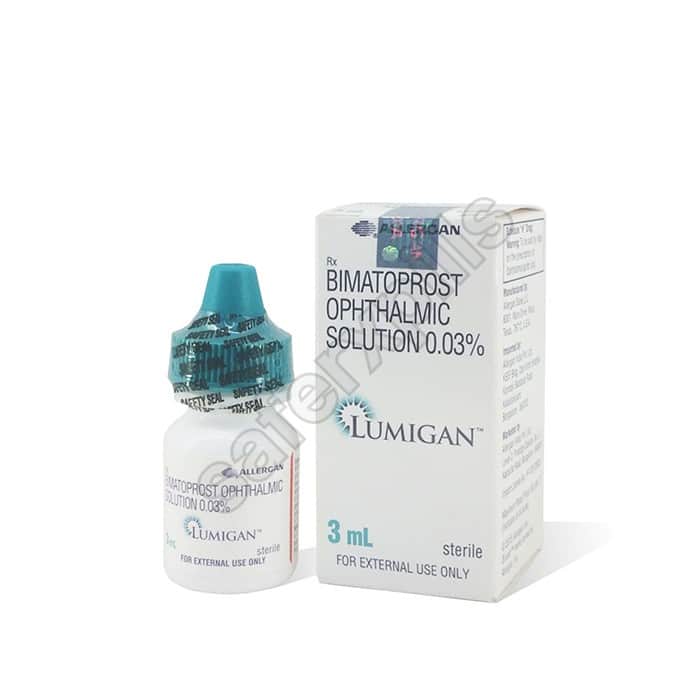
Lumigan 0.03% is AbbVie's (formerly Allergan's) bimatoprost 0.3 mg/mL eye drop for lowering raised pressure inside the eye in open-angle glaucoma and ocular hypertension. It is the original Lumigan strength. We sell the Indian pack: PharmEasy, Apollo, Medkart and Tata 1mg all list it as a 3 mL bottle from Allergan India, and PharmEasy gives the manufacturer address as Allergan Sales LLC in Waco, Texas, USA. Packs of 3 and 6 bottles cost from $15.00 a bottle (about $5.00 per mL) before shipping.
Glaucoma needs an eye doctor. The US National Eye Institute says it usually has no symptoms at first, and that treatment cannot undo vision already lost, though early treatment can often stop the damage. Eye drops only help if the diagnosis is right and the pressure is checked to confirm they are working. Use Lumigan only after an eye examination and with regular pressure checks by an ophthalmologist or optometrist. Do not start it, or switch to it from another drop or strength, on your own.
This page covers the price per bottle, how the Indian pack compares with US generic bimatoprost, the difference between the 0.03% and 0.01% strengths, how to use the drops, side effects, when to get urgent help, who should not use it, and delivery. The US brand Lumigan 0.03% is discontinued, so US label wording on this page comes from a current US generic bimatoprost 0.03% label (Apotex). UK wording comes from the UK product information for Lumigan 0.3 mg/mL single-dose and Lumigan 0.1 mg/ml. All are listed at the end.
Lumigan 0.03% at a glance
| Active ingredient | Bimatoprost 0.03% (0.3 mg per mL), a prostaglandin analogue. The US generic 0.03% bottle is preserved with benzalkonium chloride 0.05 mg per mL (50 ppm), a quarter of the level in the 0.01% drop. We have not confirmed the preservative on the Indian carton. |
| Brand and maker | Lumigan, AbbVie (Allergan). PharmEasy, Medkart and Tata 1mg name Allergan India Pvt Ltd; Apollo names Allergan Healthcare India Pvt Ltd. PharmEasy and Tata 1mg give the USA as the country of origin; Apollo and Medkart say India. |
| Labelled use | Lowering raised eye pressure in open-angle glaucoma or ocular hypertension (adults in the UK label) |
| Regulatory status | Lumigan 0.03% is registered in Australia (Schedule 4). The US brand was FDA approved in 2001 and is now discontinued, but generic bimatoprost 0.03% is FDA approved and sold. In the UK, emc lists Lumigan 0.3 mg/mL only as a single-dose container, alongside generic bimatoprost 0.3 mg/ml bottles; Health Canada lists Lumigan 0.03% as cancelled (generic bimatoprost 0.03% drops remain marketed there). The Indian pack we sell is not registered with the FDA, the MHRA, the TGA or Health Canada. |
| Usual dose from the label | One drop in the affected eye or eyes once daily in the evening; not more than once daily |
| Timing | Pressure starts to fall about 4 hours after the first drop, with the maximum effect within about 8 to 12 hours (US label section 2); the UK label says the effect lasts at least 24 hours |
| Packs | 3 bottles or 6 bottles (3 mL each, per the Indian listings) |
| Price per bottle | $16.67 (3 bottles) or $15.00 (6 bottles), before shipping |
| Delivery | 7 to 14 business days to the US, UK, Australia and Canada; $25 shipping under $149, free from $149 |
Price per bottle
Prices below are as of October 2026; the pack selector shows the current price.
| Pack | Price | Per bottle | Per mL | Shipping | Per bottle with shipping | Lasts at one bottle per 4 weeks (our estimate) |
|---|---|---|---|---|---|---|
| 3 bottles | $50 | $16.67 | $5.56 | $25 | $25.00 | About 12 weeks |
| 6 bottles | $90 | $15.00 | $5.00 | $25 | $19.17 | About 24 weeks |
The 6 bottle pack is cheaper per bottle before shipping as well as after it. Both packs are under the $149 free shipping threshold, so each order carries the flat $25. The last column is our own arithmetic: healthdirect Australia's entry for Lumigan 0.03% says to discard the bottle 4 weeks after opening, and Tata 1mg says to use it within 4 weeks of opening, so one bottle a month is the rule we used. Check the expiry date on the cartons before you buy a large supply.
Our Lumigan 0.01% costs less per bottle ($12.67 to $14.67 before shipping). Which strength you use is your eye doctor's decision, covered below.
Compared with US Lumigan and generic bimatoprost
| Product | Maker | FDA approved | Cost per mL | Cost per bottle |
|---|---|---|---|---|
| Lumigan 0.03%, Indian 3 mL pack (this page) | AbbVie (Allergan), per the Indian listings | No (the Indian pack is not the US pack) | $5.00 to $5.56 from us before shipping; $6.39 to $8.33 with shipping | $15.00 to $16.67 before shipping |
| Lumigan 0.03%, US brand | Allergan (AbbVie) | Approved 2001, now discontinued | No NADAC row | Not sold |
| Generic bimatoprost 0.03%, US | Several makers (for example Apotex, Micro Labs, Aurobindo) | Yes | About $3.82 to $7.75 (NADAC; the 7.5 mL bottle has the lowest per-mL rate) | About $16 (2.5 mL), $39 (5 mL), $29 (7.5 mL) |
| Lumigan 0.01%, US brand | AbbVie | Yes (2010) | About $103 (NADAC) | About $258 (2.5 mL), $515 (5 mL), $773 (7.5 mL) |
The US figures are what US pharmacies paid per mL in the Medicaid NADAC survey (rates effective 21 October 2026), multiplied by each bottle size. They are acquisition costs, not shelf prices, and the price at the counter is higher. Even so, a US pharmacy pays less per mL for a 7.5 mL bottle of generic bimatoprost 0.03% than our price before shipping, and once shipping is added our cost per mL is close to what US pharmacies pay for the 2.5 mL and 5 mL bottles. If you are in the US and have a prescription or insurance, compare your copay and local cash prices for generic bimatoprost 0.03% first; it may well be cheaper than ordering from abroad.
The FDA lists the US Lumigan 0.03% brand (NDA 021275) as discontinued, and a Federal Register notice of 31 October 2014 recorded the FDA's determination that it was not withdrawn from sale for reasons of safety or effectiveness. We have not found a published study comparing the Indian Lumigan 0.03% pack with any registered pack, and we have not seen the strip or carton ourselves.
Which strength to choose
We stock two Lumigan strengths. They are not interchangeable without your eye doctor's agreement.
| Product | Strength | What the labels and trials say |
|---|---|---|
| Lumigan 0.03% (this page) | 0.3 mg/mL | The original strength, one drop once daily in the evening. PBS listed in Australia (healthdirect also lists Lumigan RC 0.01%, not PBS listed); sold in the US as generics. The US 0.03% label lists less benzalkonium chloride than the 0.01% drop (the UK label says the 0.01% drop has four times the concentration in 0.3 mg/ml drops); we have not confirmed the Indian carton. |
| Lumigan 0.01% Eye Drop | 0.1 mg/mL | The current US and Canadian Lumigan brand strength. One drop once daily in the evening. In the trial below it lowered pressure as well as 0.03% with less eye redness. |
In a 12 month randomised, double-masked trial of 561 patients (Katz 2010, PMID 20346780), bimatoprost 0.01% lowered eye pressure as well as 0.03%, with differences in mean pressure under 0.9 mmHg throughout. Treatment-related adverse events were significantly more common with 0.03%, and a moderate to severe increase in eye redness occurred in 9.1% on 0.03% against 3.2% on 0.01%.

So why would an eye doctor choose 0.03%? One possible reason, in our reading of the labels, is the preservative: the UK label for Lumigan 0.1 mg/ml says its 200 ppm of benzalkonium chloride is four times the concentration in the 0.3 mg/ml drop, and advises caution with the 0.01% drop in dry eye, a compromised cornea or several preserved drops. That trade between redness and preservative is a decision for your eye doctor, not one to make by switching bottles yourself.
Do not use two bimatoprost products together without your eye doctor's agreement. The UK label says more frequent exposure of the eye to more than one dose of bimatoprost daily may decrease the pressure-lowering effect, and that the effect of prostaglandin analogues may be reduced when they are used with other prostaglandin analogues. The Latisse label says people using Lumigan or other prostaglandin drops for eye pressure should only use Latisse after consulting their doctor, because it may interfere with the pressure reduction. Careprost is Sun Pharma's bimatoprost 0.03% eye drop, made in India for glaucoma; our Careprost page covers its use on the eyelashes. It is a different maker's product, so changing from Lumigan to Careprost, like any change of glaucoma drop, is a decision for your eye doctor. See Lumigan vs Careprost for the full comparison.
How to use Lumigan 0.03%
- Wash your hands. If you wear soft contact lenses, take them out first.
- Tilt your head back and gently pull down the lower eyelid to make a small pocket.
- Turn the bottle upside down and squeeze one drop into each eye that needs treatment. Do not let the tip touch your eye, eyelid, fingers or any other surface.
- Let go of the lid and close your eye. Wipe off any drop that runs onto your cheek.
- Put the cap back on straight away. Wait 15 minutes before putting contact lenses back in.
- Once a day, in the evening. The US label says it "should not be administered more than once daily since it has been shown that more frequent administration of prostaglandin analogs may decrease the intraocular pressure lowering effect."
- Other eye drops: leave at least 5 minutes between Lumigan and any other eye drop.
- Missed dose: the UK leaflet says use a single drop as soon as you remember, then go back to your regular routine. Do not take a double dose.
- Too many drops: the UK leaflet says this is unlikely to cause any serious harm; put the next dose in at the usual time.
- Do not stop on your own: the UK leaflet says the pressure inside the eye may go up if you stop, so talk to your doctor first.
- Skin contact: hair can grow where the solution repeatedly touches the skin (UK label), so wipe away runoff.
- Contact lenses: the US label says the benzalkonium chloride in the 0.03% drop may be absorbed by and discolour soft lenses.
- Driving: wait until any blurring after the drop has cleared.
healthdirect Australia says to discard the bottle 4 weeks after opening and store it below 25°C. The US generic label lets an opened bottle be used until the expiry date and allows storage between 2°C and 25°C. Follow the instruction printed on your Indian carton, and write the opening date on the box. Our guide to glaucoma eye drop types explains how prostaglandin drops fit with the other classes.
Groups who need extra care
- Children and teenagers: the US label says use below the age of 16 "is not recommended because of potential safety concerns related to increased pigmentation following long-term chronic use." The UK label says safety and efficacy from 0 to 18 years have not been established, and the UK leaflet says it should not be used by patients under 18.
- Inflammation inside the eye: the US label says caution should be used in active intraocular inflammation such as uveitis, because prostaglandin analogues may make it worse. The UK label adds caution after significant viral eye infections such as herpes simplex, or uveitis or iritis.
- Risk of macular oedema: caution if you have had cataract surgery without a lens implant (aphakia), have a lens implant with a torn posterior capsule, or have other known risk factors (US label 5.4). The UK label says cystoid macular oedema has been uncommonly reported with the 0.3 mg/mL bottle.
- Asthma, COPD or other breathing problems: the UK label reports post-marketing cases of asthma, worsening asthma or COPD and shortness of breath, and says to use it with caution.
- Heart problems, low heart rate or low blood pressure: the UK label says Lumigan has not been studied in heart block more severe than first degree or uncontrolled heart failure, and says caution in people predisposed to low heart rate or low blood pressure after a limited number of reports with the 0.3 mg/mL bottle.
- Liver or kidney problems: not studied in kidney impairment or moderate to severe liver impairment; the UK label says caution. In people with a history of mild liver disease or abnormal liver tests, the 0.3 mg/mL bottle had no adverse effect on liver function over 24 months (UK label 4.2).
- Other glaucoma types: the UK label says Lumigan has not been studied in inflammatory, neovascular, angle-closure, congenital or narrow-angle glaucoma.
- Pregnancy: the US label says it "should be administered during pregnancy only if the potential benefit justifies the potential risk to the fetus"; the UK label says it "should not be used during pregnancy unless clearly necessary".
- Breastfeeding: the UK leaflet says you should not breastfeed while using Lumigan 0.3 mg/mL. The UK SmPC says to decide between stopping breastfeeding or stopping treatment. The US label says to weigh the benefits of breastfeeding against the mother's need for the drug.
Side effects
The US label for bimatoprost 0.03% says the most frequent events in clinical trials, in about 15% to 45% of patients, were red eyes (conjunctival hyperaemia), growth of eyelashes and itchy eyes, and that about 3% of patients stopped treatment because of red eyes. The UK label, pooling over 1,800 patients on the 0.3 mg/mL bottle, gives eyelash growth in up to 45% and red eyes (mostly trace to mild) in up to 44% in the first year, and itchy eyes in up to 14%; fewer than 9% stopped because of any side effect in the first year. For comparison, the UK label gives 29% red eyes over 12 months with the 0.01% drop. These figures come from different studies; the Katz trial above is the direct comparison.
| How common (US label 6.1) | Reactions with bimatoprost 0.03% |
|---|---|
| About 15% to 45% | Red eyes, growth of eyelashes, itchy eyes |
| About 3% to 10% | Dry eyes, visual disturbance, burning, a feeling of something in the eye, eye pain, darker skin around the eye, blepharitis (lid inflammation), cataract, superficial punctate keratitis (tiny surface spots), redness around the eye, eye irritation, darker eyelashes |
| About 1% to 3% | Eye discharge, watering, sensitivity to light, allergic conjunctivitis, tired eyes, darker iris, swelling of the conjunctiva |
| Under 1% | Inflammation inside the eye (iritis) |
| Body-wide | Infections such as colds in about 10%; headaches, abnormal liver function tests, weakness and extra hair growth in about 1% to 5% |
The labels also warn about changes that can last:
- Brown darkening of the iris. The US label says it is "likely to be permanent" after stopping and may not be noticeable for several months to years. The UK label gives 1.5% at 12 months with the 0.3 mg/mL bottle (0.5% with 0.01%), not increasing over 3 years. Treatment can continue, but you should be examined regularly.
- Darker eyelid skin and longer, thicker, darker lashes in the treated eye, which can make the eyes look different if only one is treated. The US label says darker eyelid skin and eyelash changes "have been reported to be reversible in some patients" (5.1), that eyelash changes are "usually reversible upon discontinuation of treatment" (5.2), and that eyelid skin darkening "may be reversible" (17). The UK leaflet says these changes may be permanent.
- Fat loss around the eye (prostaglandin analogue periorbitopathy): a deeper lid crease, a sunken eye, a drooping or retracted lid. The UK label for Lumigan 0.3 mg/mL single-dose lists it as very common and says it can start as early as one month after starting. The same label warns that "some of these changes may be permanent" and may impair the field of vision, while also noting that changes have been partially or fully reversible after stopping or switching treatment.
- Macular oedema (swelling at the back of the eye that can blur vision) and inflammation inside the eye have been reported.
- Eye infection from a contaminated bottle tip. The US label says serious damage to the eye and subsequent loss of vision may result from using contaminated solutions.
Reports after approval in the US label include asthma-like symptoms, dizziness, shortness of breath, eyelid swelling, allergic reactions of the eye or skin, high blood pressure, nausea and skin discoloration. Our Lumigan glaucoma guide covers them in more depth.
When to get urgent help
- Sudden eye pain, a sudden drop in vision or any new change in your sight.
- Signs of an eye infection, such as a painful red eye, discharge or sensitivity to light, or any injury to the eye.
- Swelling of the eyelids, a rash on the eyelids or around the eye, or marked redness and itching after a drop: signs of an allergic reaction. Stop the drops and get medical advice.
The US label tells patients to seek their physician's advice immediately about continuing bimatoprost if they develop an eye condition such as trauma or infection, have eye surgery, or develop any eye reaction, particularly conjunctivitis and eyelid reactions. Tell any doctor treating you that you use bimatoprost eye drops.
Who should not use Lumigan 0.03%
Never use it (contraindication, US label section 4 and UK label 4.3):
- if you are allergic to bimatoprost or any ingredient of the drops. The US 0.03% bottle contains benzalkonium chloride, so if you have reacted to that preservative before, tell your eye doctor before using this drop.
Not recommended (US label 8.4):
- children under 16. The UK leaflet says it should not be used under 18.
Talk to your eye doctor first (label cautions): the groups listed above, including uveitis or a past herpes eye infection, macular oedema risk, asthma or COPD, heart block, low heart rate or blood pressure, liver or kidney problems, pregnancy and breastfeeding. Also tell your doctor about every other eye drop you use, especially other prostaglandin drops such as latanoprost or travoprost.
Prescription and legal status
Bimatoprost glaucoma drops are prescription medicines in the US ("Rx Only" on the generic 0.03% label), the UK (prescription only medicine on emc), Canada (prescription in the Health Canada database) and Australia (Lumigan 0.03% is Schedule 4, prescription only, and PBS listed). PharmEasy, Apollo, Medkart and Tata 1mg in India also mark Lumigan 0.03% as a prescription medicine. The Indian pack is not registered with the FDA, the MHRA, the TGA or Health Canada, and in the US the FDA says personal importation of unapproved medicines is illegal in most circumstances. In the UK, emc lists Lumigan 0.3 mg/mL only in single-dose containers, and an NHS prescribing advisers' blog reported (in a post dated August 2015 in its web address) that the maker had discontinued the 0.3 mg/ml dropper bottles. Generic bimatoprost 0.3 mg/ml bottles (for example Bimatoprost Aspire and Eyreida) are listed on emc. emc is not the full MHRA register, so check with your pharmacist. Whatever the rules where you live, glaucoma needs a diagnosis and regular eye pressure and optic nerve checks; we recommend buying Lumigan only to continue a treatment your eye doctor has prescribed. Our guide to buying eye drops online covers this in more detail.
Buying genuine Lumigan
The MHRA warns: "Any medicine not authorised for sale in the UK can be unsafe or ineffective and there is no way of knowing what is in them or the negative health effects they can have." The Indian pack is not authorised for sale in the UK, so this applies to it. The MHRA also advises: "Only use UK-registered pharmacies, including online pharmacies displaying the official green cross logo." When your order arrives, check that the carton names Allergan or AbbVie and shows bimatoprost 0.03%, a batch number and an expiry date, that the seal on the bottle neck is unbroken, and that the solution is clear and colourless. These checks cannot prove a bottle is genuine, because counterfeiters copy packaging. If your eye pressure readings rise after switching supply, tell your eye doctor. If a batch causes unusual symptoms, stop using it, seek medical advice, and report it to your medicines regulator (the MHRA Yellow Card scheme in the UK, FDA MedWatch in the US, the TGA in Australia or Health Canada) as well as to us.
Delivery
We ship Lumigan 0.03% to the US, UK, Australia and Canada in plain packaging with tracking. Standard delivery takes 7 to 14 business days to most countries, so order well before your current bottle runs out: missing doses lets eye pressure rise. The US label allows storage between 2°C and 25°C and the Australian entry says below 25°C, so, in our reading, the labels do not call for a fridge. The Indian listings we checked disagree on storage, so follow the line printed on your carton. Shipping costs a flat $25 on orders under $149 and is free from $149. See our shipping page for times by region.
Related guides and products
- Lumigan eye drops for glaucoma: uses, dosage, side effects and cost
- Lumigan vs Careprost: how the two bimatoprost drops compare
- Glaucoma eye drops: every type explained
- Latanoprost eye drops guide
- Buying eye drops from an online pharmacy
Other glaucoma drops we stock: Lumigan 0.01%, Careprost Plus (bimatoprost with timolol), Latoprost (latanoprost) and Combigan (brimonidine with timolol). Changing from one to another is a decision for your eye doctor.
Sources
- Bimatoprost ophthalmic solution 0.03%, US prescribing information, Apotex Corp. (text revised January 2023; DailyMed version 8, September 2026), sections 1, 2, 4, 5, 6, 8, 10, 11, 14, 16 and 17. DailyMed
- LUMIGAN 0.3 mg/mL eye drops, solution, in single-dose container, UK Summary of Product Characteristics (revised 1 April 2022) and patient leaflet (revised February 2022), AbbVie Ltd, PLGB 41042/0084. emc
- emc search for bimatoprost, read 21 October 2026 (Lumigan 0.1 mg/ml, Lumigan 0.3 mg/mL single-dose, generic bimatoprost 0.1 and 0.3 mg/ml eye drops). emc
- LUMIGAN 0.1 mg/ml eye drops, solution, UK Summary of Product Characteristics (revised 1 April 2022), AbbVie Ltd, sections 4.4 and 4.8. emc
- Drugs@FDA: LUMIGAN 0.03%, NDA 021275, approved 16 March 2001, discontinued; Federal Register, 31 October 2014, document 2014-25911 (not withdrawn for reasons of safety or effectiveness).
- healthdirect Australia: Lumigan 0.03% eye drops, 3 mL bottle, Schedule 4, PBS listed, discard 4 weeks after opening (ARTG data updated 3 August 2026).
- Health Canada Drug Product Database: LUMIGAN (bimatoprost 0.03%), DIN 02245860, cancelled post market 17 November 2023; LUMIGAN RC (0.01%), DIN 02324997, marketed, prescription.
- Katz LJ et al. Twelve-month, randomized, controlled trial of bimatoprost 0.01%, 0.0125%, and 0.03% in patients with glaucoma or ocular hypertension. Am J Ophthalmol 2010;149(4):661-671.e1. PMID 20346780.
- Centers for Medicare and Medicaid Services. National Average Drug Acquisition Cost (NADAC), 2026 file, rates effective 21 October 2026. data.medicaid.gov
- Indian listings for Lumigan 0.03% 3 mL (PharmEasy, Apollo Pharmacy, Medkart, Tata 1mg), read 21 October 2026.
- MHRA warning on medicines bought online, 13 February 2026.
- Prescribing Advice for GPs (NHS prescribing advisers' blog). Bimatoprost 0.03% discontinued. prescriber.org.uk
- LATISSE (bimatoprost ophthalmic solution) 0.03%, US prescribing information, AbbVie (DailyMed version 25, December 2025), sections 5.1 and 17.
- National Eye Institute. Glaucoma. NEI
- US Food and Drug Administration. Personal Importation. FDA
This page is for information and is not medical advice. Lumigan is a prescription medicine for glaucoma; use it only under the care of an eye doctor.
Key Information
- ✓Active Ingredient: Bimatoprost
- ✓Category: Eye Care
- ✓Form: Eye Drop
- ✓Brand: Allergan India Pvt Ltd
- ✓Manufacturer: Allergan India Pvt Ltd
Frequently Asked Questions
What is Lumigan 0.03% Eye Drop?
It is AbbVie's (Allergan's) bimatoprost 0.3 mg/mL eye drop for lowering raised eye pressure in open-angle glaucoma and ocular hypertension, the original Lumigan strength. We sell the Indian pack, which PharmEasy, Apollo, Medkart and Tata 1mg list as a 3 mL bottle from Allergan India. Glaucoma needs an eye doctor's diagnosis and regular pressure checks, so use it only under that care.
Is the Indian Lumigan 0.03% the same as Lumigan sold elsewhere?
It is the same brand and strength, bimatoprost 0.03%, and PharmEasy gives a US manufacturer address (Allergan Sales LLC, Waco, Texas). It is not the pack registered with the FDA, the MHRA, the TGA or Health Canada, we have not seen the carton ourselves, and we have not found a published study comparing the Indian pack with a registered pack.
How much does Lumigan 0.03% cost?
As of October 2026, $50 for 3 bottles ($16.67 a bottle) or $90 for 6 bottles ($15.00 a bottle), plus $25 shipping on orders under $149. US pharmacies paid about $3.82 to $7.75 per mL for generic bimatoprost 0.03% in the NADAC survey, so a US buyer with a prescription should compare local generic prices first.
How do I use Lumigan 0.03%?
One drop in each affected eye once daily in the evening, and not more than once a day, because the US label says more frequent use may reduce the pressure-lowering effect. Leave 5 minutes between eye drops, take out soft contact lenses first and wait 15 minutes before putting them back, and never let the tip touch anything.
Should I use Lumigan 0.03% or 0.01%?
That is your eye doctor's decision. In a 12 month trial of 561 patients, 0.01% lowered eye pressure as well as 0.03%, with less eye redness: a moderate to severe increase occurred in 9.1% on 0.03% against 3.2% on 0.01%. The 0.01% drop has four times the benzalkonium chloride, which the UK label says needs caution in dry eye. Never use both at once.
How quickly does it work and how long does a bottle last?
The US label says eye pressure starts to fall about 4 hours after the first drop, with the maximum effect within about 8 to 12 hours. You will not feel it working; only a pressure check shows the effect. healthdirect Australia says to discard the bottle 4 weeks after opening, so we plan on one 3 mL bottle a month (our estimate).
Can I use Lumigan 0.03% for eyelash growth?
It is labelled as a glaucoma eye drop, not a lash product. Longer, darker lashes are a side effect in the treated eye. The lash product Latisse uses the same 0.03% strength applied to the upper lid margin with sterile applicators. If you use Lumigan for glaucoma, do not add any lash product without your eye doctor.
What are the side effects of Lumigan 0.03%?
The US label says red eyes, eyelash growth and itchy eyes affected about 15% to 45% of patients in trials, and about 3% stopped because of red eyes. Others include dry or burning eyes, eye pain and darker skin around the eye. Brown darkening of the iris is likely to be permanent, and the UK label describes fat loss around the eye that can deepen the lid crease.
Who should not use Lumigan 0.03%?
Anyone allergic to bimatoprost or any ingredient of the drops, including the preservative. The US label does not recommend it under 16, and the UK leaflet says not under 18. Talk to your eye doctor first if you have eye inflammation, a past herpes eye infection, macular oedema risk, asthma or COPD, heart block, or are pregnant or breastfeeding.
Do I need a prescription for Lumigan 0.03%?
Bimatoprost glaucoma drops are prescription medicines in the US, UK, Canada and Australia, where Lumigan 0.03% is Schedule 4. The Indian listings we checked also mark it as a prescription medicine. The FDA says personal importation of unapproved medicines is illegal in most circumstances. We recommend buying it only to continue a treatment your eye doctor prescribed.
How long does delivery take?
Standard delivery takes 7 to 14 business days to the US, UK, Australia and Canada, in plain packaging with tracking, so order before your bottle runs out. The US label allows storage between 2 and 25 degrees Celsius; the Indian listings disagree on storage, so follow your carton. Shipping is a flat $25 under $149 and free from $149.
Medical References
- 1.OpenFDA Drug Label (U.S. FDA)
- 2.ClinicalTrials.gov NCT01632423
- 3.ClinicalTrials.gov NCT01915940
- 4.ClinicalTrials.gov NCT01975714
Sources: U.S. National Library of Medicine (DailyMed, PubMed), openFDA
Related Products
View all
Customer Reviews
No reviews yet. Be the first to review Lumigan 0.03% Eye Drop.
Related Articles
Health guides about Bimatoprost, written by pharmacists
Lumigan vs Careprost: Same Bimatoprost, Different Strengths and What That Means
Lumigan and Careprost share an active ingredient, bimatoprost, but US Lumigan is now 0.01% while Careprost is 0.03%. This guide covers what the strength difference means for eye pressure and redness, how bimatoprost ranks among glaucoma drops, 2026 US pharmacy costs, Medicare, eyelash use and why switching needs an eye doctor.

Lumigan Eye Drops for Glaucoma: Uses, Dosage, Side Effects, and Cost
Latisse vs Bimatoprost Difference: What US Patients Need to Know
Latisse and bimatoprost 0.03% contain the same active ingredient at the same concentration. The latisse vs bimatoprost difference is essentially branding and price. US patients can access generic bimatoprost at significantly lower cost with identical clinical results.
Are Lash Growth Serums Safe? Bimatoprost, Cosmetic Prostaglandin Serums and What Regulators Found
A reference on eyelash serum safety: what the Latisse (bimatoprost 0.03%) label says about benefits and risks, which cosmetic lash serums contain prostaglandin analogues, what market testing found, and what the FDA, Health Canada, the EU SCCS, ANSES and other regulators have done, with ingredient names to check.
Careprost vs Latisse: Same Bimatoprost 0.03%, What Differs and What It Costs
Careprost and Latisse share the same drug and strength, bimatoprost 0.03%. This guide compares approval, applicators, the Latisse trial results, 2026 US pharmacy costs including cheaper FDA-approved generics, whether insurance or Medicare pays, side effects and who should not use either.
Bimatoprost for Eyebrows: What the Trials Show About Off Label Use
Bimatoprost is FDA approved for eyelashes, not eyebrows, so brow use is off label and rarely discussed properly. A Phase 3 trial and three smaller randomised studies say it works. This guide covers the evidence, a realistic timeline, how brow application differs from lashes, and the risks worth taking seriously.
Related Health Guide
Understanding Eyelash Growth & Eye Conditions: Complete Guide