
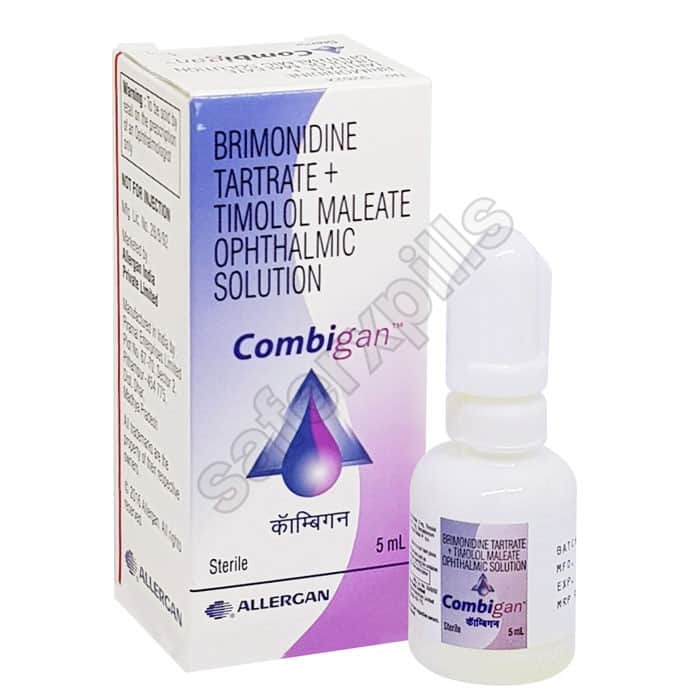
Combigan Eye Drop
Generic: Timolol/Brimonidine
Select Pack Size:
Selected: 1 Bottle
$18.00 total
$30.00 total
Save 40%About Combigan Eye Drop
Combigan Eye Drop is a 5 mL bottle that combines two glaucoma medicines in one drop: brimonidine tartrate 0.2% (an alpha-2 agonist) and timolol 0.5% (a beta blocker). It lowers raised eye pressure in open-angle glaucoma and ocular hypertension when one medicine alone has not been enough. The pack we sell is the Indian Combigan: Apollo Pharmacy names Allergan Healthcare India Pvt Ltd, and PharmEasy and Truemeds name AbbVie Therapeutics India Private Limited. We sell 1, 3 or 6 bottles, from $14.33 a bottle before shipping. That is far below what US pharmacies pay for brand Combigan, but US generic brimonidine and timolol drops cost less than ours once shipping is added (see the price comparison below).
Because one ingredient is a beta blocker, Combigan is not just an eye medicine. Timolol is absorbed into the bloodstream, and the US label says severe breathing and heart reactions, including deaths from bronchospasm in people with asthma, have been reported after timolol eye drops (5.1). People with asthma, severe COPD, a slow heart rate (sinus bradycardia), certain heart blocks or overt heart failure must not use it. Glaucoma also needs an eye doctor and regular pressure checks; never start, switch or stop glaucoma drops without one. Clinical details on this page come from the US Combigan label, the UK Combigan label, the Canadian product monograph and the Australian product information, each named where it is used and listed under Sources.
Combigan at a glance
| Active ingredients | Brimonidine tartrate 0.2% (2 mg per mL) and timolol 0.5% (5 mg per mL, as 6.8 mg timolol maleate), 5 mL bottle. Benzalkonium chloride is the preservative in the US, UK and Australian labels and on the Apollo Pharmacy listing for the Indian pack. |
| Brand and maker | Combigan, an Allergan (AbbVie) brand. Indian pack: Allergan Healthcare India Pvt Ltd (Apollo Pharmacy) or AbbVie Therapeutics India Private Limited (PharmEasy, Truemeds) |
| Labelled use | Lowering raised eye pressure in glaucoma or ocular hypertension when pressure is not controlled well enough on other treatment (US label 1). The UK label limits it to chronic open-angle glaucoma or ocular hypertension not responding enough to beta blocker drops (4.1). |
| Regulatory status | Combigan is licensed in the US (NDA 021398, approved 2007), the UK, Canada and Australia, and US generics are FDA approved. The Indian pack we sell is not registered with the FDA, MHRA, TGA or Health Canada. |
| Usual dose | One drop in the affected eye(s) twice daily, about 12 hours apart (US, UK, Canadian and Australian labels agree) |
| Peak effect | About 2 hours after a drop for brimonidine and 1 to 2 hours for timolol (US label 12.1) |
| Packs | 1, 3 or 6 bottles |
| Price per bottle | $14.33 to $18 before shipping ($2.87 to $3.60 per mL) |
| Delivery | 7 to 14 business days to the US, UK, Australia and Canada; $25 shipping under $149, free from $149 |
Price per bottle
Prices as of October 2026; the pack selector shows the current price. None of the packs reaches the $149 free shipping level on its own (the 6 bottle pack is $86), so each includes the $25 shipping charge below unless you add other items. The 3 and 6 bottle packs cost the same per bottle.
| Pack | Price | Per bottle | Per mL | Shipping | Per bottle with shipping | Per mL with shipping |
|---|---|---|---|---|---|---|
| 1 bottle (5 mL) | $18.00 | $18.00 | $3.60 | $25 | $43.00 | $8.60 |
| 3 bottles (15 mL) | $43.00 | $14.33 | $2.87 | $25 | $22.67 | $4.53 |
| 6 bottles (30 mL) | $86.00 | $14.33 | $2.87 | $25 | $18.50 | $3.70 |
How long a pack lasts depends on the opened-bottle rule. The UK label says use within 28 days of first opening (6.3) and the Australian label says discard 4 weeks after opening (6.6); PharmEasy and Truemeds also say use within 4 weeks. The US label gives no opened-bottle period. If you open one bottle every 4 weeks, a single bottle covers about 4 weeks, a 3 bottle pack about 12 weeks and a 6 bottle pack about 24 weeks (our estimate). Check the expiry date on the cartons before you buy a large pack.
Compared with Combigan and generics in the US
AbbVie still sells Combigan in the US in 5, 10 and 15 mL bottles, and generic brimonidine tartrate and timolol maleate 0.2%/0.5% drops from several makers are FDA approved. The figures below are what US pharmacies paid according to the Medicaid NADAC survey, per-NDC rows effective 21 October 2026. They are pharmacy acquisition costs, not the price at the counter, which is usually higher.
| Product | Maker | FDA approved | US pharmacy cost per mL | Per bottle |
|---|---|---|---|---|
| Combigan 0.2%/0.5%, 5 mL | AbbVie (Allergan) | Yes | $39.15 | About $195.76 |
| Combigan 0.2%/0.5%, 10 mL | AbbVie (Allergan) | Yes | $39.09 | About $390.91 |
| Generic brimonidine/timolol 0.2%/0.5%, 5 mL | Several | Yes | $3.16 | About $15.79 |
| Generic brimonidine/timolol 0.2%/0.5%, 10 mL | Several | Yes | $2.00 | About $19.99 |
| Generic brimonidine/timolol 0.2%/0.5%, 15 mL | Several | Yes | $2.04 | About $30.62 |
| Combigan, Indian pack (this page), 5 mL | Allergan / AbbVie India | No (not registered with the FDA) | $2.87 to $3.60 from us | $14.33 to $18, before shipping |
Plainly: our bottle is far cheaper than US brand Combigan, but not cheaper than the US generic. Before shipping, our 3 and 6 bottle packs ($2.87 per mL) cost a little less than what a US pharmacy pays for a 5 mL generic ($3.16 per mL), but more than the 10 mL generic ($2.00 per mL). With shipping, ours costs $18.50 to $43 a bottle, more than the $15.79 a US pharmacy pays for a 5 mL generic. If you are in the US and have a prescription, compare US generic cash prices and your insurance cover before ordering from abroad. In Australia, Combigan 5 mL is on the PBS (item 8826M, Restricted Benefit for elevated intra-ocular pressure) with a dispensed price of A$26.70 and a general patient charge of A$25.00, so Australian patients with a prescription should compare that too.
Combigan or separate drops
There is only one strength of Combigan (brimonidine 0.2% with timolol 0.5%). The choice your eye doctor makes is between this combination, the two medicines as separate bottles, or a different drop.
| Option | Schedule in the labels | What the labels say |
|---|---|---|
| Combigan (this product) | One drop twice daily | Lowered pressure by an extra 1 to 3 mmHg over brimonidine 0.2% three times daily and 1 to 2 mmHg over timolol 0.5% twice daily during the first 7 hours after dosing, but about 1 to 2 mmHg less than the two drops used separately (US label 14). |
| Brimonidine 0.2% and timolol 0.5% as separate bottles | US: brimonidine three times daily plus timolol twice daily | Slightly more pressure lowering than Combigan in the US studies (US label 1 and 14). The UK label says Combigan was consistently non-inferior to the two given separately, all twice daily (5.1). |
| Brimonidine alone (Alphagan 0.2% or Alphagan P 0.15%) | UK Alphagan 0.2% label: twice daily. US Alphagan P label: three times daily | No beta blocker, so no timolol breathing or heart contraindications. See those pages for their own warnings. |
One combination bottle means fewer drops a day than two separate bottles (our point, not a label claim). In the Australian label's 12-month studies, 14.3% stopped Combigan because of adverse events, against 30.6% on brimonidine alone and 5.1% on timolol alone (4.8). Other combination drops we sell include Dorzox T (dorzolamide with timolol) and Travacom (travoprost with timolol); both also contain timolol. Do not use two drops that each contain a beta blocker: the US label says the use of two topical beta blockers is not recommended (7.2).
How to use Combigan
- Wash your hands. Tilt your head back, pull the lower lid down gently and put one drop into the pocket.
- Do not let the bottle tip touch your eye, lids, fingers or any surface. The US label warns that contaminated multiple-dose eye drop bottles have caused bacterial keratitis, and that "serious damage to the eye and subsequent loss of vision may result from using contaminated solutions" (5.10).
- Straight after the drop, press on the inner corner of the eye (the tear duct) or close your eyelids. The UK label recommends doing this for two minutes to reduce how much reaches the bloodstream, which may lower whole-body side effects (4.2); the Canadian monograph says one minute (4.3). With a beta blocker in the bottle, this step matters.
- Use one drop twice daily, about 12 hours apart (US label 2; UK label 4.2).
- If you use other eye drops, leave at least 5 minutes between them (US label 2; UK label 4.2). The Canadian monograph says at least 10 minutes (4.3) and the Australian label 5 to 10 minutes (4.2).
- If you miss a dose, use it as soon as you remember, then go back to your usual schedule (Canadian monograph 4.4).
- Replace the cap after each use. Do not use the drops if the solution changes colour or becomes cloudy, or after the expiry date (US label 17). The solution is normally clear and greenish yellow (US label 11).
- Throw the bottle away 4 weeks (28 days) after first opening (UK label 6.3; Australian label 6.6), unless the Indian carton gives a different rule.
Contact lenses. Combigan contains benzalkonium chloride, which may be absorbed by soft contact lenses. The US label says to remove lenses before the drop and that they "may be reinserted 15 minutes following administration" (5.12). The UK label adds that benzalkonium chloride is known to discolour soft contact lenses and to avoid contact with them (4.4). Apollo Pharmacy and Truemeds give the same 15 minute advice for the Indian pack; PharmEasy says to avoid contact lenses.
Keep your checks. Your eye doctor needs to measure your pressure to know whether the drop is working. If you have eye surgery or develop an eye injury or infection, ask your doctor straight away whether to keep using the same bottle (US label 17). Do not stop Combigan suddenly if you have coronary heart disease without your doctor: the UK label says that, as with beta blocker tablets, treatment should be withdrawn gradually in these patients to avoid rhythm disorders, heart attack or sudden death (4.4).
Groups who need extra care
- Mild or moderate COPD and other bronchospastic disease. The US label says these patients "should, in general, not receive beta-blocking agents, including COMBIGAN" (5.3). The UK label says use with caution and only if the potential benefit outweighs the potential risk (4.4).
- Heart disease and low blood pressure. The UK label says beta blocker therapy in patients with coronary heart disease, Prinzmetal's angina, heart failure or hypotension "should be critically assessed" and other treatment considered, and that first degree heart block needs caution (4.4). The US label says that at the first sign or symptom of heart failure, Combigan should be stopped (5.2).
- Poor circulation and related conditions. The US label says Combigan should be used with caution in depression, cerebral or coronary insufficiency, Raynaud's phenomenon, orthostatic hypotension or thromboangiitis obliterans (5.4).
- Diabetes or episodes of low blood sugar. Beta blockers may mask the signs of low blood sugar; use with caution if you take insulin or diabetes tablets, especially with labile diabetes (US label 5.7).
- Overactive thyroid. Beta blockers may mask signs such as a fast heartbeat, and stopping suddenly may trigger a thyroid storm (US label 5.8).
- Myasthenia gravis. Timolol has been reported rarely to increase muscle weakness (US label 5.6).
- Severe allergies. People with a history of severe allergic reactions may react more strongly and may not respond to the usual dose of adrenaline (epinephrine) used to treat anaphylaxis (US label 5.5).
- Surgery. Tell your surgeon and anaesthetist you use Combigan. The UK label says the anaesthetist must be informed (4.4); the US label describes severe low blood pressure during anaesthesia in some patients on beta blockers (5.11).
- Dry eye or corneal disease. Beta blocker drops may cause dry eyes, and benzalkonium chloride may affect the tear film and corneal surface; use with caution (UK label 4.4).
- Children aged 2 and over. The labels differ. The US label says safety and effectiveness have been established from age 2 (8.4). The UK label says safety and efficacy at ages 2 to 17 have not been established and its use is not recommended (4.2), and Health Canada has not authorized a paediatric indication (1.1). In a study described in the US label, children aged 2 to 6 on brimonidine 0.2% with a beta blocker had somnolence in 50% to 83%, and about 16% stopped because of it (8.4). The Australian label says safety and effectiveness in children have not been established (4.4). Children 2 and over should be treated with caution and closely monitored because of the high incidence and severity of drowsiness: the UK label says especially those aged 2 to 7 and/or weighing 20 kg or less (4.4), and the Australian label especially those weighing 20 kg or less (4.4).
- Liver or kidney problems. Not studied; the UK and Australian labels advise caution (UK 4.2; AU 4.4). The Australian label adds that timolol has caused pronounced low blood pressure in people with severe kidney impairment on dialysis.
- Older adults. No dose change is needed (UK label 4.2), although the Australian label notes that blood levels of both medicines were significantly higher in elderly patients (4.4).
- Pregnancy. The UK label says Combigan "should not be used during pregnancy unless clearly necessary", and that a baby exposed up to delivery should be carefully monitored in the first days of life for signs of beta blockade (4.6). The US label says the available data are insufficient to establish a drug-associated risk (8.1).
- Driving and machines. Combigan may cause blurred vision, fatigue or drowsiness; wait until these clear before driving or using machinery (UK label 4.7; US label 17).
Medicines to mention to your doctor:
- Beta blocker tablets or injections: watch for added beta blocker effects on the body and on eye pressure; two beta blocker eye drops together are not recommended (US label 7.2).
- Calcium antagonists (calcium channel blockers), digitalis and anti-arrhythmics including amiodarone: risk of low blood pressure, a very slow heartbeat or heart conduction problems. The US label says that in people with impaired heart function, using Combigan with oral or intravenous calcium antagonists should be avoided (7.3, 7.6; UK label 4.5).
- Blood pressure medicines: caution, because Combigan may lower blood pressure (US label 7.1).
- Reserpine and other catecholamine-depleting drugs: close observation (US label 7.4).
- CYP2D6 inhibitors such as quinidine and some SSRIs (the UK label names fluoxetine and paroxetine): stronger beta blocker effects, such as a slower heart rate, have been reported (US label 7.7; UK label 4.5).
- Alcohol, sedatives, opioids, barbiturates and anaesthetics: a possible additive effect should be considered (US label 7.5).
- Clonidine: the UK label says the rise in blood pressure after suddenly stopping clonidine can be stronger in people on beta blockers (4.5).
- Diabetes medicines: beta blockers may increase their blood sugar lowering effect and mask low blood sugar (UK label 4.5).
- Antidepressants and MAO inhibitors: see "Who should not use Combigan" below.
Side effects
The UK label says the most common reactions in 12 months of clinical data were red eyes (conjunctival hyperaemia, about 15% of patients) and burning in the eye (about 11%); most were mild, and they led 3.4% and 0.5% of patients to stop (4.8). The US label lists allergic conjunctivitis, small bumps on the inner lid (conjunctival folliculosis), red eyes, eye itching, burning and stinging in about 5% to 15% of patients in 12-month trials (6.1). Reactions in 1% to 5% included tiredness, eyelid inflammation, corneal erosion, depression, watery eyes, eye discharge, dry eye, eye pain, eyelid swelling and redness, headache, high blood pressure, dry mouth, drowsiness and visual disturbance (US label 6.1).
Eye allergy can start late. The UK label says allergic conjunctivitis was seen in 5.2% of patients, usually starting between 3 and 9 months into treatment, and led 3.1% to stop (4.4). Delayed eye allergy with brimonidine has sometimes come with a rise in eye pressure (UK label 4.4; US label 5.9). So a red, itchy eye months after starting can still be the drop.
The Australian label compares the three treatments in its 12-month studies:
| 12-month studies (selected) | Combigan twice daily | Brimonidine 0.2% alone | Timolol 0.5% alone |
|---|---|---|---|
| Red eyes (conjunctival hyperaemia) | About 17% | About 23% | About 8% |
| Burning in the eye | About 11% | Not given among the most common | About 13% |
| Allergic conjunctivitis | Not given among the most common | About 10% | Not given among the most common |
| Stopped because of adverse events | 14.3% | 30.6% | 5.1% |
Source: Australian Product Information for Combigan, AbbVie, section 4.8 (the label gives only the most common reactions for each group).
Because timolol reaches the bloodstream, the labels also list beta blocker effects reported with timolol eye drops: slow or irregular heartbeat, heart block, heart failure, cardiac arrest, fainting, stroke, bronchospasm (mainly in people who already had it), shortness of breath, cold hands and feet, low blood sugar, depression, nightmares, hair loss, worsening psoriasis, decreased libido and impotence (US label 6.1; UK label 4.8). Reports since approval include a slow or fast heartbeat, fainting, inflammation inside the eye and skin reactions (US label 6.2).
When to get urgent help
- Wheezing, chest tightness or trouble breathing after using the drops: call emergency services (911 in the US and Canada, 999 in the UK, 000 in Australia). Bronchospasm, including deaths in people with asthma, has been reported with timolol (US label 5.1).
- A very slow heartbeat, fainting, chest pain, or new swelling of the ankles with breathlessness (possible heart failure): get medical help straight away and stop the drops until a doctor advises (US label 5.2 says to stop at the first sign of heart failure).
- A baby or young child gets the drops or swallows them. Call emergency services or poison control straight away (US Poison Help 1-800-222-1222; Australian Poisons Information Centre 13 11 26). Infants given brimonidine have had apnoea (stopped breathing), coma, a slow heartbeat, low blood pressure, low body temperature, floppiness and drowsiness (US label 6.2, 8.4). Keep the bottle out of children's reach.
- An adult swallows the drops or uses far too much. Get medical advice. Timolol overdose has caused dizziness, headache, shortness of breath, a slow heartbeat, bronchospasm and cardiac arrest (US label 10).
- Eye pain, a change in vision, or signs of eye infection (increasing redness, discharge, swelling) or an eye injury: contact your eye doctor the same day (US label 5.10, 17).
- Signs of eye allergy (red, itchy, swollen eyes or lids that keep getting worse): contact your eye doctor promptly. The UK label says treatment should be stopped if allergic reactions are seen (4.4), and your doctor needs to arrange another drop so your pressure stays controlled.
- Allergy signs beyond the eye (swelling of the lips, tongue or throat, trouble breathing or swallowing, widespread rash or hives): call emergency services. Anaphylaxis and angioedema are listed with timolol (US label 6.1).
Tell emergency staff what was used or swallowed (brimonidine and timolol eye drops, a beta blocker), how much and when.
Who should not use Combigan
Never use it if (contraindicated in the US, UK, Canadian and Australian labels):
- You have asthma or a history of asthma, or other reactive airway disease (US 4.1; UK 4.3).
- You have severe chronic obstructive pulmonary disease (COPD) (US 4.1; UK 4.3).
- You have sinus bradycardia (a slow heart rate), second or third degree atrioventricular (AV) block, overt heart failure or cardiogenic shock (US 4.2). The UK, Canadian and Australian labels word the AV block item as "not controlled with a pace-maker" and add sick sinus syndrome and sino-atrial block (UK 4.3; CA 2; AU 4.3).
- It is for a newborn, a baby or a child under 2 years (US 4.3; UK 4.3).
- You have had an allergic reaction to brimonidine, timolol or any ingredient of the drops, including the preservative (US 4.4; UK 4.3).
Contraindicated in the UK, Canadian and Australian labels; a caution in the US label:
- MAO inhibitor (MAOI) therapy. The UK, Canadian and Australian labels make this a contraindication (UK 4.3; CA 2; AU 4.3), and the UK and Australian labels say to wait 14 days after stopping an MAOI before starting Combigan (UK 4.5; AU 4.3). The US label advises caution, because MAO inhibitors "may theoretically interfere" with brimonidine breakdown (7.9).
- Antidepressants that affect noradrenergic transmission, such as tricyclic antidepressants and mianserin: a contraindication in the UK label (4.3); the US label advises caution with tricyclics (7.8).
Not recommended, or only with your doctor's agreement:
- Breastfeeding: "not recommended for use during lactation" (US label 8.2), because of possible serious reactions in the baby including central nervous system depression and apnoea. The UK label says it "should not be used by women breast-feeding infants" (4.6); the Australian label asks for a decision between stopping breastfeeding or stopping the drops (4.6).
- Children and teenagers aged 2 to 17: not recommended in the UK label (4.2); see "Groups who need extra care".
- Mild or moderate COPD: "should, in general, not receive" beta blockers (US label 5.3).
- Another beta blocker eye drop at the same time: not recommended (US label 7.2).
- Angle-closure glaucoma: Combigan has not been studied (UK label 4.4).
Prescription and legal status
Combigan is a prescription medicine in the US ("Rx Only" on the US label), the UK (prescription only medicine on the emc), Australia (Schedule 4, Prescription Only Medicine, AUST R 97690) and Canada (DIN 02248347, prescription, marketed). Apollo Pharmacy and Truemeds also mark the Indian Combigan as prescription only. Combigan is licensed in all four countries, but the Indian pack we sell is not registered with the FDA, MHRA, TGA or Health Canada, and the FDA says personal importation of unapproved medicines is illegal in most circumstances. Check the rules where you live, and tell your eye doctor and your GP that you use a beta blocker eye drop.
Buying genuine Combigan
The MHRA warns: "Any medicine not authorised for sale in the UK can be unsafe or ineffective and there is no way of knowing what is in them or the negative health effects they can have." That warning covers this Indian pack. The MHRA also advises: "Only use UK-registered pharmacies, including online pharmacies displaying the official green cross logo." When your order arrives, check that the carton and bottle say Combigan, brimonidine tartrate and timolol, name Allergan or AbbVie (Indian listings name both), and show a batch number and an expiry date, that the seal is intact, and that the solution is clear and greenish yellow. These checks cannot prove a bottle is genuine, because counterfeiters copy packaging. Keep your pressure checks: if your eye doctor finds your pressure is higher than before on the same drop, tell them where the bottle came from. If a batch causes symptoms, seek medical advice and report it to your medicines regulator (the MHRA Yellow Card scheme in the UK, FDA MedWatch in the US, the TGA in Australia or Health Canada) as well as to us.
Delivery
We ship Combigan to the US, UK, Australia and Canada in plain packaging with tracking. Standard delivery takes 7 to 14 business days, so order well before your current bottle runs out; glaucoma drops should not be missed while you wait. Shipping costs a flat $25 on orders under $149 and is free from $149. None of the labels or listings we checked asks for refrigeration. The US label says store at 15°C to 25°C and protect from light (16); the Canadian monograph also gives 15°C to 25°C, the Australian label below 25°C, and the UK label says keep the bottle in the carton to protect it from light. The Indian listings differ: Apollo Pharmacy and PharmEasy give 15°C to 25°C, and Truemeds gives both below 25°C and below 30°C. Store the bottle as the carton says. See our shipping page and refund policy.
Related guides
- Glaucoma eye drops: every type explained
- Latanoprost eye drops: dosage, side effects and buying online
- Lumigan eye drops for glaucoma
- How to buy eye care medicine online safely
Other glaucoma drops: Alphagan 0.2% and Alphagan P 0.15% (brimonidine alone), Azopt Eye Drop (brinzolamide), Dorzox T (dorzolamide with timolol) and Latoprost Eye Drop (latanoprost). See also our glaucoma treatment overview.
Sources
- Combigan (brimonidine tartrate/timolol maleate ophthalmic solution) 0.2%/0.5%, US prescribing information, Allergan/AbbVie, NDA 021398, DailyMed setid feaf1480-a4b8-4486-992a-96be3a596243, version 22, effective March 2026, sections 1 to 8, 10 to 12, 14, 16 and 17. DailyMed
- Combigan 2 mg/ml + 5 mg/ml eye drops, solution, UK Summary of Product Characteristics, AbbVie Ltd, PL 41042/0062, revised 25 November 2025 (emc updated 5 February 2026), sections 2 to 6. emc
- Combigan product monograph, AbbVie Corporation, Canada, revised 3 October 2022, sections 1, 2, 4, 5 and 11. Health Canada
- Combigan eye drops, Australian Product Information, AbbVie Pty Ltd, AUST R 97690, revised 11 August 2023, sections 4.1 to 4.8 and 6 to 7. TGA ARTG 97690
- US Food and Drug Administration, Drugs@FDA: Combigan, NDA 021398 (AbbVie), approved 30 October 2007, prescription; generic brimonidine tartrate and timolol maleate (for example ANDA 091087 Sandoz, ANDA 091442 Apotex), checked 27 October 2026. Drugs@FDA
- Health Canada Drug Product Database: Combigan (DIN 02248347, brimonidine tartrate 0.2% and timolol 0.5%, prescription, marketed). Health Canada DPD
- Pharmaceutical Benefits Scheme, item 8826M, brimonidine tartrate 0.2% + timolol 0.5% eye drops 5 mL (Combigan), accessed 27 October 2026. PBS
- Centers for Medicare and Medicaid Services. National Average Drug Acquisition Cost (NADAC), Combigan and brimonidine/timolol eye drops, per-NDC rows, 2026 file as of 21 October 2026 (rates effective 21 October 2026); bottle sizes from openFDA NDC. data.medicaid.gov
- Apollo Pharmacy, PharmEasy and Truemeds. Combigan 5 ml listings, accessed 27 October 2026. Apollo Pharmacy, PharmEasy, Truemeds
- MHRA. 20 million illegal erectile dysfunction pills seized as MHRA warns against risky online buys, 13 February 2026. GOV.UK
- US Food and Drug Administration. Personal Importation. FDA
This page is for information and is not medical advice. Combigan is a prescription medicine; your eye doctor should set your treatment and check your eye pressure, and your doctor should know you use a beta blocker eye drop.
Key Information
- ✓Active Ingredient: Timolol/Brimonidine
- ✓Category: Eye Care
- ✓Form: Eye Drop
- ✓Brand: Allergan India Pvt Ltd
- ✓Manufacturer: Allergan India Pvt Ltd
Frequently Asked Questions
What is Combigan Eye Drop?
Combigan is an eye drop that combines brimonidine tartrate 0.2% (an alpha-2 agonist) with timolol 0.5% (a beta blocker) to lower raised eye pressure in glaucoma or ocular hypertension when one medicine alone has not controlled it (US label 1). The pack we sell is the Indian Combigan in a 5 mL bottle; Apollo Pharmacy names Allergan Healthcare India Pvt Ltd and PharmEasy and Truemeds name AbbVie Therapeutics India Private Limited.
Is the Indian Combigan the same as US or UK Combigan?
It has the same ingredients and strengths (brimonidine tartrate 2 mg and timolol 5 mg per mL) and the same brand owner, AbbVie (Allergan). The Apollo Pharmacy listing also names benzalkonium chloride 0.05 mg per mL as the preservative, as in the US and UK labels. But the Indian pack is not registered with the FDA, MHRA, TGA or Health Canada, and we have not seen data comparing it with the packs sold there, so read the Indian carton for its own storage and opened-bottle rules.
How much does Combigan cost per bottle?
As of October 2026, one bottle is $18, and the 3 and 6 bottle packs work out at $14.33 a bottle before shipping. Shipping is $25 on orders under $149, so with shipping a bottle costs $43, $22.67 or $18.50 depending on the pack. The pack selector shows the current price. US pharmacies paid about $195.76 for a 5 mL bottle of brand Combigan and about $15.79 for a 5 mL generic (NADAC, effective 21 October 2026), so in the US a generic is cheaper than ours once shipping is added.
How do I use Combigan?
One drop in the affected eye(s) twice daily, about 12 hours apart (US, UK, Canadian and Australian labels). Do not let the tip touch your eye or anything else. Press on the inner corner of the eye or close your eyelids straight after the drop to cut how much reaches the bloodstream (UK label 4.2 says two minutes). Leave at least 5 minutes before any other eye drop, take soft contact lenses out first and wait 15 minutes before putting them back (US label 2 and 5.12).
Is there more than one strength of Combigan?
No. Combigan comes only as brimonidine 0.2% with timolol 0.5%. The choice your eye doctor makes is between this combination, brimonidine and timolol as two separate bottles, or a different drop. In the US studies, Combigan twice daily lowered pressure about 1 to 2 mmHg less than the two drops used separately (brimonidine three times daily plus timolol twice daily), but more than either drop alone (US label 14).
How long does a bottle last?
The UK label says use a bottle within 28 days of first opening and the Australian label says discard it 4 weeks after opening; PharmEasy and Truemeds also say 4 weeks for the Indian pack. On that rule, one bottle covers about 4 weeks, a 3 bottle pack about 12 weeks and a 6 bottle pack about 24 weeks (our estimate). Check the expiry dates before buying a large pack.
How quickly does Combigan work?
The US label says both ingredients act quickly, with the peak pressure-lowering effect about 2 hours after a drop for brimonidine and 1 to 2 hours for timolol (12.1). You will not feel it working, because raised eye pressure usually has no symptoms. Only an eye pressure check can show whether it is controlling your pressure, so keep your appointments.
What are the side effects of Combigan?
The most common are red eyes (about 15%) and burning in the eye (about 11%), mostly mild (UK label 4.8). Eye allergy can start 3 to 9 months in (UK label 4.4). Dry mouth, drowsiness, tiredness and headache can occur. Because timolol reaches the bloodstream, it can also slow the heart, lower blood pressure, worsen breathing in people with lung disease and mask low blood sugar (US label 5 and 6). Wheezing, fainting or a very slow heartbeat need urgent medical help.
Who should not use Combigan?
The US, UK, Canadian and Australian labels all say never use it if you have asthma or a history of asthma, severe COPD, sinus bradycardia, second or third degree AV block, overt heart failure or cardiogenic shock, for a child under 2, or if you are allergic to any ingredient. The UK, Canadian and Australian labels also contraindicate MAO inhibitor treatment (the US label says caution), and the UK label contraindicates tricyclic antidepressants and mianserin. The US label says it is not recommended during breastfeeding.
Do I need a prescription for Combigan?
Yes. Combigan is prescription only in the US, the UK, Australia (Schedule 4) and Canada, and Apollo Pharmacy and Truemeds list the Indian pack as prescription only. The Indian pack we sell is not registered with the FDA, MHRA, TGA or Health Canada, and the FDA says personal importation of unapproved medicines is illegal in most circumstances. Glaucoma needs an eye doctor and regular pressure checks; do not start or switch drops without one.
How long does delivery take?
Standard delivery to the US, UK, Australia and Canada takes 7 to 14 business days, in plain packaging with tracking. Shipping is $25 on orders under $149 and free from $149. Order well before your current bottle runs out, because glaucoma drops should not be missed. None of the labels or Indian listings we checked asks for refrigeration; the US label says store at 15°C to 25°C, protected from light.
Medical References
Sources: U.S. National Library of Medicine (DailyMed, PubMed), openFDA
Related Products
View all

Customer Reviews
No reviews yet. Be the first to review Combigan Eye Drop.
Related Articles
Health guides about Timolol/Brimonidine, written by pharmacists

Cyclosporine Eye Drops for Dry Eye: Restasis, Cyclomune and What the Trials Show
Cyclosporine eye drops treat the inflammation behind chronic dry eye rather than just wetting the surface. They are slow, they often sting, and in the main trials only about 15 percent of patients reached the headline tear production target. This guide explains what to expect and how Cyclomune 0.05% and 0.1% compare with Restasis.
Bimatoprost for Eyebrows: What the Trials Show About Off Label Use
Bimatoprost is FDA approved for eyelashes, not eyebrows, so brow use is off label and rarely discussed properly. A Phase 3 trial and three smaller randomised studies say it works. This guide covers the evidence, a realistic timeline, how brow application differs from lashes, and the risks worth taking seriously.
Is Careprost Legal in the USA? FDA Status, Prescription Rules and Counterfeit Risk
Careprost is not FDA approved and bimatoprost is prescription only in the US for every use, including lash growth. An accurate read of the law, the FDA label warnings, and how to tell a real supplier from a dangerous one.
Related Health Guide
Understanding Eyelash Growth & Eye Conditions: Complete Guide