Azopt Eye Drop
Generic: Brinzolamide
Select Pack Size:
Selected: 1 Bottle
$32.00 total
$64.00 total
Save 50%About Azopt Eye Drop
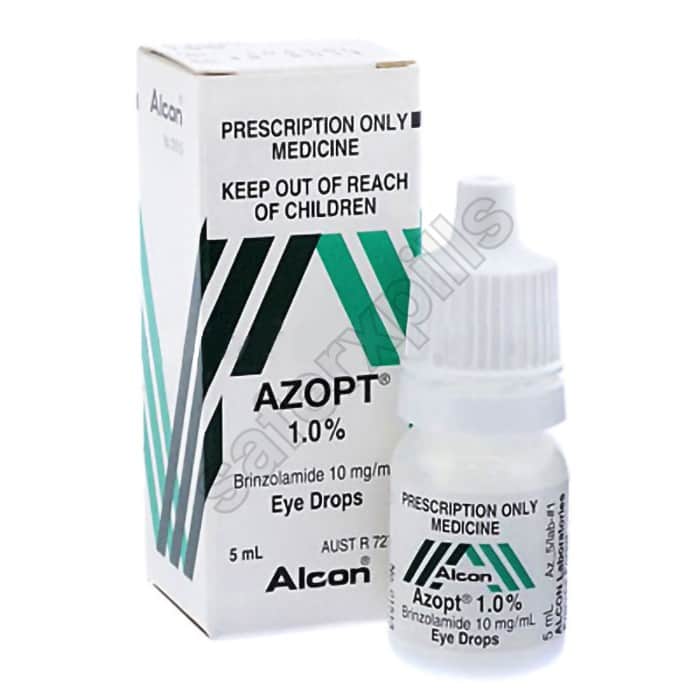
Azopt Eye Drop is a 5 mL bottle of brinzolamide 1% (10 mg per mL) eye drop suspension for open-angle glaucoma and high eye pressure (ocular hypertension). Brinzolamide is a carbonic anhydrase inhibitor: it lowers eye pressure by reducing the amount of fluid the eye makes. The pack we sell is the Indian Azopt. Apollo Pharmacy lists Alcon Laboratories Inc as manufacturer or marketer, Truemeds names Novartis Healthcare Private Limited, and PharmEasy names J B Chemicals and Pharmaceuticals with an Alcon-Couvreur (Puurs, Belgium) address; all three listings give Belgium as the country of origin. We sell it as 1, 3 or 6 bottles, from $19.67 a bottle in the 6 bottle pack, before shipping.
Brinzolamide is a sulfonamide, and although it is used in the eye it is absorbed into the body, so it carries the same allergy warnings as sulfa medicines (see below). Glaucoma treatment is not something to run on your own: raised pressure damages the optic nerve and the field of vision, often without symptoms until late, and only an eye doctor measuring your pressure can tell whether a drop is working. Use Azopt only as part of care from an eye doctor, with regular pressure checks. Clinical details on this page come from the US prescribing information for Azopt and the UK Summary of Product Characteristics (SmPC) and patient leaflet for Azopt, listed under Sources. Where the two labels differ, we say which one says what.
Azopt at a glance
| Active ingredient | Brinzolamide 1% (10 mg per mL), eye drop suspension, 5 mL bottle. The US and UK Azopt contain benzalkonium chloride 0.1 mg per mL as the preservative; the Truemeds listing for the Indian pack also names benzalkonium chloride |
| Brand and maker | Azopt (US: made by Alcon Laboratories for Sandoz; UK, Canada and Australia: Novartis). Indian pack listed under Alcon Laboratories Inc (Apollo Pharmacy), Novartis Healthcare Pvt Ltd (Truemeds) and J B Chemicals and Pharmaceuticals (PharmEasy) |
| Labelled use | Lowering raised eye pressure in ocular hypertension or open-angle glaucoma (US label 1). The UK label limits it to adults who do not respond to beta blocker drops or cannot use them, or to adding on to a beta blocker or prostaglandin drop (4.1) |
| Regulatory status | Azopt is licensed in the US (FDA approved 1998), the UK, Australia and Canada. The Indian pack we sell is not registered with the FDA, MHRA, TGA or Health Canada |
| Usual dose | US label: one drop in the affected eye(s) 3 times daily. UK label: one drop twice daily; some patients may respond better to one drop three times a day, and the dose should not exceed one drop three times daily. Use the schedule your eye doctor gives you |
| Half-life in whole blood | About 111 days (US label 12.3); a mean of about 24 weeks (UK label 5.2). This long figure comes from brinzolamide binding to red blood cells. After stopping, the UK label says the pressure-lowering effect is expected to last 5 to 7 days (4.4) |
| Packs | 1, 3 or 6 bottles of 5 mL |
| Price per bottle | $19.67 to $32 before shipping ($3.93 to $6.40 per mL) |
| Delivery | 7 to 14 business days to the US, UK, Australia and Canada; $25 shipping under $149, free from $149 |
Price per bottle
Prices as of October 2026; the pack selector shows the current price. None of the packs reaches the $149 free shipping level on its own (the 6 bottle pack is $118), so each includes the $25 shipping charge below unless you add other items.
| Pack | Price | Per bottle | Per mL | Shipping | Per bottle with shipping | Per mL with shipping |
|---|---|---|---|---|---|---|
| 1 bottle (5 mL) | $32.00 | $32.00 | $6.40 | $25 | $57.00 | $11.40 |
| 3 bottles (15 mL) | $65.00 | $21.67 | $4.33 | $25 | $30.00 | $6.00 |
| 6 bottles (30 mL) | $118.00 | $19.67 | $3.93 | $25 | $23.83 | $4.77 |
How long a pack lasts depends on the opened-bottle rule and on how many drops you use. The UK label says to throw a bottle away 4 weeks after first opening (6.3, and the UK leaflet: "to prevent infections"), and the Truemeds listing for the Indian pack says the same. The US label says that after opening, Azopt "can be used until the expiration date on the bottle" (16). Read the Indian carton for its own rule. If you open one bottle every 4 weeks, a 3 bottle pack covers about 12 weeks and a 6 bottle pack about 24 weeks (our estimate). The UK leaflet gives 3.35 micrograms of benzalkonium chloride per drop at 0.1 mg per mL, which works out to roughly 150 drops in a 5 mL bottle (our arithmetic; real drop sizes vary). At one drop in both eyes three times a day that is about 25 days, so a bottle may run out before 4 weeks. Check the expiry date on the cartons before you buy a large pack.
Compared with Azopt and generic brinzolamide in the US
In the US, Azopt (NDA 020816, approved 1 April 1998) is now sold by Sandoz and made by Alcon Laboratories in Fort Worth, Texas, in 10 mL and 15 mL bottles. Generic brinzolamide 1% is FDA approved from several makers, including a Sandoz authorized generic and Bausch & Lomb. The figures below are what US pharmacies paid according to the Medicaid NADAC survey, per-NDC rows effective 21 October 2026. They are pharmacy acquisition costs, not the price at the counter.
| Product | Maker | FDA approved | US pharmacy cost per mL | Per bottle |
|---|---|---|---|---|
| Azopt 1%, 10 mL | Sandoz (made by Alcon) | Yes | $35.09 | About $350.92 |
| Azopt 1%, 15 mL | Sandoz (made by Alcon) | Yes | $35.25 | About $528.68 |
| Generic brinzolamide 1%, 10 mL | Several | Yes | $7.95 | About $79.50 |
| Generic brinzolamide 1%, 15 mL | Several | Yes | $8.41 | About $126.22 |
| Azopt 1%, Indian pack (this page), 5 mL | Alcon / Novartis / J B Chemicals (Indian listings) | No (not registered with the FDA) | $3.93 to $6.40 from us, before shipping | $19.67 to $32, before shipping |
Plainly: on these figures, US generic brinzolamide is not cheaper per mL than our 3 or 6 bottle packs, even with shipping ($6.00 and $4.77 per mL against $7.95 to $8.41). Our single bottle with shipping ($11.40 per mL) does cost more per mL than a US pharmacy pays for the generic. The US brand costs pharmacies about $35 per mL. NADAC is what pharmacies pay, not what you pay: if you are in the US and have a prescription and insurance, your copay for generic brinzolamide may be lower than any of our prices, so check it and US cash prices before ordering from abroad. In Australia, brinzolamide 1% 5 mL is on the PBS (item 8483L, up to 5 repeats) with a dispensed price of A$23.81 for BrinzoQuin and A$30.40 for Azopt (which includes a A$6.59 brand premium), so Australian patients with a prescription should compare their PBS cost too.
Which strength to choose
Brinzolamide eye drops come in one strength, 1%. The choices your eye doctor makes are the schedule and whether brinzolamide is the right drop at all.
| Product | What it contains | Labelled schedule | What the labels say |
|---|---|---|---|
| Azopt Eye Drop (this product) | Brinzolamide 1% | US: one drop 3 times daily. UK: one drop twice daily, up to one drop three times daily | In two 3-month US studies, three times daily use lowered pressure by 4 to 5 mmHg, equivalent to dorzolamide 2% three times daily, with less stinging and burning on instillation (US label 14). Added to travoprost, it lowered mean daytime pressure by a further 3.2 to 3.4 mmHg (UK label 5.1) |
| Dorzox Eye Drop | Dorzolamide (2% on our Dorzox listing), another carbonic anhydrase inhibitor drop | Follow your eye doctor and that product's label | The comparator in the US Azopt studies above. Do not use it together with Azopt unless your eye doctor tells you to: the UK Azopt leaflet says to talk to your doctor if you take another carbonic anhydrase inhibitor (acetazolamide or dorzolamide) |
| Brinzolamide combinations (not sold by us) | Simbrinza (brinzolamide 1% with brimonidine 0.2%); Azarga (brinzolamide 1% with timolol) | Per their own labels | Simbrinza is FDA approved (NDA 204251); Health Canada lists both Simbrinza and Azarga as marketed prescription products |
Our Dorzox Eye Drop costs $11.17 to $16 a bottle before shipping, less than Azopt. A doctor may still choose Azopt, for example because it caused less stinging than dorzolamide in the US studies. Do not swap one for the other without asking your eye doctor. If you need a carbonic anhydrase inhibitor with a beta blocker in one bottle, see Dorzox T Eye Drop (dorzolamide with timolol).
How to use Azopt
- Shake the bottle well before each use (US label 2; UK label 4.2). Azopt is a milky suspension, not a clear solution (UK leaflet). After removing the cap, take off the tamper evident snap collar if it is loose (UK label 4.2).
- Wash your hands. Tilt your head back, pull the lower lid down gently and put one drop into the pocket.
- Do not let the bottle tip touch your eye, lids, the area around the eye or any surface. The US label warns that the product "can become contaminated by common bacteria known to cause ocular infections" and that "serious damage to the eye and subsequent loss of vision may result from using contaminated solutions" (5.5).
- Straight after the drop, close the eye gently or press on the inner corner of the eye (by the nose). The UK label says this may reduce how much reaches the bloodstream and the systemic side effects (4.2); the UK leaflet says to press for at least 1 minute. It may also reduce the bitter taste (UK label 4.8).
- Use it on the schedule your eye doctor sets: the US label says one drop 3 times daily, the UK label one drop twice daily, up to three times daily.
- If you use other eye drops, the US label says to leave at least 10 minutes between them (2); the UK label says at least 5 minutes, with eye ointments last (4.2).
- If you forget a dose, the UK leaflet says to use a single drop as soon as you remember and then go back to your regular routine, and not to use a double dose. If you get too much in your eyes, rinse it out with warm water and wait for your next regular dose (UK leaflet).
- If your eye doctor switches you to Azopt from another glaucoma drop, the UK label says to stop the other drop and start Azopt the following day (4.2).
- Throw the bottle away 4 weeks after first opening (UK label 6.3), unless the Indian carton gives a different rule. Write the opening date on the box.
Contact lenses. The US label says: "The preservative in AZOPT, benzalkonium chloride, may be absorbed by soft contact lenses. Contact lenses should be removed during instillation of AZOPT, but may be reinserted 15 minutes after instillation" (5.6). The UK label says Azopt "has not been studied in patients wearing contact lenses", that its benzalkonium chloride "may cause eye irritation and is known to discolour soft contact lenses", that "contact with soft contact lenses is to be avoided", and that patients must remove lenses before the drop and "wait at least 15 minutes after instillation of the dose before reinsertion" (4.4). The UK label also recommends careful monitoring of contact lens wearers, because carbonic anhydrase inhibitors may affect corneal hydration and lenses might increase the risk for the cornea (4.4). The Apollo Pharmacy, PharmEasy and Truemeds listings give the same 15 minute wait.
Driving. The US label says vision may be temporarily blurred after a drop, so take care driving or using machines (17). The UK label says to wait until vision clears, and adds that because brinzolamide is absorbed, it may impair tasks that need mental alertness or physical coordination (4.4, 4.7).
Keep using it and keep your checks. The UK leaflet says that if you stop Azopt without speaking to your doctor, the pressure in your eye will not be controlled, which could lead to loss of sight. If you have eye surgery or develop an eye injury or infection, ask your doctor straight away whether to keep using the same bottle (US label 17).
Groups who need extra care
- A weak corneal lining (low endothelial cell count). The US label says carbonic anhydrase activity has been found in the corneal endothelium, that "there is an increased potential for developing corneal edema in patients with low endothelial cell counts", and that "caution should be used" when prescribing Azopt to this group (5.2). The UK label says its effect on the corneal endothelium has not been investigated in compromised corneas, particularly with a low endothelial cell count, and recommends careful monitoring of people with compromised corneas such as people with diabetes mellitus or corneal dystrophies (4.4). Tell your eye doctor if you have had corneal problems or eye surgery.
- Dry eye or a damaged corneal surface. The UK label says benzalkonium chloride has been reported to cause punctate keratopathy and/or toxic ulcerative keratopathy, so close monitoring is required with frequent or prolonged use in dry eye or where the cornea is compromised (4.4).
- Kidney problems. Brinzolamide and its main metabolite leave the body mainly through the kidneys. Severe kidney impairment (creatinine clearance below 30 mL/min) is "not recommended" in the US label (5.3) and a contraindication in the UK label (4.3). The UK label also advises caution where there is a risk of kidney impairment, because of the possible risk of metabolic acidosis (4.4).
- Liver problems. Not studied; the UK label says it is "therefore not recommended" (4.2).
- Narrow-angle, pseudoexfoliative or pigmentary glaucoma. The UK label says Azopt has not been studied in narrow-angle glaucoma and "its use is not recommended", and that pseudoexfoliative or pigmentary glaucoma needs caution and close pressure monitoring (4.4). The US label says acute angle-closure glaucoma needs treatment in addition to pressure-lowering drops, and Azopt has not been studied in it (5.4).
- Children and teenagers. The UK label says safety and efficacy from birth to 17 years have not been established and Azopt "is not recommended" in infants, children or adolescents (4.2, 4.4). In a 3-month study in the US label of children aged 4 weeks to 5 years, dosed twice a day, pressure-lowering efficacy "was not demonstrated" (mean fall 0 to 2 mmHg), and 5 of 32 children had a 1 mm increase in corneal diameter (8.4).
- Pregnancy. The UK label says Azopt "is not recommended during pregnancy and in women of childbearing potential not using contraception" (4.6). The US label says there are no adequate and well-controlled studies in pregnant women, and oral brinzolamide caused fetal toxicity in rats at 375 times the recommended human eye dose (8.1).
- Breastfeeding. The UK label says a risk to the infant cannot be excluded and a decision must be made whether to stop breastfeeding or stop Azopt (4.6); the UK leaflet says use is not recommended during breastfeeding. The US label says there are no human data and brinzolamide was found in rat milk (8.2).
- Older adults. No dose change is needed (UK label 4.2); the US label found no overall differences in safety or effectiveness (8.5).
Medicines to mention to your doctor:
- Carbonic anhydrase inhibitor tablets such as acetazolamide (our Diamox Tablet): using them with Azopt "is not recommended" (US label 7.1; UK label 4.4), because the systemic effects may add up.
- High-dose salicylates (for example high-dose aspirin): the US label says acid-base changes have occurred rarely when oral carbonic anhydrase inhibitors were combined with high-dose salicylate therapy, and the potential for this interaction should be considered (7.2).
- CYP3A4 inhibitors (the UK label names ketoconazole, itraconazole, clotrimazole, ritonavir and troleandomycin): "caution is advised", although the UK label adds that accumulation is unlikely because the kidneys are the main route out (4.5).
- Other sulfonamide medicines: the UK leaflet asks you to talk to your doctor first.
Side effects
The US label says the most frequent adverse reactions in clinical studies, in 5% to 10% of patients, were blurred vision and a bitter, sour or unusual taste. Reactions in 1% to 5% were blepharitis, dermatitis, dry eye, a feeling of something in the eye, headache, red eyes (hyperaemia), eye discharge, eye discomfort, keratitis, eye pain, itchy eyes and rhinitis (6.1). The UK label, from studies of 2,732 patients, gives a bad or unusual taste (dysgeusia) in 6.0% and temporary blurred vision in 5.4%, lasting from a few seconds to a few minutes (4.8).
| Adverse reaction (selected) | US label 6.1 | UK label 4.8 |
|---|---|---|
| Bitter, sour or unusual taste | 5% to 10% | 6.0% (common) |
| Blurred vision | 5% to 10% | 5.4% (common) |
| Eye pain, red eyes, feeling of something in the eye | 1% to 5% | Common (1 in 100 to 1 in 10) |
| Dry eye, eye discharge, itchy eyes, keratitis | 1% to 5% | Uncommon (1 in 1,000 to 1 in 100) |
| Headache | 1% to 5% | Uncommon |
| Corneal oedema (swelling) | Not listed in 6.1 | Rare (1 in 10,000 to 1 in 1,000) |
| Stevens-Johnson syndrome, toxic epidermal necrolysis | Postmarketing reports (6.2) | Frequency not known |
Source: Azopt US prescribing information sections 6.1 and 6.2; Azopt UK SmPC section 4.8. Selected rows; both labels list more reactions.
The UK label says the bitter taste is the most frequent systemic reaction and probably comes from the drop draining through the tear duct into the nose and throat; closing the eye or pressing on the inner corner may reduce it (4.8). Because brinzolamide is absorbed, the UK label says the same types of reaction as with carbonic anhydrase inhibitor tablets may occur, including stomach, nervous system, blood, kidney and metabolic effects (4.8). Its list also includes uncommon reactions such as a slow heartbeat, palpitations, shortness of breath, dizziness, depression and a lower red blood cell count.
When to get urgent help
- A serious skin reaction: the UK leaflet says to stop using Azopt and seek medical attention immediately if you notice reddish, flat, target-like or circular patches on the trunk, often with central blisters, skin peeling, or ulcers of the mouth, throat, nose, genitals or eyes, which can be preceded by fever and flu-like symptoms (Stevens-Johnson syndrome, toxic epidermal necrolysis).
- Any other sign of a serious or allergic reaction (swelling of the lips, tongue or throat, trouble breathing or swallowing, widespread rash or hives): stop the drops and get medical help straight away, and call emergency services if breathing or swallowing is affected (911 in the US and Canada, 999 in the UK, 000 in Australia; our advice). The US label says that if signs of serious reactions or hypersensitivity occur, the drops should be stopped immediately and patients should consult their doctor immediately (5.1, 17).
- Yellowing of the skin or eyes, unusual bruising or bleeding, or repeated infections with fever or sore throat: stop the drops and get medical help the same day. This is our advice: the US label lists severe liver damage (fulminant hepatic necrosis), agranulocytosis, aplastic anaemia and other blood disorders among the rare fatal reactions to sulfonamides (5.1), but it does not list warning signs.
- Eye pain, a change in vision, or signs of eye infection (increasing redness, discharge, swelling) or an eye injury: contact your eye doctor the same day. Contaminated drops can cause serious eye damage and loss of vision (US label 5.5, 17).
- Someone swallows the drops, especially a child: get medical advice or call poison control (US Poison Help 1-800-222-1222; Australian Poisons Information Centre 13 11 26). Both labels say no overdose data are available or no case has been reported, but electrolyte imbalance, an acidotic state and nervous system effects may occur, and blood electrolytes (particularly potassium) and blood pH should be monitored (US label 10; UK label 4.9). Keep the bottle out of children's reach.
Tell emergency staff what was used or swallowed (brinzolamide eye drops), how much and when.
Who should not use Azopt
Never use it if:
- You are allergic to brinzolamide or any ingredient of the drops, including the preservative (contraindicated, US label 4; UK label 4.3).
- You have a known allergy to sulfonamide (sulfa) medicines. The UK label makes this a contraindication (4.3); the UK leaflet gives medicines for diabetes and infections and diuretics (water tablets) as examples. The US label does not list it as a contraindication but warns: "AZOPT is a sulfonamide and although administered topically, it is absorbed systemically. Therefore, the same types of adverse reactions that are attributable to sulfonamides may occur with topical administration of AZOPT. Fatalities have occurred, although rarely, due to severe reactions to sulfonamides", and "Sensitization may recur when a sulfonamide is readministered irrespective of the route of administration" (5.1).
- You have severe kidney impairment (contraindicated, UK label 4.3; "not recommended", US label 5.3).
- You have hyperchloraemic acidosis, a form of too much acid in the blood (contraindicated, UK label 4.3).
Not recommended, or only with your doctor's agreement:
- With carbonic anhydrase inhibitor tablets such as acetazolamide: "not recommended" (US label 7.1; UK label 4.4).
- If you have ever had a severe skin rash, skin peeling, blistering or mouth sores after using Azopt or a related medicine: the UK leaflet asks you to talk to your doctor before using it.
- Liver impairment: "not recommended" (UK label 4.2).
- Narrow-angle glaucoma: "not recommended" (UK label 4.4).
- Infants, children and adolescents under 18: "not recommended" (UK label 4.2).
- Pregnancy, and women who could become pregnant and are not using contraception: "not recommended" (UK label 4.6).
- Breastfeeding: a decision for you and your doctor (UK label 4.6); the UK leaflet says not recommended.
- A low corneal endothelial cell count, other corneal problems or dry eye: "caution should be used" (US label 5.2), with careful or close monitoring (UK label 4.4).
Prescription and legal status
Brinzolamide eye drops are prescription medicines in the US (Azopt is listed as a prescription product in Drugs@FDA), the UK (Azopt is a prescription only medicine, POM, on the emc), Australia (Azopt is Schedule 4, prescription only, AUST R 72750) and Canada (Azopt, DIN 02238873, prescription). The Indian listings agree: Apollo Pharmacy marks it as a prescription drug, PharmEasy as prescription only and Truemeds as "Prescription required". Azopt is licensed in all four countries, but the Indian pack we sell is not registered with the FDA, MHRA, TGA or Health Canada, and the FDA says personal importation of unapproved medicines is illegal in most circumstances. Check the rules where you live, and keep your eye doctor informed of every drop you use.
Buying genuine Azopt
The MHRA warns: "Any medicine not authorised for sale in the UK can be unsafe or ineffective and there is no way of knowing what is in them or the negative health effects they can have." That warning covers this Indian pack. The MHRA also advises: "Only use UK-registered pharmacies, including online pharmacies displaying the official green cross logo." When your order arrives, check that the carton and bottle say Azopt and brinzolamide 1% (10 mg/mL), name Alcon or Novartis (the Indian listings name Alcon, Novartis and J B Chemicals), and show a batch number and an expiry date, that the seal or snap collar is intact, and that the contents are a white to off-white suspension that mixes when shaken. These checks cannot prove a bottle is genuine, because counterfeiters copy packaging. Keep your pressure checks: if your eye doctor finds your pressure is higher than before on the same drop, tell them where the bottle came from. If a batch causes symptoms, seek medical advice and report it to your medicines regulator (the MHRA Yellow Card scheme in the UK, FDA MedWatch in the US, the TGA in Australia or Health Canada) as well as to us.
Delivery
We ship Azopt to the US, UK, Australia and Canada in plain packaging with tracking. Standard delivery takes 7 to 14 business days, so order well before your current bottle runs out; glaucoma drops should not be missed while you wait. Shipping costs a flat $25 on orders under $149 and is free from $149. None of the labels or listings we checked asks for refrigeration. Store the bottle as the carton says: the US label gives 4°C to 30°C (16) and the UK label says it does not require any special storage conditions (6.4). Among the Indian listings, Apollo Pharmacy gives 4°C to 30°C and says do not freeze, while PharmEasy and Truemeds say store below 30°C. See our shipping page and refund policy.
Related guides
- Glaucoma eye drops: every type explained
- Latanoprost eye drops: dosage, side effects and buying online
- Lumigan eye drops for glaucoma
- How to buy eye care medicine online safely
Other glaucoma drops: Dorzox Eye Drop (dorzolamide), Alphagan 0.2% (brimonidine), Combigan Eye Drop (brimonidine with timolol), Iobet Eye Drop (betaxolol, a beta blocker), Latoprost Eye Drop (latanoprost) and Lumigan 0.03% (bimatoprost). See also our glaucoma treatment overview.
Sources
- Azopt (brinzolamide ophthalmic suspension) 1%, US prescribing information, Sandoz Inc. (manufactured by Alcon Laboratories, Inc.), NDA 020816, DailyMed setid 0afb6589-51ba-432c-aed1-20a12d5d3455, version 1, effective 24 November 2023 (published on DailyMed 25 October 2024), sections 1 to 8, 10 to 12, 14, 16 and 17. DailyMed
- Azopt 10 mg/ml eye drops, suspension, UK Summary of Product Characteristics, Novartis Pharmaceuticals UK Ltd, PLGB 00101/1018, text revised 21 August 2023, sections 2 to 6. emc
- Azopt 10 mg/ml eye drops, suspension, UK package leaflet, Novartis Pharmaceuticals UK Ltd, revised June 2023. emc
- Brinzolamide ophthalmic suspension 1%, US prescribing information, Bausch & Lomb, ANDA 204884, DailyMed setid 37b19837-fcab-4536-abad-6f4f92dfe794, version 9, effective 28 September 2026, section 16. DailyMed
- US Food and Drug Administration, Drugs@FDA and NDC Directory (openFDA): Azopt NDA 020816 (Sandoz, prescription, original approval 1 April 1998); generic brinzolamide 1% ANDA 204884 (Bausch & Lomb), ANDA 209406 (Watson), Sandoz authorized generic; Simbrinza NDA 204251; bottle sizes per NDC. Checked 22 October 2026. Drugs@FDA
- Centers for Medicare and Medicaid Services. National Average Drug Acquisition Cost (NADAC), Azopt and brinzolamide 1% eye drops, per-NDC rows, 2026 file as of 21 October 2026 (rates effective 21 October 2026). data.medicaid.gov
- Health Canada Drug Product Database: Azopt (DIN 02238873, brinzolamide 1%, Novartis Pharmaceuticals Canada, prescription, marketed); Azarga (DIN 02331624) and Simbrinza (DIN 02435411), marketed. Checked 22 October 2026. Health Canada DPD
- Australian Commission on Safety and Quality in Health Care, Medicine Finder: Azopt eye drops 1.0% (brinzolamide, S4, AUST R 72750, Novartis Pharmaceuticals Australia), accessed 22 October 2026. ACSQHC
- Pharmaceutical Benefits Scheme, item 8483L, brinzolamide 1% eye drops 5 mL (BrinzoQuin, Azopt), accessed 22 October 2026. PBS
- Apollo Pharmacy, PharmEasy and Truemeds. Azopt 5 ml listings, accessed 22 October 2026. Apollo Pharmacy, PharmEasy, Truemeds
- MHRA. 20 million illegal erectile dysfunction pills seized as MHRA warns against risky online buys, 13 February 2026. GOV.UK
- US Food and Drug Administration. Personal Importation. FDA
This page is for information and is not medical advice. Brinzolamide is a prescription medicine; your eye doctor should set your treatment and check your eye pressure.
Key Information
- ✓Active Ingredient: Brinzolamide
- ✓Category: Eye Care
- ✓Form: Eye Drop
- ✓Brand: Alcon Laboratories
- ✓Manufacturer: Alcon Laboratories
Frequently Asked Questions
What is Azopt Eye Drop?
Azopt is an eye drop suspension containing brinzolamide 1% (10 mg per mL), a carbonic anhydrase inhibitor that lowers eye pressure by reducing the amount of fluid the eye makes. It is used for open-angle glaucoma and ocular hypertension. The pack we sell is the Indian Azopt in a 5 mL bottle; Apollo Pharmacy lists Alcon Laboratories Inc, Truemeds names Novartis Healthcare Pvt Ltd and PharmEasy names J B Chemicals and Pharmaceuticals, with Belgium as the country of origin on all three. Glaucoma needs an eye doctor and regular pressure checks, so use it only as part of that care.
Is the Indian Azopt the same as Azopt in the US, UK, Australia or Canada?
It has the same active ingredient and strength (brinzolamide 1%) and carries the Azopt brand, and the Truemeds listing names benzalkonium chloride as the preservative, as in the US and UK Azopt. But the Indian pack is not registered with the FDA, MHRA, TGA or Health Canada. Azopt is licensed in all four countries (US NDA 020816; UK PLGB 00101/1018; Australia AUST R 72750; Canada DIN 02238873), in packs made for those markets. We have not seen the Indian carton or leaflet, so read them for the preservative, the opened-bottle rule and storage.
How much does Azopt cost, and is US generic brinzolamide cheaper?
As of October 2026, $32 for one 5 mL bottle, $65 for three ($21.67 each) and $118 for six ($19.67 each), plus $25 shipping on orders under $149. The pack selector shows the current price. US pharmacies paid $7.95 to $8.41 per mL for generic brinzolamide and about $35 per mL for US Azopt (NADAC, effective 21 October 2026). Our 3 and 6 bottle packs work out at $6.00 and $4.77 per mL with shipping, so on these figures the US generic is not cheaper per mL than those packs, but it is cheaper per mL than our single bottle with shipping ($11.40 per mL). NADAC is what pharmacies pay, not the counter price; with US insurance your copay may be lower than our price, so check it first.
How do I use Azopt eye drops?
Shake the bottle well, then put one drop in the affected eye on the schedule your eye doctor sets: the US label says 3 times daily; the UK label says twice daily, and up to one drop three times daily for some patients. Do not let the tip touch anything. Close the eye gently or press on the inner corner for at least 1 minute (UK leaflet). Leave at least 10 minutes before other eye drops (US label) or at least 5 minutes (UK label). Remove soft contact lenses before the drop and wait at least 15 minutes before putting them back (both labels).
Should I choose Azopt or dorzolamide (Dorzox)?
That is your eye doctor's decision. Brinzolamide comes in one strength, 1%. In two 3-month studies in the US Azopt label, Azopt three times daily lowered pressure by 4 to 5 mmHg, equivalent to dorzolamide 2% three times daily, and caused less stinging and burning on instillation. Our Dorzox Eye Drop (dorzolamide) costs less per bottle than Azopt. Do not use the two together or swap between them without your eye doctor; the UK Azopt leaflet says to talk to your doctor if you use another carbonic anhydrase inhibitor such as acetazolamide or dorzolamide.
How long does a bottle of Azopt last after opening?
The UK label says to throw a bottle away 4 weeks after first opening, and the Truemeds listing for the Indian pack says the same; the US label says it can be used until the expiry date on the bottle. Read the Indian carton for its rule. A 5 mL bottle holds roughly 150 drops (our arithmetic from the UK leaflet; drop sizes vary), so at one drop in both eyes three times a day it lasts about 25 days. At one bottle every 4 weeks, our 3 and 6 bottle packs cover about 12 and 24 weeks (our estimate). After stopping, the UK label says the pressure-lowering effect is expected to last 5 to 7 days.
Can I use Azopt if I am allergic to sulfa drugs?
Not under the UK label, which makes a known allergy to sulphonamides a contraindication. Brinzolamide is a sulfonamide and is absorbed into the body. The US label does not list sulfa allergy as a contraindication, but it says the same types of adverse reactions attributable to sulfonamides may occur with Azopt, that fatalities have occurred, although rarely, due to severe reactions such as Stevens-Johnson syndrome and toxic epidermal necrolysis, and that sensitization may recur when a sulfonamide is readministered irrespective of the route. Tell your eye doctor about any sulfa allergy before starting.
What are the side effects of Azopt?
The US label says the most frequent, in 5% to 10% of patients, were blurred vision and a bitter, sour or unusual taste; blepharitis, dermatitis, dry eye, a feeling of something in the eye, headache, red eyes, discharge, discomfort, keratitis, eye pain, itching and rhinitis occurred in 1% to 5%. The UK label gives a bad taste in 6.0% and temporary blurred vision in 5.4%. Stop the drops and get medical help immediately if you notice target-like patches, blistering, skin peeling or ulcers of the mouth, throat, nose, genitals or eyes, which can follow fever and flu-like symptoms (UK leaflet).
Who should not use Azopt?
Never use it if you are allergic to brinzolamide or any ingredient (US and UK labels). The UK label also makes a known sulphonamide allergy, severe kidney impairment and hyperchloraemic acidosis contraindications; the US label says severe kidney impairment is not recommended. Both labels say combining it with carbonic anhydrase inhibitor tablets such as acetazolamide is not recommended. The UK label says it is not recommended in liver impairment, narrow-angle glaucoma, under 18 years, or in pregnancy and in women of childbearing potential not using contraception. The US label says caution with a low corneal endothelial cell count, because of an increased potential for corneal edema.
Is a prescription needed for Azopt?
Yes. Brinzolamide eye drops are prescription medicines in the US, the UK (POM), Australia (Schedule 4) and Canada, and the Apollo Pharmacy, PharmEasy and Truemeds listings mark the Indian Azopt as prescription only. The Indian pack is not registered with the FDA, MHRA, TGA or Health Canada, and the FDA says personal importation of unapproved medicines is illegal in most circumstances. Check the rules where you live and keep your eye doctor informed of every drop you use.
How long does delivery take?
Standard delivery to the US, UK, Australia and Canada takes 7 to 14 business days, in plain packaging with tracking. Shipping is a flat $25 under $149 and free from $149. None of the labels or listings we checked asks for refrigeration: the US label gives 4°C to 30°C and the UK label needs no special storage conditions. Order before your current bottle runs out so you do not miss doses while you wait.
Medical References
Sources: U.S. National Library of Medicine (DailyMed, PubMed), openFDA
Related Products
View all

Customer Reviews
No reviews yet. Be the first to review Azopt Eye Drop.
Related Articles
Health guides about Brinzolamide, written by pharmacists
Cyclosporine Eye Drops for Dry Eye: Restasis, Cyclomune and What the Trials Show
Cyclosporine eye drops treat the inflammation behind chronic dry eye rather than just wetting the surface. They are slow, they often sting, and in the main trials only about 15 percent of patients reached the headline tear production target. This guide explains what to expect and how Cyclomune 0.05% and 0.1% compare with Restasis.
Bimatoprost for Eyebrows: What the Trials Show About Off Label Use
Bimatoprost is FDA approved for eyelashes, not eyebrows, so brow use is off label and rarely discussed properly. A Phase 3 trial and three smaller randomised studies say it works. This guide covers the evidence, a realistic timeline, how brow application differs from lashes, and the risks worth taking seriously.
Is Careprost Legal in the USA? FDA Status, Prescription Rules and Counterfeit Risk
Careprost is not FDA approved and bimatoprost is prescription only in the US for every use, including lash growth. An accurate read of the law, the FDA label warnings, and how to tell a real supplier from a dangerous one.
Related Health Guide
Understanding Eyelash Growth & Eye Conditions: Complete Guide