Latanoprost Eye Drops: Complete Guide to Dosage, Side Effects, and Buying Online
SafeRxPills Pharmacy Team
Editorial team at SafeRxPills. Articles are written and checked against regulatory drug labelling (DailyMed, FDA, EMA) and published literature.
Latanoprost Eye Drops: Complete Guide to Dosage, Side Effects, and Buying Online | SafeRxPills — pharmacy guide
Quick verdict: Latanoprost is the most widely prescribed glaucoma eye drop in the world, a once-nightly prostaglandin analog that lowers eye pressure by 25 to 35 percent. It is the first-line drug for open-angle glaucoma and ocular hypertension. Brand-name Xalatan is expensive; generic latanoprost (Lacoma PF, Latoprost) is the identical molecule at a fraction of the price. This guide covers exactly how it works, correct dosing, the eye-color and eyelash side effects everyone asks about, and how to buy it online safely.
What Latanoprost Is and What It Treats
Latanoprost is a prostaglandin F2-alpha analog, first approved by the FDA in 1996 under the brand name Xalatan by Pfizer. It is prescribed to lower elevated intraocular pressure (IOP) in two conditions: open-angle glaucoma, the most common form of glaucoma, and ocular hypertension, which is elevated eye pressure without yet-detectable optic nerve damage.
Glaucoma is the second leading cause of irreversible blindness worldwide. The damage comes from sustained high pressure inside the eye slowly destroying the optic nerve. There is no cure, but lowering the pressure reliably slows or halts progression, and latanoprost is the single most effective first-line drug for doing that. It is on the WHO Model List of Essential Medicines and is recommended as initial therapy in glaucoma treatment guidelines from the American Academy of Ophthalmology and the European Glaucoma Society.
How Latanoprost Works
The eye continuously produces a fluid called aqueous humor. Eye pressure depends on the balance between how much fluid is made and how fast it drains out. In open-angle glaucoma, the drainage pathway becomes inefficient and pressure climbs.
Latanoprost works on the drainage side. It increases the outflow of aqueous humor primarily through the uveoscleral pathway, a secondary drainage route. By opening up this outflow, it lowers pressure by roughly 25 to 35 percent from baseline, which is a larger effect than most other single glaucoma drugs achieve. That combination of strong effect, once-daily dosing, and a clean systemic safety profile is why it became the global first-line standard.
The full pressure-lowering effect builds over the first few hours after dosing and is measurable within 3 to 4 hours, reaching maximum effect around 8 to 12 hours later. This is why it is dosed at night: the peak effect covers the overnight and early-morning hours when IOP naturally tends to rise.
Correct Dosage and How to Use It
The standard dose is one drop in the affected eye or eyes once daily, in the evening. This dosing reflects DailyMed Xalatan labeling. A few points that materially affect how well it works:
- Once daily, not more. Dosing latanoprost more than once a day actually reduces its pressure-lowering effect. More is worse with this drug. One drop at night is the correct and maximum useful dose.
- Evening dosing is deliberate. Nighttime application gives the best 24-hour pressure control for most patients.
- Wait 5 minutes between different eye drops. If you use more than one eye medication, space them at least 5 minutes apart so the second does not wash out the first.
- Remove contact lenses first. Latanoprost contains benzalkonium chloride (in most non-preservative-free versions), which is absorbed by soft contact lenses. Take lenses out, apply the drop, wait 15 minutes before reinserting. Preservative-free versions like Lacoma PF avoid this issue.
- Use the punctal occlusion trick. After the drop goes in, close your eye gently and press a finger against the inner corner (next to the nose) for 1 to 2 minutes. This reduces drainage into the tear duct, cuts systemic absorption, and keeps more drug on the eye.
- Store correctly. Unopened bottles need refrigeration (2 to 8 degrees C). Once opened, most latanoprost can be kept at room temperature for up to 4 to 6 weeks. Check your specific product labeling.
If you miss a dose, skip it and resume the next evening. Do not double up.
Side Effects: What to Expect
Latanoprost has an excellent systemic safety profile because so little of it reaches the bloodstream. Almost all of its side effects are local to the eye. The common ones:
- Ocular hyperemia (red eyes): the most frequent effect, usually mild and often fading with continued use.
- Mild stinging or burning on application.
- Itching and foreign-body sensation.
- Dry eye or, paradoxically, watery eyes.
- Blurred vision immediately after dosing (a reason to dose at night).
Less common but important: eyelid skin darkening (reversible), and in patients with a history of eye inflammation, latanoprost can occasionally trigger or worsen uveitis or macular edema, so those patients need monitoring. Systemic effects (headache, respiratory symptoms) are rare because of the low absorbed dose.
The Eye Color and Eyelash Changes Explained
These are the two effects patients ask about most, and they are real.
Iris color change: latanoprost can gradually and permanently darken the iris, most noticeably in people with mixed-color irises (green-brown, blue-brown, yellow-brown). It works by increasing melanin content in the iris pigment cells. In people with uniformly blue, gray, or brown eyes the change is much less likely or less visible. The change is slow, developing over months to years, is usually cosmetically subtle, and does not affect vision. But it is generally permanent, so it matters for patients treating only one eye, where a visible color mismatch could develop.
Eyelash growth: latanoprost, like its cousin bimatoprost, stimulates longer, thicker, darker eyelashes. This is the same prostaglandin mechanism that makes bimatoprost (Careprost) effective as a cosmetic lash serum. For glaucoma patients it is a harmless side effect, occasionally uneven if one eye is treated. If you are interested in the lash-growth application specifically, see our Careprost eyelash growth guide and the Lumigan vs Careprost comparison.
Who Should Not Use Latanoprost
Latanoprost is contraindicated or needs caution in:
- Known hypersensitivity to latanoprost or benzalkonium chloride (choose a preservative-free version like Lacoma PF if BAK is the issue).
- Active eye inflammation (uveitis, iritis) or a history of it, given the small risk of worsening inflammation and macular edema.
- Aphakic patients or those with torn posterior lens capsules, due to macular edema risk.
- Herpetic keratitis history, as prostaglandins may reactivate herpes simplex eye infection.
- Pregnancy and breastfeeding: use only if the benefit justifies the risk; discuss with an ophthalmologist.
- Contact lens wearers should manage timing as described above or use preservative-free drops.
Latanoprost is not a rescue medication for acute angle-closure glaucoma, which is a medical emergency requiring different treatment.
Brands, Generics, and Cost
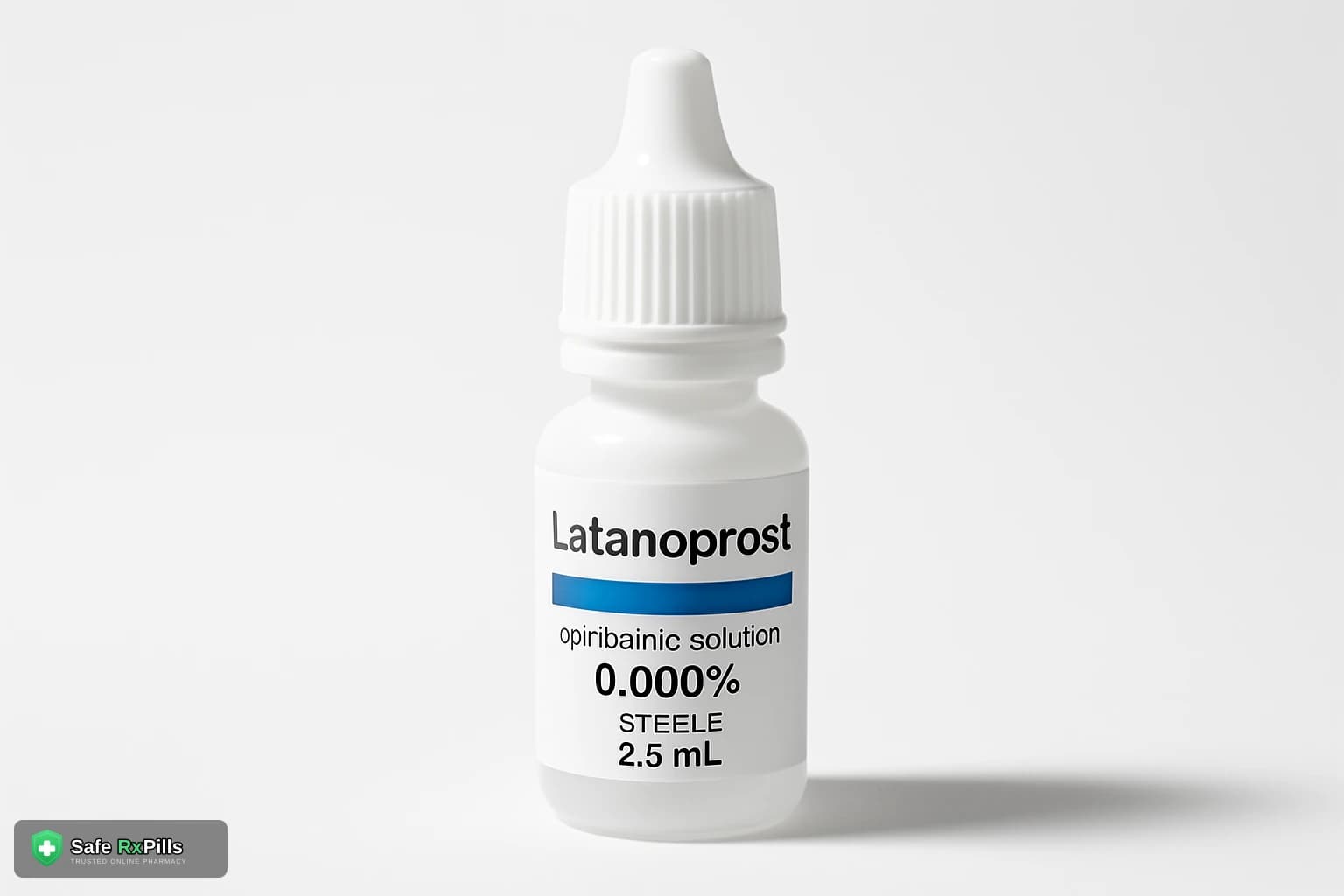
The original brand is Xalatan (Pfizer), 0.005% latanoprost, 2.5ml bottle. Since the patent expired, many generic versions exist worldwide, all containing the identical 0.005% latanoprost concentration to the same pharmacopeia specifications.
SafeRxPills stocks two generic latanoprost options:
- Lacoma PF Eye Drop (latanoprost 0.005%, 2.5ml, preservative-free) at $18. The preservative-free formulation is easier on the ocular surface and better for contact lens wearers and patients with dry eye or BAK sensitivity.
- Latoprost Eye Drop (latanoprost 0.005%, 2.5ml) at $24.
For comparison, brand-name Xalatan cash prices in US pharmacies run substantially higher per bottle, and even generic latanoprost at US retail is priced above these levels without insurance. The active molecule is the same; the difference is manufacturer, preservative choice, and price.
How to Buy Latanoprost Online Safely
Latanoprost is a prescription eye drop in the US, UK, Australia, and Canada. It should be prescribed and monitored by an eye care professional because glaucoma treatment requires periodic pressure checks and optic nerve monitoring; this is not a drug to self-manage without any professional oversight.
For patients who have an established diagnosis and want to buy generic latanoprost affordably, personal-quantity import from a WHO-GMP certified international pharmacy is a common route, falling under FDA personal-importation enforcement discretion for a non-controlled chronic-condition medication. Whatever source you use, verify these before ordering:
- The manufacturer is named and is a recognized WHO-GMP certified facility.
- The product is the correct 0.005% concentration.
- Cold-chain handling is addressed (unopened latanoprost needs refrigeration).
- A real business address and license number are published.
- Card payment is accepted, not crypto or wire transfer only.
Critically: continue your eye pressure monitoring with an ophthalmologist regardless of where you buy the drops. Buying the medication online does not replace the pressure checks that tell you whether the treatment is actually protecting your optic nerve.
Bottom Line
Latanoprost is the workhorse first-line glaucoma drug for good reason: strong pressure lowering, once-nightly dosing, minimal systemic effects, and decades of safety data. The iris-darkening and eyelash-growth effects are real but cosmetic. Generic latanoprost like Lacoma PF and Latoprost delivers the identical molecule at a fraction of brand-name cost. Use one drop at night, keep up your pressure monitoring, and this drug will do its job.
Related reading: Glaucoma Eye Drops: Every Type Explained, Lumigan for Glaucoma, and the full eye care catalog.
References:
- DailyMed. Xalatan (latanoprost ophthalmic solution) Prescribing Information. National Library of Medicine.
- American Academy of Ophthalmology. Primary Open-Angle Glaucoma Preferred Practice Pattern. 2020.
- European Glaucoma Society. Terminology and Guidelines for Glaucoma, 5th Edition. 2020.
- Alm A, Grierson I, Shields MB. Side effects associated with prostaglandin analog therapy. Surv Ophthalmol. 2008;53 Suppl1:S93 to S105. PMID: 18929760.
- World Health Organization. WHO Model List of Essential Medicines, 23rd edition, 2023.
?Frequently Asked Questions
How long does it take latanoprost to lower eye pressure?
Latanoprost begins reducing intraocular pressure within 3 to 4 hours of the first dose, with the maximum effect around 8 to 12 hours later. Because it is dosed at night, the peak effect covers the overnight and early-morning hours when eye pressure naturally tends to rise. The full stable pressure-lowering benefit is typically established within a few days to two weeks of consistent nightly use. Your ophthalmologist confirms the effect with a follow-up pressure check, usually 4 to 6 weeks after starting.
Why is latanoprost taken at night instead of morning?
Evening dosing gives the best 24-hour eye pressure control for most patients, because the peak pressure-lowering effect lands during the overnight and early-morning window when intraocular pressure naturally rises. It also means the temporary blurred vision right after application happens while you sleep rather than during the day. Take it at roughly the same time each evening for consistent control.
Does latanoprost really change eye color?
Yes, it can. Latanoprost increases melanin in the iris and can gradually, permanently darken eye color, most noticeably in people with mixed-color irises like green-brown or blue-brown. In uniformly blue, gray, or brown eyes the change is far less likely or less visible. The change develops slowly over months to years, does not affect vision, and is usually cosmetically subtle. It matters most when only one eye is being treated, where a visible color difference between the two eyes could develop over time.
Can I use latanoprost more than once a day for better results?
No. Dosing latanoprost more than once daily actually reduces its pressure-lowering effect, not increases it. One drop at night is both the correct dose and the maximum useful dose. This is an unusual property of prostaglandin analogs and a common mistake patients make. If your pressure is not controlled on once-nightly latanoprost, the solution is adding a different drug class, not dosing latanoprost more often. Discuss with your ophthalmologist.
What is the difference between Lacoma PF and Latoprost?
Both contain the identical active drug, latanoprost 0.005%, in a 2.5ml bottle. The key difference is that Lacoma PF is preservative-free (PF), meaning it does not contain benzalkonium chloride. Preservative-free latanoprost is gentler on the ocular surface, better for contact lens wearers, and preferred for patients with dry eye or benzalkonium chloride sensitivity. Latoprost is the standard preserved formulation. Both lower eye pressure equally; the choice is about ocular surface tolerance.
Is generic latanoprost as effective as brand-name Xalatan?
Yes. Generic latanoprost contains the identical active molecule at the identical 0.005% concentration to the same pharmacopeia specifications as brand-name Xalatan. WHO-GMP certified manufacturers follow international quality standards. The differences are the manufacturer, the preservative choice (some generics offer preservative-free options Xalatan does not), packaging, and price. The pressure-lowering effect is the same.
What should I do if I miss a dose of latanoprost?
If you miss your evening dose, skip it and resume your normal once-nightly schedule the following evening. Do not apply two doses to make up for the missed one, because more than one dose in a day reduces rather than improves the pressure-lowering effect. Missing an occasional dose is not dangerous, but consistent nightly use is what protects your optic nerve over the long term, so try to build a fixed routine.
Do I still need eye pressure checks if I buy latanoprost online?
Absolutely yes. Buying the medication affordably online does not replace glaucoma monitoring. Glaucoma is a progressive, sight-threatening disease, and the only way to know whether latanoprost is actually protecting your optic nerve is periodic intraocular pressure measurement and optic nerve assessment by an eye care professional. Use whatever pharmacy source you like for the drops themselves, but keep your ophthalmology follow-up appointments.
SafeRxPills Pharmacy Team
SafeRxPills Editorial Team
Editorial team at SafeRxPills. Articles are written and checked against regulatory drug labelling (DailyMed, FDA, EMA) and published literature.
Comments (0)
Leave a Comment
No comments yet. Be the first to share your thoughts!
Related Articles