
Pilocar Eye Drops
Generic: Pilocarpineby FDC Ltd
Select pack size
Similar medicines
View all

About Pilocar Eye Drops
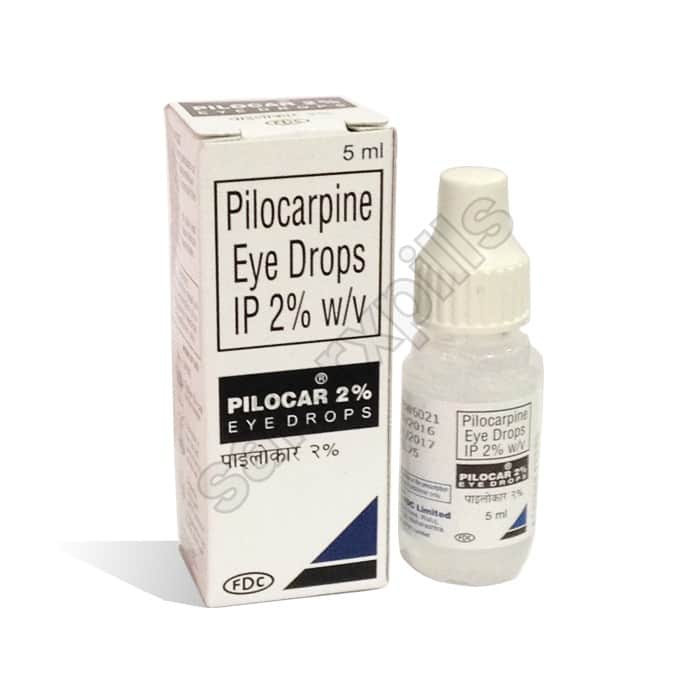
Pilocar 2% is a 5 mL bottle of pilocarpine eye drops made in India by FDC Limited. The carton and bottle in our product photo read "Pilocarpine Eye Drops IP 2% w/v" and "PILOCAR 2%", and the Apollo Pharmacy, PharmEasy and Truemeds listings all give the strength as 2%. Pilocarpine is a miotic: it makes the pupil smaller and lowers pressure inside the eye. It is used for some types of glaucoma, high eye pressure, and to reverse drops that widen the pupil. We sell it in packs of 3, 6 or 12 bottles, from $3.92 a bottle in the 12 bottle pack, before shipping.
Glaucoma is a condition your eye doctor manages, not one to treat on your own. Raised pressure damages the optic nerve and the field of vision without warning, and only an eye examination with pressure checks can show whether a drop is working. The UK labels advise regular checks of eye pressure and visual fields in people on long term pilocarpine, and an examination of the retina before starting. Use Pilocar only on an eye doctor's prescription. Pilocar 2% is not Vuity: Vuity is a 1.25% pilocarpine drop approved in the US in 2021 for age related near vision loss (presbyopia), now listed as discontinued in Drugs@FDA; it is a different strength for a different use (see below).
Pilocar 2% at a glance
| Active ingredient | Pilocarpine 2% w/v (20 mg per mL), 5 mL bottle. The carton front does not name the salt; Truemeds lists it as pilocarpine nitrate. US and Australian 2% drops use pilocarpine hydrochloride; UK drops come as the hydrochloride (Martindale) or the nitrate (Minims). |
| Brand and maker | Pilocar, FDC Limited, Waluj, Aurangabad, India (PharmEasy, Truemeds, Apollo Pharmacy) |
| Labelled uses | US: lowering raised eye pressure in open-angle glaucoma or ocular hypertension; acute angle-closure glaucoma; preventing pressure rises after eye laser surgery; making the pupil smaller (miosis). UK: chronic simple glaucoma, acute closed angle glaucoma, and reversing pupil widening drops. |
| Regulatory status | Pilocarpine 2% eye drops are licensed in the US (Isopto Carpine and generics), the UK, Canada (Isopto Carpine, Minims Pilocarpine Nitrate) and Australia (Isopto Carpine). The Indian Pilocar pack we sell is not registered with the FDA, MHRA, TGA or Health Canada. |
| Usual dose | US label: one drop up to four times daily for open-angle glaucoma; people new to pilocarpine start on 1%. UK label (Martindale 2%): one or two drops every six hours or as prescribed. Use the schedule your eye doctor sets. |
| Timing | Pupil narrowing starts within 10 to 30 minutes; the fall in eye pressure peaks within 75 minutes and lasts 4 to 14 hours depending on strength (UK Martindale label 5.2; the onset figure is for a 1% solution) |
| Packs | 3, 6 or 12 bottles (no single bottle pack) |
| Price per bottle | $3.92 to $4.33 before shipping ($0.78 to $0.87 per mL) |
| Delivery | 7 to 14 business days to the US, UK, Australia and Canada; $25 shipping under $149, free from $149 |
Price per bottle
Prices as of November 2026; the pack selector shows the current price. No pack reaches the $149 free shipping level on its own, so each pays the $25 shipping charge unless you add other items.
| Pack | Price | Per bottle | Per mL | Shipping | Per bottle with shipping | Per mL with shipping |
|---|---|---|---|---|---|---|
| 3 bottles (15 mL) | $13.00 | $4.33 | $0.87 | $25 | $12.67 | $2.53 |
| 6 bottles (30 mL) | $25.00 | $4.17 | $0.83 | $25 | $8.33 | $1.67 |
| 12 bottles (60 mL) | $47.00 | $3.92 | $0.78 | $25 | $6.00 | $1.20 |
Shipping is most of the cost of the small pack: $25 on a $13 order. How long a pack lasts depends on your dose and on the opened bottle rule. The UK Martindale label says to use a bottle within 28 days of first opening; the US labels give no opened bottle period, and the Indian listings we checked do not agree (Apollo Pharmacy says use within one month of opening), so read the Indian carton. If one bottle lasts you the full 28 days, a 3 bottle pack covers about 12 weeks, a 6 bottle pack about 24 weeks and a 12 bottle pack about 48 weeks (our estimate). At four doses a day in both eyes a bottle may run out sooner. Check the expiry dates on the cartons before buying a large pack.
Compared with pilocarpine in the US
Isopto Carpine (pilocarpine hydrochloride 1%, 2% and 4%, NDA 200890, now held by Sandoz) is FDA approved; the current DailyMed label under that NDA is Sandoz's pilocarpine hydrochloride ophthalmic solution, made by Alcon. Generic 1%, 2% and 4% drops from Somerset (ANDA 210384), Amneal (ANDA 214193) and Leading Pharma (ANDA 217052, held by FDC Limited, which makes that 15 mL US bottle in India) are also approved. FDC's US approval covers only that US product and its FDA label; it does not cover the Indian 5 mL Pilocar pack sold here, which is not registered with the FDA. US bottles hold 15 mL. The figures below are what US pharmacies paid according to the Medicaid NADAC survey, per-NDC rows in the file as of 4 November 2026 (rates effective 21 October 2026, Vuity rows effective 23 September 2026). They are pharmacy acquisition costs, not the price at the counter.
| Product | Maker | FDA approved | US pharmacy cost per mL | Per bottle |
|---|---|---|---|---|
| Pilocarpine 2%, 15 mL (NADAC generic-rate rows: Sandoz, Amneal and Somerset NDCs) | Several | Yes | $2.74 | About $41.04 |
| Pilocarpine 1%, 15 mL | Several | Yes | $3.38 | About $50.76 |
| Pilocarpine 4%, 15 mL | Several | Yes | $3.30 | About $49.55 |
| Vuity 1.25% (presbyopia, not glaucoma) | AbbVie | Approved 2021; listed as discontinued in openFDA's Drugs@FDA data | $23.39 to $31.39 | Not comparable |
| Pilocar 2%, Indian pack (this page), 5 mL | FDC Limited | No (not registered with the FDA) | $0.78 to $0.87 from us, before shipping | $3.92 to $4.33, before shipping |
On these figures ours costs less per mL than a US pharmacy pays for generic pilocarpine 2%, even with shipping: $1.20 to $2.53 per mL against $2.74 (our arithmetic). The gap is small on the 3 bottle pack, and what you pay in the US depends on your insurance and the pharmacy's cash price, so US readers with a prescription should still compare local prices. The US product is FDA approved; ours is not. In Australia, Isopto Carpine 2% 15 mL is on the PBS (for example item 2596P), so Australian patients with a prescription should compare their PBS cost. In the UK, the NHS dictionary of medicines (dm+d) lists Martindale pilocarpine hydrochloride 2% eye drops 10 mL as a current, prescription only product.
Pilocar 2% is not Vuity
Vuity (pilocarpine hydrochloride 1.25%, AbbVie, NDA 214028, approved 28 October 2021, now listed as discontinued in Drugs@FDA) is approved for presbyopia, the loss of close-up focus with age. Qlosi (0.4%) is another US presbyopia drop, and a generic 1.25% (Amneal, ANDA 217733) was approved in 2025. These are different strengths for a different use. Pilocar 2% is a glaucoma strength; do not use it as a reading drop or dilute it at home. If you want help with near vision, ask an eye doctor.
Which strength to choose
Pilocarpine glaucoma drops come in 1%, 2% and 4%. We sell only the 2%. The strength and how often you use it are your eye doctor's decision; the US label says they "are determined by the severity of the elevated intraocular pressure and miotic response of the patient".
| Strength | What the labels say | Sold by us |
|---|---|---|
| 1% | US: the starting strength for people new to pilocarpine, "as higher concentrations are often not tolerated initially" (2.1). The strength the US label gives for children under 2 (2.6) and after laser iridoplasty (2.2). | No |
| 2% (Pilocar, this product) | US: one drop up to four times daily (2.1); one of the strengths for acute angle-closure glaucoma before other treatment (2.2). UK: concentrations of up to 2% "may be safely used in children"; under 18s start on the lowest available strength (Martindale 4.2). The only pilocarpine-alone strength in the US label's trials (6.1). | Yes |
| 4% | US: one drop up to four times daily (2.1); one drop before laser treatment of an acute attack (2.2). | No |
So Pilocar 2% is not the labelled starting strength for an adult new to pilocarpine, and it is not suitable for a child under 2 (US label 2.6). Use it only if your eye doctor has prescribed pilocarpine 2%.
How to use Pilocar
- Wash your hands. Tilt your head back, pull the lower lid down gently and put one drop into the pocket.
- Do not let the dropper tip touch your eye, lids, fingers or any surface; "this may contaminate the contents" (US label 17).
- Close your eye gently and press on the inner corner, by the nose, for 2 minutes. The US label gives this step to limit how much pilocarpine reaches the rest of the body (2.1, 17); the UK labels say one minute, and the Minims label calls it especially advisable in children.
- Use it on the schedule your eye doctor sets. The US label dose for open-angle glaucoma is one drop up to four times daily. The UK Martindale label dose is one or two drops every six hours or as prescribed.
- If you use other eye drops, leave at least 5 minutes between them (US label 2.5, 17). The US label says pilocarpine may be used with beta blocker, carbonic anhydrase inhibitor, sympathomimetic or hyperosmotic drops.
- Replace the cap after use. The UK Martindale label says throw the bottle away 28 days after first opening, unless the Indian carton gives a different rule.
Contact lenses. The US label says to remove lenses before the drop and "wait 10 minutes after dosing before reinserting" (5.5). The UK labels go further: soft contact lenses are a contraindication, because soft lenses absorb pilocarpine and the preservative benzalkonium chloride (Martindale 4.3, 6.2). The Indian listings we checked do not name a preservative, so read the carton and follow your eye doctor's advice.
Night driving and focus. The US label says: "Patients should be advised to exercise caution in night driving and other hazardous occupations in poor illumination. In addition, miotics may cause accommodative spasm. Patients should be advised not to drive or use machinery if vision is not clear." (5.1). The UK label adds that pilocarpine "causes difficulty with dark adaptation" (Minims 4.7). Expect dimmer vision in poor light and trouble changing focus between near and far, and plan driving around it.
Keep your checks. Do not stop or change your drops without your eye doctor. The UK labels say people on long term pilocarpine for chronic glaucoma should have regular checks of eye pressure and visual fields (Martindale 4.4).
Groups who need extra care
- Retinal disease or a high risk of retinal detachment. The US label says: "As with all miotics, rare cases of retinal detachment have been reported when used in certain susceptible individuals and those with preexisting retinal disease; therefore, a thorough examination of the retina including funduscopy is advised in all patients prior to the initiation of therapy." (5.2). The UK labels also advise a fundus examination before starting.
- Iritis. The US label says pilocarpine "is not recommended to be used when iritis is present" (5.3). The UK labels make acute iritis a contraindication (see below).
- Children with glaucoma. The US label advises caution in primary congenital glaucoma, because "cases of a paradoxical increase in IOP have been reported", and says use "is not recommended" in children whose glaucoma is secondary to anterior segment dysgenesis or uveitis, especially active uveitis (5.4).
- Asthma, heart and other conditions. The UK Martindale label says pilocarpine "should be used with caution in patients with bronchial asthma, peptic ulceration, urinary tract obstruction, Parkinson's disease, acute heart failure and hypertension" (4.4). The same label says body-wide absorption is rare but should be considered especially in acute closed-angle glaucoma, where higher doses are given (4.4).
- Pregnancy. The US label says it "should be given to a pregnant woman only if clearly needed" (8.1). The UK Martindale label says it "should therefore only be used during pregnancy when essential", because mothers using it may give birth to infants with signs mimicking neonatal meningitis (restlessness, convulsions, sweating and low body temperature) (4.6).
- Breastfeeding. The US label says caution should be exercised (8.3). The UK Martindale label says use only when clearly indicated (4.6).
- Older adults. The US label found no overall differences in safety or effectiveness (8.5). The UK Martindale label says poorer vision in dim light is frequently experienced by older people and those with cataract (lens opacity) (4.8).
Medicines to mention to your doctor (UK Martindale label 4.5): if pilocarpine is absorbed into the body it may add to the effects of alcohol and anticholinesterases and lessen the effects of anticholinergics; its effects may be increased by anticholinesterases, MAO inhibitors, phenothiazines, antihistamines and tricyclic antidepressants; adrenergic blockers may reduce its effect. The Minims label adds that two miotics used together are not recommended (4.5). The US label has no interaction section.
Side effects
The US label pools four controlled trials of 90 days to 2 years in 317 people with open-angle glaucoma or ocular hypertension. The most frequent adverse reactions in at least 5% of people on pilocarpine 2% were "headache/brow ache, accommodative change, blurred vision, eye irritation, visual impairment (dim, dark, or 'jumping' vision), and eye pain" (6.1). The label gives no percentages for each, so we do not chart them.
The UK Martindale label lists these as common (1 in 100 to 1 in 10): poorer vision in dim light, itching, smarting and burning, sensitisation of the lids, redness of the eye surface, superficial keratitis, ciliary spasm, blurred vision, short sight caused by the drop (induced myopia), lens changes with long term use, increased pupillary block, bleeding into the vitreous and retinal detachments, plus headache and brow ache, especially in younger patients who have just started. Rare effects listed are watery eyes, sweating, increased saliva, tremor, changes in heart rhythm and blood pressure, bronchial spasm, fluid on the lungs (pulmonary oedema), nausea, vomiting and diarrhoea (4.8).
When to get urgent help
- Signs that can mean a detached retina: floaters or flashes of light that appear suddenly or increase, or a dark "curtain" or shadow moving across your vision (NHS). In the UK the NHS says get urgent help from NHS 111; elsewhere, contact your eye doctor or an emergency department the same day (our advice). Retinal detachment is listed in the US label (5.2) and the UK label (4.8).
- Severe eye pain, a red painful eye with a sudden change in vision, or signs of eye infection or injury: contact your eye doctor the same day.
- Body-wide effects after using the drops or after someone swallows them (our summary of the US and UK labels): sweating, drooling, nausea, vomiting, diarrhoea, shaking, a slow pulse, feeling faint from low blood pressure, or wheezing. The US label lists sweating, salivation, nausea, tremors, slowing of the pulse and a decrease in blood pressure in overdose, and atropine as the antidote for severe poisoning (10). Call emergency services or poison control (911 in the US and Canada, 999 in the UK, 000 in Australia; US Poison Help 1-800-222-1222; Australian Poisons Information Centre 13 11 26).
- Trouble breathing or wheezing, especially if you have asthma: call emergency services. Bronchial spasm and pulmonary oedema are listed in the UK label (4.8).
- Allergy signs (swollen, itchy lids; swelling of the lips, tongue or throat; trouble breathing or swallowing; widespread rash or hives): get medical help the same day, and call emergency services if breathing or swallowing is affected (our advice). Hypersensitivity is a UK contraindication and lid sensitisation is a listed effect (Martindale 4.3, 4.8).
Tell emergency staff what was used or swallowed (pilocarpine 2% eye drops), how much and when. Keep the bottle out of children's reach.
Who should not use Pilocar
Never use it if (UK labels, Martindale and Minims 4.3):
- You are allergic to pilocarpine or any ingredient of the drops.
- You have acute iritis or anterior uveitis, or another condition where narrowing the pupil is undesirable, including some forms of secondary glaucoma.
- You wear soft contact lenses (UK labels; the US label instead says remove them and wait 10 minutes).
The US label lists no contraindications (4).
The US label says it is not recommended:
- When iritis is present (5.3).
- In children with glaucoma secondary to anterior segment dysgenesis or uveitis, especially if uveitis is active (5.4).
Not suitable: as a first strength for someone new to pilocarpine (US label: start on 1%), for children under 2 (US label: 1%), and as a presbyopia reading drop.
Prescription and legal status
Pilocarpine glaucoma eye drops are prescription medicines in the US ("Rx only" on the Sandoz label), the UK (dm+d lists Martindale pilocarpine 2% eye drops as POM), Australia (Isopto Carpine is Schedule 4, Prescription Only Medicine) and Canada (Isopto Carpine DIN 00000868 and Minims Pilocarpine Nitrate DIN 02148463, prescription). Apollo Pharmacy and Truemeds also mark the Indian Pilocar as a prescription medicine. Pilocarpine 2% is licensed in all four countries, but the Indian pack we sell is not registered with the FDA, MHRA, TGA or Health Canada, and the FDA says personal importation of unapproved medicines is illegal in most circumstances. Check the rules where you live, and keep your eye doctor informed of every drop you use.
Buying genuine Pilocar
The MHRA warns: "Any medicine not authorised for sale in the UK can be unsafe or ineffective and there is no way of knowing what is in them or the negative health effects they can have." That warning covers this Indian pack. The MHRA also advises: "Only use UK-registered pharmacies, including online pharmacies displaying the official green cross logo." When your order arrives, check that the carton and bottle say Pilocar 2% and "Pilocarpine Eye Drops IP 2% w/v", name FDC Limited, and show a batch number and an expiry date, that the seal is intact, and that the solution is clear. These checks cannot prove a bottle is genuine, because counterfeiters copy packaging. Keep your pressure checks: if your eye doctor finds your pressure higher than before on the same drop, tell them where the bottle came from. If a batch causes symptoms, seek medical advice and report it to your medicines regulator (the MHRA Yellow Card scheme in the UK, FDA MedWatch in the US, the TGA in Australia or Health Canada) as well as to us.
Delivery
We ship Pilocar to the US, UK, Australia and Canada in plain packaging with tracking. Standard delivery takes 7 to 14 business days, so order well before your current bottle runs out; glaucoma drops should not be missed while you wait. Shipping costs a flat $25 on orders under $149 and is free from $149. PharmEasy and Truemeds say store below 25°C, and Truemeds says do not refrigerate; the US labels say store at 20°C to 25°C and protect from freezing, and the UK Martindale label says store upright below 25°C away from strong light. Store the bottle as the carton says. See our shipping page and refund policy.
Related guides
- Glaucoma eye drops: every type compared
- Prescription eye drops: types, what each treats and key label warnings
- Latanoprost eye drops: side effects, how to use, storage and cost
- Eye drops recall list and how to check your bottle
Other glaucoma drops: Alphagan 0.2% (brimonidine), Dorzox Eye Drop (dorzolamide), Azopt Eye Drop (brinzolamide), Latoprost Eye Drop (latanoprost) and Lumigan 0.01% (bimatoprost). Atropine Eye Drop does the opposite of pilocarpine (it widens the pupil), and the UK Martindale label says pilocarpine may lessen the effects of anticholinergics such as atropine (4.5); tell your eye doctor if you have both. See also our glaucoma treatment overview.
Sources
- Pilocarpine hydrochloride ophthalmic solution 1%, 2% and 4%, US prescribing information, Sandoz Inc. (manufactured by Alcon Laboratories), NDA 200890 (Isopto Carpine), DailyMed setid 53fa0b7a-f982-48a7-92c4-6f098683c1ed, SPL version 8, published 17 November 2025, sections 1 to 6, 8, 10 to 12, 14, 16 and 17. DailyMed
- Pilocarpine hydrochloride ophthalmic solution USP 1%, 2% and 4%, US prescribing information, Leading Pharma, ANDA 217052, DailyMed setid 189762b1-608a-4240-b1b5-0db3278224bb, SPL version 3, effective 2 November 2026, sections 4, 5, 6 and 16. DailyMed
- Pilocarpine Eye Drops 2.0% w/v (pilocarpine hydrochloride), UK Summary of Product Characteristics, Martindale Pharma, PL 00156/0080, text revised April 2016, sections 4.1 to 4.9, 5.2, 6.2 to 6.4. emc
- Minims Pilocarpine Nitrate 2% w/v Eye Drops, UK Summary of Product Characteristics, Bausch & Lomb UK, PL 03468/0078, text revised January 2016, sections 4.3 to 4.8. emc
- NHS Business Services Authority, dm+d: Pilocarpine hydrochloride 2% eye drops (Martindale Pharmaceuticals Ltd) 10 ml, legal category POM, accessed 7 November 2026. dm+d
- US Food and Drug Administration, Drugs@FDA data via openFDA: Isopto Carpine (NDA 200890, approved 22 June 2010), generic pilocarpine hydrochloride 1%, 2%, 4% (ANDA 210384, 214193, 217052), Vuity (NDA 214028, approved 28 October 2021, listed as discontinued), Qlosi (NDA 217836) and generic 1.25% (ANDA 217733), checked 7 November 2026. Drugs@FDA
- Health Canada Drug Product Database: Isopto Carpine 2% (DIN 00000868) and Minims Pilocarpine Nitrate 2% (DIN 02148463), prescription, marketed, checked 7 November 2026. Health Canada DPD
- Australian Commission on Safety and Quality in Health Care, Medicine Finder: Isopto Carpine (pilocarpine hydrochloride 1%, 2%, 4%, 15 mL, Schedule 4), and Pharmaceutical Benefits Scheme listing for Isopto Carpine eye drops, accessed 7 November 2026. ACSQHC, PBS
- Centers for Medicare and Medicaid Services. National Average Drug Acquisition Cost (NADAC), pilocarpine eye drops and Vuity, per-NDC rows, 2026 file as of 4 November 2026. data.medicaid.gov
- NHS. Detached retina (retinal detachment), symptoms and urgent advice. NHS
- Apollo Pharmacy, PharmEasy and Truemeds. Pilocar 2% Eye Drops 5 ml listings, accessed 7 November 2026. PharmEasy, Truemeds, Apollo Pharmacy
- MHRA. 20 million illegal erectile dysfunction pills seized as MHRA warns against risky online buys, 13 February 2026. GOV.UK
- US Food and Drug Administration. Personal Importation. FDA
This page is for information and is not medical advice. Pilocarpine is a prescription medicine; your eye doctor should set your treatment and check your eye pressure.
Frequently asked questions
What is Pilocar Eye Drop?
Pilocar 2% is pilocarpine 2% w/v (20 mg per mL) eye drops in a 5 mL bottle, made in India by FDC Limited. The carton in our product photo reads "Pilocarpine Eye Drops IP 2% w/v"; Truemeds lists the salt as pilocarpine nitrate. Pilocarpine makes the pupil smaller and lowers eye pressure. The US label covers open-angle glaucoma, ocular hypertension, acute angle-closure glaucoma, prevention of pressure rises after laser surgery and making the pupil smaller. It needs an eye doctor's diagnosis and prescription.
Is Pilocar the same as Isopto Carpine or Vuity?
Pilocar 2% contains the same active ingredient at the same strength as Isopto Carpine 2% (pilocarpine hydrochloride), but it is a different product: the Indian pack is not registered with the FDA, MHRA, TGA or Health Canada, and we have seen no study comparing the two. It is not Vuity. Vuity is a 1.25% pilocarpine drop approved in the US in 2021 for age related near vision loss (presbyopia), now listed as discontinued in Drugs@FDA; it is a different strength for a different use. Do not use Pilocar 2% as a reading drop or dilute it.
How much does Pilocar cost per bottle?
As of November 2026 (the pack selector shows the current price), 3 bottles cost $13.00 ($4.33 a bottle), 6 bottles $25.00 ($4.17) and 12 bottles $47.00 ($3.92), before shipping. Shipping is $25 on orders under $149, so with shipping a bottle costs $12.67, $8.33 or $6.00. US pharmacies paid about $2.74 per mL for generic pilocarpine 2% (NADAC, effective 21 October 2026), which is more per mL than ours even with shipping, but US prices depend on insurance, and the US product is FDA approved while ours is not.
How do I use Pilocar eye drops?
Follow your eye doctor's schedule. The US label dose for open-angle glaucoma is one drop up to four times daily; the UK Martindale label gives one or two drops every six hours or as prescribed. Do not let the tip touch anything. Afterwards close your eye and press on the inner corner for 2 minutes (US label) to limit how much reaches the body. Leave at least 5 minutes between different eye drops. Remove contact lenses first; the US label says wait 10 minutes, and the UK labels say soft lenses should not be used at all.
Is 2% the right strength for me?
Only your eye doctor can say. The US label says people new to pilocarpine should start on 1% "as higher concentrations are often not tolerated initially", and gives 1% for children under 2. We sell only the 2%, so Pilocar 2% is not the labelled starting strength for an adult new to pilocarpine and is not suitable for a child under 2. Pilocarpine also comes as 4%. Use Pilocar 2% only if your doctor has prescribed that strength.
How quickly does it work and how long does it last?
The UK Martindale label says pupil narrowing starts within 10 to 30 minutes (figure for a 1% solution), the fall in eye pressure is seen within 60 minutes and peaks within 75 minutes, and it lasts 4 to 14 hours depending on strength. That is why it is used several times a day. Pilocarpine controls pressure only while you keep using it, and your eye doctor needs to check your pressure and visual fields regularly.
Can pilocarpine affect my vision when driving?
Yes. The US label says: "Patients should be advised to exercise caution in night driving and other hazardous occupations in poor illumination. In addition, miotics may cause accommodative spasm. Patients should be advised not to drive or use machinery if vision is not clear." The small pupil makes vision dimmer in poor light, and focus spasm can blur vision when you change between near and far. Do not drive until your vision is clear.
What are the side effects of Pilocar?
In the US label's trials, the most frequent reactions with pilocarpine 2% were headache or brow ache, changes in focus, blurred vision, eye irritation, dim, dark or "jumping" vision, and eye pain. The UK label also lists itching, burning, red eyes, short sight caused by the drop and poorer vision in dim light. Retinal detachment is rare but serious: get same day help for sudden floaters, flashes or a dark curtain over your vision. Sweating, drooling, nausea, a slow pulse or wheezing can mean too much has been absorbed.
Who should not use Pilocar?
The UK labels say never use it if you are allergic to pilocarpine or any ingredient of the drops, have acute iritis or anterior uveitis or another condition where a small pupil is undesirable (including some secondary glaucomas), or wear soft contact lenses. The US label lists no contraindications but says it "is not recommended to be used when iritis is present" and advises a retinal examination before starting. The UK label advises caution in asthma, peptic ulcer, urinary obstruction, Parkinson's disease, acute heart failure and high blood pressure.
Do I need a prescription for Pilocar?
Pilocarpine glaucoma eye drops are prescription medicines in the US, the UK (POM), Australia (Schedule 4) and Canada, and Apollo Pharmacy and Truemeds mark the Indian Pilocar as prescription only. Pilocarpine 2% is licensed in all four countries, but this Indian pack is not registered with the FDA, MHRA, TGA or Health Canada, and the FDA says personal importation of unapproved medicines is illegal in most circumstances. The MHRA advises UK buyers to use only UK-registered pharmacies.
How long does delivery take and how should I store it?
Delivery to the US, UK, Australia and Canada takes 7 to 14 business days, in plain packaging with tracking, so order before your current bottle runs out. Shipping is $25 under $149 and free from $149. PharmEasy and Truemeds say store below 25°C, and Truemeds says do not refrigerate; the US labels say 20°C to 25°C and protect from freezing. The UK Martindale label says throw a bottle away 28 days after opening; follow the Indian carton.
Medical References
- 1.Pilocarpine hydrochloride ophthalmic solution 1%, 2%, 4%, US prescribing information, Sandoz (made by Alcon), NDA 200890 (DailyMed SPL version 8, published 17 November 2025) — 2025
- 2.Pilocarpine hydrochloride ophthalmic solution USP 1%, 2%, 4%, US prescribing information, Leading Pharma (manufactured by FDC Limited), ANDA 217052 (DailyMed SPL version 3, effective 2 November 2026) — 2026
- 3.Pilocarpine Eye Drops 2.0% w/v (pilocarpine hydrochloride), UK Summary of Product Characteristics, Martindale Pharma, text revised April 2016 — 2016
- 4.Minims Pilocarpine Nitrate 2% w/v Eye Drops, UK Summary of Product Characteristics, Bausch & Lomb UK, text revised January 2016 — 2016
- 5.Drugs@FDA: Isopto Carpine (pilocarpine hydrochloride ophthalmic solution), NDA 200890
- 6.CMS National Average Drug Acquisition Cost (NADAC) 2026, file as of 4 November 2026 — 2026
- 7.MHRA: 20 million illegal erectile dysfunction pills seized as MHRA warns against risky online buys, 13 February 2026 — 2026
- 8.US Food and Drug Administration: Personal Importation
Sources: U.S. National Library of Medicine (DailyMed, PubMed), openFDA
Related articles

Olopatadine Eye Drops (Pataday, Patanol): 0.1% vs 0.2% vs 0.7%, How to Use, Side Effects and US Cost
Olopatadine eye drops relieve allergic eye itch and have been sold over the counter in the US since 2020 as Pataday Twice Daily Relief (0.1%, formerly Patanol), Pataday Once Daily Relief (0.2%) and Pataday Extra Strength (0.7%, formerly Pazeo). This guide covers the label directions for each strength, contact lenses, side effect rates from the prescription labels, age limits, pregnancy, the 0.7% trial results, olopatadine vs ketotifen and cromolyn, when an allergy drop is the wrong choice, and what a bottle costs US pharmacies.
Read article
Tobramycin Eye Drops and Tobradex: Dosage, Side Effects, Steroid Warnings and US Cost
Tobramycin ophthalmic solution 0.3% is a prescription aminoglycoside eye drop for bacterial infections of the outer eye and eyelids, and Tobradex combines it with the steroid dexamethasone. This guide gives the US label dose for each, side effects, the steroid warnings on eye pressure, cataract and viral or fungal infection, Tobradex vs Tobradex ST vs Zylet, use in pregnancy and children, contact lenses, how tobramycin compares with fluoroquinolone drops, which brands are discontinued, and what a bottle costs US pharmacies.
Read article
Moxifloxacin Eye Drops (Vigamox): Dosage, Side Effects, Babies, Ointment and US Cost
Moxifloxacin ophthalmic solution 0.5% (Vigamox and generics) is a prescription fluoroquinolone eye drop for bacterial conjunctivitis. This guide gives the US label dose, the twice daily Moxeza formula and its status, how to use the drops, side effects and warnings, use in pregnancy and in newborns, why the drops carry no boxed warning while moxifloxacin tablets do, how moxifloxacin compares with other fluoroquinolone drops, the eye ointment question, and what a bottle costs US pharmacies.
Read articleCustomer Reviews
No reviews yet. Bought Pilocar Eye Drops? Tell other buyers how it went.