
Generic vs Brand Name Medicines: Are They Really the Same?
SafeRxPills Pharmacy Team
Editorial team at SafeRxPills. Articles are written and checked against regulatory drug labelling (DailyMed, FDA, EMA) and published literature.
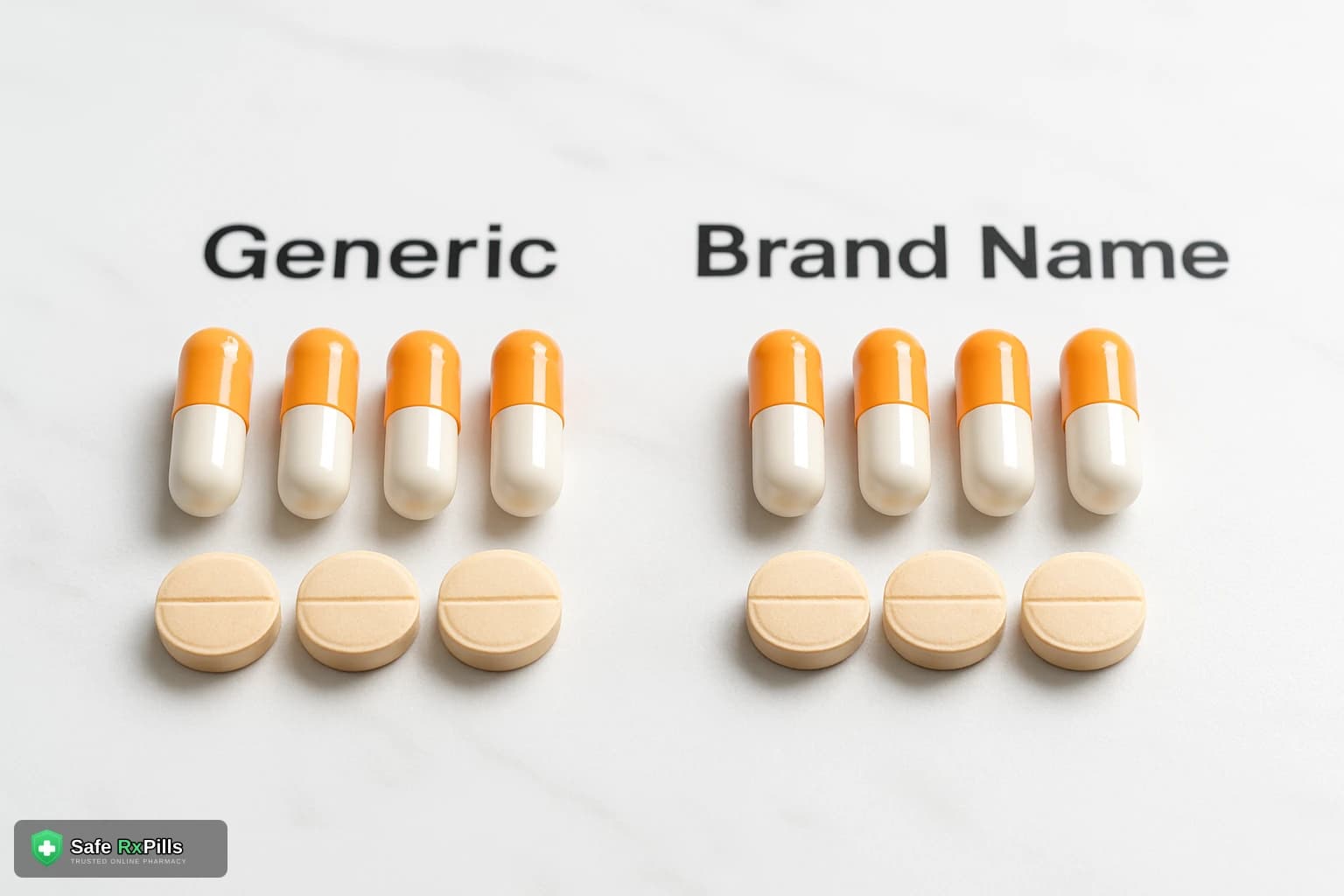
Generic vs Brand Name Medicines: Are They Really the Same? | SafeRxPills - pharmacy guide
Generic vs Brand Name Medicines: Are They Really the Same?
Generic and brand name medicines contain the same active ingredient at the same dose and are required by the FDA to be bioequivalent, meaning they work the same way in your body. The main differences are the price, appearance, and inactive fillers used in manufacturing. In most cases, choosing a generic over a brand name drug is a clinically sound decision that saves you significant money without sacrificing effectiveness.
What Makes a Generic Medicine "Generic"?
A generic medicine is a copy of a brand name drug that contains the same active ingredient, in the same strength, in the same dosage form. When a pharmaceutical company develops a new drug, they hold a patent that gives them exclusive rights to sell it, typically for 20 years. Once that patent expires, other manufacturers can apply to produce and sell the same drug under its chemical name rather than the brand name.
Take sildenafil as an example. Pfizer patented sildenafil as Viagra in the 1990s. When the patent expired, other manufacturers began producing sildenafil tablets at a fraction of the cost. The active molecule is chemically identical. The FDA requires proof of that identity before any generic hits pharmacy shelves.
Generic names are usually the chemical or nonproprietary name of the drug. Sildenafil is the generic. Viagra is the brand. Metformin is the generic. Glucophage is the brand. Atorvastatin is the generic. Lipitor is the brand. You get the picture.
Bioequivalence: What the FDA Actually Requires
This is the critical concept most patients never hear explained properly. Bioequivalence means that the generic drug delivers the same amount of active ingredient into your bloodstream, at the same rate, as the brand name version. The FDA requires that a generic's absorption profile fall within 80% to 125% of the brand name drug's profile, and in practice, approved generics typically land within 3% to 5% of the brand.
To prove bioequivalence, manufacturers submit an Abbreviated New Drug Application (ANDA) to the FDA. They don't need to repeat full clinical trials proving safety and efficacy from scratch. The brand name drug already did that work. What they do need to show is pharmacokinetic equivalence through blood concentration studies in healthy volunteers.
The FDA's Orange Book lists every approved generic drug along with its bioequivalence rating. A rating of "AB" means the generic is therapeutically equivalent to the brand. That's the standard every generic you pick up at a US pharmacy has already met.
This system has been in place since the Drug Price Competition and Patent Term Restoration Act of 1984, commonly called the Hatch-Waxman Act. It's one of the reasons generic drugs now account for roughly 90% of all prescriptions dispensed in the United States.
What Is Actually Different Between Generic and Brand Name Drugs?
The active ingredient must be identical. What can differ are the inactive ingredients, also called excipients. These include binders, fillers, colorants, coatings, and preservatives. A brand name tablet might use one type of cellulose filler while a generic uses another. These components don't affect how the drug works therapeutically, but they can matter in specific situations.
Here's what genuinely differs between generics and brand name drugs:
- Appearance: Color, shape, and size are different. Trademark law prevents generics from looking identical to the brand.
- Inactive ingredients: Fillers, binders, and dyes vary by manufacturer.
- Price: Generics typically cost 80% to 85% less than their brand name counterparts.
- Manufacturer: A different company produces it, though quality standards are the same.
- Packaging and marketing: Entirely different, obviously.
What doesn't differ: the active molecule, the approved dose strengths, the route of administration, and the therapeutic indication. A 100mg sildenafil tablet is a 100mg sildenafil tablet regardless of whose logo is on the box.
Do Generics Work Just as Well? What the Evidence Shows
Yes. A large 2016 meta-analysis published in the Journal of the American Medical Association reviewed 38 randomized controlled trials comparing generic and brand name cardiovascular drugs. The clinical outcomes were essentially identical across both groups. No meaningful difference in blood pressure control, cholesterol reduction, or cardiac event rates.
A separate FDA analysis of over 2,000 human pharmacokinetic studies found that the average difference in absorption between generics and their brand name equivalents was just 3.5%. That's well within the natural variation you'd see if you took the same brand name drug twice on different days.
The perception that generics are somehow weaker or less reliable often comes from the placebo effect working in reverse. When people expect a cheaper drug to work less well, they sometimes report that it does. This is called the nocebo effect, and it's well-documented in clinical literature. The drug itself isn't performing differently. The expectation is.
For most drug classes including antibiotics, statins, antihypertensives, diabetes medications, and ED treatments, generics are a clinically interchangeable choice. You can read more about this in detail in our article on generic medicine vs brand medicine.
Generic Medicines in the USA: Regulations, Pricing, and Where to Buy
In the United States, generic drugs save patients and the healthcare system over $300 billion per year according to the Association for Accessible Medicines. The average brand name prescription costs around $350 without insurance. The generic equivalent averages closer to $50. For patients without insurance or with high deductibles, that gap is enormous.
The FDA's Center for Drug Evaluation and Research (CDER) oversees generic drug approval. Every FDA-approved generic sold in the US has undergone rigorous review. The agency also conducts inspections of both domestic and foreign manufacturing facilities to help ongoing compliance with Good Manufacturing Practice (GMP) standards.
Despite this, many Americans still pay more than they need to. Brand name drugs are heavily marketed directly to consumers, which generic manufacturers largely don't do. That marketing cost gets built into the brand price. You're partly paying for television commercials when you buy the brand name version.
Ordering through a licensed online pharmacy is one way US patients reduce costs further. SafeRxPills ships to customers across the United States and operates as a licensed pharmacy with verified sourcing. Our US online pharmacy page covers delivery times, shipping policies, and how to place your first order. Standard delivery to most US states takes 7 to 14 business days, with express options available.
US patients ordering generics online should look for pharmacies that require a valid prescription for prescription-only medications, provide verifiable contact information, and don't promise implausibly fast overnight shipping on controlled substances. SafeRxPills meets all of these standards.
Common Generic Medicines You Can Order From SafeRxPills
SafeRxPills stocks a wide range of FDA-equivalent generics across several categories. Here are some examples of what's available and how they connect to the brand vs generic conversation.
Men's Health: Fildena 100mg contains sildenafil citrate 100mg, the same active ingredient as Viagra at the same dose. It's manufactured by Fortune Healthcare, a GMP-certified Indian pharmaceutical company. The price difference compared to brand Viagra is substantial. If you want the full breakdown on how sildenafil generics work and what to expect, our sildenafil guide covers dosing, timing, side effects, and interactions in detail.
Diabetes Management: Janumet 50mg/500mg combines sitagliptin and metformin, the same combination found in the brand name Janumet by Merck. This dual-action formulation helps control blood sugar by reducing glucose production in the liver and improving insulin sensitivity simultaneously. It's prescribed for type 2 diabetes when single-agent therapy isn't enough.
Skin Care: Betnovate GM is a topical combination of betamethasone, gentamicin, and miconazole. It treats inflammatory skin conditions with a bacterial or fungal component. Similarly, Glyco 12 Cream contains glycolic acid 12%, used for hyperpigmentation, rough skin texture, and mild acne scarring. Both are well-established formulations with long safety records.
Each of these products represents the generic-equivalent approach: the same proven molecules, manufactured to GMP standards, at prices that reflect the absence of brand marketing overhead.
When Should You Think Twice About Switching to a Generic?
For the vast majority of medications, you don't need to think twice. Switch confidently. But a small number of drug categories require more care.
Narrow therapeutic index (NTI) drugs are the exception worth knowing. These are drugs where the difference between a therapeutic dose and a toxic dose is very small. Examples include warfarin, levothyroxine, lithium, digoxin, and some anti-epileptic drugs like phenytoin and carbamazepine. For NTI drugs, even small differences in bioavailability can have clinical consequences.
The FDA applies stricter bioequivalence criteria to NTI drugs. But many neurologists, cardiologists, and endocrinologists still recommend patients stay on the same manufacturer's version once they're stable, rather than switching between generic manufacturers. If you're on one of these medications and your pharmacist switches your generic supplier, it's reasonable to ask them to maintain consistency.
Outside of NTI drugs, the case for generics is strong. If you're taking a statin, an ACE inhibitor, an ED medication, an antibiotic, or most common diabetes drugs, the generic is clinically equivalent and significantly cheaper. There's no medical justification for paying more for the brand.
One more practical note: some patients report that a particular generic causes more GI side effects than another. This can happen because the inactive ingredients differ. If a specific generic formulation bothers you, ask your pharmacist to try a different manufacturer's version. The active ingredient will be the same, but the fillers may suit you better.
This article is for informational purposes only. Always consult a licensed healthcare professional before starting, stopping, or changing any medication.
Popular Products
- Cenforce 200mg (Sildenafil) - top-selling generic ED medication
- Wormiza 444mg (Fenbendazole) - leading fenbendazole supplement
- Careprost 3ml (Bimatoprost) - best-selling eyelash growth serum
?Frequently Asked Questions
Are generic and brand name drugs exactly the same thing?
They contain the same active ingredient at the same dose and must meet the same FDA standards for bioequivalence. The differences are in inactive ingredients, appearance, and price. The FDA requires that generics deliver the same amount of active drug into your bloodstream at the same rate as the brand name version, which is the definition of therapeutic equivalence.
Why are generic medicines so much cheaper than brand name drugs?
Brand name manufacturers spend years and hundreds of millions of dollars on research, clinical trials, and FDA approval before their drug ever reaches patients. They recoup that cost during the patent period by charging premium prices. Generic manufacturers skip that R&D phase entirely because the safety and efficacy data already exists. Lower development costs plus market competition from multiple generic makers drives prices down dramatically.
Can I switch from a brand name drug to a generic mid-treatment?
For most medications, yes, you can switch at any point without clinical concern. The exception is narrow therapeutic index drugs like warfarin, levothyroxine, and certain seizure medications, where consistency of formulation matters more. For everything else, including common blood pressure medications, statins, ED drugs, and most antibiotics, switching to a generic is safe and clinically appropriate.
Do doctors prescribe generics or brand name drugs?
Doctors in the US can write prescriptions using either the brand name or the generic (chemical) name. Most state laws allow pharmacists to automatically substitute an FDA-approved generic unless the prescriber writes "dispense as written" or the patient specifically requests the brand. In practice, the majority of prescriptions are filled generically because insurers and pharmacy benefit managers strongly favor them.
Is it safe to buy generic medicines from an online pharmacy?
Yes, provided the pharmacy is legitimate and licensed. Look for pharmacies that require valid prescriptions for prescription drugs, have real contact information, and source from GMP-certified manufacturers. SafeRxPills ships verified generics to US customers with full transparency on sourcing. You can read more about safe purchasing in our guide to buying generic Viagra online safely, which covers the same principles that apply across all generic medications.
SafeRxPills Pharmacy Team
SafeRxPills Editorial Team
Editorial team at SafeRxPills. Articles are written and checked against regulatory drug labelling (DailyMed, FDA, EMA) and published literature.
Comments (0)
Leave a Comment
No comments yet. Be the first to share your thoughts!
Related Articles

How to Save Up to 80% on Prescription Medications: A Practical Guide for Americans
April 30, 2026
How to Order Medications Online Safely: Complete Guide to Legitimate Online Pharmacies
April 30, 2026
