
Olopat Eye Drop
Generic: Olopatadine
Select pack size
3 bottles · $8.33 per bottle
About Olopat Eye Drop
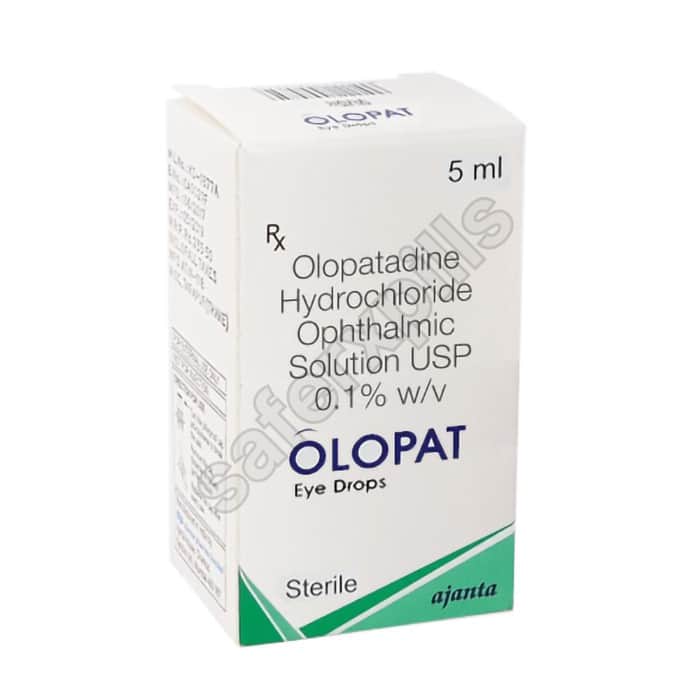
Olopat Eye Drop is olopatadine 0.1% (1 mg per mL), an antihistamine eye drop for itchy, allergic eyes, made in India by Ajanta Pharma. The carton in our product photo reads "Olopatadine Hydrochloride Ophthalmic Solution USP 0.1% w/v", "Olopat Eye Drops", "5 ml" and "Sterile", and it carries the Rx symbol and the Ajanta name. Truemeds, PharmEasy and Medkart list the same 0.1% strength in a 5 mL bottle from Ajanta Pharma. We sell it in packs of 3, 6 or 12 bottles, from $7.75 a bottle in the 12 bottle pack, before shipping. We do not sell single bottles.
Please read the price section before you order. Olopatadine 0.1% is the same strength as US Pataday Twice Daily Relief (sold as Patanol until 2020), and in the US it is now sold without a prescription. A 5 mL store brand bottle costs about $8 to $9 on US retail sites, which is less than one bottle from us once shipping is added. Our drops make most sense for buyers in countries where olopatadine needs a prescription and costs more. Clinical details come from the UK Opatanol label and leaflet, the US Pataday Drug Facts, a US prescription label for generic olopatadine 0.1%, Health Canada and healthdirect Australia, all listed under Sources.
Olopat at a glance
| Active ingredient | Olopatadine hydrochloride equivalent to olopatadine 0.1% w/v (1 mg per mL), eye drops, solution (carton in our product photo; Truemeds, PharmEasy, Medkart). A selective antihistamine that also reduces histamine release from mast cells. |
| Brand and maker | Olopat, Ajanta Pharma Ltd (carton in our product photo; Truemeds, PharmEasy, Medkart). PharmEasy gives a manufacturing address in Bhagwanpur, Roorkee, Haridwar, Uttarakhand. |
| Labelled use | UK Opatanol: ocular signs and symptoms of seasonal allergic conjunctivitis (4.1). US Pataday Twice Daily Relief: temporarily relieves itchy and red eyes due to pollen, ragweed, grass, animal hair and dander. |
| Regulatory status | Olopatadine 0.1% eye drops are licensed in the US (Pataday Twice Daily Relief and store brand generics, without a prescription), the UK (Opatanol), Canada (Patanol and generics) and Australia (Patanol). The Indian pack we sell is not registered with the FDA, MHRA, TGA or Health Canada. |
| Usual dose | One drop in the affected eye(s) twice daily: every 6 to 8 hours, no more than twice a day (US Drug Facts); 8 hourly (UK label 4.2). |
| How long | UK label: treatment may be maintained for up to four months, if considered necessary (4.2). US Drug Facts: stop and ask a doctor if itching worsens or lasts for more than 72 hours. |
| Packs | 3, 6 or 12 bottles (5 mL each) |
| Price per bottle | $7.75 to $8.33 before shipping; $9.83 to $16.67 with shipping |
| Delivery | 7 to 14 business days to the US, UK, Australia and Canada; $25 shipping under $149, free from $149 |
Price per bottle
Prices as of November 2026; the pack selector shows the current price. No pack reaches the $149 free shipping level on its own, so each includes the $25 shipping charge below unless you add other items.
| Pack | Price | Per bottle | Per mL | Shipping | Order total | Per bottle with shipping |
|---|---|---|---|---|---|---|
| 3 bottles (15 mL) | $25.00 | $8.33 | $1.67 | $25 | $50.00 | $16.67 |
| 6 bottles (30 mL) | $48.00 | $8.00 | $1.60 | $25 | $73.00 | $12.17 |
| 12 bottles (60 mL) | $93.00 | $7.75 | $1.55 | $25 | $118.00 | $9.83 |
How long a bottle lasts. A US prescription label for olopatadine 0.1% works its safety margins from a 40 microlitre drop, which makes a 5 mL bottle about 125 drops (our arithmetic; real bottles give a little less). At one drop in each eye twice a day that is 4 drops a day, or about 31 days, and Alcon prints "30 day supply" on its 5 mL Pataday Twice Daily carton. The UK label says to discard the bottle four weeks after first opening (6.3), and Truemeds, PharmEasy and Medkart give the same four weeks. So one bottle covers about four weeks for both eyes, and a 3 bottle pack about three months (our arithmetic). The UK label says treatment may be maintained for up to four months if considered necessary (4.2). With each bottle discarded four weeks after opening, the 12 bottle pack covers about 11 months of twice daily use in both eyes (our arithmetic). Buy what fits your allergy season, and check the expiry date on each carton.
Compared with Pataday and US generics
Patanol (Alcon, NDA 020688) was first approved in the US on 18 December 1996 as a prescription eye drop. On 14 February 2020 the FDA approved it for sale without a prescription, and the same 0.1% product is now Pataday Twice Daily Relief (Drugs@FDA records). Store brand olopatadine 0.1% from Walmart (Equate), Target (up&up), CVS and others sits next to it on US shelves. The once daily 0.2% (Pataday Once Daily Relief) and the 0.7% (Pataday Once Daily Relief Extra Strength, formerly Pazeo) were switched in 2020 too. The only US prescription label for olopatadine 0.1% eye drops we found on DailyMed is Alembic's, last updated in 2019; the US labels now in use are mostly OTC Drug Facts.
The table shows US retail prices read from full Target product pages and the Walmart Pataday listing page on 7 November 2026, and what US pharmacies paid according to the Medicaid NADAC survey (per-NDC rows in the file as of 4 November 2026, each effective 21 October 2026). NADAC is a pharmacy acquisition cost, not the price at the counter.
| Product (olopatadine 0.1%, 5 mL) | Maker | FDA approved | US retail price | US pharmacy cost (NADAC) |
|---|---|---|---|---|
| Pataday Twice Daily Relief | Alcon | Yes (OTC) | $17.49 at Target; from $17.48 at Walmart | $2.48194 per mL, about $12.41 a bottle |
| Target up&up Twice Daily Eye Allergy Itch Relief 0.1% | Store brand | Yes (OTC) | $8.29 | Generic 0.1%: $1.23939 per mL, about $6.20 a bottle |
| Walmart Equate olopatadine 0.1%; Glenmark olopatadine 0.1% | Store brand; Glenmark | Yes (OTC) | From $8.97; $8.99 (Walmart) | |
| Olopat, Indian pack (this page) | Ajanta Pharma | No (not registered with the FDA) | $7.75 to $8.33 before shipping; $9.83 to $16.67 with shipping | Not applicable |
Plainly: in the US, a single store brand bottle of olopatadine 0.1% ($8.29 at Target) costs less than any of our packs per bottle once our $25 shipping is added ($9.83 to $16.67), and you can buy it today without a prescription and without waiting 7 to 14 days. Our 12 bottle pack is about $7.75 a bottle only before shipping, or if your order reaches $149 with other items. If you are in the US, buy US olopatadine. In the UK, Canada and Australia olopatadine eye drops need a prescription (see "Prescription and legal status"), so local prices and access differ.

| Product | Bottle | NADAC per mL | Per bottle |
|---|---|---|---|
| Generic olopatadine 0.1% | 5 mL | $1.23939 | $6.20 |
| Pataday Twice Daily Relief 0.1% | 5 mL | $2.48194 | $12.41 |
| Generic olopatadine 0.2% (most rows) | 2.5 mL | $2.98115 | $7.45 |
| Pataday Once Daily Relief 0.2% | 2.5 mL | $5.93969 | $14.85 |
| Generic olopatadine 0.7% | 2.5 mL | $3.72267 | $9.31 |
| Pataday Once Daily Relief Extra Strength 0.7% | 2.5 mL | $6.20656 | $15.52 |
One generic 0.2% row (NDC 70000071601) is lower, at $2.02900 per mL. Per bottle figures are our arithmetic from the per mL rates and the bottle sizes in the FDA NDC directory.
Which olopatadine strength
We sell one olopatadine product, Olopat 0.1%. Ajanta also sells other Olopat drops in India. Check the strength on your prescription or on the box you used before.
| Strength | US name | Label dose | Notes |
|---|---|---|---|
| 0.1% (Olopat, this product) | Pataday Twice Daily Relief (formerly Patanol) | 1 drop twice daily, 6 to 8 hours apart (US); 8 hourly (UK) | The strength licensed as Opatanol in the UK and Patanol in Canada and Australia. |
| 0.2% | Pataday Once Daily Relief | 1 drop once daily (US Drug Facts) | Ajanta sells a once daily Olopat OD (3 mL, Tata 1mg); read its carton for the strength. We do not sell it. |
| 0.7% | Pataday Once Daily Relief Extra Strength (formerly Pazeo) | 1 drop once daily, no more than 1 drop in each eye per day (US Drug Facts) | Medkart lists Olopat Max as olopatadine 0.7%. We do not sell it. |
| Olopat KT | No US equivalent found | Not applicable | Truemeds lists ketorolac 0.4% with olopatadine 0.1% (ketorolac is an anti-inflammatory). A different product; we do not sell it. |
Do not use more than the label dose of the 0.1% drop to try to match a stronger product. If twice daily 0.1% does not control your itching, ask a doctor or pharmacist about the options (our advice). Our olopatadine eye drops guide compares the three strengths.
How to use Olopat eye drops
- Dose. One drop in the affected eye(s) twice daily. The US Drug Facts say every 6 to 8 hours, no more than twice per day; the UK label says 8 hourly (4.2). The UK leaflet says use it in both eyes only if your doctor told you to.
- Wash your hands first (our advice). Do not let the dropper tip touch your eyelids, the area around the eye or any other surface, and keep the bottle tightly closed when not in use (UK label 4.2; US Drug Facts). If the tamper evident collar is loose after you take off the cap, remove it before use (UK label 4.2).
- Other eye medicines. Wait at least 5 minutes between different eye drops (UK label 4.2; US Drug Facts), and put eye ointments in last (UK label 4.2).
- If you forget a dose, use a single drop as soon as you remember, then go back to your usual routine; if it is almost time for the next dose, skip the missed one. Do not use a double dose (UK leaflet).
- If you use too much, rinse it all out with warm water and do not put in any more drops until your next regular dose (UK leaflet).
- Throw the bottle away four weeks after first opening (UK label 6.3; Truemeds, PharmEasy, Medkart), even if some is left.
Contact lenses. Take lenses out before using the drops. The US Drug Facts say wait at least 10 minutes before putting them back, and do not wear a contact lens if your eye is red; the UK label says wait at least 15 minutes (4.4). The UK label says benzalkonium chloride is known to discolour soft contact lenses (4.4), and the US prescription label says it may be absorbed by soft contact lenses. Olopatadine is not for irritation caused by contact lenses (US Drug Facts: do not use "to treat contact lens related irritation"). Truemeds describes Olopat as free of benzalkonium chloride, but the carton in our photo does not say so and the other listings do not name a preservative, so read the carton and follow the stricter 15 minute rule if in doubt (our advice).
Driving. If the drops blur your vision for a short time, wait until it clears before driving or using machines (UK label 4.7).
Groups who need extra care
- Children. UK label: may be used from three years of age at the adult dose; safety and efficacy under 3 years have not been established (4.2), and the UK leaflet says do not use it in children under 3. US Drug Facts: adults and children 2 years and older; children under 2, consult a doctor.
- Pregnancy. The UK label says olopatadine "is not recommended during pregnancy and in women of childbearing potential not using contraception" (4.6), because animal studies with doses taken by mouth showed reproductive toxicity. The US prescription label for olopatadine 0.1% says it should be used in pregnant women only if the potential benefit to the mother justifies the potential risk to the embryo or fetus. Ask your doctor before using it in pregnancy.
- Breastfeeding. The UK label says Opatanol "should not be used during breast-feeding" (4.6), and the UK leaflet says the same. The US prescription label asks for caution in a nursing mother.
- Dry eye or a damaged cornea. The UK label says benzalkonium chloride may cause eye irritation and has been reported to cause punctate keratopathy and/or toxic ulcerative keratopathy, so close monitoring is required with frequent or prolonged use in dry eye or where the cornea is compromised (4.4). It also notes very rare reports of corneal calcification with phosphate containing eye drops in some people with significantly damaged corneas (4.8).
- Kidney or liver disease, and older people. Not studied as eye drops in kidney or liver disease, but no dose change is expected to be needed (UK label 4.2, 5.2). No dose change is needed in older people (UK label 4.2).
- Other medicines. No interaction studies have been done; laboratory studies suggest olopatadine is unlikely to cause metabolic interactions with other medicines (UK label 4.5).
Side effects
The UK label says that in clinical studies of 1,680 patients who used Opatanol one to four times daily for up to four months, about 4.5% can be expected to have adverse reactions linked to it, and 1.6% stopped because of them. No serious eye or whole body reactions related to Opatanol were reported in those studies. The most frequent treatment related reaction was eye pain, at 0.7% (4.8).
| How often (UK label 4.8) | Reactions |
|---|---|
| Common (1 in 100 to 1 in 10) | Headache, taste disturbance, eye pain, eye irritation, dry eye, abnormal sensation in the eyes, nasal dryness, fatigue |
| Uncommon (1 in 1,000 to 1 in 100), selected | Corneal erosion and other corneal surface changes, keratitis, eye discharge, sensitivity to light, blurred or reduced vision, eye itching, swollen or red eyelids, red eye, watering, rhinitis, dizziness, contact dermatitis, dry skin |
| Not known (reported after marketing), selected | Hypersensitivity, swelling of the face, sleepiness, shortness of breath, sinusitis, nausea, vomiting, swelling of the eye, enlarged pupil, eyelid crusting, weakness, malaise |
The US prescription label for olopatadine 0.1% (Alembic, revised December 2018) reports headache in 7% of patients, and these in less than 5%: asthenia, blurred vision, burning or stinging, cold syndrome, dry eye, foreign body sensation, hyperemia (redness), hypersensitivity, keratitis, lid edema, nausea, pharyngitis, pruritus (itching), rhinitis, sinusitis and taste perversion. It adds that some of these events were similar to the underlying disease being studied.
When to get urgent help
- Allergy signs, such as swelling of the face, eyelids, lips or tongue, shortness of breath, or a rash: stop the drops (UK label 4.4: "If signs of serious reactions or hypersensitivity occur, discontinue the use of this treatment"). For severe signs or trouble breathing, call emergency services (911 in the US and Canada, 999 in the UK, 000 in Australia; our advice).
- Eye pain, a change in vision, or redness that gets worse: the US Drug Facts say stop use and ask a doctor. A red eye with pain, sensitivity to light or blurred vision is not typical allergy and needs an eye doctor the same day (our advice).
- Itching that worsens or lasts for more than 72 hours: stop use and ask a doctor (US Drug Facts).
- A child swallows the drops: the US Drug Facts say get medical help or contact a Poison Control Center right away (US Poison Help 1-800-222-1222; Australian Poisons Information Centre 13 11 26). The UK label says swallowing a whole bottle would give at most 5 mg of olopatadine, and that olopatadine has a low order of acute toxicity in animals (4.9).
Tell the doctor what you used, how much and for how long, and bring the bottle or carton with you.
Who should not use Olopat
Never use it if you have (contraindication):
- An allergy to olopatadine or any ingredient of the drops (UK label 4.3; US prescription label).
Should not be used, or only after advice:
- Breastfeeding: "should not be used during breast-feeding" (UK label 4.6).
- Pregnancy, and women of childbearing potential not using contraception: "not recommended" (UK label 4.6).
- Children under 3 (UK leaflet: do not use); under 2, consult a doctor (US Drug Facts).
- Irritation caused by contact lenses, or if the solution changes colour or becomes cloudy: do not use (US Drug Facts).
- A red eye that has not been diagnosed, especially with pain, sticky discharge or vision change: olopatadine treats allergy, not infection or inflammation from other causes (our advice). See our antibiotic eye drops guide for when pink eye needs other treatment.
Prescription and legal status
In the US, olopatadine 0.1% eye drops are sold without a prescription as Pataday Twice Daily Relief and store brand generics (OTC since 14 February 2020). In the UK, Opatanol is a prescription only medicine (POM on emc). In Canada, Patanol (DIN 02233143) and the generic olopatadine 0.1% drops in the Drug Product Database are prescription products. In Australia, Patanol is Schedule 4, Prescription Only Medicine, and not on the PBS (healthdirect). In India, the carton in our product photo carries the Rx symbol, and Truemeds and Medkart mark Olopat as needing a prescription. Olopatadine 0.1% is licensed in all four countries, but the Indian pack we sell is not registered with the FDA, MHRA, TGA or Health Canada, and the FDA says personal importation of unapproved medicines is illegal in most circumstances. Check the rules where you live.
Buying genuine Olopat
The MHRA warns: "Any medicine not authorised for sale in the UK can be unsafe or ineffective and there is no way of knowing what is in them or the negative health effects they can have." That warning covers this Indian pack. The MHRA also advises: "Only use UK-registered pharmacies, including online pharmacies displaying the official green cross logo." When your order arrives, check that the carton and bottle say Olopat and olopatadine hydrochloride ophthalmic solution 0.1% w/v, name Ajanta, and show a batch number and an expiry date, that the seal is intact, and that the liquid is clear and colourless (the description in the UK label for Opatanol). These checks cannot prove a bottle is genuine, because counterfeiters copy packaging. Eye drops must be sterile: do not use a bottle with a broken seal or a cloudy or coloured liquid. If a batch causes symptoms, seek medical advice and report it to your medicines regulator (the MHRA Yellow Card scheme in the UK, FDA MedWatch in the US, the TGA in Australia or Health Canada) as well as to us.
Delivery and storage
We ship Olopat Eye Drop to the US, UK, Australia and Canada in plain packaging with tracking. Standard delivery takes 7 to 14 business days, so order before your allergy season starts. Shipping costs a flat $25 on orders under $149 and is free from $149. None of the labels or listings we checked asks for refrigeration. Store the bottle as the carton says: the UK label says no special storage conditions (6.4); the US Pataday Twice Daily label gives 4 to 25°C; healthdirect Australia says store below 25°C for Patanol; Medkart says below 25°C, PharmEasy below 30°C, and Truemeds gives both 4 to 25°C and 15 to 25°C. See our shipping page and refund policy.
Related products and guides
- Olopatadine eye drops (Pataday, Patanol): 0.1% vs 0.2% vs 0.7%
- Prescription eye drops: types, what each treats and US cost
- Antibiotic eye drops: when pink eye needs them
- Eye drops recall list and how to check your bottle
Other eye drops: Cromal Forte Eye Drop (sodium cromoglycate, another allergy drop), Lotepred Eye Drop (loteprednol, a steroid drop that needs an eye doctor) and Refresh Tear (a lubricant for dry eyes).
Sources
- Opatanol 1 mg/mL eye drops, solution, UK Summary of Product Characteristics, Novartis Pharmaceuticals UK Ltd, PLGB 00101/1114, text revised 20 December 2022 (emc updated 9 January 2023), legal category POM: sections 2, 4.1 to 4.9, 5.2, 6.3, 6.4, 6.5; and patient leaflet, revised February 2025. emc SmPC, emc leaflet
- Pataday Twice Daily Relief (olopatadine 0.1%) Drug Facts, Alcon Laboratories, NDC 0065-4274-01, DailyMed setid b7a24375-25df-4405-aa7c-34c46af51194, version 6, published 23 January 2026. DailyMed
- Pataday Once Daily Relief (olopatadine 0.2%), DailyMed setid 1c7d2342-ba1c-4244-9814-d92a05725d4e, version 7, and Pataday Once Daily Relief Extra Strength (olopatadine 0.7%), DailyMed setid 6d07a5d6-265c-4735-97b3-8a2575b276cb, version 5, both published 23 January 2026. DailyMed 0.2%, DailyMed 0.7%
- Olopatadine hydrochloride ophthalmic solution USP 0.1%, US prescription label, Alembic Pharmaceuticals (ANDA 209919), revised 12/2018, DailyMed setid 7b36e554-d68a-47e0-bf3c-f4cfdc3746b6: Indications, Dosage, Contraindications, Precautions, Pregnancy, Nursing Mothers, Pediatric Use, Adverse Reactions. DailyMed
- US Food and Drug Administration, Drugs@FDA via openFDA: NDA 020688 (Patanol, now Pataday Twice Daily Relief, original approval 18 December 1996, nonprescription supplement 14 February 2020), NDA 021545 (0.2%, 14 February 2020) and NDA 206276 (0.7%, 13 July 2020), queried 7 November 2026; FDA NDC directory for package sizes. Drugs@FDA
- Centers for Medicare and Medicaid Services. National Average Drug Acquisition Cost (NADAC), olopatadine eye drops and Pataday, per-NDC rows, 2026 file as of 4 November 2026 (rates effective 21 October 2026). data.medicaid.gov
- US retail prices, read 7 November 2026 from full Target product pages and the Walmart Pataday listing page: Target, Pataday Twice Daily 0.17 fl oz, $17.49; Target, up&up Twice Daily Eye Allergy Itch Relief 0.1% 5 mL, $8.29; Walmart Pataday listings page (Pataday Twice Daily 5 mL from $17.48; Equate olopatadine 0.1% 5 mL from $8.97; Glenmark olopatadine 0.1% 5 mL $8.99). Target Pataday, Target up&up, Walmart
- Health Canada Drug Product Database: Patanol 0.1% (DIN 02233143, Novartis, marketed, prescription) and other olopatadine ophthalmic products, all prescription, queried 7 November 2026. Health Canada DPD
- healthdirect Australia. Patanol 0.1% eye drops: Schedule 4, not on the PBS, store below 25°C, discard 4 weeks after opening, accessed 7 November 2026; Australian Commission on Safety and Quality in Health Care, Medicine Finder: Patanol, AUST R 82000. healthdirect, Medicine Finder
- Truemeds, PharmEasy and Medkart. Olopat 0.1% eye drops 5 ml listings (and Medkart Olopat Max, Truemeds Olopat KT, Tata 1mg Olopat OD), accessed 7 November 2026. Truemeds, PharmEasy, Medkart
- MHRA. 20 million illegal erectile dysfunction pills seized as MHRA warns against risky online buys, 13 February 2026. GOV.UK
- US Food and Drug Administration. Personal Importation. FDA
This page is for information and is not medical advice. Olopatadine treats allergic eyes only; see a doctor or eye doctor for a painful red eye, a change in vision, or symptoms that do not improve.
Key Information
- ✓Active Ingredient: Olopatadine
- ✓Category: Eye Care
- ✓Form: Eye Drop
- ✓Brand: Ajanta Pharma Ltd
- ✓Manufacturer: Ajanta Pharma Ltd
Frequently Asked Questions
What is Olopat Eye Drop?
Olopat is olopatadine 0.1% (1 mg per mL) eye drops in a 5 mL bottle, made in India by Ajanta Pharma. Olopatadine is an antihistamine that also reduces histamine release from mast cells in the eye. The UK Opatanol label licenses it for the ocular signs and symptoms of seasonal allergic conjunctivitis, and the US Pataday Drug Facts say it temporarily relieves itchy and red eyes due to pollen, ragweed, grass, animal hair and dander.
Is Olopat the same as Pataday or Patanol?
It has the same active ingredient and strength (olopatadine 0.1%) as US Pataday Twice Daily Relief, which was sold as Patanol until it became a non prescription product in 2020, and as UK Opatanol. It is a different product from a different maker, and the Indian pack is not registered with the FDA, MHRA, TGA or Health Canada. Pataday Once Daily Relief is 0.2% and Pataday Extra Strength is 0.7%, so they are not the same strength as Olopat.
How much does Olopat cost per bottle?
As of November 2026, $25.00 for 3 bottles ($8.33 each), $48.00 for 6 ($8.00 each) and $93.00 for 12 ($7.75 each), before shipping; the pack selector shows the current price. Each pack is under $149, so $25 shipping applies unless you add other items, which makes it $9.83 to $16.67 a bottle. In the US a 5 mL store brand olopatadine 0.1% bottle cost $8.29 at Target and from $8.97 at Walmart when we checked, so US buyers will pay less locally.
How do I use Olopat eye drops?
One drop in the affected eye(s) twice daily, every 6 to 8 hours and no more than twice a day (US Drug Facts), or 8 hourly (UK label). Do not let the dropper tip touch your eye or any surface, wait 5 minutes between different eye drops, take contact lenses out first and wait 10 minutes (US) or 15 minutes (UK) before putting them back. Throw the bottle away four weeks after opening.
How long can I use Olopat?
The UK label says treatment may be maintained for up to four months, if considered necessary. The US Drug Facts say stop and ask a doctor if itching worsens or lasts for more than 72 hours, or if you have eye pain, changes in vision or increased redness. Each opened bottle should be thrown away after four weeks (UK label).
How many bottles do I need?
At one drop in each eye twice a day, a 5 mL bottle lasts about four weeks, and the UK label says to discard it four weeks after opening anyway (our arithmetic from a 40 microlitre drop; Alcon prints 30 day supply on its 5 mL Pataday Twice Daily carton). A 3 bottle pack is about three months of use in both eyes. Buy what fits your allergy season.
Should I use 0.1%, 0.2% or 0.7% olopatadine?
Olopat is 0.1%, used twice daily. In the US, 0.2% (Pataday Once Daily Relief) and 0.7% (Pataday Extra Strength) are once daily drops. We sell only the 0.1% strength. Do not use extra drops of 0.1% to match a stronger product; if twice daily 0.1% does not control your itching, ask a doctor or pharmacist (our advice).
What are the side effects of Olopat?
In clinical studies of 1,680 patients reported in the UK label, about 4.5% had adverse reactions linked to the drops and 1.6% stopped; eye pain was the most frequent at 0.7%. Common reactions in the UK label are headache, taste disturbance, eye pain, eye irritation, dry eye, abnormal sensation in the eyes, nasal dryness and fatigue. A US prescription label for olopatadine 0.1% reports headache in 7%. Stop the drops and get help for allergy signs such as swelling of the face or shortness of breath.
Who should not use Olopat?
Anyone allergic to olopatadine or any ingredient of the drops must not use it. The UK label says it should not be used during breastfeeding, and is not recommended in pregnancy or in women of childbearing potential not using contraception. The UK leaflet says do not use it in children under 3; the US Drug Facts say consult a doctor for children under 2. The US Drug Facts say do not use it to treat contact lens related irritation. A painful red eye that has not been diagnosed needs an eye doctor first (our advice).
Do I need a prescription for Olopat?
Olopatadine 0.1% eye drops are sold without a prescription in the US. They are prescription medicines in the UK (Opatanol, POM), Canada (Patanol and generics) and Australia (Patanol, Schedule 4). The Olopat carton carries the Rx symbol, and Truemeds and Medkart mark it as prescription only in India. The Indian pack is not registered with the FDA, MHRA, TGA or Health Canada, and the FDA says personal importation of unapproved medicines is illegal in most circumstances.
How long does delivery take?
7 to 14 business days to the US, UK, Australia and Canada, in plain packaging with tracking. Shipping is a flat $25 on orders under $149 and free from $149. Order before your allergy season starts; none of the labels asks for refrigeration, but store below 25°C where the carton says so.
Medical References
- 1.Opatanol 1 mg/mL eye drops, solution, UK Summary of Product Characteristics (Novartis, PLGB 00101/1114, POM), text revised 20 December 2022 — 2022
- 2.Opatanol 1 mg/mL eye drops, solution, UK patient information leaflet, revised February 2025 — 2025
- 3.Pataday Twice Daily Relief (olopatadine 0.1%) Drug Facts, Alcon (DailyMed SPL version 6, published 23 January 2026) — 2026
- 4.Olopatadine hydrochloride ophthalmic solution USP 0.1%, US prescription label, Alembic Pharmaceuticals (revised 12/2018) — 2019
- 5.Drugs@FDA: NDA 020688, Patanol, now Pataday Twice Daily Relief (OTC since 14 February 2020) — 2020
- 6.healthdirect Australia: Patanol 0.1% eye drops (Schedule 4, not on the PBS)
- 7.Health Canada Drug Product Database: Patanol 0.1% (DIN 02233143, Novartis, marketed, prescription), queried 7 November 2026
- 8.Australian Commission on Safety and Quality in Health Care, Medicine Finder: Patanol 0.1% (AUST R 82000, Schedule 4)
- 9.CMS National Average Drug Acquisition Cost (NADAC) 2026, file as of 4 November 2026 — 2026
- 10.MHRA: 20 million illegal erectile dysfunction pills seized as MHRA warns against risky online buys, 13 February 2026 — 2026
- 11.US Food and Drug Administration: Personal Importation
Sources: U.S. National Library of Medicine (DailyMed, PubMed), openFDA
Related Products
View all

Customer Reviews
No reviews yet. Be the first to review Olopat Eye Drop.
Related Articles
Health guides about Olopatadine, written by pharmacists
Olopatadine Eye Drops (Pataday, Patanol): 0.1% vs 0.2% vs 0.7%, How to Use, Side Effects and US Cost
Olopatadine eye drops relieve allergic eye itch and have been sold over the counter in the US since 2020 as Pataday Twice Daily Relief (0.1%, formerly Patanol), Pataday Once Daily Relief (0.2%) and Pataday Extra Strength (0.7%, formerly Pazeo). This guide covers the label directions for each strength, contact lenses, side effect rates from the prescription labels, age limits, pregnancy, the 0.7% trial results, olopatadine vs ketotifen and cromolyn, when an allergy drop is the wrong choice, and what a bottle costs US pharmacies.
Tobramycin Eye Drops and Tobradex: Dosage, Side Effects, Steroid Warnings and US Cost
Tobramycin ophthalmic solution 0.3% is a prescription aminoglycoside eye drop for bacterial infections of the outer eye and eyelids, and Tobradex combines it with the steroid dexamethasone. This guide gives the US label dose for each, side effects, the steroid warnings on eye pressure, cataract and viral or fungal infection, Tobradex vs Tobradex ST vs Zylet, use in pregnancy and children, contact lenses, how tobramycin compares with fluoroquinolone drops, which brands are discontinued, and what a bottle costs US pharmacies.
Moxifloxacin Eye Drops (Vigamox): Dosage, Side Effects, Babies, Ointment and US Cost
Moxifloxacin ophthalmic solution 0.5% (Vigamox and generics) is a prescription fluoroquinolone eye drop for bacterial conjunctivitis. This guide gives the US label dose, the twice daily Moxeza formula and its status, how to use the drops, side effects and warnings, use in pregnancy and in newborns, why the drops carry no boxed warning while moxifloxacin tablets do, how moxifloxacin compares with other fluoroquinolone drops, the eye ointment question, and what a bottle costs US pharmacies.
Related Health Guide
Understanding Eyelash Growth & Eye Conditions: Complete Guide