
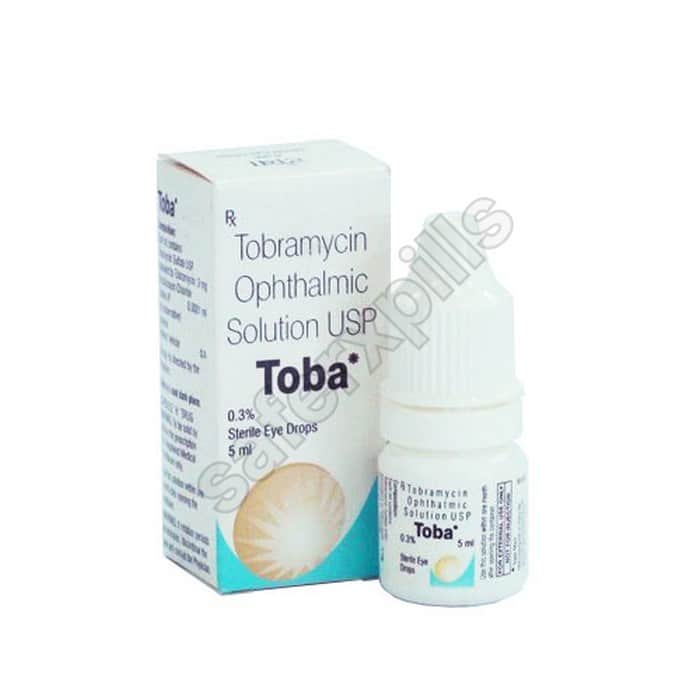
Toba Eye Drop
Generic: Tobramycin
Select pack size
3 bottles · $4.33 per bottle
About Toba Eye Drop
Toba Eye Drop is Sun Pharma's tobramycin 0.3% (3 mg per mL) antibiotic eye drop for bacterial infections of the outer eye and eyelids, such as bacterial conjunctivitis. Tata 1mg names Sun Pharmaceutical Industries Ltd as the marketer and Truemeds names Sun Pharma Laboratories Ltd; both list a 5 mL bottle. We sell it in packs of 3, 6 or 12 bottles, from $3.58 a bottle in the 12 bottle pack, before shipping.
Three things to know before you order. First, our delivery takes 7 to 14 business days, so this is not a way to treat an eye infection you have today. The CDC says bacterial pink eye "usually clears up in 2 to 5 days without treatment but can take 2 weeks to go away completely", and that "Mild bacterial pink eye may get better without antibiotic treatment and without causing any complications". So many infections will be better or over before a parcel arrives, and a red, painful eye needs to be seen the same day (see "When to get urgent help"). Second, with shipping, a single order from us costs far more than a US pharmacy pays for one generic bottle (see the price comparison below). Third, tobramycin only works on bacteria: it does nothing for viral or allergic red eyes. Clinical details on this page come from the US generic tobramycin 0.3% eye drop labels, the Australian Tobrex label and the Canadian Tobrex monograph, all listed under Sources.
Toba Eye Drop at a glance
| Active ingredient | Tobramycin 0.3% w/v (3 mg per mL), an aminoglycoside antibiotic; 5 mL bottle on the Indian listings. The listings we checked do not name a preservative, so read the carton (the US, Australian and Canadian products contain benzalkonium chloride 0.01%). |
| Brand and maker | Toba, Sun Pharma (Tata 1mg: Sun Pharmaceutical Industries Ltd; Truemeds: Sun Pharma Laboratories Ltd; MedPlus: Sun Pharma, Mumbai) |
| Labelled use | External infections of the eye and its adnexa (eyelids and nearby structures) caused by susceptible bacteria (US labels; Australian label 4.1) |
| Regulatory status | Tobramycin 0.3% eye drops are licensed in the US (generics; Tobrex), Australia (Tobrex) and Canada (Tobrex and a Sandoz generic). The Indian pack we sell is not registered with the FDA, the TGA or Health Canada. In the UK, the emc lists tobramycin eye drops only in combination with dexamethasone; we found no tobramycin-only eye drop there (the emc is not the full MHRA register). |
| Usual dose | Mild to moderate infection: 1 or 2 drops into the affected eye(s) every 4 hours. Severe infection: 2 drops hourly until improvement, then the treatment should be reduced before stopping (US labels; Australian label 4.2). |
| Course length | "The usual duration of treatment is 7-10 days" (Australian label 4.2). The US labels give no fixed length. |
| Packs | 3, 6 or 12 bottles (no single bottle pack) |
| Price per bottle | $3.58 to $4.33 before shipping; $5.67 to $12.67 with shipping |
| Delivery | 7 to 14 business days to the US, UK, Australia and Canada; $25 shipping under $149, free from $149 |
Price per bottle
Prices as of October 2026; the pack selector shows the current price. No pack reaches the $149 free shipping level on its own, so each includes the $25 shipping charge below unless you add other items. Per mL figures assume 5 mL bottles, the size on every Indian listing we checked; confirm the size on the carton.
| Pack | Price | Per bottle | Per mL | Shipping | Order total | Per bottle with shipping |
|---|---|---|---|---|---|---|
| 3 bottles | $13.00 | $4.33 | $0.87 | $25 | $38.00 | $12.67 |
| 6 bottles | $23.00 | $3.83 | $0.77 | $25 | $48.00 | $8.00 |
| 12 bottles | $43.00 | $3.58 | $0.72 | $25 | $68.00 | $5.67 |
How many bottles you need. The US generics, Australian Tobrex and Canadian Tobrex all come as a single 5 mL bottle, and the Australian label gives a usual course of 7 to 10 days. So even our smallest pack holds more bottles than one labelled course is supplied with. An opened bottle should be thrown away 4 weeks after opening (Australian label 6.4; the Tata 1mg listing says the same for Toba) or 28 days after opening (Canadian monograph). The US generic labels say an opened bottle can be used until the expiry date, but follow the carton of the pack you have. A 6 or 12 bottle pack is far more than any labelled course. Please do not keep spare bottles to treat a future red eye yourself: many red eyes are viral or allergic, and the NHS notes that antibiotics will not work for those.
Compared with tobramycin eye drops in the US
Drugs@FDA lists the original Tobrex solution approval (NDA 050541, Novartis) as discontinued, with a Federal Register determination that it was not discontinued for safety or effectiveness reasons, and lists Tobrex solution under a Sandoz application (ANDA 062535) as a prescription product. Several makers sell FDA approved generic tobramycin 0.3% eye drops in 5 mL bottles (for example Sandoz, Bausch & Lomb, Alembic and Somerset). The figures below are what US pharmacies paid according to the Medicaid NADAC survey, per-NDC rows in the file as of 28 October 2026 (each row effective 21 October 2026). They are pharmacy acquisition costs, not the price at the counter.
| Product | Maker | FDA approved | US pharmacy cost per mL | Per 5 mL bottle |
|---|---|---|---|---|
| Generic tobramycin 0.3% eye drops, 5 mL (4 NDCs) | Sandoz, Bausch & Lomb, Alembic, Somerset | Yes | $1.10 ($1.09593) | About $5.48 |
| Tobrex eye drops | Novartis / Sandoz | Yes | No NADAC row | Not available |
| Toba Eye Drop, Indian pack (this page), 5 mL | Sun Pharma | No (not registered with the FDA) | $0.72 to $0.87 from us, before shipping | $3.58 to $4.33 before shipping; $5.67 to $12.67 with shipping |
Plainly: per bottle before shipping, ours costs less than a US pharmacy pays. But most people need one bottle, not 3 to 12, and our cheapest order is $38 with shipping, against about $5.48 that a US pharmacy pays for one generic 5 mL bottle. For one infection, a US generic on prescription is very likely to cost you less, and you get it the same day. If you are in the US and have a prescription, compare US generic cash prices and your insurance cover first. (NADAC's only Tobrex row is for the eye ointment, $84.33326 per gram, a different product.)
Toba and related products
Tobramycin eye drops come in one strength (0.3%), so there is no strength to choose. The questions are whether you need an antibiotic eye drop at all, and which product.
| Product | What it is | When it fits |
|---|---|---|
| Toba Eye Drop (this product) | Tobramycin 0.3% antibiotic alone | Bacterial eye infection diagnosed or judged likely by a doctor, optometrist or pharmacist |
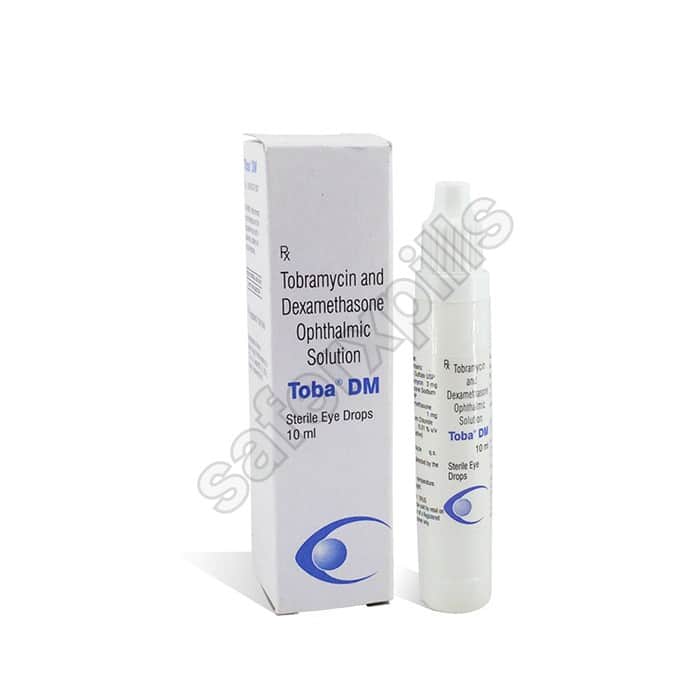
| Toba DM Eye Drop | Tobramycin with the corticosteroid dexamethasone (as listed on our site) | A different product. Steroid eye drops should only be used when an eye doctor prescribes them (our advice); they are not a stronger version of Toba. |
| Toba F Eye Drop | Tobramycin 0.3% with the corticosteroid fluorometholone 0.1% (Tata 1mg listing) | Also a steroid combination for use only under an eye doctor (our advice). |
| Oflox Eye Drop | Ofloxacin 0.3%, a fluoroquinolone antibiotic | A different antibiotic class for bacterial eye infections. Do not switch between antibiotic drops on your own; ask the person treating you. |
Eye or ear? The Tata 1mg listing says Toba is used for infections of the eye, eyelids "and ear". The US labels and the Australian and Canadian Tobrex labels cover the eye only, and the Australian leaflet says Tobrex is "for Eye use only". We have not seen Sun Pharma's leaflet. This page gives eye use only. Do not put it in the ear unless a doctor has told you to.
How to use Toba eye drops
Use the schedule your doctor gives you. The labels set this schedule:
| Infection | Dose | Then |
|---|---|---|
| Mild to moderate | 1 or 2 drops into the affected eye(s) every 4 hours (US labels; Australian label 4.2; Canadian monograph) | Usual course 7 to 10 days (Australian label 4.2) |
| Severe | 2 drops into the eye(s) hourly until improvement (same labels) | Treatment "should be reduced prior to discontinuation" (US labels) |
The Canadian monograph gives this dose for adults and children above the age of 1 year. A severe infection, or any infection of the clear front of the eye (the cornea), needs an eye doctor to diagnose it and check it during treatment (our advice); the hourly schedule is not for self-treatment.
- Wash your hands. Remove contact lenses first (Australian leaflet). Tilt your head back, pull the lower lid down gently and put the drop into the pocket.
- Do not let the dropper tip touch your eye, lids or any surface: the US labels say this may contaminate the solution.
- Close the eye and press gently on the inner corner for about two minutes (Australian leaflet).
- If you use another eye medicine, wait at least 5 minutes between them (Australian leaflet; the Tata 1mg listing says the same).
- If you miss a dose, put it in as soon as you remember; if it is almost time for the next dose, skip the missed one. Do not use a double dose (Australian leaflet; Canadian monograph).
- If too many drops go in, rinse the eye with lukewarm water (Australian label 4.9).
- If the infection does not improve within 3 days or gets worse, tell your doctor (Canadian monograph, patient information). The Canadian monograph also says prescribing tobramycin without a proven or strongly suspected bacterial infection "is unlikely to provide benefit to the patient and risks the development of drug-resistant bacteria".
- Throw the bottle away 4 weeks after opening (Australian label; Tata 1mg listing), even if some is left.
Contact lenses. The US labels say people should be advised not to wear contact lenses if they have signs and symptoms of a bacterial eye infection. The Australian label says the drops should not be put in while wearing contact lenses and that contact lens wear is not recommended during treatment of an eye infection; if lenses are worn, remove them first and wait 15 minutes before putting them back, because benzalkonium chloride may irritate the eye and is known to discolour soft lenses (4.4). The Canadian monograph says the same. Our advice: leave lenses out for the whole course, and throw away the lenses and case you were wearing when the infection started.
Not for injection. The US labels say "NOT FOR INJECTION INTO THE EYE".
Groups who need extra care
- Babies and children. The US labels say safety and effectiveness below the age of 2 months have not been established, and that clinical studies have shown tobramycin to be safe and effective for use in children. The Australian label says safety and effectiveness below 1 year have not been established (4.4), and the Australian leaflet says do not use it in children less than 12 months of age. The Canadian dose is for adults and children above 1 year. A newborn with pink eye symptoms should see a doctor right away (CDC); the NHS says get an urgent appointment for a baby less than 30 days old.
- Muscle weakness disorders. Aminoglycosides may aggravate muscle weakness in people with known or suspected neuromuscular disorders such as myasthenia gravis or Parkinson's disease (US labels, among reactions reported with aminoglycosides given systemically; the Australian label 4.4 says caution should be exercised when prescribing Tobrex for these patients).
- Antibiotic injections or tablets of the same class. Serious nerve, hearing and kidney damage has occurred with aminoglycosides given by injection. The Australian label says these effects have not been reported after use in the eye, but advises caution and monitoring of blood levels if Tobrex is used alongside systemic aminoglycosides (4.4, 4.5). Tell your doctor if you are being treated with gentamicin, amikacin or tobramycin by injection or inhaler (our advice).
- Kidney, hearing or balance problems. The Australian label says caution should be exercised with known or suspected renal, auditory, vestibular or neuromuscular dysfunction (4.4), but that no dose change is needed in kidney or liver impairment because little is absorbed.
- Healing eye surface. The Australian label says eye solutions and ointments may retard corneal wound healing (4.4).
- Long use. As with other antibiotics, prolonged use may result in overgrowth of organisms that do not respond, including fungi; if a new infection appears, other treatment is needed (US labels; Australian label 4.4).
- Pregnancy. The US labels and the Canadian monograph say it should be used during pregnancy "only if clearly needed". The Australian label (Category B3) says it should be used during pregnancy only if the potential benefit for the mother justifies the potential risk to the foetus, "otherwise tobramycin is not recommended during pregnancy" (4.6). Tell your doctor before using it.
- Breastfeeding. The US labels say a decision should be made whether to stop nursing or stop the drug, taking into account how important the drug is to the mother. The Canadian patient information says "TOBREX is not recommended during breastfeeding". The Australian label says use it only if the potential benefit for the mother justifies the potential risk to the infant (4.6).
- Driving. Vision may blur for a short time after the drops; wait until it clears before driving or using machines (Australian label 4.7; Canadian monograph).
- Older adults. The US labels found no overall differences in safety or effectiveness compared with younger patients.
Medicines to mention to your doctor: The Australian label says the concurrent or sequential use of Tobrex with other drugs that can harm nerves or hearing should be avoided, and that Tobrex should not be used at the same time as a topical beta lactam antibiotic (the Australian leaflet describes these as antibiotics used for infections of the ear, eye or skin), as this is likely to inactivate tobramycin (4.5).
Side effects
The US labels say the most frequent adverse reactions are hypersensitivity and localised eye toxicity, including lid itching and swelling and redness of the conjunctiva, occurring in less than three of 100 patients. The Australian label puts these reactions at approximately 3% and lists burning and stinging of the eyes (4.8). Selected items, with the frequencies it gives from literature and post-marketing reports:
- Common (more than 1% to under 10%): eye discomfort and eye redness.
- Uncommon (more than 0.1% to 1%): hypersensitivity, headache, keratitis, corneal abrasion, blurred vision or other visual problems, eyelid redness, swelling or other eyelid problems, eye pain, dry eye, eye discharge, itching, a feeling of something in the eye, watery eyes, hives, dermatitis, loss of eyelashes or eyebrows (madarosis), pale patches of skin (leukoderma), itching and dry skin.
- Frequency not known: anaphylactic reaction, eye allergy, eye irritation, eyelid itching, Stevens-Johnson syndrome, erythema multiforme and rash.
The US labels list anaphylactic reaction, Stevens-Johnson syndrome and erythema multiforme from post-marketing use. They add that sensitivity to aminoglycosides applied to the eye can range from local effects to generalised reactions such as redness, itching, hives, skin rash, anaphylaxis or blistering reactions, and that the drops should be stopped if a sensitivity reaction occurs.
When to get urgent help
- A red, painful eye with blurred or reduced vision, strong sensitivity to light, or a white spot on the clear front of the eye, especially if you wear contact lenses: get same-day care from an eye doctor or an emergency department (our advice; these can be signs of a corneal infection). The NHS lists eye pain, sensitivity to light, vision changes and very red eyes as reasons for an urgent GP appointment or NHS 111.
- A newborn with red, sticky eyes: see a doctor right away (CDC; the NHS says an urgent appointment for a baby less than 30 days old).
- Allergy signs (rash, hives, blisters, swelling of the face, lips, tongue or throat, wheezing, trouble breathing or swallowing): stop the drops and call emergency services (911 in the US and Canada, 999 in the UK, 000 in Australia; our advice for severe signs). The Australian leaflet says to call your doctor straight away or go straight to the emergency department for these signs.
- Blurred vision or partial loss of vision, or signs of corneal damage such as light sensitivity, discomfort or pain in the eyes, during treatment: the Australian leaflet lists these among serious side effects that need a doctor straight away or the emergency department.
- The infection gets worse, or does not improve within 3 days: tell your doctor rather than carrying on (Canadian monograph, patient information).
- Someone swallows the drops, or too much is used: the Australian label says clinical signs are not expected even after accidentally swallowing the contents of one bottle (4.9), but the Australian leaflet says that if you think you have used too much, phone the Poisons Information Centre (13 11 26), contact your doctor or go to the emergency department. In the US, call Poison Help on 1-800-222-1222 (our advice).
Tell the doctor or emergency staff what was used (tobramycin 0.3% eye drops), how much and when.
Who should not use Toba eye drops
Never use it if:
- You have had an allergic reaction to tobramycin or any ingredient of the drops (contraindicated in the US labels, the Australian label 4.3 and the Canadian monograph).
- You have a known allergy to any other aminoglycoside antibiotic, such as gentamicin, amikacin, kanamycin or streptomycin (contraindicated in the Australian label 4.3 and the Canadian monograph; the US labels warn that cross-sensitivity may occur).
Not recommended, or only with your doctor's agreement:
- Pregnancy: only if clearly needed (US labels; Canadian monograph); otherwise not recommended (Australian label 4.6).
- Breastfeeding: not recommended (Canadian patient information); a decision for you and your doctor (US and Australian labels).
- Children under 1 year: do not use (Australian leaflet); safety under 2 months not established (US labels).
- Contact lenses during treatment: not recommended (Australian label 4.4; Canadian monograph; US labels).
- Myasthenia gravis, Parkinson's disease, kidney, hearing or balance problems, or treatment with aminoglycosides by injection: only after talking to your doctor (see "Groups who need extra care").
- A red eye that may be viral or allergic: antibiotics will not help (NHS).
Prescription and legal status
Tobramycin eye drops are prescription medicines in the US ("Rx only" on the US labels), Australia (Tobrex is Schedule 4, Prescription Only Medicine) and Canada (Tobrex, DIN 00513962, and Sandoz Tobramycin, DIN 02241755, prescription). In the UK, the emc lists tobramycin eye drops only with dexamethasone (Tobradex is a prescription only medicine), and we found no tobramycin-only eye drop there; the emc is not the full MHRA register. Tata 1mg and Truemeds mark the Indian Toba as needing a prescription. The Indian pack we sell is not registered with the FDA, the TGA or Health Canada, and the FDA says personal importation of unapproved medicines is illegal in most circumstances. Check the rules where you live.
Buying genuine Toba
The MHRA warns: "Any medicine not authorised for sale in the UK can be unsafe or ineffective and there is no way of knowing what is in them or the negative health effects they can have." That warning covers this Indian pack. The MHRA also advises: "Only use UK-registered pharmacies, including online pharmacies displaying the official green cross logo." When your order arrives, check that the carton and bottle say Toba and tobramycin 0.3% w/v, name Sun Pharma, and show a batch number and an expiry date, that the seal on the bottle is intact, and that the solution is clear. These checks cannot prove a bottle is genuine, because counterfeiters copy packaging. Eye drops must be sterile: do not use a bottle with a broken seal or a cloudy solution. If a batch causes symptoms, seek medical advice and report it to your medicines regulator (the MHRA Yellow Card scheme in the UK, FDA MedWatch in the US, the TGA in Australia or Health Canada) as well as to us.
Delivery and storage
We ship Toba Eye Drop to the US, UK, Australia and Canada in plain packaging with tracking. Standard delivery takes 7 to 14 business days, which is too slow for an infection you have now. Shipping costs a flat $25 on orders under $149 and is free from $149. None of the labels or listings we checked asks for refrigeration. Store the bottle as the carton says: Tata 1mg and Truemeds say store below 30°C, and Truemeds adds do not freeze or refrigerate; the Australian label says store below 25°C (6.4) and the Australian leaflet adds do not freeze; the Canadian monograph gives room temperature (15°C to 30°C); the US generic labels give 2°C to 25°C. See our shipping page and refund policy.
Related guides
- Antibiotic resistance: when antibiotics do not work
- How to buy eye care medicine online safely
- Buying eye drops from an online pharmacy
Other eye drops: Oflox Eye Drop (ofloxacin) and FML Eye Drop (fluorometholone, a steroid for eye inflammation).
Sources
- Tobramycin ophthalmic solution USP 0.3%, US prescribing information, Sandoz Inc. (manufactured by Alcon Laboratories), NDC 61314-643-05, DailyMed setid 27e2c16e-19b0-4745-93eb-5cf99f94bb92, version 8 (text revised August 2021): Description, Indications, Contraindications, Warnings, Precautions, Adverse Reactions, Dosage and Administration, How Supplied. DailyMed
- Tobramycin ophthalmic solution USP 0.3%, US prescribing information, Bausch & Lomb, ANDA 064052, DailyMed setid a5693ec9-d2f7-4d45-90b0-a113c54840d7, version 17 (revised November 2023); Somerset Therapeutics, setid 7333280d-5d2a-4609-ab93-3ab7031b65db, version 9 (revised July 2024); Alembic, setid 3c23234a-452b-40d0-922f-37e49147d537, version 9 (revised 04/2024). Cross-checks. DailyMed
- US Food and Drug Administration, Drugs@FDA via openFDA: Tobrex solution NDA 050541 (discontinued; Federal Register determination) and ANDA 062535 (Sandoz, prescription); generic tobramycin eye drops ANDA 064052, 211847, 212628, 207444; queried 28 October 2026. Drugs@FDA
- Tobrex eye drops and eye ointment, Australian Product Information (date of revision 20 November 2023) and Consumer Medicine Information (May 2025), Novartis Pharmaceuticals Australia, AUST R 25365, sections 4.1 to 4.9, 6.1, 6.4, 7, via the ACSQHC Medicine Finder, accessed 28 October 2026. ACSQHC
- Tobrex Product Monograph, Novartis Pharmaceuticals Canada, date of revision 20 February 2019: Contraindications, Warnings and Precautions, Adverse Reactions, Dosage and Administration, Storage, Patient Medication Information. Health Canada PM
- Health Canada Drug Product Database: Tobrex solution (DIN 00513962) and Sandoz Tobramycin (DIN 02241755), tobramycin 0.3%, prescription, marketed; queried 28 October 2026. Health Canada DPD
- emc (electronic medicines compendium), search for tobramycin, 28 October 2026: Tobradex Eye Drops and Tobramycin/Dexamethasone eye drops are the only eye products listed. emc
- Centers for Medicare and Medicaid Services. National Average Drug Acquisition Cost (NADAC), tobramycin 0.3% eye drops and Tobrex, per-NDC rows, 2026 file as of 28 October 2026 (rates effective 21 October 2026). data.medicaid.gov
- Centers for Disease Control and Prevention. How to Treat Pink Eye, 15 April 2024. CDC
- NHS. Conjunctivitis, page last reviewed 23 April 2024. NHS
- Tata 1mg, Truemeds and MedPlus. Toba 0.3% eye drops 5 ml listings, and Tata 1mg Toba F listing, accessed 28 October 2026. Tata 1mg, Truemeds, MedPlus
- MHRA. 20 million illegal erectile dysfunction pills seized as MHRA warns against risky online buys, 13 February 2026. GOV.UK
- US Food and Drug Administration. Personal Importation. FDA
This page is for information and is not medical advice. Tobramycin eye drops are a prescription medicine; a doctor should confirm that you have a bacterial eye infection and set your treatment.
Key Information
- ✓Active Ingredient: Tobramycin
- ✓Category: Eye Care
- ✓Form: Eye Drop
- ✓Brand: Sun Pharmaceutical Industries Ltd
- ✓Manufacturer: Sun Pharmaceutical Industries Ltd
Frequently Asked Questions
What is Toba Eye Drop?
Toba is Sun Pharma's tobramycin 0.3% (3 mg per mL) antibiotic eye drop, sold in India in 5 mL bottles. Tobramycin is an aminoglycoside antibiotic. The US labels and the Australian Tobrex label cover external infections of the eye and eyelids caused by susceptible bacteria, such as bacterial conjunctivitis. It does not treat viral or allergic red eyes.
Is Toba the same as Tobrex?
It has the same active ingredient and strength (tobramycin 0.3%) as Tobrex and the US generic tobramycin eye drops. It is a different product from a different maker, and the Indian pack is not registered with the FDA, the TGA or Health Canada. The Indian listings we checked do not name a preservative; the US, Australian and Canadian products contain benzalkonium chloride. Read the carton.
How much does Toba Eye Drop cost?
As of October 2026, $13.00 for 3 bottles ($4.33 each), $23.00 for 6 ($3.83 each) and $43.00 for 12 ($3.58 each), plus $25 shipping on orders under $149, so $38.00 to $68.00 an order. A US pharmacy pays about $5.48 for one generic 5 mL bottle (NADAC, effective 21 October 2026), so for a single infection a US generic on prescription is likely to cost you less. The pack selector shows the current price.
How do I use tobramycin eye drops?
Follow your doctor's schedule. For mild to moderate infection the labels give 1 or 2 drops into the affected eye(s) every 4 hours. For severe infection, 2 drops hourly until improvement, then the dose is reduced before stopping. Wash your hands, do not let the dropper tip touch anything, and wait at least 5 minutes before another eye drop.
How long should I use Toba, and how many bottles do I need?
The Australian Tobrex label says the usual course is 7 to 10 days. The US, Australian and Canadian products come as one 5 mL bottle, so our smallest pack (3 bottles) holds more bottles than one labelled course is supplied with. Throw an opened bottle away 4 weeks after opening (Australian label; Tata 1mg listing), and do not keep spares to treat a later red eye yourself.
Is this fast enough for pink eye I have now?
No. Our delivery takes 7 to 14 business days. The CDC says bacterial pink eye usually clears up in 2 to 5 days without treatment but can take 2 weeks to go away completely. If you have an infection now, see a doctor, optometrist or pharmacist locally. A red, painful eye, light sensitivity or a change in vision needs same-day care.
Can I use Toba eye drops in my ear?
The Tata 1mg listing mentions ear infections, but the US labels and the Australian and Canadian Tobrex labels cover the eye only, and the Australian leaflet says Tobrex is for eye use only. We have not seen Sun Pharma's leaflet. Do not use it in the ear unless a doctor has told you to.
What are the side effects of tobramycin eye drops?
The most frequent are allergy and local eye irritation, such as itchy or swollen lids and red eyes, in under 3 in 100 people (US labels). Burning and stinging can occur (Australian label). Serious reactions reported after marketing, with no known frequency, include anaphylaxis, Stevens-Johnson syndrome and erythema multiforme (US labels; Australian label). Stop the drops and get help at the first sign of rash, blisters, swelling or breathing trouble.
Who should not use Toba eye drops?
Never use it if you are allergic to tobramycin or any ingredient (US, Australian and Canadian labels), or to any other aminoglycoside such as gentamicin or amikacin (Australian and Canadian labels). Talk to your doctor first if you are pregnant or breastfeeding, have myasthenia gravis or Parkinson's disease, or are on aminoglycoside injections. The Australian leaflet says do not use it in children under 12 months. Leave contact lenses out during treatment.
Do I need a prescription for tobramycin eye drops?
Yes in the US, Australia (Schedule 4) and Canada, and Tata 1mg and Truemeds mark the Indian Toba as prescription only. We found no tobramycin-only eye drop on the UK emc. A red eye should be checked before using an antibiotic, because many are viral or allergic. The FDA says personal importation of unapproved medicines is illegal in most circumstances.
How long does delivery take, and how should I store it?
Standard delivery to the US, UK, Australia and Canada takes 7 to 14 business days, in plain packaging with tracking, which is too slow for an infection you have now. Shipping is a flat $25 under $149 and free from $149. No label or listing we checked asks for refrigeration: Tata 1mg and Truemeds say store below 30°C, and the Australian label says below 25°C (its leaflet adds do not freeze).
Medical References
Sources: U.S. National Library of Medicine (DailyMed, PubMed), openFDA
Related Products
View all

Customer Reviews
No reviews yet. Be the first to review Toba Eye Drop.
Related Articles
Health guides about Tobramycin, written by pharmacists
Tobramycin Eye Drops and Tobradex: Dosage, Side Effects, Steroid Warnings and US Cost
Tobramycin ophthalmic solution 0.3% is a prescription aminoglycoside eye drop for bacterial infections of the outer eye and eyelids, and Tobradex combines it with the steroid dexamethasone. This guide gives the US label dose for each, side effects, the steroid warnings on eye pressure, cataract and viral or fungal infection, Tobradex vs Tobradex ST vs Zylet, use in pregnancy and children, contact lenses, how tobramycin compares with fluoroquinolone drops, which brands are discontinued, and what a bottle costs US pharmacies.
Olopatadine Eye Drops (Pataday, Patanol): 0.1% vs 0.2% vs 0.7%, How to Use, Side Effects and US Cost
Olopatadine eye drops relieve allergic eye itch and have been sold over the counter in the US since 2020 as Pataday Twice Daily Relief (0.1%, formerly Patanol), Pataday Once Daily Relief (0.2%) and Pataday Extra Strength (0.7%, formerly Pazeo). This guide covers the label directions for each strength, contact lenses, side effect rates from the prescription labels, age limits, pregnancy, the 0.7% trial results, olopatadine vs ketotifen and cromolyn, when an allergy drop is the wrong choice, and what a bottle costs US pharmacies.
Moxifloxacin Eye Drops (Vigamox): Dosage, Side Effects, Babies, Ointment and US Cost
Moxifloxacin ophthalmic solution 0.5% (Vigamox and generics) is a prescription fluoroquinolone eye drop for bacterial conjunctivitis. This guide gives the US label dose, the twice daily Moxeza formula and its status, how to use the drops, side effects and warnings, use in pregnancy and in newborns, why the drops carry no boxed warning while moxifloxacin tablets do, how moxifloxacin compares with other fluoroquinolone drops, the eye ointment question, and what a bottle costs US pharmacies.
Related Health Guide
Understanding Eyelash Growth & Eye Conditions: Complete Guide