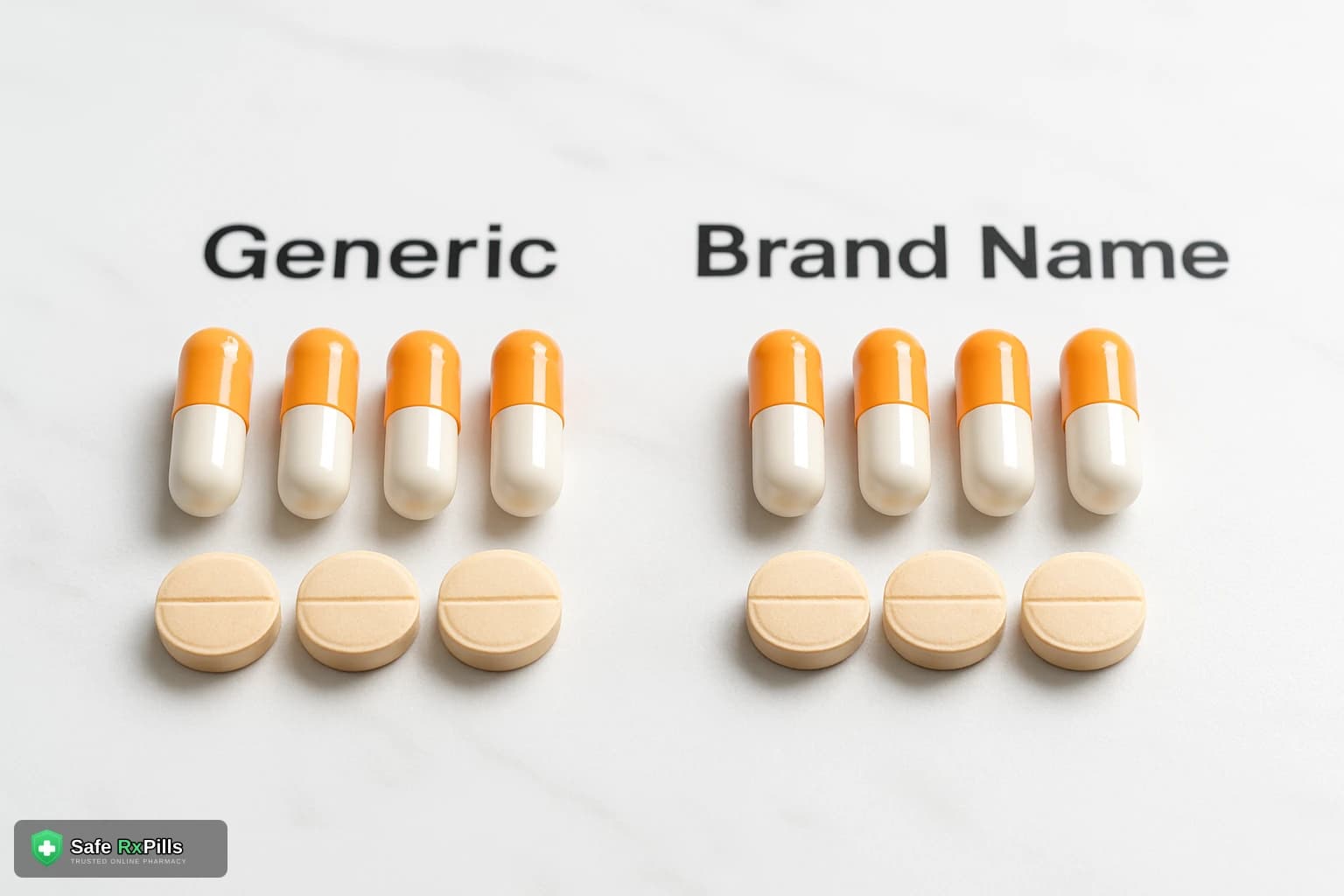
Generic vs Branded Medicines: What You Really Need to Know
Milan Sojitra
B.Pharm, Rajiv Gandhi University. Founder, SafeRxPills

Generic vs Branded Medicines: What You Really Need to Know - pharmacy guide
In this article (9 sections)
What Is a Generic Medicine?
A generic medicine is a copy of a brand-name drug that contains the same active ingredient in the same amount, the same dosage form (tablet, capsule, liquid), and the same route of administration. It is designed to produce the same therapeutic effect in your body as the original.
When a pharmaceutical company develops a new drug, they receive a patent that gives them exclusive rights to manufacture and sell it: usually for 20 years from the date of filing. During that period, only the original company can sell the drug, which is why brand-name prices are so high. Once the patent expires, any manufacturer that meets regulatory requirements can produce the same molecule. These copies are generics.
Generic manufacturers do not need to repeat the original clinical trials. They must simply prove that their version delivers the same amount of active ingredient to the bloodstream at the same rate. This proof is called bioequivalence testing.
Well-known examples: Sildenafil is the generic for Viagra. Tadalafil is the generic for Cialis. Metformin is the generic for Glucophage. In each case, the active molecule is chemically identical: manufactured under the same regulatory standards, just by a different company at a much lower cost.
At SafeRxPills, every product in our catalog is a generic manufactured by Actiza Pharmaceutical Pvt. Ltd., a WHO-GMP and ISO 9001:2015 certified manufacturer based in Surat, India. Products like Cenforce 100mg (Sildenafil) and Vidalista 20mg (Tadalafil) contain the same active molecules as their brand-name counterparts at a fraction of the cost.
Bioequivalence: The Science Behind Generic Drugs
Bioequivalence is the cornerstone of generic drug regulation. Two drugs are bioequivalent if they produce the same concentration of active ingredient in the bloodstream over the same time period, within a defined statistical range.
The FDA's standard for bioequivalence requires that the generic's pharmacokinetic profile: specifically the area under the plasma concentration-time curve (AUC) and the peak concentration (Cmax): fall within 80 to 125 percent of the reference brand drug's values, with 90 percent confidence intervals. This range was chosen because individual variation between people taking the same brand-name drug on different days often exceeds this range. In other words, the acceptable variation for a generic is no greater than the natural day-to-day variation of the brand drug itself.
Bioequivalence studies are conducted in human volunteers using crossover designs: participants take both the brand and the generic in separate sessions, and blood samples are taken at multiple time points to measure drug concentration. Statistical analysis confirms whether the generic falls within the accepted range.
This means a generic Sildenafil tablet: whether it is Cenforce, Fildena, or Kamagra: delivers the same plasma concentration curve as Viagra. The erectile response, onset time, duration, and side effect profile are the same because the pharmacology is driven by the molecule, not the manufacturer's name on the box.
One nuance worth knowing: inactive ingredients (excipients like fillers, binders, coatings) can differ between brand and generic. For the vast majority of medications this is irrelevant: the inactive components do not affect how the active ingredient works. However, for a small number of drugs with narrow therapeutic windows (certain antiepileptics, thyroid medications, some anticoagulants), even small differences in absorption rate can matter. For those specific drugs, your doctor may prefer to keep you on one consistent formulation. For ED medications, antiparasitic drugs, eye care serums, and skin care treatments: the categories sold at SafeRxPills: this is not a concern.
Why Generics Cost So Much Less
The price gap between brand and generic medicines shocks most patients the first time they see it. Generic Sildenafil costs around $1 to $2 per tablet. Brand Viagra can cost $60 to $80 per tablet in the United States. Same molecule. Same effect. An 80 to 85 percent price difference.
The reasons are structural, not quality-related:
No research and development costs. The original manufacturer spent a decade and hundreds of millions of dollars discovering the molecule, running Phase I through Phase III clinical trials, and navigating FDA approval. The generic manufacturer inherits all of that data once the patent expires. Their only obligation is to prove bioequivalence: a much cheaper, faster process.
No marketing spend. Brand pharmaceutical companies spend more on marketing than on research in some years. TV ads, doctor detailing, patient programs: these costs are embedded in the brand price. Generic manufacturers do not advertise to consumers and do not run physician gifting programs. Their cost base is almost purely manufacturing and compliance.
Competition between multiple manufacturers. Once a patent expires, dozens of manufacturers can enter the market. Competition drives prices down quickly. Sildenafil went generic in 2017 in the US: within months, the price dropped by over 90 percent as manufacturers competed for market share.
Lower regulatory burden. The Abbreviated New Drug Application (ANDA) process for generics is faster and cheaper than the full NDA required for new drugs. This reduces the cost of bringing a generic to market.
Generic manufacturers in India: where Actiza Pharmaceutical operates: benefit from additional cost advantages: lower manufacturing labor costs, established API (active pharmaceutical ingredient) supply chains, and government support for the pharmaceutical export sector. This is why Indian generics dominate international markets. India supplies roughly 20 percent of global generic medicines by volume, and the Indian pharmaceutical industry holds more US FDA-approved manufacturing facilities outside the United States than any other country.
For patients looking to save money on prescription medications without compromising on therapeutic outcome, generic medicines from certified manufacturers are the most evidence-based option available.
How the FDA Approves Generic Drugs
In the United States, generic drugs are approved through the Abbreviated New Drug Application (ANDA) process managed by the FDA's Office of Generic Drugs. "Abbreviated" means the manufacturer does not need to independently prove the drug's safety and efficacy: that work was done by the original brand company. Instead, the ANDA applicant must demonstrate:
Same active ingredient. The generic must contain the identical active pharmaceutical ingredient (API) as the reference listed drug (RLD). The API must meet the same purity and potency specifications.
Same dosage form and strength. A 100mg tablet must be a 100mg tablet. A topical cream must be the same formulation type.
Same route of administration. Oral, topical, ophthalmic: the delivery method must match.
Bioequivalence. The pharmacokinetic study described above must demonstrate that the generic's absorption profile falls within the FDA's accepted statistical range compared to the brand.
Same labeling. The generic's approved uses, contraindications, warnings, and dosing information must match the brand's approved labeling. The generic cannot claim anything the brand cannot claim.
Manufacturing quality. The facility must meet Current Good Manufacturing Practice (cGMP) standards. The FDA conducts pre-approval inspections of manufacturing facilities and can reject an ANDA if the facility does not meet standards.
Once approved, the FDA assigns a generic an "AB" therapeutic equivalence rating, which means it is substitutable for the brand at the pharmacy level without physician intervention. Every state in the US allows pharmacists to automatically substitute an AB-rated generic when a doctor writes a prescription for the brand name, unless the prescription specifies "dispense as written."
The FDA's Orange Book (Approved Drug Products with Therapeutic Equivalence Evaluations) lists all approved drugs with their equivalence ratings. This is a public database and the authoritative reference for whether a specific generic is considered interchangeable with its brand counterpart. Sildenafil tablets, tadalafil tablets, and bimatoprost ophthalmic solution: the active ingredients in our ED and eye care products: all carry AB ratings in the Orange Book.
WHO-GMP Certification and International Generics
For patients sourcing medications internationally: which is how SafeRxPills operates: the relevant quality standard is WHO-GMP (World Health Organization Good Manufacturing Practices). This is the international equivalent of the FDA's cGMP requirements and is used by regulatory bodies in over 100 countries to assess pharmaceutical manufacturing quality.
WHO-GMP certification covers the full manufacturing environment: facility design, equipment qualification, raw material testing, in-process quality controls, finished product testing, batch record keeping, stability testing, and recall procedures. A WHO-GMP certified facility has passed independent audits confirming that every step of the manufacturing process meets international pharmaceutical standards.
Actiza Pharmaceutical Pvt. Ltd.: the manufacturer behind all SafeRxPills products: holds WHO-GMP certification alongside ISO 9001:2015 certification. This means the Cenforce, Vidalista, Careprost, and Wormiza products you order have been produced in a facility that meets the same basic manufacturing standards required of pharmaceutical manufacturers supplying the NHS in the UK, the TGA in Australia, and Health Canada.
When evaluating any international online pharmacy, WHO-GMP certification of the source manufacturer is the most important quality signal to look for. It is more meaningful than packaging or pricing. You can learn more in our guide to ordering safely from international online pharmacies.
5 Common Myths About Generic Medicines
Myth 1: Generics are lower quality because they are cheaper.
Price reflects development cost recovery and marketing spend, not manufacturing quality. A generic approved by the FDA or manufactured under WHO-GMP standards has passed the same quality tests as the brand. The active ingredient is chemically identical. Lower price means lower overhead, not lower quality.
Myth 2: Generic drugs take longer to work.
Bioequivalence testing specifically measures Tmax: the time to peak plasma concentration. The FDA's standard requires generics to reach peak concentration within the same time window as the brand. A generic Sildenafil tablet has the same 30 to 60 minute onset window as Viagra. There is no clinically meaningful difference in onset speed.
Myth 3: Generics cause more side effects.
Side effects are caused by the active molecule interacting with receptors in your body. Since the active molecule is identical, the side effect profile is the same. The inactive excipients in generics can occasionally cause allergic reactions in people with specific sensitivities to those excipients: but this is rare and applies equally to different formulations of the same brand drug. The core pharmacological side effects are identical.
Myth 4: Doctors prefer brands because they work better.
Many physicians prescribe brand names out of habit, familiarity, or because that is what they were trained on during medical school (when the generic was not yet available). Evidence does not support brand superiority for the vast majority of medications. Many physicians are also subject to marketing from brand pharmaceutical companies, which has historically influenced prescribing patterns. The FDA's bioequivalence standard exists precisely because regulators determined that AB-rated generics are therapeutically interchangeable.
Myth 5: Generic manufacturers cut corners.
The FDA inspects generic drug manufacturing facilities and can issue warning letters, import alerts, and consent decrees when standards are not met. Indian pharmaceutical manufacturers: the world's largest producers of generic medicines: face some of the highest scrutiny in the global pharmaceutical supply chain because of the volume they supply to regulated markets. Facilities that fail inspections lose the ability to export to the US, UK, and EU markets. This creates strong regulatory incentive for compliance.
When Brand Name Might Actually Matter
For most medications, including all categories sold at SafeRxPills, there is no clinically meaningful reason to pay brand prices. However, there are a handful of specific drug classes where consistency of formulation can matter:
Narrow therapeutic index (NTI) drugs. These are drugs where a small difference in blood concentration can mean the difference between therapeutic effect and toxicity. Examples include levothyroxine (thyroid hormone), warfarin (blood thinner), digoxin (heart medication), lithium (bipolar disorder), and certain antiepileptic drugs like phenytoin and carbamazepine. For these specific drugs, some physicians prefer patients stay on one consistent brand to avoid any variability. This is a prescriber judgment call, not a blanket rule.
Modified-release formulations. Extended-release or sustained-release formulations use proprietary technologies that affect how the drug is released over time. If the release mechanism differs between brand and generic, the pharmacokinetic profile may vary even if the total drug delivered is the same. For immediate-release tablets and capsules: which account for the majority of generics: this is not a concern.
Complex biologics (biosimilars). Biologic drugs (large protein molecules like insulin analogs, monoclonal antibodies) are not small-molecule generics. They are called biosimilars and have a separate, more complex regulatory pathway. The interchangeability standards for biosimilars are more nuanced than for small-molecule generics. This does not apply to any product category at SafeRxPills.
For ED medications, antiparasitic drugs, eye care solutions, tretinoin, and the other product categories we carry: all small-molecule, immediate-release formulations: none of these NTI exceptions apply. The generic is clinically interchangeable with the brand.
Generic Medicines at SafeRxPills
Every product in our catalog is a WHO-GMP certified generic manufactured by Actiza Pharmaceutical. Here is a brief overview of our key categories and the generic molecules they contain:
Men's Health (ED): Our ED range covers Sildenafil (the generic molecule in Viagra), Tadalafil (generic Cialis), and Vardenafil (generic Levitra). Products include Cenforce 100mg, Vidalista 20mg, Kamagra Oral Jelly, and Fildena 100mg. Same molecules, same clinical outcomes, prices 85 percent below US pharmacy retail.
Antiparasitic: Includes Fenbendazole (Wormiza, Wormentel), Ivermectin (Ivercor), Albendazole (Zentel), and Mebendazole (Mebex). Each is a well-established generic antiparasitic molecule with decades of safety data. Products like Wormiza 444mg and Ivercor 12mg are sourced from the same certified manufacturers supplying institutional buyers globally.
Eye Care: Bimatoprost ophthalmic solution: the same active ingredient as Latisse: is available as Careprost 3ml at a fraction of the Allergan brand price. Same 0.03% concentration, same clinical evidence base for eyelash growth.
Skin Care: Tretinoin (all-trans retinoic acid) in the A-Ret Gel range (0.025%, 0.05%, 0.1%) is the same molecule as Retin-A. Extensively studied for acne, photoaging, and hyperpigmentation. Prescription-grade tretinoin at accessible pricing.
The Bottom Line
Generic medicines are not a compromise. They are the same pharmaceutical molecules, manufactured under the same regulatory standards, delivering the same clinical outcomes. The price difference reflects cost structure: not quality.
For the 8 out of 10 prescriptions in the United States that are already filled with generics, this is already accepted practice. The remaining question is whether patients sourcing medications internationally can access generics from manufacturers that meet the same quality standards. The answer is yes: provided the manufacturer is WHO-GMP certified and the pharmacy operates transparently.
SafeRxPills sources all products from Actiza Pharmaceutical, a WHO-GMP and ISO 9001:2015 certified manufacturer. We publish manufacturer credentials on our About page. Every order ships with documentation. If you have questions about a specific product or its equivalence to a brand-name drug, our support team can help.
For further reading on purchasing medications safely, see our guide to ordering medications online safely and our comparison of generic vs brand-name medication options.
Related Topics:
?Frequently Asked Questions
What is the main difference between generic vs branded medicines?
The main difference between generic and branded medicines is that branded drugs are developed and marketed by the original pharmaceutical company under a trademarked name, while generics contain the same active ingredient but are sold under the chemical name after the patent expires. Both must meet the same FDA standards for quality, strength, purity, and stability. The primary distinction lies in pricing, packaging, and inactive ingredients like fillers or dyes, not in therapeutic effectiveness.
Are generic medicines as effective as brand-name drugs?
Yes, generic medicines are just as effective as brand-name drugs because they contain the same active ingredient in the same dosage and form. The FDA requires generic medications to be bioequivalent to their branded counterparts, meaning they work in the body the same way. Studies consistently show that generics produce the same clinical results as brand-name medications.
Why are generic medicines so much cheaper than branded ones?
Generic medicines are significantly cheaper because manufacturers don't have to repeat the costly clinical trials and research that the original brand invested in, which can cost billions of dollars. Generic companies also don't spend money on extensive marketing and advertising campaigns. These savings are passed on to consumers, making generics 80-85% less expensive on average while maintaining the same quality and effectiveness.
What should I really know about generic vs branded medicines when choosing medication?
What you really need to know is that generics are FDA-approved alternatives that contain identical active ingredients and work the same way in your body as branded medicines. The choice often comes down to cost, personal preference, and whether your insurance covers one option better than the other. Your doctor or pharmacist can help you decide if there are specific reasons you might need the brand-name version.
Can I switch from a branded medicine to a generic version safely?
Yes, you can safely switch from a branded medicine to its generic equivalent in most cases, as they are bioequivalent and therapeutically interchangeable. However, it's important to consult with your doctor or pharmacist before switching, especially for medications with narrow therapeutic windows like thyroid hormones or blood thinners. Most patients experience no difference when switching to generics.
Do generic medicines have different side effects than branded drugs?
Generic medicines have the same side effects as their branded counterparts because they contain the same active ingredient in the same strength. Any differences in side effects are typically related to inactive ingredients like fillers, dyes, or preservatives, which rarely cause issues. If you experience a reaction after switching to a generic, consult your pharmacist as you may be sensitive to a specific inactive ingredient.
Milan Sojitra
Founder, SafeRxPills, B.Pharm, Rajiv Gandhi University
Pharmacist and founder of SafeRxPills. Works on generic medicine sourcing and patient-facing drug information for the US, UK, Australian and Canadian markets.
Comments (0)
Leave a Comment
No comments yet. Be the first to share your thoughts!
Related Articles
Stromectol vs Generic Ivermectin: FDA-Approved Generics, Dosing and What It Treats
May 21, 2026