
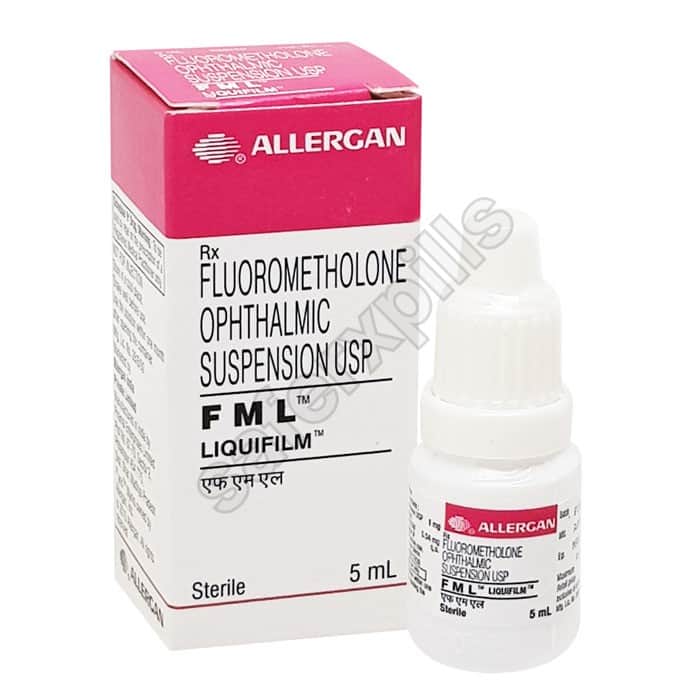
FML Eye Drop
Generic: Fluorometholone
Select Pack Size:
Selected: 1 Bottle
$12.00 total
$24.00 total
Save 50%About FML Eye Drop
FML Eye Drop is fluorometholone 0.1% (1 mg per mL), a corticosteroid (steroid) eye drop for inflammation of the surface and front of the eye. It is the Indian pack of the FML Liquifilm brand, a white suspension that you shake before each use. PharmEasy names Allergan India Pvt Ltd as the maker; Tata 1mg and Truemeds name AbbVie Therapeutics India Private Limited (Allergan is now part of AbbVie). The Indian listings we checked all show a 5 mL bottle. We sell it as 1, 3 or 6 bottles, from $9.67 a bottle in the 6 bottle pack, before shipping.
Please read this before you order. A steroid eye drop needs an eye doctor. The US label says the first prescription, and any renewal beyond 20 mL, should be made only after the eye has been examined with magnification such as a slit lamp, and the UK label says steroid eye drops should not be used for longer than a week except under an eye specialist's careful watch with regular eye pressure checks. Used on the wrong red eye (for example a herpes infection) or for too long, a steroid drop can cause glaucoma, cataract and serious eye infections. This page is for people whose eye doctor has already prescribed fluorometholone. Clinical details come from the US FML label, the UK FML Liquifilm label and leaflet, Health Canada and healthdirect Australia, all listed under Sources.
FML Eye Drop at a glance
| Active ingredient | Fluorometholone 0.1% (1 mg per mL), a corticosteroid; eye drops, suspension. The Indian listings we checked do not name a preservative, so read the carton (the US and UK FML products contain benzalkonium chloride). |
| Brand and maker | FML (Liquifilm). PharmEasy: Allergan India Pvt Ltd. Tata 1mg and Truemeds: AbbVie Therapeutics India Private Limited. |
| Labelled use | Corticosteroid responsive inflammation of the palpebral and bulbar conjunctiva, cornea and anterior segment of the globe (US label, Indications; UK label 4.1). In plain words: inflammation of the lining of the eyelids and eye, the clear front window of the eye and the front part of the eyeball. |
| Regulatory status | Fluorometholone 0.1% eye drops are licensed in the US (FML and generics), the UK (FML Liquifilm), Canada (FML and a Sandoz generic) and Australia (FML). The Indian pack we sell is not registered with the FDA, MHRA, TGA or Health Canada. |
| Usual dose | US label: one drop two to four times daily; in the first 24 to 48 hours, up to one drop every four hours. UK label: one to two drops two to four times daily; in the first 24 to 48 hours, up to two drops at one hour intervals. Your eye doctor sets the schedule. |
| Checks | Re-examination if there is no improvement after two days (US label). Eye pressure monitoring if used for 10 days or longer (US label); no longer than a week without an eye specialist's surveillance (UK label 4.4). |
| Packs | 1, 3 or 6 bottles (5 mL each on the Indian listings) |
| Price per bottle | $9.67 to $12.00 before shipping; $13.83 to $37.00 with shipping |
| Delivery | 7 to 14 business days to the US, UK, Australia and Canada; $25 shipping under $149, free from $149 |
Price per bottle
Prices as of October 2026; the pack selector shows the current price. No pack reaches the $149 free shipping level on its own, so each includes the $25 shipping charge below unless you add other items. Per mL figures assume 5 mL bottles, the size on every Indian listing we checked; confirm the size on the carton.
| Pack | Price | Per bottle | Per mL | Shipping | Order total | Per bottle with shipping |
|---|---|---|---|---|---|---|
| 1 bottle | $12.00 | $12.00 | $2.40 | $25 | $37.00 | $37.00 |
| 3 bottles | $33.00 | $11.00 | $2.20 | $25 | $58.00 | $19.33 |
| 6 bottles | $58.00 | $9.67 | $1.93 | $25 | $83.00 | $13.83 |
How many bottles make sense. Three label rules limit how much fluorometholone one person should use without being seen again. The US label says renewal of the prescription beyond 20 mL should be made only after an eye examination with magnification (Precautions). The UK label says to throw a bottle away 28 days after first opening (6.3), and Tata 1mg and PharmEasy say to use it within 4 weeks of opening. The UK label also says steroid eye drops should not be used for longer than a week except under an eye specialist's surveillance (4.4). By our arithmetic, 3 bottles are 15 mL and 6 bottles are 30 mL, so the 6 bottle pack is more than the 20 mL the US label allows before a re-examination. Buy only what your eye doctor has prescribed for this course, and never keep spare bottles to treat a future red eye yourself: a steroid can make some eye infections much worse (see "Who should not use FML").
Compared with fluorometholone eye drops in the US
FML (Allergan, now AbbVie, NDA 016851) is a prescription product in Drugs@FDA, and FDA approved generic fluorometholone 0.1% eye drops are sold by Sandoz, Amneal and Pacific Pharma in 5 mL and 10 mL bottles. The figures below are what US pharmacies paid according to the Medicaid NADAC survey, per-NDC rows in the file as of 28 October 2026 (each row effective 21 October 2026). They are pharmacy acquisition costs, not the price at the counter.
| Product | Maker | FDA approved | US pharmacy cost per mL | Per 5 mL bottle |
|---|---|---|---|---|
| FML 0.1% (brand), 5 mL | Allergan (AbbVie) | Yes | $32.10 ($32.09846) | About $160.49 |
| Generic fluorometholone 0.1%, 5 mL | Sandoz, Amneal, Pacific Pharma | Yes | $11.01 ($11.00753) | About $55.04 |
| FML Eye Drop, Indian pack (this page), 5 mL | Allergan India / AbbVie India (per listings) | No (not registered with the FDA) | $1.93 to $2.40 from us, before shipping | $9.67 to $12.00 before shipping; $13.83 to $37.00 with shipping |
Plainly: even a single bottle from us with shipping ($37.00) costs less than a US pharmacy pays for one 5 mL generic bottle (about $55.04). What a lower price does not buy you is the eye examination and pressure checks the labels call for, and our delivery takes 7 to 14 business days, which is too slow for inflammation you have today or for drops you need straight after surgery. If you are in the US and have a prescription, also compare US generic cash prices and your insurance cover, because what you pay at the counter can differ from the NADAC figure. In Australia, healthdirect says FML is not listed on the PBS.
FML and related fluorometholone products
We sell one fluorometholone product, the 0.1% FML Eye Drop, so there is no strength to choose here. Your prescription should name the product and strength.
| Product | What it is | Notes |
|---|---|---|
| FML Eye Drop (this product) | Fluorometholone 0.1% suspension | The strength of FML in the US, Canada and Australia and of FML Liquifilm in the UK. |
| FML Forte | Fluorometholone 0.25% suspension | A stronger product with the same dosing text in the US label. Health Canada lists it as cancelled (2016), Tata 1mg shows it as not available in India, and we do not sell it. Do not try to make up a higher dose by using more drops of FML 0.1%. |
| Flarex | Fluorometholone acetate 0.1% | A different form of fluorometholone (US NDA 019079). Not interchangeable without your eye doctor's say. |
| Lotepred Eye Drop | Loteprednol, a different steroid eye drop | Another steroid; never use two steroid eye drops together unless your eye doctor prescribes both. |
How to use FML eye drops
Use the schedule your eye doctor gives you. The labels set these schedules:
| Label | Usual dose | First 24 to 48 hours |
|---|---|---|
| US FML label | One drop into the conjunctival sac two to four times daily | The dosing frequency may be increased to one application every four hours |
| UK FML Liquifilm label (4.2) | One to two drops into the conjunctival sac two to four times daily | The dose may be safely increased to two drops at one hour intervals |
- Shake well before each use (US label; UK label 4.2). FML is a suspension, so the medicine settles in the bottle.
- Wash your hands. Do not use a new bottle if the seal on the neck is broken (UK leaflet). Tilt your head back, pull the lower lid down gently to make a pocket, and squeeze in the drop. Let go of the lid and close the eye for 30 seconds (UK leaflet).
- Do not let the bottle tip touch your eyelids, your eye or any other surface, and do not share the bottle: the US label says use of a bottle by more than one person may spread infection. Keep the bottle tightly closed, and store it upright (US label, How Supplied).
- If you use another eye medicine, put that one in at least 5 minutes before FML (UK label 4.4; UK leaflet).
- If you forget a dose, use it as soon as you remember unless it is almost time for the next one; do not use a double dose (UK leaflet).
- If too many drops go in, rinse the eye with clean water and take the next dose at the usual time (UK leaflet; UK label 4.9).
- Do not stop too early, and do not stop suddenly in a long-standing condition. The US label says care should be taken not to discontinue therapy prematurely, and in chronic conditions treatment should be withdrawn by gradually decreasing how often you use it (US label; UK label 4.2). Follow your eye doctor's plan for cutting down.
- Know when to go back. If signs and symptoms fail to improve after two days, the patient should be re-evaluated (US label). If inflammation or pain persists longer than 48 hours or becomes aggravated, the US label advises patients to discontinue use and consult a physician.
- Eye pressure checks. If the drops are used for 10 days or longer, the US label says eye pressure should be routinely monitored. The UK label says steroid eye drops should not be used for longer than a week except under an eye specialist's careful surveillance combined with regular measurement of eye pressure (4.4).
- Throw the bottle away 28 days after first opening (UK label 6.3; Truemeds) or 4 weeks (Tata 1mg; PharmEasy), even if some is left.
Contact lenses. The benzalkonium chloride in the US and UK products may be absorbed by soft contact lenses. The US label says soft lens wearers should wait at least 15 minutes after the drops before putting their lenses in. The UK label says to avoid contact with soft lenses, remove lenses before using FML and wait at least 15 minutes before putting them back (4.4). We do not know whether the Indian pack contains the same preservative, so follow the same rule. Ask your eye doctor whether to wear lenses at all while the eye is inflamed (our advice).
Driving. The drops can blur vision for a short time. Wait for it to clear before driving or using machines (UK label 4.7).
Groups who need extra care
- Glaucoma or raised eye pressure. Steroids should be used with caution in the presence of glaucoma, and eye pressure should be checked frequently (US label Warnings; UK label 4.4).
- A history of herpes simplex eye infection. The US label says use of a corticosteroid in patients with a history of herpes simplex requires great caution, and frequent slit lamp microscopy is recommended. The UK leaflet says to use FML only under close supervision of your doctor.
- Thin cornea or sclera. Various eye diseases and long-term use of topical corticosteroids have been known to cause thinning of the cornea and sclera, and use in the presence of thin tissue may lead to perforation (US label Warnings).
- After cataract surgery. The US label says steroids after cataract surgery may delay healing and increase the incidence of bleb formation.
- Children. Safety and effectiveness in infants below the age of two years have not been established (US label); the UK label says the same for children aged 2 years or less (4.2). The US label notes that eye pressure monitoring may be difficult in children and uncooperative patients.
- Pregnancy. The US label says fluorometholone caused fetal loss and abnormalities in rabbits at low multiples of the human eye dose and should be used in pregnancy only if the potential benefit justifies the potential risk to the fetus. The UK label says FML is not recommended during pregnancy (4.6).
- Breastfeeding. The UK label says FML should not be used during breast-feeding (4.6). The US label says a decision should be made whether to discontinue nursing or to discontinue the drug, taking into account the importance of the drug to the mother. Ask your doctor.
- Medicines that raise steroid levels. The UK label says co-treatment with CYP3A inhibitors, including cobicistat-containing products, is expected to increase the risk of systemic side effects, and the combination should be avoided unless the benefit outweighs that risk (4.5). The UK leaflet names the HIV medicines ritonavir and cobicistat. Tell your doctor about every medicine you take.
- Dry eye or a damaged cornea. The UK leaflet says benzalkonium chloride may cause eye irritation, especially in dry eyes or disorders of the cornea, and that in very rare cases phosphates have caused cloudy patches on a severely damaged cornea.
- Older adults. No overall differences in safety or effectiveness have been observed between elderly and younger patients (US label).
Side effects
The US label lists the main adverse reactions in decreasing order of frequency: raised eye pressure (intraocular pressure) with possible development of glaucoma and infrequent optic nerve damage, posterior subcapsular cataract, and delayed wound healing. The UK leaflet lists increased pressure inside the eye as common (may affect up to 1 in 10 people).
Eye pressure, in numbers. The two labels describe the pressure effect differently. The US label says that in studies of people known to respond to steroids with a pressure rise, fluorometholone took significantly longer on average than dexamethasone to raise pressure, but in a small percentage of people a significant rise happened within one week, and the ultimate size of the rise was the same for both drugs. The UK label describes a study in which, after six weeks, eye pressure rose by a mean of 3 mmHg on fluorometholone against 9 mmHg on dexamethasone (5.1). Either way, fluorometholone can raise eye pressure, which is why the labels ask for pressure checks.
Other reactions in the US label: secondary eye infections (bacterial, fungal and viral), acute anterior uveitis and perforation of the globe with steroid preparations, keratitis, conjunctivitis, corneal ulcers, a dilated pupil, eye redness, loss of focusing (accommodation) and a drooping eyelid, plus transient burning and stinging. It also lists allergic reactions, a feeling of something in the eye, eyelid redness, swelling of the eyelid or eye, eye discharge, eye pain, itching, watering, rash, a changed sense of taste, blurred vision and visual field defects. The UK leaflet lists the same kind of eye effects, including cataract and secondary infections, with a frequency that cannot be estimated from the available data.
The UK label adds that blurred vision or other visual disturbances should prompt referral to an eye specialist, because the cause may be cataract, glaucoma or a rare condition called central serous chorioretinopathy (4.4). Systemic effects are extremely uncommon, but rare cases of systemic hypercorticoidism (too much steroid in the body) have been reported after topical steroid use (UK label 4.8).
When to get urgent help
- Eye pain, a sudden change in vision, blurred or reduced vision, seeing halos, or a red, painful eye with headache: get same-day care from an eye doctor or an emergency department (our advice; raised eye pressure and steroid side effects can damage sight). The UK label says blurred vision or other visual disturbance should lead to referral to an eye specialist (4.4).
- Signs of an eye infection, such as more redness, pain, sticky discharge, sensitivity to light, or a white spot on the clear front of the eye: see an eye doctor the same day (our advice). Steroids can hide or worsen infections: the US label says acute pus-forming infections may be masked or made more active, and fungal infection should be suspected in any corneal ulcer that does not heal while a steroid is used.
- Blisters or sores on the eyelid or a painful red eye if you have ever had herpes (cold sores) near the eye: stop and see an eye doctor straight away (our advice). The labels say steroids may prolong and worsen viral eye infections, including herpes simplex (US label Warnings; UK label 4.4).
- Inflammation or pain that lasts longer than 48 hours or gets worse: stop the drops and see your doctor (US label, Information for Patients).
- Allergy signs (difficulty swallowing or breathing, or swelling of the lips, face, throat or tongue): the UK leaflet says contact your doctor or go to the hospital immediately. For severe signs, call emergency services (911 in the US and Canada, 999 in the UK, 000 in Australia; our advice).
- Someone swallows the drops: the UK leaflet says it is unlikely to cause harm and the person should drink fluids to dilute. If a child has swallowed a lot or seems unwell, call a doctor or poison control (US Poison Help 1-800-222-1222; Australian Poisons Information Centre 13 11 26; our advice).
Tell the doctor what you used (fluorometholone 0.1% eye drops), how often and for how long.
Who should not use FML
Never use it if you have (contraindications):
- Most viral diseases of the cornea and conjunctiva, including epithelial herpes simplex keratitis (dendritic keratitis), vaccinia and varicella (chickenpox) (US label; UK label 4.3).
- A mycobacterial infection of the eye (such as tuberculosis of the eye) or a fungal disease of the eye (US label; UK label 4.3).
- An untreated bacterial infection of the eye, or any undiagnosed red eye, because it may be a viral infection (UK label 4.3). The UK leaflet says do not use FML if you have a bacterial, viral or fungal infection of the eye.
- A known or suspected allergy to fluorometholone, any ingredient of the drops, or other corticosteroids (US label; UK label 4.3 names the active substance and the ingredients).
This is why a steroid eye drop must never be used for a red eye that has not been diagnosed. Many red eyes are infections, and a steroid can make some of them, especially herpes, much worse.
Not recommended, or only with your eye doctor's agreement:
- Longer than a week without an eye specialist's surveillance and regular pressure checks (UK label 4.4).
- Pregnancy: not recommended (UK label 4.6); only if the benefit justifies the risk (US label).
- Breastfeeding: should not be used (UK label 4.6); the US label asks for a decision between nursing and the drug.
- Young children: safety and effectiveness not established in infants below the age of two years (US label) or in children aged 2 years or less (UK label 4.2).
- Glaucoma, a history of herpes simplex, thin cornea or sclera, recent cataract surgery, CYP3A inhibitors such as ritonavir or cobicistat, dry eye and soft contact lenses: see "Groups who need extra care".
Prescription and legal status
Fluorometholone eye drops are prescription medicines in the US ("Rx only" on the FML label), the UK (FML Liquifilm is a prescription only medicine, PL 41042/0065), Canada (FML, DIN 00247855, and Sandoz Fluorometholone, DIN 00432814, both prescription and marketed) and Australia (FML is Schedule 4, Prescription Only Medicine, per healthdirect). Tata 1mg and Truemeds mark the Indian FML as needing a prescription. Fluorometholone 0.1% eye drops are licensed in all four countries, but the Indian pack we sell is not registered with the FDA, MHRA, TGA or Health Canada, and the FDA says personal importation of unapproved medicines is illegal in most circumstances. Check the rules where you live.
Buying genuine FML
The MHRA warns: "Any medicine not authorised for sale in the UK can be unsafe or ineffective and there is no way of knowing what is in them or the negative health effects they can have." That warning covers this Indian pack. The MHRA also advises: "Only use UK-registered pharmacies, including online pharmacies displaying the official green cross logo." When your order arrives, check that the carton and bottle say FML and fluorometholone 0.1%, name Allergan or AbbVie, and show a batch number and an expiry date, that the seal on the bottle neck is intact, and that the liquid is a white suspension that mixes evenly when shaken. These checks cannot prove a bottle is genuine, because counterfeiters copy packaging. Eye drops must be sterile: do not use a bottle with a broken seal, lumps that do not shake back into the liquid, or an unusual colour. If a batch causes symptoms, seek medical advice and report it to your medicines regulator (the MHRA Yellow Card scheme in the UK, FDA MedWatch in the US, the TGA in Australia or Health Canada) as well as to us.
Delivery and storage
We ship FML Eye Drop to the US, UK, Australia and Canada in plain packaging with tracking. Standard delivery takes 7 to 14 business days, so order well before your current bottle runs out, and never as a way to treat an eye problem you have now. Shipping costs a flat $25 on orders under $149 and is free from $149. None of the labels or listings we checked asks for refrigeration. Store the bottle as the carton says: the US label gives 2°C to 25°C, protect from freezing and store upright; the UK label says do not store above 25°C and do not freeze (6.4); healthdirect Australia says store below 30°C and do not freeze; Tata 1mg and PharmEasy say below 25°C, and Truemeds gives both below 30°C and below 25°C on the same page. See our shipping page and refund policy.
Related guides
- How to buy eye care medicine online safely
- Buying eye drops from an online pharmacy
- Glaucoma eye drops: every type explained (useful if a steroid has raised your eye pressure)
Other eye drops: Nevanac Eye Drop (nepafenac, a non-steroid drop for pain and inflammation after cataract surgery), Lotepred Eye Drop (loteprednol, another steroid) and Olopat Eye Drop (olopatadine, an antihistamine eye drop).
Sources
- FML (fluorometholone ophthalmic suspension, USP) 0.1%, US prescribing information, Allergan/AbbVie, NDA 016851, DailyMed setid c374d65a-35b5-4c9e-9069-5148875dc4df, version 14, published 29 September 2025 (text revised 12/2023): Description, Clinical Pharmacology, Indications and Usage, Contraindications, Warnings, Precautions, Adverse Reactions, Dosage and Administration, How Supplied. DailyMed
- Fluorometholone ophthalmic suspension USP 0.1%, US prescribing information, Sandoz Inc., ANDA 218819, DailyMed setid c9cbf06e-5413-4c3c-9ded-174c856a4ce1, version 3, published 13 July 2026 (cross-check). DailyMed
- FML Forte (fluorometholone 0.25%), US prescribing information, NDA 019216, DailyMed setid b810b4c3-ac7a-4ba5-85bf-ebfaf3b1dabf, version 16, published 24 February 2025. DailyMed
- FML Liquifilm Ophthalmic 1 mg/ml eye drops, suspension, UK Summary of Product Characteristics, AbbVie Ltd, PL 41042/0065, text revised 28 September 2023, sections 2, 4.1 to 4.9, 5.1, 6.3, 6.4; and patient leaflet. emc SmPC, emc leaflet
- Health Canada Drug Product Database: FML (DIN 00247855, AbbVie, marketed, prescription); Sandoz Fluorometholone (DIN 00432814, marketed, prescription); FML Forte 0.25% (DIN 00707511, cancelled 2016), queried 28 October 2026. Health Canada DPD
- healthdirect Australia. FML (fluorometholone 0.1% eye drops, 5 mL): Schedule 4, not on the PBS, storage, accessed 28 October 2026. healthdirect
- US Food and Drug Administration, Drugs@FDA and NDC Directory via openFDA: FML NDA 016851 (prescription), FML Forte NDA 019216, generic fluorometholone 0.1% (Sandoz ANDA 218819, Amneal ANDA 216348, Pacific Pharma), Flarex NDA 019079; bottle sizes per NDC, queried 28 October 2026. Drugs@FDA
- Centers for Medicare and Medicaid Services. National Average Drug Acquisition Cost (NADAC), fluorometholone 0.1% eye drops and FML Liquifilm 0.1%, per-NDC rows, 2026 file as of 28 October 2026 (rates effective 21 October 2026). data.medicaid.gov
- Tata 1mg, PharmEasy and Truemeds. FML Liquifilm 5 ml eye drops listings, accessed 28 October 2026. Tata 1mg, PharmEasy, Truemeds
- MHRA. 20 million illegal erectile dysfunction pills seized as MHRA warns against risky online buys, 13 February 2026. GOV.UK
- US Food and Drug Administration. Personal Importation. FDA
This page is for information and is not medical advice. Fluorometholone eye drops are a prescription steroid medicine; an eye doctor should examine your eye, prescribe the drops and check your eye pressure during treatment.
Key Information
- ✓Active Ingredient: Fluorometholone
- ✓Category: Eye Care
- ✓Form: Eye Drop
- ✓Brand: Allergan India Pvt Ltd
- ✓Manufacturer: Allergan India Pvt Ltd
Frequently Asked Questions
What is FML Eye Drop?
FML Eye Drop is fluorometholone 0.1% (1 mg per mL), a corticosteroid (steroid) eye drop suspension for inflammation of the conjunctiva, cornea and front of the eye. It is the Indian pack of FML Liquifilm, sold in 5 mL bottles; PharmEasy names Allergan India Pvt Ltd as the maker, and Tata 1mg and Truemeds name AbbVie Therapeutics India. It should only be used when an eye doctor has examined the eye and prescribed it.
Is it the same as FML in the US or FML Liquifilm in the UK?
It is the same brand, active ingredient and strength (fluorometholone 0.1%) as FML in the US, Canada and Australia and FML Liquifilm in the UK, but it is the Indian pack, which is not registered with the FDA, MHRA, TGA or Health Canada. The US and UK products contain the preservative benzalkonium chloride; the Indian listings we checked do not name a preservative, so read the carton.
How much does FML Eye Drop cost?
As of October 2026, 1 bottle is $12.00, 3 bottles are $33.00 ($11.00 each) and 6 bottles are $58.00 ($9.67 each), before shipping. Shipping is $25 on orders under $149, so with shipping a single bottle costs $37.00 and the 6 bottle pack works out at $13.83 a bottle. NADAC data show US pharmacies paid about $55.04 for a 5 mL generic bottle and about $160.49 for 5 mL of brand FML (effective 21 October 2026). The pack selector shows the current price.
How do I use fluorometholone eye drops?
Shake the bottle well before each use. The US label dose is one drop two to four times daily, and in the first 24 to 48 hours up to one drop every four hours; the UK label allows one to two drops two to four times daily, and up to two drops at one hour intervals in the first 24 to 48 hours. Your eye doctor sets the schedule. Do not let the tip touch the eye, wait at least 5 minutes after any other eye drop, and do not stop suddenly in a long-standing condition: the labels say to cut down gradually.
How long can I use FML eye drops?
Only as long as your eye doctor says. The UK label says steroid eye drops should not be used for longer than a week except under an eye specialist's careful surveillance with regular eye pressure checks. The US label says eye pressure should be routinely monitored if the drops are used for 10 days or longer, and that the patient should be re-evaluated if there is no improvement after two days. Throw a bottle away 28 days (UK label) or 4 weeks (Tata 1mg, PharmEasy) after opening.
Can I use FML for a red eye or pink eye without seeing a doctor?
No. The UK label lists any undiagnosed red eye as a contraindication because it may be a viral infection, and both the US and UK labels say not to use it in most viral eye infections, including herpes simplex keratitis, or in fungal or mycobacterial eye infections. A steroid can hide an infection or make it worse. A red eye needs to be diagnosed first, and our 7 to 14 business day delivery is too slow for an eye problem you have now.
What are the side effects of FML eye drops?
The main ones in the US label are raised eye pressure with possible glaucoma and, infrequently, optic nerve damage, posterior subcapsular cataract and delayed wound healing. The UK leaflet lists raised eye pressure as common (up to 1 in 10 people). Other reported effects include secondary eye infections, burning and stinging, blurred vision, eye pain, eyelid swelling, a drooping eyelid, rash and a changed sense of taste. Eye pain, vision changes or signs of infection need same-day care.
Who should not use FML eye drops?
The labels say never use it in most viral diseases of the cornea and conjunctiva (including dendritic herpes simplex keratitis, vaccinia and chickenpox), mycobacterial or fungal eye infections, or with an allergy to fluorometholone, any ingredient or (US label) other corticosteroids. The UK label adds untreated bacterial eye infections and any undiagnosed red eye. It is not recommended in pregnancy and should not be used while breastfeeding (UK label), and safety in children aged 2 or under is not established.
Can I wear contact lenses while using FML?
The US and UK products contain benzalkonium chloride, which soft contact lenses can absorb. The US label says wait at least 15 minutes after the drops before putting soft lenses in, and the UK label says remove lenses before using FML and wait at least 15 minutes before putting them back. We do not know whether the Indian pack has the same preservative, so follow the same rule, and ask your eye doctor whether to wear lenses at all while the eye is inflamed.
Do I need a prescription for fluorometholone eye drops?
Yes. Fluorometholone eye drops are prescription only in the US, the UK, Canada (FML and Sandoz Fluorometholone) and Australia (Schedule 4). Tata 1mg and Truemeds also mark the Indian FML as prescription required. The US label says the first prescription and any renewal beyond 20 mL should follow an eye examination with magnification. The FDA says personal importation of unapproved medicines is illegal in most circumstances, so check the rules where you live.
How long does delivery take?
Standard delivery to the US, UK, Australia and Canada takes 7 to 14 business days, in plain packaging with tracking. Shipping is $25 on orders under $149 and free from $149. That is too slow for inflammation you have today or for drops you need straight after eye surgery, so order well before your current bottle runs out. No label or listing we checked asks for refrigeration; store below 25°C, do not freeze, and keep the bottle upright.
Medical References
Sources: U.S. National Library of Medicine (DailyMed, PubMed), openFDA
Related Products
View all

Customer Reviews
No reviews yet. Be the first to review FML Eye Drop.
Related Articles
Health guides about Fluorometholone, written by pharmacists
Cyclosporine Eye Drops for Dry Eye: Restasis, Cyclomune and What the Trials Show
Cyclosporine eye drops treat the inflammation behind chronic dry eye rather than just wetting the surface. They are slow, they often sting, and in the main trials only about 15 percent of patients reached the headline tear production target. This guide explains what to expect and how Cyclomune 0.05% and 0.1% compare with Restasis.
Bimatoprost for Eyebrows: What the Trials Show About Off Label Use
Bimatoprost is FDA approved for eyelashes, not eyebrows, so brow use is off label and rarely discussed properly. A Phase 3 trial and three smaller randomised studies say it works. This guide covers the evidence, a realistic timeline, how brow application differs from lashes, and the risks worth taking seriously.
Is Careprost Legal in the USA? FDA Status, Prescription Rules and Counterfeit Risk
Careprost is not FDA approved and bimatoprost is prescription only in the US for every use, including lash growth. An accurate read of the law, the FDA label warnings, and how to tell a real supplier from a dangerous one.
Related Health Guide
Understanding Eyelash Growth & Eye Conditions: Complete Guide