Nevanac Eye Drop
Generic: Nepafenac
Select pack size
3 bottles · $10.33 per bottle
About Nevanac Eye Drop
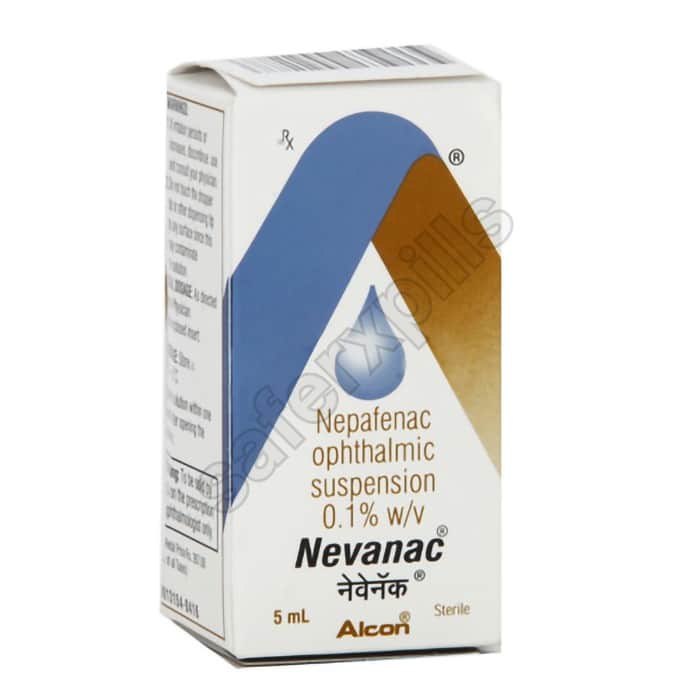
Nevanac Eye Drop is nepafenac 0.1% (1 mg per mL), a nonsteroidal anti-inflammatory (NSAID) eye drop in suspension, sold in India in a 5 mL bottle. It is a drop for the days around cataract surgery: the labels approve it for pain and inflammation after cataract surgery, and the UK label also for lowering the risk of swelling at the back of the eye (macular oedema) after cataract surgery in people with diabetes. Truemeds and Tata 1mg list the Indian pack under Alcon Laboratories; PharmEasy names J B Chemicals and Pharmaceuticals as the maker, with an Alcon Research address in Fort Worth, Texas, and the USA as country of origin. We sell it in packs of 3, 6 or 12 bottles, from $9.83 a bottle before shipping.
Please read this before you buy. Nevanac is not a drop for general eye pain, a red eye, dry eyes or an eye infection. It should be used only on the schedule your eye surgeon sets, because NSAID eye drops can damage the surface of the eye, and the US label says postmarketing experience suggests that using them more than 1 day before surgery or more than 14 days after it may increase that risk. If your eye is sore or red and you have not just had eye surgery, see a doctor or optometrist instead. Clinical details on this page come from the US and UK labels listed under Sources.
Nevanac Eye Drop at a glance
| Active ingredient | Nepafenac 0.1% (1 mg per mL), eye drops, suspension; 5 mL bottle (Truemeds, PharmEasy, Tata 1mg) |
| Brand and maker | Nevanac. Truemeds and Tata 1mg name Alcon Laboratories; PharmEasy names J B Chemicals and Pharmaceuticals, with Alcon Research LLC, Fort Worth, USA as the address and country of origin |
| Labelled uses | US: pain and inflammation associated with cataract surgery. UK (adults): prevention and treatment of pain and inflammation after cataract surgery, and reducing the risk of macular oedema after cataract surgery in diabetic patients |
| Regulatory status | Nevanac 0.1% is FDA approved (2005), licensed in the UK and marketed in Canada, all as a prescription medicine. In Australia we found only Ilevro 0.3% listed. The Indian pack we sell is not registered with the FDA, MHRA, TGA or Health Canada |
| Usual dose | 1 drop in the affected eye 3 times daily, from 1 day before cataract surgery, on the day of surgery and for the first 2 weeks after it (US 2.1; UK 4.2). The UK label adds 1 extra drop 30 to 120 minutes before surgery |
| Course length | US: 2 weeks after surgery. UK: 2 weeks, which the clinician can extend to 3 weeks; up to 60 days in diabetic patients, as the clinician directs |
| Packs | 3, 6 or 12 bottles of 5 mL |
| Price per bottle | $9.83 to $10.33 before shipping |
| Delivery | 7 to 14 business days to the US, UK, Australia and Canada; $25 shipping under $149, free from $149 |
Price per bottle
Prices as of October 2026; the pack selector shows the current price. None of the packs reaches the $149 free shipping level on its own, so each includes the $25 shipping charge below unless you add other items.
| Pack | Price | Per bottle | Per mL | Shipping | Per bottle with shipping | Per mL with shipping |
|---|---|---|---|---|---|---|
| 3 bottles (15 mL) | $31.00 | $10.33 | $2.07 | $25 | $18.67 | $3.73 |
| 6 bottles (30 mL) | $60.00 | $10.00 | $2.00 | $25 | $14.17 | $2.83 |
| 12 bottles (60 mL) | $118.00 | $9.83 | $1.97 | $25 | $11.92 | $2.38 |
How many bottles you need. The usual course for one eye is 1 drop 3 times a day from the day before surgery to 2 weeks after it, about 16 days. The US label says "use of the same bottle for both eyes is not recommended with topical eye drops that are used in association with surgery" (US 17), and the UK label says to discard the bottle 4 weeks after first opening (UK 6.3). In the US, Nevanac is supplied as a single 3 mL bottle (US 16). Our reading of the US label is that one 5 mL bottle covers one eye for one standard course (16 days at 3 drops a day is about 48 drops, well inside the 4 week discard limit; our arithmetic), so someone having both eyes done needs two bottles. The UK label is different: it doses "the affected eye(s)" (UK 4.2) and the UK leaflet says "If you use drops in both eyes, repeat the steps for your other eye", so if both eyes are treated at the same time, a UK surgeon may expect one bottle to cover both. Our smallest pack of 3 bottles is therefore more than most people need, and the 6 and 12 bottle packs are far more than one person needs for their own surgery. The exception is the UK diabetic schedule of up to 60 days after surgery: with the 4 week discard rule, that is about 3 bottles per eye (our arithmetic). Do not keep spare bottles to treat a later sore or red eye yourself.
Compared with Nevanac and other NSAID eye drops in the US and UK
We found no generic nepafenac in the US: Drugs@FDA lists only Nevanac 0.1% (NDA 021862, approved 19 August 2005) and Ilevro 0.3% (NDA 203491, approved 16 October 2012), both now sponsored by Harrow Eye, and NADAC has no generic nepafenac row. The figures below are what US pharmacies paid according to the Medicaid NADAC survey (rates effective 21 October 2026). They are pharmacy acquisition costs, not the price at the counter.
| Product | Maker | FDA approved | Cost per mL | Per bottle |
|---|---|---|---|---|
| Nevanac 0.1%, 3 mL (NDCs 0078-0778-03 and 82667-500-03) | Novartis, now Harrow Eye | Yes | $104.99 | About $314.96 |
| Ilevro 0.3%, 3 mL (once daily) | Novartis, now Harrow Eye | Yes | $121.11 | About $363.34 |
| Generic ketorolac 0.5% eye drops (a different NSAID) | Several | Yes | $1.16 to $1.41 | Depends on bottle size |
| Generic diclofenac 0.1% eye drops (a different NSAID) | Several | Yes | $1.60 to $1.71 | Depends on bottle size |
| Nevanac 0.1%, 5 mL, Indian pack (this page) | See above | Not registered with the FDA (Indian pack) | $1.97 to $2.07 from us, before shipping | $9.83 to $10.33, before shipping |
So against US Nevanac itself, the Indian pack costs far less. But US pharmacies pay less per mL for generic ketorolac and diclofenac eye drops than our price, and much less once our shipping is added. These are different medicines, and only your surgeon can say whether one of them suits your operation. If you are in the US, ask your surgeon whether a generic NSAID drop is an option, and check your insurance cover, before ordering Nevanac from abroad. In the UK, the NHS indicative price of a 5 mL bottle of Nevanac is £14.92 (NHS dm+d, a list price, not what a patient pays). If you are having surgery at a clinic or on the NHS, ask whether your drops are supplied as part of your care (our advice).
What Nevanac is for, and what it is not for
Nepafenac is a prodrug. After the drop goes in, it passes through the cornea and enzymes in the eye convert it to amfenac, an NSAID that blocks the enzyme the eye needs to make prostaglandins, the chemicals behind inflammation and pain (US 12.1; UK 5.1). In two placebo-controlled US trials of the 3 times daily schedule, about 80% of people on Nevanac reported no eye pain on the day after cataract surgery, against about 50% on the inactive drop (US 14). In one UK label study, Nevanac was non-inferior to ketorolac 0.5% for inflammation and eye pain (UK 5.1). In a placebo-controlled study in people with diabetic retinopathy, macular oedema developed in 3.2% on Nevanac against 16.7% on the inactive drop (UK 5.1).
| Situation | Nevanac? |
|---|---|
| Planned cataract surgery, and your surgeon has prescribed Nevanac | Yes, on the surgeon's schedule |
| Cataract surgery in a person with diabetes (UK indication) | Only if your surgeon prescribes it, for the time they set (up to 60 days in the UK label) |
| Eye pain, a red eye or an eye injury without recent surgery | No. See a doctor or optometrist: these need an examination, and NSAID drops can hide an infection (UK 4.4) |
| Dry eyes, allergy or tired eyes | No. It is not labelled for these, and people with dry eye may be at increased risk of corneal side effects (US 5.3) |
| Children and teenagers | Not established under 10 in the US label (8.4); not recommended in children and adolescents in the UK label (4.2) |
Nevanac 0.1% and Ilevro 0.3%. Ilevro is nepafenac 0.3%, used once daily from the day before surgery to 2 weeks after it, with an extra drop 30 to 120 minutes before surgery (Ilevro US 2.1). We sell only the 0.1% Nevanac drop. The two are not used drop for drop the same way, so follow the instructions for the product your surgeon prescribed.
How to use Nevanac Eye Drop
- Follow your surgeon's schedule. The labelled dose is 1 drop in the eye being operated on, 3 times daily, starting 1 day before cataract surgery, continuing on the day of surgery and for the first 2 weeks after it (US 2.1; UK 4.2). The UK label adds one extra drop 30 to 120 minutes before surgery and allows the course to be extended to 3 weeks if the clinician directs (UK 4.2). The UK leaflet suggests morning, midday and evening.
- Shake the bottle well before each use (US 2.1; UK 4.2). It is a suspension, so the medicine settles.
- Wash your hands. If the tamper-evident snap collar is loose after you take off the cap, remove it (UK 4.2). Tilt your head back, pull the lower lid down and put one drop into the pocket.
- Do not let the dropper tip touch your eye, eyelids or any surface. The US label warns that a contaminated tip can cause eye infections, and that "serious damage to the eye and subsequent loss of vision may result from using contaminated solutions" (US 17). This matters more than usual after surgery.
- If both eyes are being treated, the US label says using the same bottle for both eyes is not recommended with drops used around surgery (US 17). The UK leaflet says that if you use drops in both eyes, repeat the steps for your other eye. Keep the bottle tightly closed (UK 4.2).
- If you use other eye drops, leave at least 5 minutes between them, and use eye ointments last (US 2.2; UK 4.2).
- Missed dose: put in a single drop as soon as you remember, then go back to your usual times. Do not use a double dose (UK 4.2). If it is almost time for the next dose, skip the missed one (UK leaflet).
- Do not swallow or inject it (UK 4.4). The UK label says no toxic effects are likely even if it is swallowed by accident (UK 4.9); if a child swallows some and you are worried, call your doctor or a poison line (our advice).
- Do not stop early without speaking to your doctor (UK leaflet), and do not carry on past the time your surgeon set.
Contact lenses. The US label says Nevanac "should not be administered while using contact lenses" (US 5.4). The UK label says contact lenses are not recommended after cataract surgery unless your doctor clearly advises it; if you must wear them, take them out before the drop and wait at least 15 minutes before putting them back, because the preservative, benzalkonium chloride, can discolour soft lenses (UK 4.4).
Sunlight and driving. The UK label says to avoid sunlight during treatment (UK 4.4). Vision may blur for a time after a drop; wait until it clears before driving or using machines (UK 4.7).
Storage. US: 2°C to 25°C (US 16). UK: do not store above 30°C, and throw the bottle away 4 weeks after first opening; write the opening date on the label (UK 6.3, 6.4, leaflet). For the Indian pack, Truemeds lists storage below 25°C and use within 28 days of opening, and PharmEasy lists below 30°C and discard 4 weeks after first opening. No source we checked asks for it to be kept in a fridge. Read the carton that comes with your bottle.
Why the length of the course matters
The US label says: "Postmarketing experience with topical NSAIDs also suggests that use more than 1 day prior to surgery or use beyond 14 days post-surgery may increase patient risk and severity of corneal adverse events" (US 5.3). The UK label says: "Prolonged use of topical NSAIDs may increase patient risk for occurrence and severity of corneal adverse reactions" (UK 4.4). The UK label does allow longer courses (3 weeks, or up to 60 days in diabetic patients) when the clinician directs, and it says that when nepafenac is prescribed to a diabetic patient after cataract surgery, any additional risk factor "should lead to reassessment of the foreseen benefit/risk and to intensified patient monitoring" (UK 4.8). In both cases, the course length is the surgeon's decision, not one to extend yourself. Go to every follow-up check your surgeon books.
Groups who need extra care
- People at higher risk of corneal damage. Both labels say postmarketing experience suggests a higher risk of corneal adverse events, "which may become sight threatening", in people with complicated eye surgery, corneal denervation, corneal epithelial defects, diabetes mellitus, ocular surface diseases such as dry eye, rheumatoid arthritis, or repeat eye surgery within a short period, and that topical NSAIDs "should be used with caution" in them (US 5.3; UK 4.4).
- Bleeding problems or blood thinners. There have been reports that NSAID eye drops may cause increased bleeding of eye tissues, including hyphaema (blood in the front of the eye), in connection with eye surgery. Use with caution if you bruise or bleed easily or take medicines that prolong bleeding time (US 5.1; UK 4.4). The UK leaflet names warfarin and other NSAIDs.
- Steroid eye drops. Topical NSAIDs and topical steroids can each slow healing, and using them together "may increase the potential for healing problems" (US 5.2; UK 4.4). The UK label advises caution, particularly in people at high risk of corneal reactions. Surgeons often prescribe both; follow their schedule and attend checks (our advice).
- Glaucoma drops. The UK label says there are very limited data on using Nevanac with prostaglandin analogue drops (for example latanoprost or bimatoprost) and that "the concomitant use of these medicinal products is not recommended" (UK 4.5). Tell your surgeon about every eye drop you use.
- Eye infection. Anti-inflammatory drops may mask an acute eye infection, and NSAIDs do not treat infection (UK 4.4).
- Dry eye or corneal disease. The preservative benzalkonium chloride can irritate the eye and has been reported to cause punctate keratopathy and toxic ulcerative keratopathy; close monitoring is needed with frequent or prolonged use (UK 4.4).
- Pregnancy. The UK label says Nevanac "is not recommended during pregnancy" and "should not be used by women of child bearing potential not using contraception" (UK 4.6). The US label says to use it in pregnancy only if the potential benefit justifies the potential risk to the fetus, and that use in late pregnancy "should be avoided" because of effects on the baby's heart circulation (closure of the ductus arteriosus) (US 8.1).
- Breastfeeding. The UK label says "NEVANAC can be used during breast-feeding" because exposure is negligible (UK 4.6). The US label says caution should be exercised (US 8.3).
- Children and teenagers. US: safety and effectiveness below 10 years not established (8.4). UK: not established in children and adolescents, and "not recommended" (4.2); the UK leaflet says not to give it to anyone below 18.
- Older people, kidney or liver disease. No overall differences were seen in older people (US 8.5; UK 4.2). It has not been studied in kidney or liver disease, but systemic exposure is very low and the UK label says no dose adjustment is warranted (UK 4.2).
Side effects
The two labels report different figures because they come from different data. The US figures are from the cataract surgery trials, and the label says "some of these reactions may be the consequence of the cataract surgical procedure" (US 6.1). The UK figures come from clinical studies in 2,314 patients and from postmarketing reports (UK 4.8).
| Label | How often | Reactions |
|---|---|---|
| US 6.1 | About 5% to 10% | Capsular opacity, decreased visual acuity, foreign body sensation, increased eye pressure, sticky sensation |
| US 6.1 | About 1% to 5% | Conjunctival oedema, corneal oedema, dry eye, lid margin crusting, eye discomfort, eye redness, eye pain, itching, light sensitivity, tearing, vitreous detachment |
| US 6.1 | 1% to 4% (outside the eye) | Headache, high blood pressure, nausea or vomiting, sinusitis |
| UK 4.8 | Uncommon (up to 1 in 100) | Keratitis, punctate keratitis, corneal epithelium defect, foreign body sensation, eyelid margin crusting |
| UK 4.8 | Rare (up to 1 in 1,000) | Iritis, choroidal effusion, corneal deposits, eye pain, discomfort, dry eye, blepharitis, irritation, itching, discharge, allergic conjunctivitis, tearing, redness; hypersensitivity, dizziness, headache, nausea; dermatochalasis, allergic dermatitis |
| UK 4.8 | Not known | Corneal perforation, impaired corneal healing, corneal opacity, corneal scar, reduced visual acuity, eye swelling, ulcerative keratitis, corneal thinning, blurred vision; raised blood pressure; vomiting |
In the UK diabetic studies (209 patients treated for 60 days or more), punctate keratitis occurred in 3% (UK 4.8). The US label says Nevanac had no significant effect on eye pressure in the trials, but that eye pressure can change after cataract surgery (US 14). From postmarketing experience, corneal epithelium problems have ranged from minor to cases needing surgery or medical treatment "to regain clear vision" (UK 4.8).
When to get urgent help
- Your eye becomes more red or more painful while you are using the drops. The UK leaflet says to contact your doctor immediately, as this may be inflammation of the eye surface or of the iris.
- Worse vision, a cloudy or white patch on the cornea, or a feeling that something is scratching the eye. These can be signs of damage to the eye surface (our description). The labels say anyone with evidence of corneal epithelial breakdown "should immediately discontinue" the drop and be closely monitored (US 5.3; UK 4.4). Contact your surgeon the same day (our advice).
- Signs of infection or a new eye injury, such as discharge, swelling or increasing pain. The US label says to seek your doctor's advice immediately about carrying on with the bottle (US 17).
- Bleeding in the eye, for example blood visible in the front of the eye after surgery (US 5.1). Contact your surgeon or go to emergency eye care straight away (our advice).
- Allergy signs: swelling of the eyelids, lips, face or throat, hives, wheezing or trouble breathing. Stop the drop and get emergency help (911 in the US and Canada, 999 in the UK, 000 in Australia) if breathing is affected (our advice). This matters most if aspirin or other NSAIDs have caused asthma, hives or a runny nose before (UK 4.3).
Who should not use it
Never use it if:
- You have had an allergic reaction to nepafenac or any ingredient of the drop, or to other NSAIDs (US 4; UK 4.3).
- Aspirin or other NSAIDs have brought on attacks of asthma, urticaria (hives) or acute rhinitis (UK 4.3). The UK leaflet gives aspirin, ibuprofen, ketoprofen, piroxicam and diclofenac as examples of NSAIDs. The UK label also warns of possible cross-sensitivity with aspirin and phenylacetic acid derivatives (UK 4.4).
Not recommended, or use only with your surgeon's agreement:
- Without a planned or recent cataract operation, or for longer than your surgeon set (our advice; the labels approve it only for use around cataract surgery).
- Pregnancy: "not recommended" (UK 4.6); avoid in late pregnancy (US 8.1).
- Women who could become pregnant and are not using contraception: "should not be used" (UK 4.6).
- Children and adolescents: "not recommended" (UK 4.2).
- With prostaglandin analogue glaucoma drops: "not recommended" (UK 4.5).
- While wearing contact lenses: "should not be administered" (US 5.4).
- Bleeding tendencies, blood thinners, steroid drops, diabetes, rheumatoid arthritis, dry eye, corneal problems or repeat eye surgery: caution, as above.
Prescription and legal status
Nevanac 0.1% is a prescription medicine in the US (Drugs@FDA lists NDA 021862 as prescription; US sponsor Harrow Eye), the UK (prescription only medicine, PLGB 00101/1110, Novartis Pharmaceuticals UK) and Canada (Nevanac, DIN 02308983, prescription, marketed). In Australia, healthdirect lists Ilevro 0.3% as Schedule 4, Prescription Only Medicine; we found no Australian listing for Nevanac 0.1%. In India, Truemeds says "Prescription required" and PharmEasy marks it prescription only. The FDA says personal importation of unapproved medicines is illegal in most circumstances, and this Indian pack is not the US-approved pack. Check the rules where you live, and use Nevanac only with a prescription and instructions from your eye surgeon.
Buying genuine Nevanac
The MHRA warns: "Any medicine not authorised for sale in the UK can be unsafe or ineffective and there is no way of knowing what is in them or the negative health effects they can have." It also advises: "Only use UK-registered pharmacies, including online pharmacies displaying the official green cross logo." When your order arrives, check that the carton and bottle say nepafenac 0.1% (1 mg/mL) ophthalmic suspension, show a batch number and an expiry date, and that the seal is intact. The UK label describes the suspension as light yellow to light orange (UK 3). These checks cannot prove a bottle is genuine, because counterfeiters copy packaging. If a batch looks wrong or causes symptoms, stop using it, seek medical advice and report it to your medicines regulator (the MHRA Yellow Card scheme in the UK, FDA MedWatch in the US, the TGA in Australia or Health Canada) as well as to us.
Delivery
We ship Nevanac Eye Drop to the US, UK, Australia and Canada in plain packaging with tracking. Standard delivery takes 7 to 14 business days. Because the drops start the day before surgery, order well ahead; if your operation is less than about three weeks away, get the drops locally so you are not left without them (our advice). Shipping costs a flat $25 on orders under $149 and is free from $149. See our shipping page and returns and refunds.
Related guides
- Buying eye drops from an online pharmacy: what you need to know
- How to buy eye care medicine online safely
- Glaucoma eye drops: every type explained (useful if you also use glaucoma drops)
Another NSAID eye drop: Megabrom Eye Drop (bromfenac). Your surgeon decides which drop you use.
Sources
- NEVANAC (nepafenac ophthalmic suspension) 0.1%, US Prescribing Information, Harrow Eye LLC, DailyMed setid 11b9a0cf-2a70-17ef-e063-6394a90a5d9e, SPL version 3 (document date 5 November 2024, label revised 11/2025, published on DailyMed 17 November 2025), sections 1, 2, 4, 5, 6.1, 8, 12, 14, 16 and 17; earlier Novartis version, setid a2909252-c5f1-421f-9073-b7be90b45b51 (2023). DailyMed
- ILEVRO (nepafenac ophthalmic suspension) 0.3%, US Prescribing Information, Harrow Eye LLC, DailyMed setid 10f411d3-a81e-074a-e063-6294a90ab547, SPL version 5 (effective 1 April 2026), sections 2.1 and 16. DailyMed
- NEVANAC 1 mg/ml eye drops, suspension, UK Summary of Product Characteristics, Novartis Pharmaceuticals UK, PLGB 00101/1110, revised 20 May 2024, sections 3 to 6. emc
- NEVANAC 1 mg/ml eye drops, suspension, UK Package Leaflet, revised December 2024. emc
- US Food and Drug Administration, Drugs@FDA (via openFDA, searched 21 October 2026): NDA 021862 Nevanac 0.1% (approved 19 August 2005) and NDA 203491 Ilevro 0.3% (approved 16 October 2012), prescription; no generic nepafenac listed. Drugs@FDA
- Health Canada Drug Product Database: Nevanac (DIN 02308983) and Ilevro (DIN 02411393), Novartis Pharmaceuticals Canada, prescription, marketed, searched 21 October 2026. Health Canada DPD
- healthdirect Australia: Ilevro 0.3% eye drops, 3 mL, Schedule 4, accessed October 2026. healthdirect
- NHS Business Services Authority, dm+d: Nevanac 1 mg/ml eye drops 5 ml, NHS indicative price £14.92, accessed October 2026. dm+d
- Centers for Medicare and Medicaid Services. National Average Drug Acquisition Cost (NADAC), per-NDC rows for Nevanac 0.1%, Ilevro 0.3%, ketorolac 0.5% and diclofenac 0.1% eye drops, 2026 file as of 21 October 2026 (rates effective 21 October 2026). data.medicaid.gov
- Truemeds, PharmEasy and Tata 1mg. Nevanac 0.1% eye drops 5 mL listings, accessed October 2026. Truemeds, PharmEasy
- MHRA. 20 million illegal erectile dysfunction pills seized as MHRA warns against risky online buys, 13 February 2026. GOV.UK
- US Food and Drug Administration. Personal Importation. FDA
This page is for information and is not medical advice. Nevanac is a prescription medicine for use around eye surgery; your eye surgeon should set the dose and the length of the course.
Key Information
- ✓Active Ingredient: Nepafenac
- ✓Category: Eye Care
- ✓Form: Eye Drop
- ✓Brand: Alcon Laboratories
- ✓Manufacturer: Alcon Laboratories
Frequently Asked Questions
What is Nevanac Eye Drop used for?
Nevanac is nepafenac 0.1%, an NSAID eye drop used around cataract surgery. The US label approves it for pain and inflammation associated with cataract surgery. The UK label covers prevention and treatment of pain and inflammation after cataract surgery in adults, and reducing the risk of macular oedema (swelling at the back of the eye) after cataract surgery in diabetic patients. It is not a drop for general eye pain, red eyes, dry eyes or infections.
Is the Indian Nevanac the same as Nevanac in the US or UK?
It has the same active ingredient at the same strength, nepafenac 0.1% (1 mg per mL), in a 5 mL bottle according to Truemeds, PharmEasy and Tata 1mg. Truemeds and Tata 1mg name Alcon Laboratories; PharmEasy names J B Chemicals and Pharmaceuticals with an Alcon Research address in Fort Worth, USA. Nevanac is FDA approved and licensed in the UK and Canada, but this Indian pack is not registered with the FDA, MHRA, TGA or Health Canada. The US bottle holds 3 mL; the UK and Indian bottles hold 5 mL.
How much does Nevanac Eye Drop cost?
As of October 2026, $31 for 3 bottles ($10.33 each), $60 for 6 ($10.00 each) and $118 for 12 ($9.83 each), plus $25 shipping on orders under $149. The pack selector shows the current price. US pharmacies paid about $314.96 for a 3 mL bottle of Nevanac (NADAC, October 2026), but generic ketorolac 0.5% and diclofenac 0.1% eye drops cost US pharmacies about $1.16 to $1.71 per mL, less than ours. Ask your surgeon whether a generic drop is an option.
How do I use Nevanac eye drops?
Follow your surgeon's schedule. The labelled dose is 1 drop in the eye being operated on 3 times daily, starting 1 day before cataract surgery, continuing on the day of surgery and for the first 2 weeks after it (US 2.1; UK 4.2). The UK label adds one drop 30 to 120 minutes before surgery. Shake the bottle well first, do not let the tip touch the eye, and leave 5 minutes between different eye drops.
How long should I use Nevanac?
For as long as your surgeon tells you. The US label course ends 2 weeks after surgery and says postmarketing experience suggests that use more than 1 day before or more than 14 days after surgery may increase the risk and severity of corneal problems (US 5.3). The UK label allows the clinician to extend the course to 3 weeks, or up to 60 days in diabetic patients. Do not extend the course yourself.
Can I use Nevanac for eye pain or a red eye without surgery?
No. Nevanac is approved only for use around cataract surgery. A painful or red eye needs an examination, because it can be an infection, an injury or raised eye pressure, and the UK label warns that anti-inflammatory drops can mask an eye infection (UK 4.4). Using NSAID drops without need also exposes the cornea to risk. See a doctor or optometrist instead.
What are the side effects of Nevanac?
In the US cataract surgery trials, capsular opacity, decreased visual acuity, foreign body sensation, increased eye pressure and a sticky feeling occurred in about 5% to 10%, and the label notes that some may come from the surgery itself (US 6.1). The UK label lists keratitis, foreign body sensation and eyelid crusting as uncommon. Serious corneal problems, including thinning, ulcers and perforation, have been reported with frequency not known (UK 4.8) and can threaten sight. Contact your doctor immediately if your eye becomes more red or painful.
Who should not use Nevanac?
Do not use it if you are allergic to nepafenac, any ingredient or other NSAIDs (US 4; UK 4.3), or if aspirin or other NSAIDs have caused asthma, hives or acute rhinitis (UK 4.3). The UK label says it is not recommended in pregnancy, in children and adolescents, or with prostaglandin glaucoma drops, and should not be used by women who could become pregnant and are not using contraception. Bleeding problems, steroid drops, diabetes, dry eye and rheumatoid arthritis need caution.
Can I wear contact lenses while using Nevanac?
The US label says Nevanac should not be used while wearing contact lenses (US 5.4). The UK label says contact lenses are not recommended after cataract surgery unless your doctor clearly advises it; if you must wear them, remove them before the drop and wait at least 15 minutes, because the preservative benzalkonium chloride can discolour soft lenses (UK 4.4).
Do I need a prescription for Nevanac?
Yes. Nevanac is a prescription medicine in the US, the UK (prescription only medicine) and Canada, and in Australia healthdirect lists Ilevro 0.3% as Schedule 4 (we found no Nevanac 0.1% listing there). Truemeds and PharmEasy list it as prescription only in India. The FDA says personal importation of unapproved medicines is illegal in most circumstances. Use it only with a prescription and instructions from your eye surgeon.
How long does delivery take, and how many bottles do I need?
Delivery takes 7 to 14 business days to the US, UK, Australia and Canada, with tracking and plain packaging; shipping is $25 under $149 and free from $149. The drops start the day before surgery, so order well ahead, or buy locally if surgery is less than about three weeks away (our advice). The US label advises against using one bottle for both eyes, so our reading is one bottle per eye for a standard course; the UK leaflet instead says to repeat the steps for the other eye with the same bottle; our smallest pack of 3 is more than most people need.
Medical References
Sources: U.S. National Library of Medicine (DailyMed, PubMed), openFDA
Related Products
View all

Customer Reviews
No reviews yet. Be the first to review Nevanac Eye Drop.
Related Articles
Health guides about Nepafenac, written by pharmacists
Antibiotic Eye Drops: When Pink Eye Needs Them, US Options, Doses and Cost
Antibiotic eye drops treat bacterial conjunctivitis, not viral or allergic pink eye. This guide covers when an antibiotic is likely to help (CDC, AAO and the 2023 Cochrane review), the main US options from ofloxacin, ciprofloxacin and moxifloxacin to tobramycin, polymyxin B with trimethoprim, azithromycin and erythromycin ointment, the dose on each label, label trial results, steroid combination warnings, contact lens rules and what each costs US pharmacies.
Cyclosporine Eye Drops for Dry Eye: Restasis, Cyclomune and What the Trials Show
Cyclosporine eye drops treat the inflammation behind chronic dry eye rather than just wetting the surface. They are slow, they often sting, and in the main trials only about 15 percent of patients reached the headline tear production target. This guide explains what to expect and how Cyclomune 0.05% and 0.1% compare with Restasis.
Bimatoprost for Eyebrows: What the Trials Show About Off Label Use
Bimatoprost is FDA approved for eyelashes, not eyebrows, so brow use is off label and rarely discussed properly. A Phase 3 trial and three smaller randomised studies say it works. This guide covers the evidence, a realistic timeline, how brow application differs from lashes, and the risks worth taking seriously.
Related Health Guide
Understanding Eyelash Growth & Eye Conditions: Complete Guide