
Hypersol Eye Drop
Generic: Sodium Chloride
Select pack size
3 bottles · $4.33 per bottle
About Hypersol Eye Drop
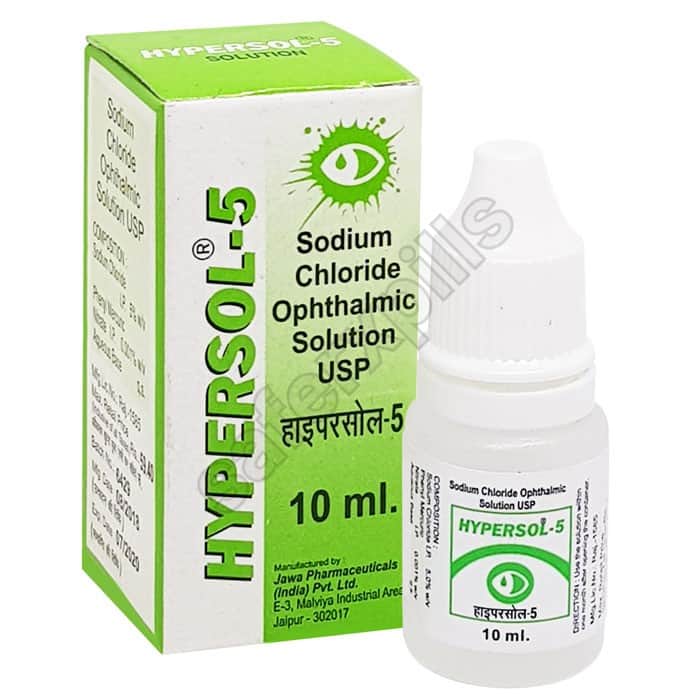
Hypersol 5 is a hypertonic salt eye drop: sodium chloride 5% w/v, made in India by Jawa Pharmaceuticals in Jaipur. Its job is to draw excess water out of a swollen cornea (corneal oedema), for example in Fuchs dystrophy or after eye surgery. The carton and bottle in our product photo show a 10 ml bottle. We sell packs of 3, 6 and 12 bottles, from $3.42 a bottle in the 12 pack before shipping.
Three points before you buy. First, this is not a dry eye drop. Our old listing said it was, and that was wrong: the US label for the same 5% drop lists one use, the temporary relief of corneal oedema, and says not to use it except under the advice and supervision of a doctor. Second, Hypersol 5 contains a mercury compound, phenylmercuric nitrate 0.001% w/v, as its preservative (Tata 1mg, MediBuddy; the bottle in our product photo). Third, in the US and the UK the same strength is sold without a prescription, and a local pharmacy can often supply it quickly for less than one of our packs costs with shipping (our view; details below).
Hypersol 5 at a glance
| Active ingredient | Sodium chloride 5% w/v (50 mg per ml), a hypertonicity agent. Preservative: phenylmercuric nitrate 0.001% w/v (Tata 1mg, MediBuddy; Truemeds names it without a strength; partly legible on the bottle in our product photo) |
| Brand and maker | Hypersol 5, Jawa Pharmaceuticals (India) Pvt. Ltd., Malviya Industrial Area, Jaipur (carton in our product photo; Tata 1mg). Apollo Pharmacy, Truemeds and MediBuddy name Jawa Pharmaceuticals as well. |
| Used for | Swelling of the cornea (corneal oedema). US label: "temporary relief of corneal edema". It is not a treatment for dry eye or eye infections. |
| Regulatory status | This Indian pack is not registered with the FDA, MHRA, TGA or Health Canada. The US sells 5% sodium chloride eye drops without a prescription under the FDA's OTC monograph rules (for example Muro 128). In the UK, 5% saline eye drops are listed as medical devices. |
| Usual dose | US label: 1 or 2 drops in the affected eye(s) every 3 or 4 hours, or as directed by a doctor. The Indian listings leave the dose to your doctor. |
| How it works | It is saltier than the cornea, so water moves out of the cornea into the drop (21 CFR 349.3). The effect is temporary; it does not treat the cause of the swelling. |
| Storage | Below 30 °C (Tata 1mg, Truemeds). The US Muro 128 label says store upright at 15 to 25 °C and keep tightly closed. |
| Packs | 3, 6 and 12 bottles (10 ml each in our product photo) |
| Price per bottle | $4.33 (3 pack) down to $3.42 (12 pack), before shipping |
| Delivery | 7 to 14 business days to the US, UK, Australia and Canada; $25 shipping under $149, free from $149 |
Price per bottle
Prices below are as of November 2026; the pack selector shows the current price.
| Pack | Price | Per bottle | Shipping | Per bottle with shipping | Per ml with shipping |
|---|---|---|---|---|---|
| 3 bottles | $13 | $4.33 | $25 | $12.67 | $1.27 |
| 6 bottles | $25 | $4.17 | $25 | $8.33 | $0.83 |
| 12 bottles | $41 | $3.42 | $25 | $5.50 | $0.55 |
Every pack is under the $149 free shipping line, so each order of one pack carries $25 shipping, which is more than the price of the 3 pack itself. The larger packs are also a little cheaper per bottle before shipping. Per ml figures assume the 10 ml bottle shown in our product photo (our arithmetic). Our product record lists the volume as 5 ml, while the photo and all four Indian listings we checked show 10 ml; check the volume on the carton when your order arrives, and contact us if it differs.
How long a bottle lasts. Drop sizes vary, so we cannot give an exact count. If the label dose of 1 or 2 drops every 3 or 4 hours is used in one eye during waking hours, that is roughly 4 to 12 drops a day (our estimate). Some doctors use fewer doses (our note): the 2024 trial below used drops four times a day. None of the Indian listings gives a time limit for an opened bottle; check the carton, and if it gives none, ask a pharmacist how long to keep an open bottle (our advice). The 12 pack only makes sense if an eye doctor has told you to use these drops long term.
Compared with what you can buy locally
| Hypersol 5 (ours) | Muro 128 5% (US brand) | US generic 5% drops (for example Rugby) | |
|---|---|---|---|
| Active ingredient | Sodium chloride 5% | Sodium chloride 5% | Sodium chloride 5% |
| Preservative | Phenylmercuric nitrate 0.001% (Indian listings) | Methylparaben and propylparaben, with boric acid, hypromellose, propylene glycol and sodium borate | Same inactive ingredients as Muro 128 on the Rugby label |
| Bottle | 10 ml (our photo) | 15 ml | 15 ml |
| Status in the US | Not registered with the FDA | Sold without a prescription (OTC) | Sold without a prescription (OTC) |
| Cost | $12.67 a bottle with shipping in the 3 pack, $5.50 in the 12 pack | US pharmacies pay about $16.78 a bottle (NADAC $1.11839 per ml); Walmart.com listed $27.99 for one 15 ml bottle (third-party seller) | US pharmacies pay about $5.17 a bottle (NADAC $0.34465 per ml) |
NADAC is the average price US pharmacies pay, not the shelf price. Both NADAC rows are from the file as of 4 November 2026, effective 21 October 2026; the per-bottle figures are our arithmetic. Per ml with shipping, and assuming the 10 ml bottle in our photo, our 3 pack ($1.27) is cheaper than the Muro 128 bottle at Walmart.com ($1.87 per ml, our arithmetic) but costs far more than a US pharmacy pays for a generic 5% bottle. In the UK, Well Pharmacy lists sodium chloride 5% eye drops at GBP 7.75 for 10 ml (brand may vary). We have not found any study comparing Hypersol 5 with Muro 128.
- US: 5% sodium chloride eye drops are an OTC product under 21 CFR 349, which allows 2 to 5 percent. Ask the pharmacist for a store brand "sodium chloride hypertonicity ophthalmic solution, 5%". If your eye doctor has prescribed a hypertonic drop, the local product is usually the quicker and cheaper choice (our view).
- UK: 5% saline eye drops such as Hypersal 5% (Ennogen) are listed in the NHS dictionary of medicines and devices (dm+d) under the licensing authority "Devices", and can be prescribed on the NHS. Several are sold without a prescription.
- Canada: the only Muro 128 entry we found in the Health Canada Drug Product Database is the 2% solution, cancelled in 1997. We found no 5% sodium chloride eye drop there (brand name searches, 7 November 2026). Ask a pharmacist what is available.
- Australia: we could not search the TGA register directly. Ask a pharmacist or optometrist about hypertonic saline drops available locally.
Is Hypersol 5 the right product?
A hypertonic drop helps only when the cornea itself is swollen. Corneal oedema causes hazy or blurred vision, often worse on waking, and can cause glare or halos; the Mayo Clinic says the swelling in Fuchs dystrophy is worse in the morning. It needs an eye examination to diagnose, because other causes of blurred vision need different treatment (our advice).
- Not for dry eye. The US label lists no dry eye use. Tear film hyperosmolarity (tears that are too salty) is one of the core mechanisms named in the TFOS DEWS II definition of dry eye disease, so adding a 5% salt drop to a dry eye is not a logical treatment (our reasoning). For dry eye, lubricating drops are the usual first step; see Refresh Tear, GenTeal Gel and our cyclosporine eye drops for dry eye guide.
- Not for infections. It contains no antibiotic or antiviral, and Tata 1mg says it should not be used for viral or fungal eye infections. One Indian listing (Truemeds) says it is for bacterial eye infections; that text does not match the product, and we have not used it.
- Not for a fresh eye injury without a doctor. Tata 1mg lists "eye injury" as a use, but an injured eye needs to be examined first (our advice).
What the evidence says
The evidence for hypertonic saline drops is limited and mostly small studies.
- Review of 16 studies (Chow 2021, PMID 33470681): 4 randomised trials, 6 prospective and 4 retrospective studies and 2 case reports. Efficacy "varied widely" by condition. There was limited efficacy in bullous keratopathy (where the swelling involves the surface layer), while most studies found clinical improvement in corneal oedema without surface involvement, especially in Fuchs dystrophy. Side effects were mild stinging or burning, with no serious complications reported.
- Bullous keratopathy, 70 eyes (Knezović 2006, PMID 16848159): 5% NaCl improved vision and corneal thickness readings in early disease, when only the deeper layer (stroma) was swollen. In advanced disease with blisters on the corneal surface it was not effective, and patients needed a corneal transplant.
- Drops vs ointment, 40 eyes (Agrawal 2024, PMID 39309585): an open-label crossover trial of 5% drops and 6% ointment, each four times a day for a week. At 6 hours the ointment reduced corneal thickness more (median 37.5 vs 23 micrometres); at one week the difference between them was not statistically significant. The ointment caused more stickiness, stinging, blurring and foreign body sensation.
Hypertonic drops give temporary relief. They do not repair the corneal cells that cause the swelling, so ongoing care from an eye doctor matters (our summary of the label wording "temporary relief" and the studies above).
Which strength to choose
| Product | Sodium chloride | Where it fits |
|---|---|---|
| Muro 128 2% solution (US) | 2% | The lowest strength the US rule allows (2 to 5 percent); same label dose and use |
| Hypersol 5 (ours) / Muro 128 5% solution | 5% | The highest strength allowed for US OTC drops; the drop strength used in the 2006 and 2024 studies above |
| Hypersol 6 ointment (Jawa, India; we do not sell it) / Muro 128 5% ointment (US) | 6% / 5% | Ointments are often used at night (our note); in the 2024 trial the 6% ointment worked faster but caused more blurring and stickiness |
Hypersol 5 is the only Hypersol product we sell. Which strength and form you use should be your eye doctor's decision.
How to use Hypersol 5
- Wash your hands (MediBuddy). Do not touch the tip of the bottle to any surface, including your eye, and replace the cap after use (US label).
- Put 1 or 2 drops inside the lower eyelid, holding the dropper close to the eye without touching it, and wipe off any extra liquid (Tata 1mg, MediBuddy). Tilting your head back and gently pulling down the lower eyelid can help (our advice).
- The US label dose is 1 or 2 drops every 3 or 4 hours, or as directed by a doctor. Follow your eye doctor's schedule.
- Expect brief burning or stinging when the drop goes in. The US label says it "may cause temporary burning and irritation".
- Do not use the solution if it changes colour or becomes cloudy (US label).
- If you use other eye drops, wait about 5 minutes between different drops (our advice).
- Contact lenses: MediBuddy says to tell your doctor if you wear soft contact lenses and to avoid wearing them while using these drops. Truemeds says to remove lenses and wait at least 15 minutes before putting them back.
- The Mayo Clinic also suggests, for Fuchs dystrophy, drying the eyes with a hair dryer held at arm's length, using warm, not hot, air, especially in the morning.
Side effects
- US label: temporary burning and irritation when the drop is put in.
- Indian listings: irritation, burning, itching and redness around the eye (Tata 1mg, MediBuddy); sensitivity to light and temporary discomfort (Tata 1mg). None give frequencies.
- Studies: the 2021 review found mild stinging or burning and no serious complications reported. In the 2024 trial, stickiness, stinging, blurring and foreign body sensation were more common with the ointment than the drops.
- Mercury preservative: Hypersol 5 contains phenylmercuric nitrate. US OTC rules require eye products preserved with a mercury compound to say: "Do not use this product if you are sensitive to" mercury or the named ingredient (21 CFR 349.50). If you have reacted to a mercury preservative before (for example thiomersal), do not use Hypersol 5 (our advice based on that rule).
When to get urgent help
- Eye pain, a change in vision, or redness or irritation that continues: stop using the drops and see a doctor. The US label says to stop use and ask a doctor for these, or if the condition "worsens or persists for more than 72 hours". MediBuddy says to stop using it and contact your doctor without delay for severe pain or rapid changes in vision, and to seek medical advice promptly for severe eye pain, vision changes, redness, swelling or irritation.
- A sudden, painful red eye with blurred vision or haloes, or sudden loss of vision: get emergency eye care the same day (our advice).
- Worsening blur or pain after eye surgery: contact your surgeon straight away (our advice).
- Signs of an allergic reaction: swelling of the eyelids or face, a rash, or trouble breathing. Stop using it and get medical help; for breathing problems call emergency services (911 in the US and Canada, 999 in the UK, 000 in Australia) (our advice).
- Someone has swallowed it: the US label says "If swallowed, get medical help or contact a Poison Control Center right away." Poison help: US 1-800-222-1222, Australia 13 11 26, UK NHS 111, Canada your provincial poison centre (numbers added by us).
Who should not use Hypersol 5
Do not use it:
- without the advice and supervision of a doctor. That is the first warning on the US label: "Do not use except under the advice and supervision of a doctor".
- if you are sensitive to mercury, phenylmercuric nitrate or any other ingredient containing mercury (based on the US OTC rule for mercury-preserved eye products, 21 CFR 349.50(c)(3)). Truemeds also advises checking with a healthcare provider if you have a known sensitivity to mercury compounds.
- if you are allergic to phenylmercuric nitrate or any other ingredient (Truemeds).
- for viral or fungal eye infections (Tata 1mg).
- if the solution has changed colour or become cloudy (US label).
Talk to a doctor first if:
- you are pregnant or breastfeeding. Tata 1mg and MediBuddy say information on use in pregnancy is not available; Tata 1mg says the same for breastfeeding.
- it is for a child. The US label sets no age limit. The Indian listings disagree: Tata 1mg says it is generally safe above 2 years under medical supervision, and MediBuddy advises caution under 6 months and over 75. Use it in a child only on a doctor's advice (our advice).
- you wear soft contact lenses (MediBuddy), or you use other eye drops.
Prescription and legal status
In India, Hypersol 5 is marked as prescription only on all four listings we checked (Tata 1mg, Apollo Pharmacy, Truemeds, MediBuddy). In the US, 5% sodium chloride eye drops are sold without a prescription under the FDA's OTC monograph rules (21 CFR 349), though the label still says to use them only under a doctor's advice and supervision. In the UK, 5% saline eye drops are listed as medical devices and are sold without a prescription. In Canada we found no current product, and in Australia we could not confirm one. Hypersol 5 itself is not registered with the FDA, MHRA, TGA or Health Canada. In the US, the FDA says personal importation of unapproved medicines is illegal in most circumstances. Check the rules where you live.
Buying genuine Hypersol 5
The MHRA warns: "Any medicine not authorised for sale in the UK can be unsafe or ineffective and there is no way of knowing what is in them or the negative health effects they can have." It advises UK buyers: "Only use UK-registered pharmacies, including online pharmacies displaying the official green cross logo". That warning covers this Indian pack. When your order arrives, check that the carton and bottle name Jawa Pharmaceuticals and Hypersol 5, show sodium chloride 5% w/v, the volume, a batch number and an expiry date, and that the seal is intact. These checks cannot prove a bottle is genuine, because counterfeiters copy packaging. If a bottle causes unusual symptoms, stop using it, seek medical advice, and report it to your medicines regulator (the MHRA Yellow Card scheme in the UK, FDA MedWatch in the US, the TGA in Australia or Health Canada) as well as to us.
Delivery and storage
We ship Hypersol 5 to the US, UK, Australia and Canada in plain packaging with tracking. Standard delivery takes 7 to 14 business days. Shipping costs a flat $25 on orders under $149 and is free from $149. Store the bottles below 30 °C (Tata 1mg, Truemeds) and keep them tightly closed (US Muro 128 label). If your eye is getting worse now, do not wait for a delivery: see an eye doctor (our advice). See our shipping page and refund policy.
Related products and guides
- Refresh Tear and GenTeal Gel: lubricating drops and gel for dry eye, which Hypersol 5 is not.
- Prescription eye drops: types, what each treats and US cost
- Eye drops recall list 2026 and how to check your bottle
- Is it safe to buy medicine online?
Sources
- Muro 128 (sodium chloride 5%) solution, Bausch & Lomb, US Drug Facts label, DailyMed setid 454f337e-d897-46de-ab05-1c543a33061c, version 8, 27 September 2024. DailyMed
- Muro 128 (sodium chloride 2%) solution, DailyMed setid cc3d5bc8-9d3c-4c65-9e43-707a2db4081a, version 8, 27 September 2024. DailyMed
- Rugby sodium chloride hypertonicity ophthalmic solution 5%, DailyMed setid 822d25c0-71b3-421d-b702-4cded0c4ca32, version 3, 25 September 2026. DailyMed
- 21 CFR Part 349, Ophthalmic drug products for over-the-counter human use: 349.3, 349.16, 349.50 and 349.70 (eCFR, checked 7 November 2026). eCFR
- Chow SC, Chan JC. Review on the use of topical ocular hypertonic saline in corneal edema. Cornea 2021. PMID 33470681.
- Knezović I, et al. Therapeutic efficacy of 5% NaCl hypertonic solution in patients with bullous keratopathy. Coll Antropol 2006. PMID 16848159.
- Agrawal S, Gupta S, Gupta N, Vanathi M, Tandon R. Efficacy of hypertonic saline in treatment of corneal edema: a randomized crossover trial. Med J Armed Forces India 2024. PMID 39309585.
- Craig JP, et al. TFOS DEWS II Definition and Classification Report. Ocul Surf 2017. PMID 28736335.
- Mayo Clinic. Fuchs dystrophy: diagnosis and treatment, 13 July 2024. Mayo Clinic
- Indian listings for Hypersol 5 (Tata 1mg, Apollo Pharmacy, Truemeds, MediBuddy), read 7 November 2026, and the carton and bottle in our product photo.
- Centers for Medicare and Medicaid Services. NADAC 2026: sodium chloride 5% eye drop (NDC 00536125494) $0.34465 per ml and Muro-128 5% eye drops (NDC 24208027715) $1.11839 per ml, effective 21 October 2026, file as of 4 November 2026. data.medicaid.gov
- NHS dictionary of medicines and devices: Hypersal 5% eye drops (Ennogen Healthcare Ltd) 10 ml, licensing authority "Devices". Well Pharmacy listing, sodium chloride 5% eye drops 10 ml, GBP 7.75; Walmart.com Muro 128 5% 15 ml, $27.99 (third-party seller); Health Canada Drug Product Database, Muro 128 2% (DIN 00741183, cancelled 1997). All checked 7 November 2026.
- MHRA. 20 million illegal erectile dysfunction pills seized as MHRA warns against risky online buys, 13 February 2026. GOV.UK
- US Food and Drug Administration. Personal Importation. FDA
This page is for information and is not medical advice. Hypertonic saline eye drops should be used only on the advice of an eye doctor who has examined your eyes. They are not a treatment for dry eye or eye infections.
Key Information
- ✓Active Ingredient: Sodium Chloride
- ✓Category: Eye Care
- ✓Form: Eye Drop
- ✓Brand: Jawa Pharmaceuticals Pvt Ltd
- ✓Manufacturer: Jawa Pharmaceuticals Pvt Ltd
Frequently Asked Questions
What is Hypersol 5 eye drop?
Hypersol 5 is a hypertonic salt eye drop: sodium chloride 5% w/v, made in India by Jawa Pharmaceuticals. It draws excess water out of a swollen cornea (corneal oedema), for example in Fuchs dystrophy or after eye surgery. It is preserved with phenylmercuric nitrate 0.001% (Indian listings). The bottle in our product photo is 10 ml. It is not registered with the FDA, MHRA, TGA or Health Canada.
Is Hypersol 5 the same as Muro 128?
It has the same active ingredient at the same strength: Muro 128 5% solution is also sodium chloride 5%, sold without a prescription in the US. The preservatives differ: Muro 128 uses methylparaben and propylparaben, while Hypersol 5 uses a mercury compound, phenylmercuric nitrate (Indian listings). Muro 128 comes in 15 ml bottles. We have not found any study comparing the two.
How much does Hypersol 5 cost per bottle?
As of November 2026, the 3 pack is $13 ($4.33 a bottle), the 6 pack $25 ($4.17) and the 12 pack $41 ($3.42), before shipping. Shipping is $25 on orders under $149, so a bottle costs $12.67 in the 3 pack and $5.50 in the 12 pack delivered (our arithmetic). US pharmacies pay about $5.17 for a 15 ml bottle of generic 5% drops (NADAC). The pack selector shows the current price.
How do I use Hypersol 5?
The US label for 5% sodium chloride drops says: instill 1 or 2 drops in the affected eye(s) every 3 or 4 hours, or as directed by a doctor. Follow your eye doctor's schedule. Wash your hands, do not touch the tip of the bottle to anything, and replace the cap after use. Expect brief burning or stinging. Do not use the solution if it changes colour or becomes cloudy.
Can I use Hypersol 5 for dry eyes?
No. Our old listing said it was for dry eyes, and that was wrong. The US label lists one use, the temporary relief of corneal oedema. Tears that are too salty are one of the core mechanisms of dry eye disease (TFOS DEWS II), so a 5% salt drop is not a dry eye treatment (our reasoning). Lubricating drops such as Refresh Tear or GenTeal Gel are the usual first step for dry eye.
Which strength should I use: 2%, 5% drops or 6% ointment?
US rules allow 2 to 5 percent sodium chloride in OTC eye drops; Muro 128 comes as 2% and 5%. Hypersol 5 is 5%. Jawa also makes Hypersol 6 ointment, which we do not sell. In a 2024 trial of 40 eyes, 6% ointment reduced corneal swelling more at 6 hours, but at one week the difference was not significant and the ointment caused more blurring and stickiness. Your eye doctor should choose.
How long will I need Hypersol 5?
The US label describes the effect as temporary relief. The drops do not repair the cornea, so people with a long-term condition such as Fuchs dystrophy may use them for a long time, while swelling after surgery may settle. The US label says to stop and ask a doctor if the condition worsens or persists for more than 72 hours. Your eye doctor should decide how long you use it.
What are the side effects of Hypersol 5?
The US label lists temporary burning and irritation when the drop goes in. Indian listings add itching, redness and sensitivity to light, without frequencies. A 2021 review of 16 studies found mild stinging or burning and no serious complications reported. Stop and see a doctor for eye pain, a change in vision, or redness or irritation that continues.
Who should not use Hypersol 5?
Do not use it without the advice and supervision of a doctor (US label). Do not use it if you are sensitive to mercury or mercury preservatives, because it contains phenylmercuric nitrate (US OTC rules require this warning on mercury-preserved eye products). Do not use it if you are allergic to any ingredient, for viral or fungal eye infections, or if the solution is cloudy or discoloured. Ask a doctor first if pregnant, breastfeeding or treating a child.
Do I need a prescription for Hypersol 5?
In India it is marked prescription only on the four listings we checked. In the US, 5% sodium chloride eye drops are sold without a prescription, but the label says to use them only under a doctor's advice and supervision. In the UK, 5% saline eye drops are listed as medical devices. Hypersol 5 is not registered with the FDA, MHRA, TGA or Health Canada, and the FDA says personal importation of unapproved medicines is illegal in most circumstances.
How long does delivery take?
Delivery to the US, UK, Australia and Canada takes 7 to 14 business days in plain packaging with tracking. Shipping is $25 on orders under $149 and free from $149. Every Hypersol 5 pack is under $149. If your eye is getting worse, do not wait for a delivery: see an eye doctor, and note that US and UK pharmacies sell 5% saline drops without a prescription.
Medical References
- 1.Muro 128 (sodium chloride 5%) ophthalmic solution, Bausch & Lomb, US Drug Facts label (DailyMed SPL version 8, 27 September 2024) — 2024
- 2.Rugby sodium chloride hypertonicity ophthalmic solution 5%, US Drug Facts label (DailyMed SPL version 3, 25 September 2026) — 2026
- 3.21 CFR Part 349: Ophthalmic drug products for over-the-counter human use (349.16 hypertonicity agent, 349.50 mercury preservative warning, 349.70 labeling)
- 4.Chow SC, Chan JC. Review on the Use of Topical Ocular Hypertonic Saline in Corneal Edema. Cornea 2021 (PMID: 33470681) — 2021
- 5.Knezovic I, et al. Therapeutic efficacy of 5% NaCl hypertonic solution in patients with bullous keratopathy. Coll Antropol 2006 (PMID: 16848159) — 2006
- 6.Agrawal S, et al. Efficacy of hypertonic saline in treatment of corneal edema: a randomized crossover trial. Med J Armed Forces India 2024 (PMID: 39309585) — 2024
- 7.Craig JP, et al. TFOS DEWS II Definition and Classification Report. Ocul Surf 2017 (PMID: 28736335) — 2017
- 8.Mayo Clinic: Fuchs dystrophy, diagnosis and treatment (13 July 2024) — 2024
- 9.CMS National Average Drug Acquisition Cost (NADAC) 2026, file as of 4 November 2026 — 2026
- 10.MHRA: 20 million illegal erectile dysfunction pills seized as MHRA warns against risky online buys, 13 February 2026 — 2026
- 11.US Food and Drug Administration: Personal Importation
Sources: U.S. National Library of Medicine (DailyMed, PubMed), openFDA
Related Products
View all

Customer Reviews
No reviews yet. Be the first to review Hypersol Eye Drop.
Related Articles
Health guides about Sodium Chloride, written by pharmacists
Olopatadine Eye Drops (Pataday, Patanol): 0.1% vs 0.2% vs 0.7%, How to Use, Side Effects and US Cost
Olopatadine eye drops relieve allergic eye itch and have been sold over the counter in the US since 2020 as Pataday Twice Daily Relief (0.1%, formerly Patanol), Pataday Once Daily Relief (0.2%) and Pataday Extra Strength (0.7%, formerly Pazeo). This guide covers the label directions for each strength, contact lenses, side effect rates from the prescription labels, age limits, pregnancy, the 0.7% trial results, olopatadine vs ketotifen and cromolyn, when an allergy drop is the wrong choice, and what a bottle costs US pharmacies.
Tobramycin Eye Drops and Tobradex: Dosage, Side Effects, Steroid Warnings and US Cost
Tobramycin ophthalmic solution 0.3% is a prescription aminoglycoside eye drop for bacterial infections of the outer eye and eyelids, and Tobradex combines it with the steroid dexamethasone. This guide gives the US label dose for each, side effects, the steroid warnings on eye pressure, cataract and viral or fungal infection, Tobradex vs Tobradex ST vs Zylet, use in pregnancy and children, contact lenses, how tobramycin compares with fluoroquinolone drops, which brands are discontinued, and what a bottle costs US pharmacies.
Moxifloxacin Eye Drops (Vigamox): Dosage, Side Effects, Babies, Ointment and US Cost
Moxifloxacin ophthalmic solution 0.5% (Vigamox and generics) is a prescription fluoroquinolone eye drop for bacterial conjunctivitis. This guide gives the US label dose, the twice daily Moxeza formula and its status, how to use the drops, side effects and warnings, use in pregnancy and in newborns, why the drops carry no boxed warning while moxifloxacin tablets do, how moxifloxacin compares with other fluoroquinolone drops, the eye ointment question, and what a bottle costs US pharmacies.
Related Health Guide
Understanding Eyelash Growth & Eye Conditions: Complete Guide