
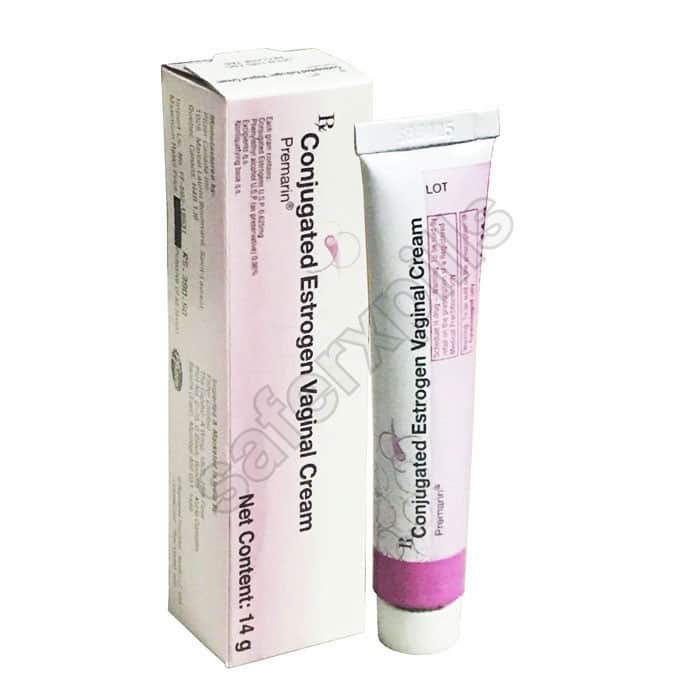
Premarin Vaginal Cream
Generic: Conjugated Estrogen
Select pack size
1 cream
About Premarin Vaginal Cream
Premarin Vaginal Cream is a conjugated estrogens cream made for the Indian market by Pfizer Ltd (Mumbai). Each gram contains 0.625 mg of conjugated estrogens, and Indian pharmacy listings describe it as a 14 g tube. It is a local oestrogen treatment: you put it inside the vagina with an applicator to treat the thinning, dryness and soreness of the vagina and vulva that follow the menopause, including pain during sex. We sell it as 1 tube for $19.50 or 3 tubes for $43.75, from $1.04 a gram before shipping.
Four points first. Premarin Vaginal Cream needs a prescription and a doctor's review, because some of the oestrogen is absorbed into the bloodstream (US label 5.1). It is not a contraceptive and it is not licensed to prevent osteoporosis: our old listing said both, and that was wrong. Unusual vaginal bleeding after the menopause must be checked by a doctor before you start and whenever it happens. And the cream can weaken latex condoms and diaphragms (US label 5.19). Clinical facts on this page come from the current US Premarin Vaginal Cream label and the Canadian product monograph, which describe the same 0.625 mg per gram cream. They are listed at the end. The Indian pack itself has not been tested in a published trial.
Premarin Vaginal Cream at a glance
| Active ingredient | Conjugated estrogens 0.625 mg per gram of cream (a mixture of estrogens, mainly sodium estrone sulfate and sodium equilin sulfate) |
| Brand and maker | Premarin Vaginal Cream, Pfizer Ltd, Mumbai (Apollo Pharmacy, Truemeds and MediBuddy listings); 14 g tube |
| What it is for | Atrophic vaginitis and kraurosis vulvae, and moderate to severe pain during sex (dyspareunia) caused by menopausal changes of the vagina (US label 1.1, 1.2; Canadian monograph) |
| Regulatory status | Premarin Vaginal Cream is licensed, prescription only, in the US and Canada. It is no longer available in the UK, and we found none in Australia. This Indian pack is not registered with the FDA, MHRA, TGA or Health Canada |
| Usual dose from the label | US: 0.5 g twice a week, or 0.5 g a day for 21 days then 7 days off; for atrophic vaginitis the dose may be adjusted from 0.5 to 2 g a day on the 21 days on, 7 days off cycle |
| Timing | In the label trial, symptoms and vaginal tests were measured at week 12 (US label 14.1) |
| Packs | 1 tube or 3 tubes (14 g each in Indian listings) |
| Price per gram | $1.39 (1 tube) and $1.04 (3 tubes), before shipping |
| Delivery | 7 to 14 business days to the US, UK, Australia and Canada; $25 shipping under $149, free from $149 |
Price per tube and per gram
Prices below are as of October 2026; the pack selector shows the current price. Gram figures assume 14 g in each tube, as the Indian listings state.
| Pack | Price | Per tube | Per gram | Shipping | Per gram with shipping |
|---|---|---|---|---|---|
| 1 tube (14 g) | $19.50 | $19.50 | $1.39 | $25 | $3.18 |
| 3 tubes (42 g) | $43.75 | $14.58 | $1.04 | $25 | $1.64 |
The 3 tube pack is cheaper per tube even before shipping ($14.58 against $19.50). Both packs are under $149, so each order of them pays the $25 shipping charge. The cheapest way to reach free shipping would be three 3 tube packs plus one single tube ($150.75 for 10 tubes, 140 g, by our arithmetic), which is far more cream than most women use before a doctor reviews the treatment, so we do not suggest it.
How long a tube lasts (our estimate). The labels do not say how long an Indian 14 g tube lasts, so these are our sums, assuming every gram can be used:
| Regimen (US label 2) | Cream used | One 14 g tube lasts about | Three tubes last about |
|---|---|---|---|
| 0.5 g twice a week | 1 g a week | 14 weeks | 42 weeks |
| 0.5 g a day, 21 days on, 7 off | 10.5 g per 4 week cycle | 5 weeks | 4 cycles (16 weeks) |
| 2 g a day, 21 days on, 7 off (highest labelled dose) | 42 g per 4 week cycle | 7 days of use | 1 cycle |
At 0.5 g twice a week, the cost works out at about $3.18 a week with one tube and $1.64 a week with three, including shipping (our arithmetic). Your dose is your doctor's decision and the labels expect it to be reviewed, so do not buy more than you expect to use before your next review. Check the expiry date when the tubes arrive.
Compared with US prices
| Premarin Vaginal Cream (India, from us) | Premarin Vaginal Cream (US) | Estrace cream (US) | Generic estradiol 0.01% cream (US) | |
|---|---|---|---|---|
| Oestrogen | Conjugated estrogens 0.625 mg/g | Conjugated estrogens 0.625 mg/g | Estradiol 0.1 mg/g | Estradiol 0.1 mg/g |
| Tube | 14 g | 30 g, with applicators | 42.5 g | 42.5 g |
| FDA approved | Not registered with the FDA (Indian pack) | Yes, prescription only | Yes, prescription only | Yes, prescription only |
| Cost per gram | $1.64 to $3.18 including shipping ($1.04 to $1.39 before shipping) | NADAC $15.07, about $452 a tube | NADAC $7.76, about $330 a tube | NADAC $0.48, about $20 a tube |
NADAC is what US pharmacies pay for a medicine, not what you pay at the counter. The rows above are $15.07403 per gram for Premarin Vaginal Cream (NDC 00046087221), $7.76131 for Estrace cream and $0.47650 for generic estradiol 0.01% cream, all effective 21 October 2026; the per tube figures are our arithmetic (NADAC per gram times tube size). Our cream is far cheaper per gram than US Premarin. There is no US generic of Premarin Vaginal Cream, but US generic estradiol vaginal cream is cheaper per gram than ours even before shipping. It is a different oestrogen with its own dosing, so it is not a straight swap; if you are in the US and have a prescription, ask your doctor whether estradiol cream would suit you and check its cash price first.
What Premarin Vaginal Cream is used for
After the menopause, low oestrogen makes the lining of the vagina thinner, drier and less elastic. The labelled uses are:
- US label (section 1): treatment of atrophic vaginitis and kraurosis vulvae (1.1), and treatment of moderate to severe dyspareunia, a symptom of vulvar and vaginal atrophy, due to menopause (1.2).
- Canadian monograph: treatment of atrophic vaginitis, dyspareunia and kraurosis vulvae.
Atrophic vaginitis means thinning and inflammation of the vaginal lining from lack of oestrogen; kraurosis vulvae is an older term for shrinking and dryness of the vulval skin. Neither label lists contraception, osteoporosis or hot flushes as a use of the cream. For hot flushes, doctors use systemic HRT such as Estogel gel or Progynova tablets, which carry their own risks.
What the trial found (US label 14.1). A 12 week placebo-controlled trial randomised 423 postmenopausal women aged 44 to 77 to 0.5 g of cream twice a week, 0.5 g a day for 21 days then 7 days off, or matching placebo. On the label's severity score for painful sex, the cream groups improved by 1.48 and 1.55 points against 0.40 and 0.62 on placebo. Superficial (mature) vaginal cells rose by 28% and 26% against 3% and 1%, and vaginal pH fell by 1.62 and 1.57 against 0.36 and 0.26. In the open-label phase, 155 women had evaluable womb lining biopsies at week 52, with no endometrial hyperplasia or cancer reported.
Which dose
The cream comes in one strength. The dose is set by how much you put in with the applicator. Each 0.5 g holds about 0.31 mg of conjugated estrogens (our arithmetic; the label rounds it to 0.3 mg).
| Use | Label | Dose and schedule |
|---|---|---|
| Painful sex (dyspareunia) due to menopause | US 2.2 | 0.5 g twice a week (for example Monday and Thursday), continuously, or 0.5 g a day for 21 days then 7 days off |
| Atrophic vaginitis and kraurosis vulvae | US 2.1 | Daily for 21 days then 7 days off. "Generally, women should be started at the 0.5 g dosage strength"; adjustments from 0.5 to 2 g based on response |
| All uses | Canadian monograph | Low dose 0.5 g twice a week; maximum recommended dose 0.5 to 2 g a day for 21 days then 7 days off, starting at 0.5 g. "administered cyclically for short-term use only" |
Both labels say to use the lowest dose that controls symptoms and to re-evaluate regularly whether treatment is still needed (US 2; Canadian monograph). The US patient information suggests talking with your healthcare provider about it regularly, for example every 3 to 6 months.
How to use Premarin Vaginal Cream
The US label's patient instructions are:
- Remove the cap from the tube.
- Screw the nozzle end of the applicator onto the tube.
- Gently squeeze the tube from the bottom to fill the barrel, using the marked stopping points on the applicator to measure your prescribed dose.
- Unscrew the applicator from the tube.
- Lie on your back with your knees drawn up, gently insert the applicator deeply into the vagina and press the plunger down to its original position.
- To clean it, pull the plunger out of the barrel and wash both with mild soap and warm water. Do not boil it or use hot water.
The applicator. The US 30 g pack comes with applicators marked in 0.5 g steps up to 2 g (US 3); the Canadian monograph says a 14 g tube comes with one applicator. The Indian listings we checked do not clearly confirm what is in the Indian carton, so check it when your pack arrives. If there is no measuring applicator, ask a pharmacist or your doctor how to measure your dose; do not guess.
Missed dose (Canadian monograph). Use it as soon as possible. If it is close to your next scheduled dose, skip the missed one and carry on as normal. Never use two doses at the same time.
Condoms and diaphragms. The US label says Premarin Vaginal Cream "has been reported to weaken latex condoms", and that its potential to weaken and contribute to the failure of condoms, diaphragms or cervical caps made of latex or rubber "should be considered" (5.19). The Canadian monograph says the same. If you rely on a latex condom or diaphragm for protection against pregnancy or infection, talk to your doctor about another method.
If you have a womb: the progestogen question
Oestrogen on its own makes the womb lining grow, and some of the oestrogen from the cream reaches the bloodstream. The US label says the endometrial cancer risk among women with a womb using unopposed oestrogen is "about 2 to 12 times greater than in non-users", depending on dose and length of use, with no significant increase in most studies for use under 1 year (5.3).
- US label: "Generally, when estrogen is prescribed for a postmenopausal woman with a uterus, a progestin should also be considered to reduce the risk of endometrial cancer" (2). A woman without a uterus does not need a progestin, although some women who had a hysterectomy because of endometriosis may (2, 5.15).
- US label: in a 52 week trial of the cream alone at 0.5 g twice a week or 0.5 g a day for 21 days then 7 off, there was no evidence of endometrial hyperplasia or cancer (5.3).
- Canadian monograph: the cream "should be prescribed with an appropriate dose of a progestin for women with intact uteri in order to prevent endometrial hyperplasia/carcinoma".
The two labels put this differently, so whether you need a progestogen, which one and on what schedule is your doctor's decision. Progesterone capsules such as Susten 100mg are one option doctors use; do not choose one yourself. Report any vaginal bleeding to your doctor as soon as possible (US 17.1).
Medicines that interact
No drug interaction studies have been done with Premarin Vaginal Cream (US 7). Oestrogens are partly broken down by the liver enzyme CYP3A4, so the US label says:
- Medicines that may lower oestrogen levels: St John's wort, phenobarbital, carbamazepine and rifampin, possibly reducing the effect or changing bleeding (7.1).
- Medicines that may raise oestrogen levels: erythromycin, clarithromycin, ketoconazole, itraconazole, ritonavir and grapefruit juice, which may cause side effects (7.1).
- Thyroid hormone: women on thyroid replacement may need a higher dose, so thyroid function should be monitored (5.12).
Do not use the cream together with another oestrogen, such as Premarin tablets, Evalon estriol cream or an estradiol gel, unless a doctor has told you to. Tell your doctor and pharmacist about every medicine and herbal product you use.
Side effects
In the 12 week placebo-controlled trial (US label 6.1, Table 1), side effects were reported by small numbers of women. Selected rows:
| Side effect (US label 6.1, Table 1, selected) | Cream 0.5 g, 21 days on, 7 off (n=143) | Placebo (n=72) | Cream 0.5 g twice a week (n=140) | Placebo (n=68) |
|---|---|---|---|---|
| Breast pain | 4.9% | 0 | 2.1% | 0 |
| Headache | 3.5% | 1.4% | 2.1% | 1.5% |
| Pelvic pain | 2.8% | 2.8% | 2.9% | 0 |
| Vulvovaginal disorder | 2.8% | 0 | 2.1% | 2.9% |
| Vaginal discharge (leukorrhea) | 2.1% | 1.4% | 2.9% | 7.4% |
| Vasodilation (flushing) | 2.1% | 2.8% | 1.4% | 0 |
| Vaginitis | 1.4% | 1.4% | 2.1% | 4.4% |
| Vaginal bleeding | 1.4% | 0 | 0.7% | 1.5% |
The full table also lists abdominal pain, thrush, muscle cramp, dizziness, acne, itching and urinary symptoms at around 1%. Reports after approval include abnormal bleeding or spotting, vaginal thrush, burning, irritation and itching where the cream is applied, breast tenderness or enlargement, nausea, bloating, headache, mood changes and, with no frequency given, blood clots, stroke, heart attack, breast cancer and endometrial cancer (US 6.2). The US patient information lists headache, breast pain, irregular bleeding or spotting, cramps, bloating, nausea, hair loss, fluid retention, yeast infection and reactions where the cream is inserted as common side effects.
Long term risks and the US boxed warning
The current US Premarin Vaginal Cream label on DailyMed (version 33, effective 30 May 2025, revised April 2025, checked 27 October 2026) carries a boxed warning: "WARNING: ENDOMETRIAL CANCER, CARDIOVASCULAR DISORDERS, BREAST CANCER and PROBABLE DEMENTIA". The box says estrogen-alone therapy "should not be used for the prevention of cardiovascular disease or dementia", and that estrogens with or without progestins "should be prescribed at the lowest effective doses and for the shortest duration consistent with treatment goals and risks for the individual woman". Most of the figures behind it come from the Women's Health Initiative (WHI), which studied daily conjugated estrogen tablets (0.625 mg by mouth), not the cream. The label says that "in the absence of comparable data, these risks should be assumed to be similar for other doses of CE and other dosage forms of estrogens", and that the warnings for oral Premarin "should be taken into account" because systemic absorption occurs with the cream (5.1).
FDA label changes in progress. On 10 November 2025 the FDA asked makers of all menopausal hormone therapies, "systemic and local vaginal products", to remove the boxed warning language on cardiovascular disease, breast cancer and probable dementia, to remove the endometrial cancer language "except in the systemic estrogen-alone drugs", and to remove the advice on the lowest dose for the shortest time. For local vaginal oestrogen products it also asked makers to "condense safety information and prioritize information most relevant to the local vaginal formulation". Premarin Vaginal Cream is a local vaginal product. When we checked on 27 October 2026, its US label had not yet been updated, so this page quotes the current label, and we will update the page when the label changes.
| WHI outcome, daily oral CE 0.625 mg (US label 5.2, 5.3) | Hormone group | Placebo |
|---|---|---|
| Stroke, oestrogen alone (per 10,000 women-years) | 45 | 33 |
| DVT (clot in a leg vein), oestrogen alone | 23 | 15 |
| Blood clots in a vein or lung, oestrogen plus progestin | 35 | 17 |
| Invasive breast cancer, oestrogen plus progestin | 41 | 33 |
In women aged 50 to 59, subgroup analyses suggested no increased risk of stroke with oestrogen alone (18 against 21 per 10,000 women-years; US 5.2). Oestrogen alone was not associated with an increased risk of invasive breast cancer in the WHI (relative risk 0.80; US 5.3). The US label also describes a 2 to 4 fold increase in gallbladder disease needing surgery (5.5) and recommends yearly breast examinations by a healthcare provider (5.3). The Canadian monograph says risks and benefits should be appraised at least once a year.
When to get urgent help
Call emergency services (911 in the US and Canada, 999 in the UK, 000 in Australia) for possible signs of a blood clot, stroke or heart attack. The US label says oestrogen should be stopped immediately if any of these occur or are suspected (5.2), and stopped until the eyes are examined after sudden vision loss (5.7). The US patient information says to call your healthcare provider right away for these warning signs; calling emergency services for possible clot, stroke or heart attack symptoms is our advice.
- severe pains in your chest or legs, with or without shortness of breath, weakness and fatigue (US patient information)
- changes in vision or speech, or sudden new severe headaches (US patient information)
- sudden partial or complete loss of vision, bulging of an eye, double vision or migraine (US 5.7)
- swelling of the face, lips and tongue, with or without red itchy bumps (US patient information), or trouble breathing or swallowing; the US label reports anaphylaxis and angioedema with oral Premarin (5.16), and a known anaphylactic reaction or angioedema to Premarin is a contraindication (4)
See a doctor promptly for:
- unusual vaginal bleeding: after the menopause it may be a warning sign of cancer of the womb (US patient information)
- a new breast lump (US patient information)
- yellowing of the skin or eyes; the US label says to stop if cholestatic jaundice comes back (5.11)
- severe pain in the upper abdomen if you have high blood fats (triglycerides), because the US label reports pancreatitis (5.10)
If a child swallows the cream, call a poison line (1-800-222-1222 in the US, 13 11 26 in Australia, NHS 111 in the UK) or a doctor. The Canadian monograph says that reports of young children swallowing large doses of oestrogen products have not shown acute serious ill effects. Too much oestrogen may cause nausea, vomiting, breast tenderness, abdominal pain, drowsiness, tiredness and withdrawal bleeding (US 10). Tell emergency staff that you use conjugated estrogens vaginal cream, how much and since when, and whether you also take a progestogen.
Who should not use Premarin Vaginal Cream
Never use it if you have any of the conditions the US label lists as contraindications (US 4):
- vaginal or genital bleeding that a doctor has not diagnosed
- breast cancer now or in the past
- an oestrogen-dependent cancer (estrogen-dependent neoplasia)
- a blood clot in a vein or the lungs (DVT or PE) now or in the past
- a stroke or heart attack, or other arterial clotting disease, now or in the past
- a known anaphylactic reaction or angioedema to Premarin
- liver impairment or liver disease
- protein C, protein S or antithrombin deficiency, or another known clotting disorder (thrombophilia)
The Canadian monograph lists similar conditions in its own wording (it names allergy to the drug in general rather than anaphylaxis or angioedema), and adds as contraindications: endometrial hyperplasia; known or suspected pregnancy; partial or complete loss of vision due to eye blood vessel disease; prothrombin mutation or anticardiolipin antibodies; migraine with or without aura; and allergy to any ingredient or to a component of the container. For liver disease, it says "as long as liver function tests have failed to return to normal".
Not for use in: pregnancy (US 8.1: "not indicated for use during pregnancy"; Canadian monograph: contraindicated in known or suspected pregnancy) or children (US 8.4). In breastfeeding, the US label says oestrogens pass into milk and can reduce milk production (8.2). It is not for preventing heart disease or dementia (US Boxed Warning).
Talk to a doctor first, and expect closer checks, if you have or have had (US 5.x and patient information):
- migraine: the US label says use with caution (5.18), while the Canadian monograph lists migraine with or without aura as a contraindication
- asthma, diabetes, epilepsy, lupus, porphyria or liver haemangiomas, which oestrogen may make worse (5.18)
- endometriosis, or fibroids (US 5.15, 6.2)
- risk factors for clots or heart disease, such as high blood pressure, smoking, high cholesterol, obesity or a family history of clots (5.2); the US label says, if feasible, to stop oestrogens at least 4 to 6 weeks before surgery linked with a higher risk of clots, or during long immobilisation
- a close relative with breast cancer, past breast lumps or an abnormal mammogram (US patient information)
- high triglycerides, jaundice with past oestrogen use or in pregnancy, low parathyroid function, hereditary angioedema, thyroid hormone treatment, or heart or kidney problems that cause fluid retention (5.10 to 5.14, 5.17)
- a bleeding disorder (the US patient information says do not start the cream if you have been diagnosed with one)
Age. The US label says too few women over 65 were studied to know whether they respond differently, and the WHI memory study found more probable dementia in women aged 65 to 79 taking oral oestrogen (8.5).
Prescription and legal status
- US: Premarin Vaginal Cream (Wyeth, a Pfizer subsidiary, NDA 020216) is FDA approved and labelled "Rx only". The Indian pack is not registered with the FDA. The FDA says personal importation of unapproved medicines is illegal in most circumstances.
- UK: Premarin vaginal cream is listed in the NHS dictionary of medicines as discontinued and not available, and the UK emc lists only Premarin (conjugated oestrogens) tablets. Vaginal oestrogens licensed in the UK include estriol creams (such as Ovesse and Gynest), estriol pessaries (such as Imvaggis) and estradiol 10 microgram vaginal tablets (such as Vagifem and Vagirux). In July 2022 Gina 10 microgram vaginal tablets became the first HRT product in the UK that can be bought from a pharmacy without a prescription, by women aged 50 and over who have not had a period for at least a year. The Indian pack is not registered with the MHRA.
- Australia: healthdirect lists only Premarin tablets (Schedule 4), and we found no Premarin vaginal cream on the ARTG. Ovestin estriol 1 mg/g cream (ARTG 14515) is a prescription medicine (Schedule 4). The Indian pack is not registered with the TGA.
- Canada: Premarin Vaginal Cream (Pfizer Canada, DIN 02043440) is marketed as a prescription medicine; Health Canada's shortage site listed the 30 g tube as in actual shortage in a report last updated 20 February 2026. The Indian pack is not registered with Health Canada.
- India: Apollo Pharmacy, Truemeds and MediBuddy list it as a prescription medicine.
Vaginal oestrogen is prescription only in the US, Canada and Australia, and in the UK apart from pharmacy estradiol vaginal tablets such as Gina, because a doctor needs to rule out other causes of your symptoms and of any bleeding, and to review treatment. See a doctor before you use it, and check the rules where you live.
Buying genuine Premarin Vaginal Cream
The MHRA warns that "Any medicine not authorised for sale in the UK can be unsafe or ineffective and there is no way of knowing what is in them or the negative health effects they can have", and advises UK buyers: "Only use UK-registered pharmacies, including online pharmacies displaying the official green cross logo". That warning covers this Indian pack, which is not registered with the MHRA. When your order arrives, check that the carton and tube name Premarin Vaginal Cream, conjugated estrogens 0.625 mg/g and Pfizer, and show a batch number and an expiry date. These checks cannot prove that a pack is genuine, because counterfeiters copy packaging. Storage is room temperature: the US label says 20 to 25 C (16.2), the Canadian monograph 15 to 30 C, and Indian listings say 20 to 25 C (Apollo) or below 25 C (Truemeds). Keep it out of the reach of children. If a pack causes unusual symptoms, seek medical advice and report it to your medicines regulator (the MHRA Yellow Card scheme in the UK, FDA MedWatch in the US, the TGA in Australia or Health Canada) as well as to us.
Delivery
We ship Premarin Vaginal Cream to the US, UK, Australia and Canada in plain packaging with tracking. Standard delivery takes 7 to 14 business days to most countries. Shipping costs a flat $25 on orders under $149 and is free from $149; both of our packs are under $149. If you use the cream regularly, order your next tube two to three weeks before the current one runs out. See our shipping page and refund policy.
Sources
- Premarin (conjugated estrogens) Vaginal Cream, US Prescribing Information and Patient Information, Wyeth Pharmaceuticals LLC, a subsidiary of Pfizer Inc., DailyMed setid 96609623-528e-4aba-cabe-7254aed816d5, version 33, effective 30 May 2025 (PI LAB-0498-9.0; patient information revised 04/2025): Boxed Warning and sections 1 to 4, 5.1 to 5.19, 6.1, 6.2, 7, 8.1 to 8.5, 10, 11, 14.1, 16, 17. DailyMed
- Premarin Vaginal Cream (Conjugated Estrogens, C.S.D.) 0.625 mg/g, Product Monograph, Pfizer Canada ULC, date of revision 26 June 2025: indications, contraindications, warnings (latex condoms), dosage and administration, missed dose, overdosage, storage, dosage forms. Health Canada
- US Food and Drug Administration. FDA Requests Labeling Changes Related to Safety Information to Clarify the Benefit/Risk Considerations for Menopausal Hormone Therapies (10 November 2025, content current as of 12 February 2026). FDA
- Drugs@FDA via openFDA: Premarin cream NDA 020216 (Wyeth), prescription; latest labeling supplement approved 22 April 2025. openFDA
- CMS National Average Drug Acquisition Cost (NADAC): Premarin Vaginal Cream NDC 00046087221 $15.07403 per gram; Estrace 0.01% cream NDC 00430375414 $7.76131 per gram; generic estradiol 0.01% cream (six NDCs) $0.47650 per gram; all effective 21 October 2026. Tube sizes from the openFDA NDC directory. Medicaid.gov
- Health Canada Drug Product Database: PREMARIN VAGINAL CREAM, DIN 02043440, Pfizer Canada ULC, marketed, prescription; Drug Shortages Canada, Premarin Vaginal Cream reports. Health Canada
- NHS Business Services Authority, dictionary of medicines and devices: Premarin 0.625mg/g vaginal cream (Pfizer Ltd), discontinued. dm+d
- Electronic Medicines Compendium (emc), UK: searches for Premarin, estriol and estradiol vaginal products, 27 October 2026; Gina 10 micrograms vaginal tablets SmPC section 4.1, revised 7 March 2025. emc
- The Pharmaceutical Journal. First HRT product in the UK to be made available without a prescription, 20 July 2022. PJ
- healthdirect Australia: Premarin and Ovestin medicine pages; TGA ARTG 14515, Ovestin estriol 1 mg/g cream. healthdirect
- MHRA warning on buying medicines online, 13 February 2026; US FDA personal importation guidance. FDA
- Indian pack details: Apollo Pharmacy, Truemeds and MediBuddy listings for Premarin Vaginal Cream 14 g, checked 27 October 2026.
Key Information
- ✓Active Ingredient: Conjugated Estrogen
- ✓Category: Women's Health
- ✓Form: Cream
- ✓Brand: Pfizer India Ltd
- ✓Manufacturer: Pfizer India Ltd
Frequently Asked Questions
What is Premarin Vaginal Cream?
It is a conjugated estrogens cream, 0.625 mg per gram, made for the Indian market by Pfizer Ltd and sold there as a 14 g tube. You put it inside the vagina with an applicator to treat menopausal thinning and dryness of the vagina and vulva (atrophic vaginitis and kraurosis vulvae) and moderate to severe pain during sex caused by the menopause. It needs a prescription and regular review by a doctor.
Is it a contraceptive or a treatment for osteoporosis?
No. Neither the US label nor the Canadian monograph lists contraception, osteoporosis or hot flushes as a use of the cream. Our old listing said it was for contraception and osteoporosis, which was wrong. The cream can also weaken latex condoms and diaphragms, so it can make some barrier methods less reliable (US label 5.19).
Is the Indian pack the same as US Premarin Vaginal Cream?
It has the same ingredient at the same strength, conjugated estrogens 0.625 mg per gram, under the same brand name from Pfizer. But the Indian pack is not registered with the FDA, MHRA, TGA or Health Canada, the Indian tube is 14 g rather than the US 30 g, and we have not found a study testing the Indian pack, so we do not claim it is identical to the US product.
How much does it cost per gram?
As of October 2026, 1 tube costs $19.50 ($1.39 a gram) and 3 tubes cost $43.75 ($1.04 a gram), assuming 14 g per tube. Shipping is $25 on orders under $149, so with shipping it is $3.18 or $1.64 a gram. The US pharmacy acquisition cost (NADAC) of Premarin Vaginal Cream is $15.07 a gram, but the NADAC of US generic estradiol 0.01% cream is $0.48 a gram, cheaper than ours even before shipping. The pack selector shows the current price.
How do I use it?
Fill the applicator from the tube up to the mark for your prescribed dose, lie on your back with your knees drawn up, insert the applicator deeply into the vagina and press the plunger down. Wash the applicator with mild soap and warm water, never boiling or hot water (US patient information). Check that your Indian carton contains a measuring applicator; if it does not, ask a pharmacist how to measure the dose.
What dose is usual?
The US label gives 0.5 g twice a week, or 0.5 g a day for 21 days then 7 days off, for painful sex due to menopause. For atrophic vaginitis and kraurosis vulvae it is used daily for 21 days then 7 days off, generally starting at 0.5 g, with adjustments from 0.5 to 2 g. Both labels say to use the lowest dose that controls symptoms. Your doctor sets your dose.
How long does one tube last?
By our arithmetic, a 14 g tube lasts about 14 weeks at 0.5 g twice a week, about 5 weeks at 0.5 g a day on the 21 days on, 7 days off cycle, and only 7 days of use at 2 g a day. These are our estimates, assuming every gram can be used.
Do I need a progestogen as well?
The US label says that for a postmenopausal woman with a womb a progestin should generally be considered, while also reporting no endometrial hyperplasia or cancer in a 52 week trial of the cream alone at 0.5 g. The Canadian monograph says the cream should be prescribed with a progestin for women with a womb. Your doctor decides. Report any vaginal bleeding as soon as possible.
What are the side effects?
In the 12 week trial in the US label, the most frequent were breast pain (up to 4.9%), headache (up to 3.5%), pelvic pain and vaginal symptoms such as discharge or irritation, mostly at low rates. The label also carries a boxed warning about endometrial cancer, cardiovascular disorders, breast cancer and probable dementia, based mainly on oral oestrogen studies. On 10 November 2025 the FDA asked makers of all menopausal hormone therapies, including local vaginal products, to remove this boxed warning language, but the US Premarin Vaginal Cream label (DailyMed version 33, May 2025) had not been updated when we checked on 27 October 2026.
Who should not use it?
Do not use it with undiagnosed vaginal bleeding, breast cancer now or in the past, an oestrogen-dependent cancer, a past or current blood clot, stroke or heart attack, liver disease, a clotting disorder, or a known anaphylactic reaction or angioedema to Premarin (US label 4). The Canadian monograph adds pregnancy, endometrial hyperplasia, migraine with or without aura and vision loss from eye blood vessel disease. It is not for use in pregnancy or in children.
Do I need a prescription, and how long is delivery?
Premarin Vaginal Cream is prescription only in the US and Canada, and it is no longer available in the UK; we found none in Australia. FDA says personal importation of unapproved medicines is illegal in most circumstances. We ship in plain packaging with tracking in 7 to 14 business days; shipping is $25 under $149 and free from $149.
Medical References
- 1.PubMed (NCBI) (PMID: 38595196) — 2024
- 2.PubMed (NCBI) (PMID: 16972673) — 2006
- 3.PubMed (NCBI) (PMID: 40633782) — 2025
- 4.PubMed (NCBI) (PMID: 41700516) — 2026
- 5.PubMed (NCBI) (PMID: 23621618) — 2013
- 6.PubMed (NCBI) (PMID: 32893510) — 2020
- 7.DailyMed (U.S. National Library of Medicine)
- 8.PubMed (NCBI) (PMID: 31085766) — 2019
Sources: U.S. National Library of Medicine (DailyMed, PubMed), openFDA
Related Products
View all
Customer Reviews
No reviews yet. Be the first to review Premarin Vaginal Cream.
Related Articles
Health guides about Conjugated Estrogen, written by pharmacists

Diane-35 in the USA: Why It Isn't FDA-Approved, What It Treats, Clot Risk and US Alternatives
Diane-35 combines cyproterone acetate 2 mg with ethinylestradiol 35 micrograms for acne and hirsutism in women. It is prescribed in Canada, the UK, Australia and India but has never been FDA-approved. This guide covers its licensed uses, trial results, the 2013 European review, blood clot risk against other pills, the 2020 meningioma review, who should not take it, and FDA-approved US alternatives.

Visanne (Dienogest 2 mg) for Endometriosis: Trial Results, Side Effects and Where It Is Available
Visanne is Bayer's dienogest 2 mg tablet for endometriosis pain. This guide covers the placebo and leuprorelin trials, how many women got a large benefit, bleeding changes, side effects, mood and bone density, who must not take it, interactions, and its status in the US, UK, Canada and Australia, with FDA-approved US alternatives.

Provera and the Progestin Withdrawal Bleed: What Bleeding, or Not Bleeding, Actually Tells You
A progestin course to bring on a missed period is a diagnostic test, not just a treatment. Bleeding proves estrogen, a responsive endometrium and an open outflow tract all at once; no bleeding sends the investigation somewhere else entirely. Label doses for medroxyprogesterone and micronized progesterone, the response rates behind them, and why the pregnancy test comes first.
Related Health Guide
Understanding Female Infertility & Women's Health: Complete Guide