Tretinoin Gel vs Cream: What the Base Changes, From the Labels, Trials and Pharmacy Prices
Lokesh Maurya
Tretinoin Gel vs Cream: What the Base Changes, From the Labels, Trials and Pharmacy Prices - pharmacy guide
In this article (11 sections)
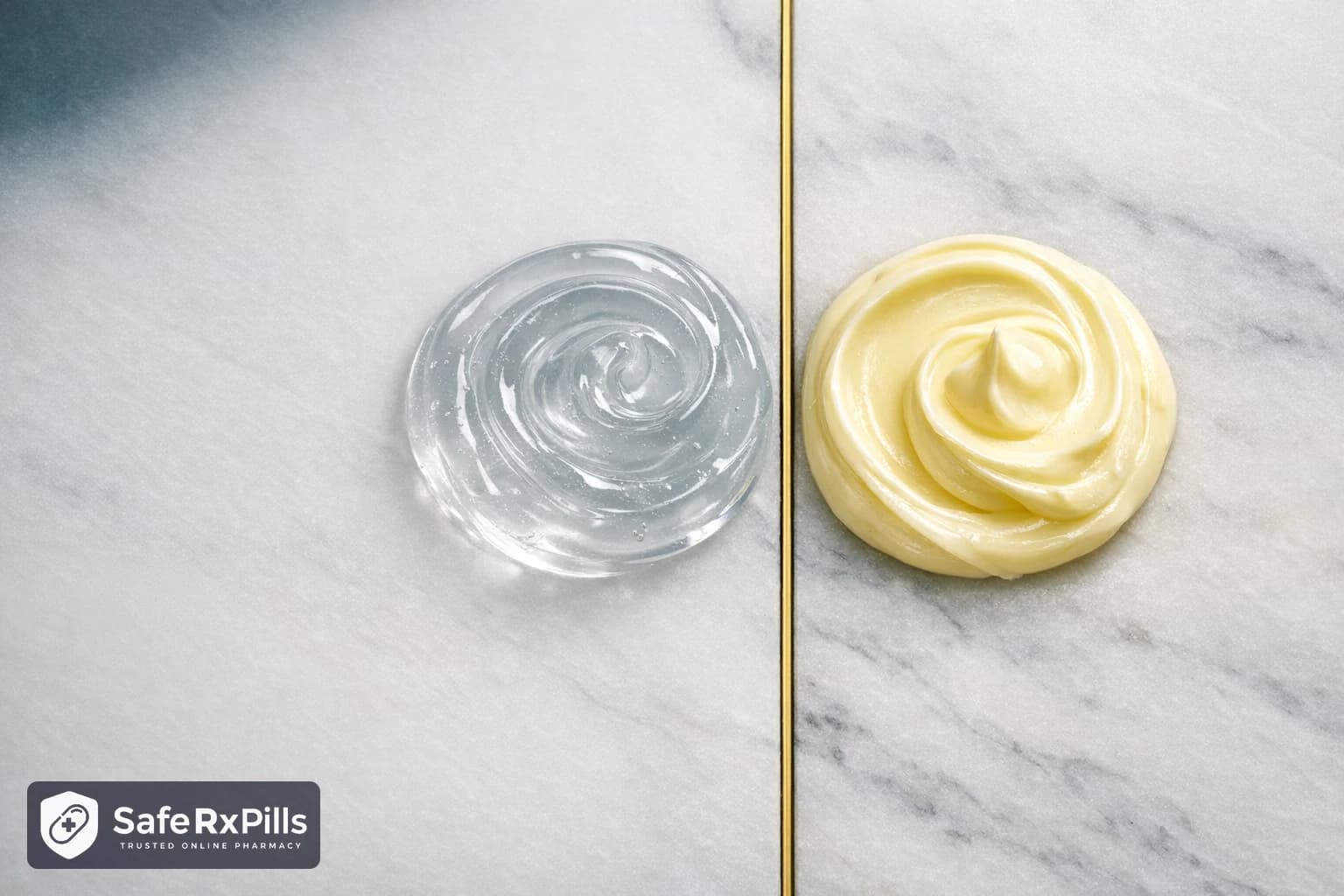
Tretinoin gel and tretinoin cream contain the same drug; the difference is the base it sits in. Classic tretinoin gel is a light, alcohol-based gel that suits oily, acne-prone skin, while the cream is a heavier oil-and-water base that suits normal, dry or sensitive skin. Gel is not automatically stronger: in irritation studies, irritation tracked the concentration and the base together, and the 0.025% cream sat in the same irritation group as the 0.01% and 0.025% gels.
This guide uses the US prescribing labels for Retin-A, Retin-A Micro and Atralin, published comparison trials, and US pharmacy cost data to show what changes when you pick one form over the other. For how strengths compare across retinoids, see our retinoid strength chart; for the application steps, see how to use tretinoin.
Tretinoin gel vs cream at a glance
| Point | Classic gel (Retin-A gel and generics) | Cream (Retin-A cream and generics) |
|---|---|---|
| Base | Hydroxypropyl cellulose and alcohol 90% w/w | Stearic acid, isopropyl myristate, stearyl alcohol, xanthan gum, purified water |
| US label strengths | 0.01%, 0.025% | 0.025%, 0.05%, 0.1% |
| Feel on skin | Light, dries fast, can "pill" if overapplied | Richer, with a water and oil base |
| Flammable | Yes: label says "GELS ARE FLAMMABLE" | No such warning |
| Storage (Retin-A label) | Below 86°F | Below 80°F |
| Usually suits | Oily, acne-prone skin | Normal, dry or sensitive skin |
| US pharmacy cost, 45 g, 0.025% | $89.30 | $21.63 |
Newer gels do not follow the classic pattern. Retin-A Micro is a water-based microsphere gel in 0.04%, 0.06%, 0.08% and 0.1%, and Atralin is a water-based 0.05% gel. Neither label carries the flammability warning, and both are covered below.
What is in each base, from the labels
The Retin-A label (Bausch Health, DailyMed, revised 03/2024) lists both forms side by side:
- Gel: tretinoin 0.025% or 0.01% "in a gel vehicle of butylated hydroxytoluene, hydroxypropyl cellulose and alcohol (denatured with tert-butyl alcohol and brucine sulfate) 90% w/w."
- Cream: tretinoin 0.1%, 0.05% or 0.025% "in a hydrophilic cream vehicle of stearic acid, isopropyl myristate, polyoxyl 40 stearate, stearyl alcohol, xanthan gum, sorbic acid, butylated hydroxytoluene, and purified water."
The high alcohol content is why classic gels feel drying and why the label adds: "GELS ARE FLAMMABLE. Note: Keep away from heat and flame. Keep tube tightly closed." The patient leaflet adds "AVOID FIRE, FLAME OR SMOKING DURING USE." For more on the cream itself, see our tretinoin cream guide.
The label also notes a built-in safeguard for the gel: "Excessive application results in 'pilling' of the gel, which minimizes the likelihood of overapplication." If gel rolls into small flakes on your face, you are using too much.
| Product | Form | Main base ingredients (label) | Label point to know |
|---|---|---|---|
| Retin-A gel | Alcohol gel | Alcohol 90% w/w, hydroxypropyl cellulose, BHT | Flammable |
| Retin-A cream | Cream | Stearic acid, isopropyl myristate, polyoxyl 40 stearate, stearyl alcohol, water | Store below 80°F |
| Retin-A Micro | Water-based microsphere gel | Methyl methacrylate/glycol dimethacrylate crosspolymer (Microsponge), carbomer, glycerin, propylene glycol, water | Store pump upright |
| Atralin | Water-based gel | Carbomer, glycerin, sodium hyaluronate, fish collagen hydrolyzates, parabens, water | Caution if allergic to fish |
The Atralin label warns that it "contains soluble fish proteins and should be used with caution in patients with known sensitivity or allergy to fish."
Which strengths each form comes in
Form limits your strength options. In the US labels, classic gel stops at 0.025% and cream goes up to 0.1%, while the higher-strength gels are the newer water-based types.
| Product (US label) | Form | Strengths | Pack sizes |
|---|---|---|---|
| Retin-A cream | Cream | 0.025%, 0.05%, 0.1% | 20 g, 45 g |
| Retin-A gel | Alcohol gel | 0.01%, 0.025% | 15 g, 45 g |
| Retin-A Micro | Microsphere gel | 0.04%, 0.06%, 0.08%, 0.1% | 20 g and 45 g tubes (0.04%, 0.1%); 50 g pump (all strengths) |
| Atralin | Water-based gel | 0.05% | 45 g |
Which percentage to start with is a prescriber's call and depends on your skin, not on the form alone. Our retinoid strength chart covers that comparison in detail.
Is tretinoin gel stronger or harsher than cream?
Not as a rule. The best direct comparison is a 1998 study in the British Journal of Dermatology (Galvin, PMID 9990419) that tested six tretinoin products for 21 days on the skin of 55 healthy volunteers. The products fell into groups by how much irritation they caused:
| Study | Most irritating | Middle group | Least irritating |
|---|---|---|---|
| Study A | Cream 0.1%, cream 0.05% | Gel 0.025%, gel 0.01%, cream 0.025% | Adapalene 0.1% gel, petrolatum |
| Study B | Cream 0.1% | Cream 0.05%, cream 0.025%, microsphere gel 0.1% | Adapalene 0.1% gel, petrolatum |
So at the low end, the 0.025% cream behaved like the gels, and the higher-strength creams were the most irritating. A second patch study (Greenspan 2003, PMID 12889719, 38 completers) recorded how many people had to stop a test site because of irritation: 7 for microsphere gel 0.1%, 3 for Avita cream 0.025% and 1 for Avita gel 0.025%.
Two limits apply. These studies tested patches on the back or face of people without acne, often under occlusion, so they exaggerate irritation compared with normal use. And skin type changes the picture: alcohol gel on dry skin can sting even at a low strength. A 2008 split-face analysis (Leyden, PMID 18724650) found no significant difference in cumulative irritation between 0.04% microsphere gel and 0.025% cream.
On results, the Retin-A label does not claim one form works better. It gives one dosing instruction for both: once a day before bed, enough to cover the area lightly. In four bioequivalence trials with 1,642 patients, Tretin-X and Retin-A were clinically equivalent in each form tested: 0.1% cream, 0.025% cream, 0.025% gel and 0.01% gel (Webster 2006, PMID 16687979). Those trials compared brands within each form, not gel against cream.
Microsphere and water-based gels: a different kind of gel
Retin-A Micro holds tretinoin inside porous polymer microspheres in a water-based gel. Atralin and its generics use micronized tretinoin in a water-based gel with glycerin and sodium hyaluronate. Both were built to cut irritation while allowing higher strengths in a gel.
A combined analysis of two 12-week phase 3 trials (Webster 2009, PMID 19363908, 1,537 participants) compared tretinoin gel 0.05% with its vehicle in both trials and with microsphere gel 0.1% in one. Skin-related adverse events occurred in 31% on the 0.05% gel and 52% on the 0.1% microsphere gel. The authors reported the efficacy rate of the 0.05% gel as about 12% less than the 0.1% microsphere gel.
In younger patients aged 10 to 14 from the same trials (Lucky 2011, PMID 21838089, 483 participants), lesion reductions were comparable between the two gels, and the 0.05% gel was better tolerated.
| Skin event, age 10 to 14 | Tretinoin gel 0.05% | Microsphere gel 0.1% |
|---|---|---|
| Dry skin | 14% | 32% |
| Skin burning | 8% | 11% |
| Erythema (redness) | 5% | 23% |
| Dermatitis exfoliative (peeling) | 5% | 23% |

Microsphere gel also tested well for shine. In a half-face study of 35 people aged 12 to 24 with moderate acne and oily skin (Nyirady 2000, PMID 10955199), the side treated with 0.1% microsphere gel had significantly less facial shine at 3 and 6 hours after 4 days of use than the side treated with 0.025% cream.
What the gel trials showed against their own base
The Atralin label reports two randomized 12-week trials. In Trial 1, total facial lesions fell by 43% with tretinoin gel 0.05% and 22% with the vehicle gel; in Trial 2, by 35% and 19%. Treatment success (clear or very mild) was 21% vs 12% and 23% vs 14%.
Side effects followed the pattern seen with all tretinoin forms: dryness and peeling, peaking early. The label says skin reactions "first appear during the first two weeks of treatment" and peak "around the second and third week."
| Adverse reaction (label Table 1) | Tretinoin gel 0.05% (674) | Vehicle (487) |
|---|---|---|
| Dry skin | 16% | 2% |
| Peeling, scaling, flaking | 12% | 1% |
| Skin burning sensation | 8% | 2% |
| Erythema | 7% | under 1% |
| Pruritus (itching) | 2% | 1% |

The Retin-A label adds that "an apparent exacerbation of inflammatory lesions may occur" in the early weeks. That applies to gel and cream alike; our tretinoin purge guide explains it, and tretinoin before and after covers the timeline.
Gel or cream: matching the form to your skin
| Your skin | Form usually tried first | Why |
|---|---|---|
| Oily, acne-prone, humid climate | Gel (classic or water-based) | Light, dries fast, less residue; microsphere gel reduced shine in one study |
| Dry or sensitive | Cream | No alcohol solvent; the base leaves moisture on the skin |
| Combination | Low-strength cream or water-based gel | Avoids the drying alcohol base on dry zones |
| Mature, sun-damaged skin | Cream | The cream base has no alcohol solvent, which drier skin often tolerates better |
| Eczema-prone | Ask a doctor first | Labels warn of severe irritation on eczematous skin |
Weather matters too. The Retin-A label says "weather extremes, such as wind or cold, also may be irritating,". The labels also say both forms make skin more sensitive to sun: use sunscreen and protective clothing when exposure cannot be avoided, and do not apply on sunburned skin.
Age does not decide the form. The Retin-A label says safety and effectiveness "in a geriatric population have not been established" because trials included few people aged 65 and over; the Atralin trials enrolled ages 10 to 65.
Why is tretinoin gel more expensive than cream?
US pharmacy cost data show a large gap. The National Average Drug Acquisition Cost (NADAC) is what US pharmacies pay for a drug, published weekly by CMS. As of 18 November 2026:
| Generic tretinoin | NADAC per gram | Per 45 g tube |
|---|---|---|
| Cream 0.025% | $0.48060 | $21.63 |
| Cream 0.05% | $1.17771 | $53.00 |
| Cream 0.1% | $0.79666 | $35.85 |
| Gel 0.01% | $1.95732 | $88.08 |
| Gel 0.025% | $1.98453 | $89.30 |
| Gel 0.05% (one NDC listed) | $4.00710 | Pack size not checked |
| Microsphere gel 0.08% pump | $10.22163 | Pack size not checked |

At the same 0.025% strength, the gel costs US pharmacies about 4.1 times as much as the cream. The NADAC file does not give reasons. One visible difference is supply: the file lists 8 NDC rows for each classic gel strength against 12 to 14 for each cream strength. Microsphere and micronized gels also use more complex delivery systems. Your own price depends on your pharmacy, insurance and coupons; our tretinoin price guide covers retail and brand costs.
Switching from cream to gel, or back
The Retin-A label covers switching in one line: "Alterations of vehicle, drug concentration, or dose frequency should be closely monitored by careful observation of the clinical therapeutic response and skin tolerance." In practice that means:
- Change one thing at a time: the form or the strength, not both together.
- Expect a short readjustment. Moving from cream to alcohol gel often brings back some dryness and stinging.
- If irritation is marked, the labels allow using it less often or pausing, then resuming once the skin settles.
- Once acne responds, the Retin-A label says it "may be possible to maintain the improvement with less frequent applications, or other dosage forms."
If neither form suits you, adapalene is a common alternative; see adapalene vs tretinoin for the head-to-head trials, or switching from adapalene to tretinoin.
Safety points that apply to both forms
- Pregnancy: the Retin-A label states there are "no adequate and well-controlled studies in pregnant women" and that tretinoin "should be used during pregnancy only if the potential benefit justifies the potential risk to the fetus." It reports thirty human cases of congenital malformations temporally associated with Retin-A use over two decades, five of them holoprosencephaly, with no causal link established. Talk to a doctor if you are pregnant or planning pregnancy.
- Children: safety and effectiveness below age 12 have not been established (Retin-A label); Retin-A Micro is indicated from age 12.
- Irritating products: the labels advise caution with medicated or abrasive soaps, drying cosmetics, products high in alcohol, astringents, and "particular caution" with sulfur, resorcinol, salicylic acid or benzoyl peroxide.
- Areas to avoid: eyes, mouth, angles of the nose and mucous membranes.
- Allergy: the Retin-A label says to stop if hypersensitivity to any ingredient is noted; Atralin carries the fish protein caution.
- Fire: classic alcohol gels are flammable; keep away from flame and do not smoke while applying.
Tretinoin gel at SafeRxPills: prices as of 18 November 2026
Among the tretinoin products we list is A Ret Gel by Menarini India, in three strengths. The 0.05% listing states 20 g tubes. These Indian packs are not approved by the FDA, MHRA, TGA or Health Canada. We have not confirmed whether their base is alcohol-based or water-based, so check the pack leaflet.
| Product | Tubes | Price | Per tube |
|---|---|---|---|
| A Ret Gel 0.025% | 3 | $18.00 | $6.00 |
| 6 | $27.50 | $4.58 | |
| 12 | $52.50 | $4.38 | |
| 24 | $100.00 | $4.17 | |
| A Ret Gel 0.05% | 3 | $19.50 | $6.50 |
| 6 | $28.75 | $4.79 | |
| 12 | $56.25 | $4.69 | |
| 24 | $106.25 | $4.43 | |
| A Ret Gel 0.1% | 3 | $25.50 | $8.50 |
| 6 | $37.50 | $6.25 | |
| 12 | $72.50 | $6.04 | |
| 24 | $140.00 | $5.83 |
Import rules differ by country. The US FDA's personal importation page states: "In most circumstances, it is illegal for individuals to import drugs or devices into the U.S. for personal use because these products purchased from other countries often have not been approved by the FDA for use and sale in the U.S." Check the rules that apply to you before ordering, and use tretinoin under a prescriber's advice. More on acne treatment options is on our acne page.
Comments (0)
No comments yet. Be the first to share your thoughts!
Related Articles