
About Baclofen 10mg
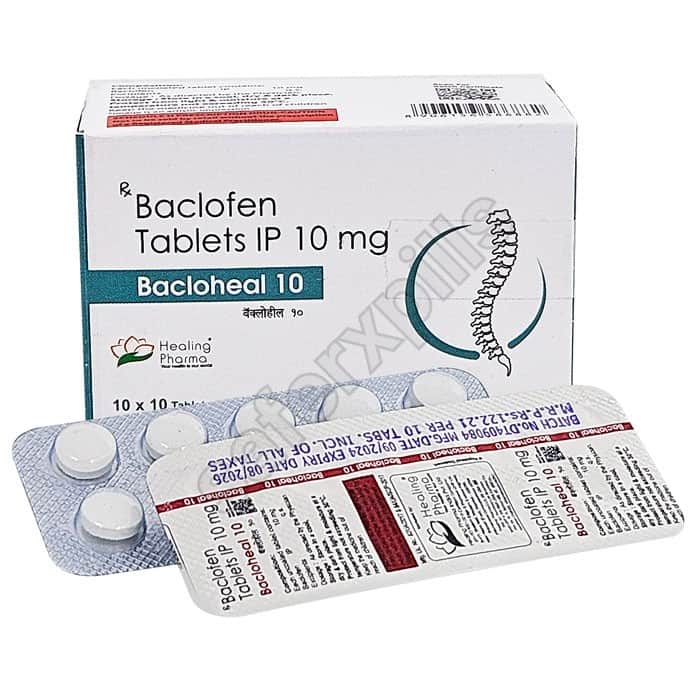
Baclofen 10mg on this page is Bacloheal 10, an Indian brand of baclofen 10 mg tablets sold under the Healing Pharma name. The carton in our product photo reads "Baclofen Tablets IP 10 mg", "Bacloheal 10", "Healing Pharma" and "10 x 10 Tablets", and the strip shows its price per 10 tablets. Baclofen is a prescription medicine for spasticity: stiff, tight or jerking muscles caused by damage to the brain or spinal cord, such as in multiple sclerosis or spinal cord injury. Our packs are 100, 200 and 300 tablets, from $0.25 to $0.32 a tablet before shipping (see Price per tablet).
Four points before you read further. First, baclofen is not a general painkiller or a back pain tablet: the US baclofen tablet label says it is "not indicated in the treatment of skeletal muscle spasm resulting from rheumatic disorders", and neither the US nor the UK label lists ordinary back pain or muscle strain. Second, never stop it suddenly: the US label says "Hallucinations and seizures have occurred on abrupt withdrawal of baclofen." Third, it makes many people drowsy, and alcohol and other sedating medicines add to that. Fourth, in the US generic baclofen 10 mg tablets cost pharmacies about $0.03 each, roughly an eighth to a tenth of our price, so US readers with a prescription should compare a local generic first. This page uses the current US baclofen tablet label, the UK Lioresal 10mg tablet label (SmPC), Australian and Canadian regulator records and Indian pharmacy listings, all listed at the end.
Baclofen 10mg (Bacloheal 10) at a glance
| Active ingredient | Baclofen 10 mg per tablet ("Baclofen Tablets IP 10 mg" on the carton in our product photo; Truemeds lists Baclofen 10 mg) |
| Brand and maker | Bacloheal 10, Healing Pharma (the carton and strip in our product photo, the Truemeds listing and Healing Pharma India Pvt Ltd's own product page). The "Mfd. by" line on the strip in our photo is not legible, so the factory that makes it is not confirmed; read the strip you receive. Tata 1mg lists a different "Bacloheal 10mg Tablet" from Syndicate Life Sciences, marked sold out |
| Drug class | Muscle relaxant and antispastic (US label); a GABA derivative acting at the spinal level (UK label) |
| Regulatory status | Baclofen tablets are licensed and prescription only in the US, UK, Canada and Australia, mostly as generics. This Indian Bacloheal pack is not registered with the FDA, MHRA, TGA or Health Canada. Baclofen is not a controlled drug in any of the four countries (see Prescription and legal status) |
| Usual dose from the label | US label: start at 5 mg three times a day for 3 days and raise the dose every 3 days; the best dose is "usually between 40 to 80 mg daily"; maximum 80 mg a day (20 mg four times a day). UK label: start at 15 mg a day, usually up to 60 mg a day; more than 100 mg a day is not advised outside hospital |
| Half-life | Averages 3 to 4 hours; peak blood levels 0.5 to 1.5 hours after a dose (UK label 5.2) |
| Packs | 100, 200 and 300 tablets (10, 20 and 30 Indian strips of 10) |
| Price per tablet | $0.25 to $0.32 before shipping; $0.34 to $0.57 with shipping on a single pack (our arithmetic) |
| Delivery | 7 to 14 business days to the US, UK, Australia and Canada; $25 shipping under $149, free from $149. Because baclofen must not be stopped suddenly, never rely on an international parcel as your only supply |
Price per tablet
Prices below are as of October 2026; the pack selector shows the current price. Per-tablet figures are our arithmetic.
| Pack | Price | Per tablet | Shipping | Per tablet with shipping |
|---|---|---|---|---|
| 100 tablets | $32.00 | $0.32 | $25 | $0.57 |
| 200 tablets | $56.00 | $0.28 | $25 | $0.41 |
| 300 tablets | $75.60 | $0.25 | $25 | $0.34 |
The larger packs cost less per tablet before shipping as well, so free shipping is not the only reason they work out cheaper. Every single pack is below the $149 free shipping line; two 300 packs ($151.20, 600 tablets) ship free and come to about $0.25 a tablet (our arithmetic).
How long a pack lasts at label doses (our arithmetic, one 10 mg tablet = 10 mg):
| Daily dose | 10 mg tablets a day | 100 pack | 200 pack | 300 pack |
|---|---|---|---|---|
| 40 mg (low end of the US usual range) | 4 | 25 days | 50 days | 75 days |
| 60 mg (20 mg three times a day; the UK "usually up to" dose) | 6 | about 16 days | about 33 days | 50 days |
| 80 mg (US maximum) | 8 | 12 to 13 days | 25 days | 37 to 38 days |
The four 3-day steps of the label's starting schedule (5, 10, 15 and 20 mg three times a day) use about 45 of these tablets over 12 days, if your doctor has you take half a tablet for the 5 mg and 15 mg doses (our arithmetic). Your doctor may go slower, and many people settle on a dose below 80 mg, so buy for the dose you have actually been prescribed. The strip in our product photo shows a manufacturing date of 09/2024 and an expiry of 08/2026, a shelf life of about two years; that photographed batch is now past its expiry and is shown only to identify the pack. Check that the expiry on the strips you receive is later than the date you will finish the pack, and do not take tablets past their expiry date.
Compared with US generic baclofen
| Bacloheal 10 (ours, India) | US generic baclofen 10 mg tablets | |
|---|---|---|
| Maker | Healing Pharma brand (factory not confirmed) | Many FDA-approved generic makers |
| FDA approved | No | Yes |
| Cost per tablet | $0.25 to $0.32 before shipping; $0.34 to $0.57 with shipping | $0.03260 (NADAC) |
| Cost of 180 tablets (60 mg a day for 30 days) | About $45 to $58 before shipping (our arithmetic) | About $5.87 (NADAC; our arithmetic) |
NADAC is the average price US pharmacies pay to buy a medicine, published by the US Medicaid programme. It is not the counter price, which adds a dispensing fee and margin, and insurance can change what you pay. All 50 NDC rows for baclofen 10 mg tablets in the NADAC file dated 28 October 2026 show $0.03260 per tablet, effective 21 October 2026. On that figure, our tablets cost roughly 8 to 10 times what US pharmacies pay before shipping is added (our arithmetic). If you are in the US with a prescription, a local generic will almost certainly be cheaper and faster than ours. Ask your pharmacy for the cash price and your copay before you compare.
The FDA application data we checked list baclofen tablets only as generics; we found no current brand-name baclofen tablet in the US. In Canada, Novartis's Lioresal tablets were cancelled in 2020 and generic 10 mg tablets (for example Apo-Baclofen, PMS-Baclofen and Mylan-Baclofen) are marketed. In Australia, baclofen 10 mg tablets (Lioresal 10, Clofen 10, APO-Baclofen and Stelax 10) are on the PBS (item 2729P), with a dispensed price for 100 tablets of A$22.96 (PBS, checked 31 October 2026). We have seen no bioequivalence study of Bacloheal 10 against a US, UK, Canadian or Australian baclofen tablet.
What baclofen is for, and what it is not for
US label. Baclofen tablets "are useful for the alleviation of signs and symptoms of spasticity resulting from multiple sclerosis, particularly for the relief of flexor spasms and concomitant pain, clonus, and muscular rigidity." Patients "should have reversible spasticity so that baclofen treatment will aid in restoring residual function." It "may also be of some value in patients with spinal cord injuries and other spinal cord diseases." The same label says baclofen is "not indicated in the treatment of skeletal muscle spasm resulting from rheumatic disorders", and: "The efficacy of baclofen in stroke, cerebral palsy, and Parkinson's disease has not been established and, therefore, it is not recommended for these conditions."
UK label. The UK Lioresal label is wider. It covers spasticity of voluntary muscle from multiple sclerosis and other spinal lesions (for example spinal cord tumours, syringomyelia, motor neurone disease, transverse myelitis and partial cord injury), and also spasticity arising from, for example, cerebrovascular accidents (stroke), cerebral palsy, meningitis and traumatic head injury, in adults and children. It says treatment "should not be commenced until the spastic state has become stabilised", and that baclofen is likely to help most where spasticity "constitutes a handicap to activities and/or physiotherapy".
Not for back pain. Neither label lists ordinary back pain, neck pain, sports injuries or muscle strain. Medicines such as cyclobenzaprine are labelled for short-term muscle spasm from injuries; baclofen is labelled for spasticity of neurological origin. If you have back pain without a neurological condition, baclofen is the wrong medicine to buy, in our view; see our muscle relaxer comparison and speak to a doctor.
Which strength to choose
| Product | Tablet | How it fits the labels |
|---|---|---|
| Liofen 5mg | Baclofen 5 mg | One tablet is the first step of the US and UK starting schedule (5 mg three times a day), and about the daily dose the UK label sets for kidney impairment |
| Baclofen 10mg, Bacloheal 10 (this page) | Baclofen 10 mg | The second step of the schedule (10 mg three times a day); four to eight tablets a day give the US usual range of 40 to 80 mg |
| Liofen 10mg | Baclofen 10 mg (Sun Pharma) | Same dose as this page, from a different Indian maker, in packs of 30, 60 and 90 |
| Baclofen 25mg and Liofen 25mg | Baclofen 25 mg | There is no 25 mg tablet in the US labels or among the UK tablets on emc; Australia registers 25 mg tablets. Three a day give 75 mg (within the US maximum of 80 mg); four a day give 100 mg, above the US maximum (our arithmetic). Not a starting strength |
| Liofen XL 10mg, XL 20mg and XL 30mg | Baclofen capsules sold as XL | No extended-release baclofen is approved in the US, and we have not read an Indian label stating its release profile or dosing interval. Never swap it milligram for milligram with plain tablets without your prescriber |
Daily limits by label. US label: maximum 80 mg a day (20 mg four times a day). UK label: "Satisfactory control of symptoms is usually obtained with doses of up to 60mg daily", and "a maximum daily dose of more than 100mg is not advised unless the patient is in hospital under careful medical supervision". Australia (TGA): the product information gives an optimum of 30 to 75 mg a day, with doses up to 100 mg a day occasionally needed in hospitalised patients. Never raise your own dose above what your doctor has prescribed.
Splitting. The label starting dose is 5 mg, which is half of this tablet. We could not confirm from the photo or the listings whether Bacloheal 10 tablets are scored, so ask your pharmacist before cutting one, or use a 5 mg tablet for the first steps if your doctor agrees.
How to take baclofen 10mg
- Take it exactly as your doctor prescribes. The US label says "The determination of optimal dosage requires individual titration" and suggests 5 mg three times a day for 3 days, then 10 mg, 15 mg and 20 mg three times a day for 3 days each, with further increases only if needed and never above 80 mg a day.
- Use the lowest dose that works. Both labels say "The lowest dose compatible with an optimal response is recommended" (US wording; the UK wording is the same).
- The UK label says to take it "during meals with a little liquid", and that if nausea persists after a dose reduction, take it with food or a milk drink.
- Give it time, and give your doctor a reason to keep it going. The UK label says that once the maximum recommended dose is reached, "if the therapeutic effect is not apparent within 6 weeks a decision whether to continue with Lioresal should be taken." The US label says that if benefits are not evident after a reasonable trial, "patients should be slowly withdrawn from the drug".
- Never stop suddenly, never skip days to make a pack last, and order refills before you run low (see the withdrawal section below).
- Do not drive or use machines until you know how it affects you, especially when you start or when your dose goes up.

Never stop baclofen suddenly
This is the most important safety point on this page. The US baclofen tablet label says: "Hallucinations and seizures have occurred on abrupt withdrawal of baclofen. Therefore, except for serious adverse reactions, the dose should be reduced slowly when the drug is discontinued."
A newer US baclofen label (Lyvispah oral granules, 2026) goes further: "Abrupt discontinuation of baclofen, regardless of the cause, has resulted in adverse reactions that include hallucinations, seizures, high fever, altered mental status, exaggerated rebound spasticity, and muscle rigidity, that in rare cases has advanced to rhabdomyolysis, multiple organ-system failure, and death." It tells patients that "early symptoms of LYVISPAH withdrawal may include increased spasticity, itching, and tingling of extremities."
The UK label says treatment should always (unless serious adverse effects occur) be stopped gradually "by successively reducing the dosage over a period of about 1-2 weeks", and lists anxiety, confusion, delirium, hallucination, psychotic disorder, mania or paranoia, convulsions (status epilepticus), dyskinesia, fast heartbeat, high temperature, rhabdomyolysis and a temporary worsening of spasticity and hypertonia (raised muscle tone) as reported with abrupt withdrawal, "especially after long term medication".
What this means when you buy from us (our advice):
- Our delivery takes 7 to 14 business days and parcels can be held at customs. Keep enough supply from a local pharmacy to cover any delay; an international order should never be your only source.
- Do not switch between brands, strengths or tablets and capsules without your prescriber.
- If you are admitted to hospital, cannot swallow or are vomiting, tell the team you take baclofen and how much.
Lower doses and extra care for some groups
- Kidney problems. The US label says: "Because baclofen is primarily excreted unchanged through the kidneys, it should be given with caution, and it may be necessary to reduce the dosage." The UK label is more specific: in impaired kidney function or chronic haemodialysis, "a particularly low dosage of Lioresal should be selected i.e. approx. 5mg daily", and in end-stage kidney failure only if the expected benefit outweighs the potential risk, with close monitoring for early signs of toxicity such as sleepiness and lethargy. It says signs of overdose, including toxic encephalopathy (confusion, disorientation, sleepiness, reduced consciousness), have been seen in people with kidney impairment taking more than 5 mg a day. At about 5 mg a day, one 10 mg tablet is twice the UK kidney dose, so this tablet is not suitable for that dose unless your doctor tells you to split it.
- Older people. The UK label says elderly patients may be more susceptible to side effects, so small doses should be used at the start and titrated gradually under careful supervision. A newer US label (Lyvispah 8.5) advises starting "at the low end of the dosing range" and says it "may be useful to monitor renal function".
- Liver problems. The UK label says to prescribe it with caution in hepatic impairment, because baclofen can raise liver enzymes. The US tablet label gives no liver dosing advice.
- Spasticity from the brain (for example after a stroke): the UK label says unwanted effects are more likely and recommends a cautious schedule with surveillance; the US label says baclofen "has not significantly benefited patients with stroke" and that these patients "have also shown poor tolerability to the drug".
- People who use their spasticity to stand or walk. The US label says baclofen should be used with caution "where spasticity is utilized to sustain upright posture and balance in locomotion or whenever spasticity is utilized to obtain increased function"; the UK label carries the same caution.
- Children. US label: safety and effectiveness below age 12 "have not been established". UK label: Lioresal tablets are "not suitable for use in children below 33 kg body weight", with lower daily maximums for children. Children's dosing is a specialist decision; do not buy this product for a child without one.
Side effects
The US label says the most common side effect "is transient drowsiness (10 to 63%). In one controlled study of 175 patients, transient drowsiness was observed in 63% of those receiving baclofen compared to 36% of those in the placebo group." Other common reactions are dizziness (5 to 15%), weakness (5 to 15%) and fatigue (2 to 4%).
| Effect (US label) | Reported rate |
|---|---|
| Drowsiness | 10% to 63% |
| Dizziness | 5% to 15% |
| Weakness | 5% to 15% |
| Nausea | 4% to 12% |
| Confusion | 1% to 11% |
| Low blood pressure | 0% to 9% |
| Headache | 4% to 8% |
| Insomnia | 2% to 7% |
| Constipation | 2% to 6% |
| Urinary frequency | 2% to 6% |
| Fatigue | 2% to 4% |
Source: US baclofen tablet label, Adverse Reactions. The label gives ranges across studies, not placebo-controlled rates for each effect. Rarer effects it lists include hallucinations, depression, euphoria, slurred speech, tremor, blurred or double vision, seizures, shortness of breath, palpitations, chest pain, fainting, urinary retention, impotence and rash. A few patients had raised liver enzymes (SGOT), alkaline phosphatase or blood sugar. The label adds that some nervous system and urinary symptoms "may be related to the underlying disease rather than to drug therapy", and that ovarian cysts were found by palpation in about 4% of multiple sclerosis patients treated for up to a year, most disappearing while the drug was continued.
The UK label says side effects occur mainly at the start of treatment, if the dose is raised too fast, at large doses or in elderly people, and are often temporary. It lists sedation, sleepiness and nausea as very common, and breathing depression, confusion, hallucination, depression, muscle weakness and low blood pressure among common effects. It also lists encephalopathy and sleep apnoea with frequency not known; the sleep apnoea cases were seen at high doses (100 mg or more) in people who were alcohol dependent.

Drowsiness, driving and alcohol
The US label says: "Because of the possibility of sedation, patients should be cautioned regarding the operation of automobiles or other dangerous machinery, and activities made hazardous by decreased alertness. Patients should also be cautioned that the central nervous system effects of baclofen may be additive to those of alcohol and other CNS depressants." The UK label says people who get dizziness, sedation, sleepiness or vision problems "should be advised to refrain from driving or using machines".
The UK label names the combinations: increased sedation with other medicines that depress the nervous system, "including other muscle relaxants (such as tizanidine), with synthetic opiates or with alcohol", with a higher risk of breathing depression. In our view, keep alcohol low or avoid it, especially while your dose is changing, and tell your doctor about opioid painkillers, benzodiazepines, sleeping tablets, sedating antihistamines, gabapentin or pregabalin and other muscle relaxants.
When to get urgent help
Call emergency services (911 in the US and Canada, 999 in the UK, 000 in Australia), or ask someone to call for you, if you or someone taking baclofen has:
- Signs of overdose: the US label lists "Vomiting, muscular hypotonia, drowsiness, accommodation disorders, coma, respiratory depression and seizures". Very heavy sleepiness, slow or shallow breathing, or being hard to wake are emergencies, especially after alcohol or other sedating medicines. The UK label says people with kidney impairment can develop signs of overdose even on low doses.
- A seizure, hallucinations, sudden confusion, high fever or severe rebound stiffness after missing doses, running out or stopping suddenly (see the withdrawal section).
- Thoughts of suicide or self-harm, or sudden changes in mood or behaviour. The UK label says suicide and suicide-related events have been reported, mostly in people with other risk factors (alcohol use disorder, depression or previous suicide attempts), and that patients and carers should "seek medical advice immediately" if these appear.
- Swelling of the face, lips or tongue, trouble breathing, or a widespread rash or hives (allergy to baclofen is the one contraindication in the US label; the UK label lists hypersensitivity, urticaria and face swelling).
- Taking more than your prescribed dose, or a child swallowing the tablets. Poison lines (our addition, not from the label): US 1-800-222-1222, Australia 13 11 26. Keep the tablets out of reach of children; the US label calls for child-resistant closures.
Tell the emergency staff that the medicine is baclofen (Bacloheal 10, 10 mg tablets), how much was taken and when, and anything else taken with it. The UK label says there is no specific antidote and that haemodialysis may help in severe poisoning with kidney failure.
Who should not take baclofen
Never take it if:
- you are allergic to baclofen (US and UK labels), or to any ingredient of the tablet (UK label)
- you have a peptic (stomach or duodenal) ulcer: a contraindication in the UK label only; the UK label also says baclofen stimulates stomach acid secretion
Not recommended, or use only with care:
- Stroke, cerebral palsy and Parkinson's disease: the US label says efficacy "has not been established and, therefore, it is not recommended for these conditions". The UK label does include spasticity after stroke and in cerebral palsy, with a cautious schedule, and says Parkinson's disease may be made worse. Follow your specialist.
- Psychotic disorders, schizophrenia, depressive or manic disorders and confusional states: the UK label says they may be made worse, so treat cautiously and keep under close surveillance.
- Epilepsy: the US label says seizure control and the EEG have occasionally deteriorated, so they should be monitored at regular intervals; the UK label says it can be used with supervision and adequate anticonvulsant treatment.
- Kidney impairment: see Lower doses above.
- A history of substance misuse: the UK label says cases of misuse, abuse and dependence have been reported, and to watch for dose escalation, drug-seeking and tolerance.
- Breathing problems or liver impairment: use with caution (UK label).
- Blood pressure medicines: the UK label says baclofen "should be used with extreme care in patients already receiving antihypertensive therapy", because the fall in blood pressure is likely to be greater.
- Bladder outflow problems: in people with pre-existing sphincter hypertonia, acute urine retention may occur (UK label).
- Autonomic dysreflexia (in high spinal cord injury): a newer US label (Lyvispah 5.6) says use with caution, as painful stimuli or abrupt withdrawal may trigger an episode.
Pregnancy and breastfeeding. The US label says there are no studies in pregnant women and that baclofen "should be used during pregnancy only if the benefit clearly justifies the potential risk to the fetus". It warns that withdrawal symptoms (increased muscle tone, tremor, jitteriness and seizure) have been reported in newborns whose mothers took oral baclofen throughout pregnancy, and that if it is continued, the dose should be reduced gradually and stopped before delivery, and if slow withdrawal is not feasible, the parents or caregivers should be told about the potential for withdrawal in the newborn. The UK label says that during pregnancy, especially the first 3 months, it "should only be employed if its use is of vital necessity". On breastfeeding, the US tablet label says it is not known whether baclofen passes into milk; the UK label says it passes into milk "in quantities so small that no undesirable effects in the infant are to be expected"; and a newer US label (Lyvispah 8.2) says baclofen is present in milk and that withdrawal symptoms can occur in breastfed infants when the mother stops baclofen or stops breastfeeding. Talk to your doctor before a pregnancy or before stopping breastfeeding.
Medicines that interact
- Alcohol and other sedating medicines: the US label says baclofen's effects on the nervous system may add to those of alcohol and other CNS depressants; the UK label (4.5) names other muscle relaxants such as tizanidine, synthetic opiates and alcohol, and says the risk of breathing depression is increased. Benzodiazepines, sleeping tablets and sedating antihistamines are in the same group (our examples).
- Tricyclic antidepressants: the UK label says the effect of baclofen may be strengthened, with pronounced loss of muscle tone.
- Blood pressure medicines: a greater fall in blood pressure; the UK label says their doses should be adjusted.
- Levodopa (with carbidopa) for Parkinson's disease: the UK label reports confusion, hallucinations, nausea, agitation and worsening Parkinson's symptoms.
- Lithium: the UK label reports aggravated hyperkinetic symptoms.
- Medicines that reduce kidney function: may reduce baclofen clearance and cause toxic effects (UK label).
Tell your doctor or pharmacist about every medicine and supplement you take before you start, and before you start anything new.
Baclofen and alcohol use disorder
You may read that baclofen is used for alcohol dependence. It is not a licensed use in the US or the UK: no US baclofen label lists it, and the UK Lioresal label lists only spasticity. In Australia, the TGA calls it off-label use and says recent coronial inquiries into 2 deaths highlighted the risks, with overdose risks "particularly pronounced when using high doses for off-label treatment of alcohol-use disorder". France is the exception: its medicines agency (ANSM) authorised a baclofen brand, Baclocur, in October 2018 for reducing alcohol consumption in adults, alongside psychosocial follow-up, after other treatments have failed.
The evidence is mixed. A 2023 Cochrane review of 17 trials (1,818 participants) found baclofen probably reduces the risk of relapse and increases the percentage of abstinent days, mainly in people who had been detoxified first, but probably does not reduce heavy drinking days or drinks per drinking day. We give no doses for this use. It is a decision for an addiction specialist, and alcohol itself adds to baclofen's sedation. Our baclofen guide covers the trials in more detail.
Prescription and legal status
In India, the carton in our product photo carries the "Rx" symbol and Truemeds marks Bacloheal 10 as "Prescription required".
- US: baclofen tablets are prescription only ("Rx only" on the label). Baclofen does not appear in the federal schedules of controlled substances (21 CFR Part 1308). The FDA says personal importation of unapproved medicines is illegal in most circumstances.
- UK: Lioresal 10mg tablets and generic baclofen tablets are prescription only medicines (POM on emc), not controlled drugs.
- Canada: generic baclofen tablets are marketed as prescription medicines (Health Canada Drug Product Database), not as controlled substances.
- Australia: baclofen tablets are Schedule 4, Prescription Only Medicine (healthdirect, from the ARTG), not Schedule 8.
This Indian Bacloheal pack is not registered with the FDA, the MHRA, the TGA or Health Canada. Check the rules where you live.
Buying genuine Bacloheal 10
The MHRA warns that "Any medicine not authorised for sale in the UK can be unsafe or ineffective and there is no way of knowing what is in them or the negative health effects they can have", and it advises UK buyers to "Only use UK-registered pharmacies, including online pharmacies displaying the official green cross logo". That warning covers this Indian pack, which is not authorised in the UK. When your order arrives, read the strip: it should say Bacloheal 10 and "Baclofen Tablets IP 10 mg", name the maker, and carry a batch number, a manufacturing date and an expiry date. These checks cannot prove that tablets are genuine, because counterfeiters copy packaging. With baclofen, a weaker or stronger batch matters: watch for unusual drowsiness or a return of stiffness when you start a new supply, and tell your doctor. If a batch causes unusual symptoms, seek medical advice and report it to your medicines regulator (the MHRA Yellow Card scheme in the UK, FDA MedWatch in the US, the TGA in Australia or Health Canada) as well as to us.
Delivery
We ship Bacloheal 10 to the US, UK, Australia and Canada in plain packaging with tracking. Standard delivery takes 7 to 14 business days to most countries. Shipping costs a flat $25 on orders under $149 and is free from $149. The Truemeds listing says to store it below 30°C; the UK Lioresal label says store below 25°C in the original packaging to protect from moisture. Keep the tablets in the strip until you take them. Order well before your current supply ends, and never let a delay force you to stop baclofen suddenly. See our shipping page and refund policy.
Related guides
- Baclofen: uses, dosage, side effects, withdrawal risks and cost
- Muscle relaxers compared: cyclobenzaprine, tizanidine, baclofen and carisoprodol
- Tizanidine dosage and the drug interactions that change it
- Cyclobenzaprine dosage: 5 mg vs 10 mg and the three week limit
- Pregabalin withdrawal: symptoms, timeline and how to taper
Other baclofen products: Baclofen 25mg, Liofen 5mg, Liofen 10mg and Liofen 25mg.
Sources
- Baclofen Tablets USP 10 mg and 20 mg, US prescribing information, Par Health USA, revised 07/2026 (DailyMed setid c17527be-661d-42f5-b6f6-56a681ba7870, published 7 September 2026; current on 31 October 2026): Indications and Usage, Contraindications, Warnings (neonatal withdrawal, abrupt withdrawal, renal function, stroke, pregnancy), Precautions, Adverse Reactions, Overdosage, Dosage and Administration, How Supplied. DailyMed
- LYVISPAH (baclofen) oral granules, US prescribing information, September 2026 (DailyMed setid 5b13c40d-a109-f838-e063-6294a90aecf2): sections 5.1, 5.6, 8.2, 8.5 and 17. DailyMed
- Lioresal Tablets 10mg, UK SmPC, Novartis Pharmaceuticals UK Ltd, PL 00101/0504, revised 22 June 2026, legal category POM: sections 4.1 to 4.9, 5.1, 5.2, 6.4. emc
- Centers for Medicare and Medicaid Services. National Average Drug Acquisition Cost (NADAC) 2026, file dated 28 October 2026: baclofen 10 mg tablet, 50 NDC rows, all $0.03260 per tablet, effective 21 October 2026. data.medicaid.gov
- openFDA Drugs@FDA data for baclofen, accessed 30 October 2026; Code of Federal Regulations, Title 21, Part 1308 (eCFR).
- Health Canada Drug Product Database: Apo-Baclofen (DIN 02139332), PMS-Baclofen (DIN 02063735), Mylan-Baclofen (DIN 02088398) 10 mg, marketed, prescription; Lioresal Tab 10mg (DIN 00455881), cancelled post market 26 June 2020; checked 31 October 2026. Health Canada
- Pharmaceutical Benefits Scheme, item 2729P, baclofen 10 mg tablets, 100: dispensed price A$22.96; brands APO-Baclofen, Clofen 10, Lioresal 10, Stelax 10; checked 31 October 2026. PBS
- healthdirect Australia, baclofen brand pages (Clofen, Lioresal, Baclofen Apo): Schedule 4, Prescription Only Medicine (source ARTG); checked 31 October 2026.
- Therapeutic Goods Administration. Be alert if you are taking baclofen in high doses (safety alert) and Use caution when prescribing baclofen off label (Medicines Safety Update). TGA
- ANSM (France). Autorisation de mise sur le marché de Baclocur (baclofène) dans la réduction de la consommation d'alcool, October 2018.
- Agabio R et al. Baclofen for alcohol use disorder. Cochrane Database Syst Rev 2023. PMID 36637087.
- Indian listings for Bacloheal 10, checked 31 October 2026: Truemeds (Healing Pharma, strip of 10, prescription required, store below 30°C), Healing Pharma India Pvt Ltd product page (Bacloheal 10), IndiaMART supplier listing (10 x 10 tablets, IP, 24 month shelf life), and Tata 1mg (a "Bacloheal 10mg Tablet" from Syndicate Life Sciences Pvt Ltd, sold out).
- Medicines and Healthcare products Regulatory Agency, press release on buying medicines online, 13 February 2026.
- US Food and Drug Administration. Personal importation policy.
Key Information
- ✓Active Ingredient: Bacloheal
- ✓Category: Pain
- ✓Form: Tablet
- ✓Brand: Healing Pharma, India
- ✓Manufacturer: Healing Pharma, India
Frequently Asked Questions
What is Baclofen 10mg (Bacloheal 10)?
It is an Indian brand of baclofen 10 mg tablets sold under the Healing Pharma name; the carton in our product photo reads "Baclofen Tablets IP 10 mg" and "Bacloheal 10". Baclofen is a prescription muscle relaxant and antispastic. The US label says it is for spasticity resulting from multiple sclerosis and may also help in spinal cord injuries and other spinal cord diseases; the UK label also covers spasticity after stroke, cerebral palsy, meningitis and head injury.
Is baclofen for back pain or ordinary muscle spasm?
No. The US label says baclofen is "not indicated in the treatment of skeletal muscle spasm resulting from rheumatic disorders", and neither the US nor the UK label lists ordinary back pain, neck pain or muscle strain. It is labelled for spasticity caused by conditions of the brain or spinal cord. If you have back pain without a neurological condition, speak to a doctor about other options.
Is Bacloheal 10 the same as US or UK baclofen?
It contains the same active ingredient at the same strength, 10 mg of baclofen per tablet. It is made for the Indian market, is not registered with the FDA, MHRA, TGA or Health Canada, and we have seen no bioequivalence study comparing it with a US, UK, Canadian or Australian baclofen tablet. Do not switch brands without your prescriber.
How much does Baclofen 10mg cost per tablet?
As of October 2026, 100 tablets cost $32 ($0.32 each), 200 cost $56 ($0.28) and 300 cost $75.60 ($0.25), before $25 shipping on orders under $149; the pack selector shows the current price. In the US, pharmacies pay about $0.03 per generic baclofen 10 mg tablet (NADAC, effective 21 October 2026), so a local US generic will almost certainly be cheaper than ours.
How do I take baclofen 10 mg?
Exactly as your doctor prescribes. The US label suggests starting at 5 mg three times a day for 3 days, then 10, 15 and 20 mg three times a day for 3 days each, with a usual best dose of 40 to 80 mg a day and a maximum of 80 mg a day. The UK label says to take it during meals with a little liquid. The first step, 5 mg, is half of this tablet; ask your pharmacist before splitting it.
How long does baclofen take to work?
Blood levels peak 0.5 to 1.5 hours after a dose (UK label), but finding the right dose takes weeks of gradual increases. The UK label says that once the maximum recommended dose is reached, if the effect is not apparent within 6 weeks, a decision should be taken on whether to continue. If it is stopped, the dose must be reduced slowly.
Can I stop baclofen suddenly?
No. The US label says "Hallucinations and seizures have occurred on abrupt withdrawal of baclofen" and that, except for serious adverse reactions, the dose should be reduced slowly. The UK label says to reduce it over about 1 to 2 weeks. Because our delivery takes 7 to 14 business days, never rely on an order from us as your only supply.
What are the side effects of baclofen?
The US label says the most common is transient drowsiness (10 to 63%), followed by dizziness and weakness (5 to 15% each), nausea (4 to 12%), confusion (1 to 11%), headache (4 to 8%) and fatigue (2 to 4%). Alcohol and other sedating medicines add to the drowsiness, so do not drive until you know how it affects you. Get emergency help for very heavy sleepiness, slow breathing, seizures or hallucinations.
Who should not take baclofen?
Anyone allergic to baclofen (US and UK labels) and, under the UK label, anyone with a peptic ulcer. The US label says it is not recommended for stroke, cerebral palsy or Parkinson's disease. Kidney problems need a much lower dose (the UK label suggests about 5 mg a day), and care is needed with epilepsy, mental health conditions, a history of substance misuse, blood pressure medicines, pregnancy and breastfeeding.
Do I need a prescription for baclofen, and is it a controlled drug?
Baclofen is prescription only in the US, UK, Canada and Australia (Schedule 4 there), and Truemeds marks Bacloheal 10 as prescription required in India. It is not a controlled substance in the US (21 CFR Part 1308), the UK, Canada or Australia. The FDA says personal importation of unapproved medicines is illegal in most circumstances.
How long does delivery take?
Standard delivery takes 7 to 14 business days to the US, UK, Australia and Canada, in plain packaging with tracking. Shipping is $25 on orders under $149 and free from $149. Order well before your current supply runs out, and keep a local supply so that a delay never forces you to stop baclofen suddenly.
Medical References
- 1.PubMed (NCBI) (PMID: 41555041) — 2026
- 2.PubMed (NCBI) (PMID: 39754631) — 2025
- 3.PubMed (NCBI) (PMID: 31689723) — 2019
- 4.DailyMed (U.S. National Library of Medicine)
- 5.PubMed (NCBI) (PMID: 28822350) — 2017
- 6.PubMed (NCBI) (PMID: 15276195) — 2004
- 7.PubMed (NCBI) (PMID: 35653782)
Sources: U.S. National Library of Medicine (DailyMed, PubMed), openFDA
Related Products
View all
Customer Reviews
No reviews yet. Be the first to review Baclofen 10mg.
Related Articles
Health guides about Bacloheal, written by pharmacists
Baclofen: Uses, Dosage, Side Effects, Withdrawal Risks and Cost
Baclofen is a prescription antispastic for spasticity from multiple sclerosis and spinal cord disease. This guide covers what it is and is not approved for, the US forms, the label titration schedule up to 80 mg a day, side effect rates from the label, the abrupt withdrawal warning, kidney dosing, alcohol and other interactions, the intrathecal pump, its legal status, the alcohol use disorder trials and what generic baclofen costs US pharmacies.
Cyclobenzaprine Dosage: 5 mg vs 10 mg and the Three Week Limit
Cyclobenzaprine is dosed at 5 mg three times daily, raised to 10 mg if needed, for two to three weeks at most. Trial data shows drowsiness rising from 19 to 28 points over placebo when the dose doubles, which is the case for starting low.
Tizanidine Dosage and the Drug Interactions That Change It
Tizanidine starts at 2 mg every six to eight hours and tops out at 36 mg daily, but interactions usually decide the ceiling. Ciprofloxacin raises exposure tenfold and fluvoxamine thirty three fold, and both combinations are contraindicated.
Related Health Guide
Understanding Chronic Pain Management: Complete Guide