
Flutivate Cream
Generic: Fluticasone
Select pack size
3 tubes · $8.33 per tube
About Flutivate Cream
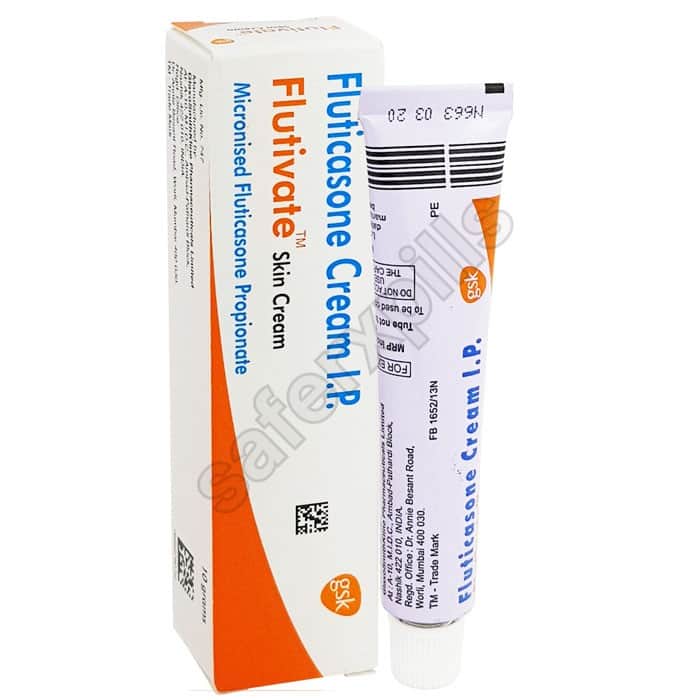
Flutivate cream is GSK India's fluticasone propionate 0.05% skin cream (0.5 mg of fluticasone propionate in each gram). The tube in our product photo is a 10 g tube from GlaxoSmithKline Pharmaceuticals Limited, Nashik, and we sell it in packs of 3, 6 and 12 tubes, from $8.02 a tube ($0.80 a gram) in the 12 pack before shipping. Two Indian pharmacy listings (PharmEasy and Tata 1mg) now mark Flutivate cream as discontinued, so read the expiry date on the tube when it arrives.
Before you order, know what kind of medicine this is. Fluticasone propionate cream is a steroid for diagnosed, steroid-responsive skin conditions such as eczema (atopic dermatitis) and psoriasis. The UK Cutivate label calls it a potent steroid; the US generic label calls it medium potency. It is not a treatment for fungal rashes such as ringworm, for acne or rosacea, or for lightening the skin, and both labels warn about the face and skin folds. It is a prescription medicine in the US and UK, and Indian listings mark Flutivate as prescription required. Use it only if a doctor has diagnosed your skin condition and told you how long to use it.
Flutivate cream at a glance
| Active ingredient | Fluticasone propionate 0.05% w/w (0.5 mg per gram), a corticosteroid. UK Cutivate label: "potent (Group III)" (section 5.1). US generic label: "a medium potency corticosteroid" (Indications). |
| Brand and maker | Flutivate skin cream, GlaxoSmithKline Pharmaceuticals Limited, India. Carton and tube in our product photo: "Fluticasone Cream I.P.", 10 grams, made at Nashik. |
| Used for | US label: the inflammatory and itchy signs of corticosteroid-responsive skin conditions. UK Cutivate label: the same in adults, listing atopic dermatitis, discoid eczema, psoriasis (excluding widespread plaque psoriasis), lichen planus, seborrhoeic dermatitis, contact dermatitis and others; in children, atopic dermatitis that has not responded to weaker steroids, under specialist supervision. |
| Regulatory status | Generic fluticasone propionate 0.05% cream is FDA approved and licensed in the UK. This Indian pack is not registered with the FDA, MHRA, TGA or Health Canada. |
| Usual use | A thin film once or twice a day (US: once or twice daily for atopic dermatitis, twice daily for other conditions). Stop when the skin is under control. |
| Age | US generic label and UK Cutivate label: 3 months and over. Not for babies under 3 months. |
| Prescription | Prescription required on Tata 1mg, Truemeds and Medkart. Prescription only in the US and UK; Schedule 4 (prescription only) in Australia. |
| Storage | Below 25 °C (Tata 1mg) or below 30 °C, not in the fridge or freezer (Truemeds). No cold chain needed. |
| Packs | 3, 6 and 12 tubes of 10 g |
| Price per tube | $8.33 (3 pack) down to $8.02 (12 pack), before shipping |
| Delivery | 7 to 14 business days to the US, UK, Australia and Canada; $25 shipping under $149, free from $149 |
Flutivate cream price per tube
Prices below are as of November 2026; the pack selector shows the current price.
| Pack | Price | Per tube | Per gram | Shipping | Per tube with shipping |
|---|---|---|---|---|---|
| 3 tubes (30 g) | $25.00 | $8.33 | $0.83 | $25 | $16.67 |
| 6 tubes (60 g) | $48.75 | $8.13 | $0.81 | $25 | $12.29 |
| 12 tubes (120 g) | $96.25 | $8.02 | $0.80 | $25 | $10.10 |
All three packs are under the $149 free shipping threshold, so every order pays $25 shipping. With shipping, the 3 pack works out at about $1.67 a gram and the 12 pack at about $1.01 a gram (our arithmetic). There is no single tube option.
Think about how much you need before choosing a pack. A fingertip unit, the line of cream from the tip of an adult index finger to the first crease, is about 0.5 g and covers an area about the size of two adult hands, roughly 250 to 300 square centimetres (UK fluticasone cream label from Aspire Pharma, section 4.2). So a 10 g tube holds about 20 fingertip units. Twice a day on a patch that size uses about 1 g a day, so one tube lasts about 10 days, and the 3 pack covers about 4 weeks (our arithmetic, not a label figure). The 12 pack is far more than one course for a small patch. Buying more is not a reason to keep going: the labels say to stop once the skin is under control.
Compared with US and UK fluticasone cream
| Status | Cost | |
|---|---|---|
| Flutivate 10 g (India, our pack) | Not registered with the FDA, MHRA, TGA or Health Canada | $0.80 to $0.83 per gram before shipping |
| US Cutivate cream (the original brand) | Drugs@FDA lists it as discontinued, with a Federal Register finding that it was not withdrawn for safety or effectiveness reasons | No NADAC row |
| US generic fluticasone propionate 0.05% cream (Encube, Cosette, Padagis) | FDA approved, prescription only; 15, 30 and 60 g tubes | NADAC effective 21 October 2026: $0.35375 per gram for 15 g tubes (about $5.31 a tube), $0.24630 for 30 g tubes (about $7.39) and $0.23121 for 60 g tubes (about $13.87) |
| UK Cutivate 0.05% w/w Cream (GSK UK) | PL 10949/0013, prescription only medicine; the emc now marks it discontinued | Not checked |
| UK fluticasone propionate 0.05% cream (Aspire Pharma) | PL 35533/0205, prescription only medicine, 30 g tube | Not checked |
| Canada | Cutivate cream (DIN 02089912) was cancelled post market on 1 August 2013; we found no other fluticasone skin cream in Health Canada's database | None |
| Australia | Fluticasone is Schedule 4 (prescription only) except nasal sprays in Schedule 2; we did not find a fluticasone skin cream on the Australian market | None |
NADAC is the average price US pharmacies pay to buy a medicine, not the price at the counter. Even so, the difference is large: a US pharmacy pays $0.23 to $0.35 a gram for FDA approved generic fluticasone cream, against our $0.80 to $0.83 a gram before shipping, so the US acquisition cost is about 29% to 44% of our lowest price per gram (our arithmetic). If you are in the US and have a prescription, compare local cash prices for generic fluticasone propionate 0.05% cream first. We have not found a published study comparing the Indian Flutivate tube with the US or UK product.
Which steroid cream: Flutivate and our other options
| Product | What it is |
|---|---|
| Flutivate Cream (this page) | Fluticasone propionate 0.05% cream, 10 g tube. UK: potent; US: medium potency. |
| Elocon 10g Cream | Mometasone furoate 0.1%, used once a day (UK: potent; US: medium range). A different steroid, not a substitute without a doctor's advice. |
| Betnovate 20g | Betamethasone valerate 0.1% (UK: potent), 20 g tube, at about $0.15 to $0.17 a gram before shipping on our listing. |
| Clostaf Cream | Clobetasol propionate, a very potent steroid (our listing). Much stronger than fluticasone; only for a doctor to choose. |
| Flutibact Ointment | Fluticasone 0.05% with the antibiotic mupirocin 2% (our listing). A combination for a doctor to choose, not a substitute for plain Flutivate. |
Flutivate cream comes in one strength, 0.05%. Indian pharmacies also list a Flutivate ointment, which is a different product that we do not sell. For eczema on the face or eyelids, where a potent steroid is a poor fit, doctors sometimes use non-steroid treatments such as tacrolimus (Tacroz Forte Ointment) or pimecrolimus (Pimrolis 1% Cream). Do not swap between these on your own.
How to use Flutivate cream
- Use it only for the skin condition a doctor diagnosed. The US label says it "should not be used for any disorder other than that for which it was prescribed" and is "for external use only" (Information for Patients).
- Apply a thin film to the affected skin and rub in gently. US label: once or twice daily for atopic dermatitis; twice daily for other steroid-responsive conditions (Dosage and Administration). UK Cutivate label: "once or twice a day for up to 4 weeks until improvement occurs", then use it less often or change to a weaker steroid (section 4.2).
- In two US trials of moderate to severe eczema lasting 28 days, once daily worked as well as twice daily (US label, Clinical Studies). Ask your doctor whether once a day is enough for you.
- If you also use a moisturiser, give the cream time to soak in first (UK Cutivate label, section 4.2).
- Keep it out of the eyes. If it is used on the eyelids, the UK label says to take care it does not get into the eye, because cataract and glaucoma might result from repeated exposure (section 4.4).
- Do not cover it. The US label says it "should not be used with occlusive dressings" and must not be used in the nappy area, because nappies or plastic pants act like a covering (Dosage and Administration).
- Stop when the skin is under control. If there is no improvement within 2 weeks, the US label says to contact the doctor; the UK Cutivate label says to re-evaluate adults whose skin has not improved within 4 weeks (section 4.2).
- After a long course, do not stop suddenly unless your doctor says so: the UK label says to reduce gradually, because rebound flares can follow abrupt stopping, especially with potent steroids (section 4.2).
How long to use it: face, skin folds and children
- Face. The US label says it "should not be used on the face, underarms, or groin areas unless directed by a physician" (Information for Patients). The UK Cutivate label says "Prolonged application to the face is undesirable as this area is more susceptible to atrophic changes" (section 4.4), and lists the face among the thin skin areas that raise the risk of the steroid getting into the body.
- Groin, armpits and other skin folds. Same US wording as above. The UK label names skin folds (intertriginous areas) as covered skin that increases absorption, and says warm, moist skin folds encourage bacterial infection (section 4.4). Itching around the anus or genitals is a UK contraindication.
- Adults. The US label sets no fixed limit for adults: stop when control is achieved and reassess if no improvement within 2 weeks. The UK Cutivate label gives up to 4 weeks, then less often or a weaker steroid (section 4.2).
- Children 3 months and over. US label: "may be used with caution" from 3 months; "The safety and efficacy of drug use for longer than 4 weeks in this population have not been established." UK Cutivate label: if a child has not improved within 7 to 14 days, stop and re-evaluate; once controlled, reduce to the lowest effective use for the shortest time, and "Continuous daily treatment for longer than 4 weeks is not recommended" (section 4.2). Under 12, long-term continuous use "should be avoided where possible" (section 4.4).
- Under 3 months. Safety and efficacy are not established (US label). The UK Cutivate label says skin conditions in infants under 3 months, including nappy rash, should not be treated with it (section 4.3). The UK Aspire generic label sets its lower age at 1 year.
- Psoriasis. The UK label says topical steroids should be used with caution in psoriasis because of rebound relapses, tolerance, generalised pustular psoriasis and toxicity, and careful supervision is important (section 4.4). Widespread plaque psoriasis is excluded from the UK indication.
Rebound after stopping. The UK label describes topical steroid withdrawal: after long-term use, a flare with intense redness, stinging and burning that can spread beyond the area treated, more likely on the face and skin folds (section 4.4). The MHRA says these reactions are estimated to be rare, and advises that if your skin worsens within 2 weeks of stopping a topical steroid, you should not start it again without consulting your doctor, unless they have advised you to.
Not for ringworm, acne or skin lightening
- Fungal rashes. The UK Cutivate label contraindicates untreated skin infections (section 4.3), and the US label says it "should not be used where infection is present at the treatment site". A steroid can calm a ringworm rash for a while as the fungus spreads. In 13 Indian centres, 50.9% of people with chronic or recurrent ringworm had misused topical steroid creams (Shenoy 2022, PMID 34378240), and an Indian dermatology expert group "strongly discouraged" topical steroids for ringworm, alone or in combination (Rengasamy 2020, PMID 32832435).
- Skin lightening and melasma. An Indian Pigmentary Expert Group consensus named this drug directly: "Mometasone or fluticasone containing creams should be totally discouraged" (Sarkar 2017, PMID 29263529). In a 12 centre Indian study of 433 people using steroid creams on the face, 90.5% had side effects (Saraswat 2011, PMID 21393945). Flutivate does not lighten skin.
- Acne, rosacea and a rash around the mouth. All three are UK contraindications (section 4.3); the US label says it should not be used for rosacea or perioral dermatitis and lists acne-like eruptions among topical steroid reactions.

Extra care for some groups
- Large areas and absorption. In a US label study, the cream lowered morning cortisol in 1 of 6 adults using it daily for 7 days on at least 30% of the body; it recovered by day 6 of treatment. In an open study of 51 children aged 3 months to 5 years treated twice daily for 3 to 4 weeks over a mean 64% of the body, 2 of the 43 with end of treatment results showed adrenal suppression (US label, Precautions and Adverse Reactions). The UK label says overt suppression is very unlikely unless more than 50% of an adult's body is treated with more than 20 g a day (section 4.4).
- Formaldehyde allergy. The US label says the cream contains imidurea, which releases formaldehyde, and "should not be used in individuals with hypersensitivity to formaldehyde as it may prevent healing or worsen dermatitis". The UK Cutivate cream also contains imidurea, cetostearyl alcohol and propylene glycol (100 mg per gram). The Indian ingredient list is not given on the listings we read, so check the carton.
- HIV or fungal medicines. The UK label says CYP3A4 inhibitors such as ritonavir and itraconazole can raise the amount of steroid in the body (section 4.5). Tell your doctor if you take them.
- Pregnancy. US label: use "only if the potential benefit justifies the potential risk to the fetus". UK Cutivate label: only if the expected benefit to the mother is greater than any possible risk to the foetus, using the minimum quantity for the minimum duration (section 4.6).
- Breastfeeding. US label: "caution should be exercised". UK Cutivate label: consider it only if the benefit outweighs the risk to the infant, and do not apply it to the breasts (section 4.6).
- Older people. 126 people over 65 were treated in trials, with side effects like those in younger people, and the US label says no dose change is needed. The UK label advises the minimum quantity for the shortest time, as kidney or liver problems may slow elimination (section 4.2).
- Smoking and naked flames. The UK label says the UK cream contains paraffin: do not smoke or go near naked flames because of the risk of severe burns, and fabric that has been in contact with it burns more easily and is a serious fire hazard (section 4.4). We do not know whether the Indian cream base is the same, so take the same care.
Flutivate cream side effects
In US controlled trials of twice daily use, side effects linked to the cream occurred in about 4% of people, usually mild: itching 2.9%, dryness 1.2%, numbness of fingers 1.0% and burning 0.6% (US label, Adverse Reactions). Selected rows from the US eczema trials:
| Skin event (drug related) | Once daily (210 people) | Twice daily (203) | Vehicle, no steroid (78) |
|---|---|---|---|
| Skin irritation | 2.9% | 1.0% | 0 |
| Itching | 1.0% | 1.9% | 5.1% |
| Burning | 1.0% | 1.0% | 2.6% |
| Worsening of eczema | 1.9% | 0.5% | 1.3% |
| Dry skin | 1.4% | 0.5% | 0 |
| Infected eczema | 0.5% | 1.0% | 0 |
Selected from US label Table 1 (two studies, 491 patients). The UK Cutivate label lists itching as common and local burning as uncommon; very rare effects include skin thinning, stretch marks, visible small blood vessels, colour changes, extra hair growth, allergic contact dermatitis and pustular psoriasis, and, if the steroid is absorbed, Cushingoid features, raised blood sugar, high blood pressure, slowed growth in children, cataract and glaucoma (section 4.8). Blurred vision and withdrawal reactions are listed with frequency not known. After US approval, reports also included immunosuppression with Pneumocystis pneumonia, low white cell and platelet counts, and throat swelling with hives (US label, Post Marketing Experience). If irritation develops, stop and speak to your doctor.
When to stop and get help
- Swelling of the face, lips, tongue or throat, trouble breathing or widespread hives: get emergency help. The US label lists an acute urticarial reaction with throat swelling among post-marketing reports.
- Dizziness, fainting or feeling very weak, especially after long use on large areas or after stopping suddenly: get urgent medical help. The MHRA says adrenal suppression from overuse of topical steroids causes low blood pressure, dizziness and fainting, is "a serious, life-threatening condition that needs urgent treatment", and that stopping the steroid suddenly is dangerous if adrenal suppression is present. Tell the staff what you used, how much and for how long.
- In a child using the cream: headaches or, in a baby, a bulging soft spot on the head. The US label lists bulging fontanelles, headaches and papilloedema as signs of raised pressure in the head reported with topical steroids in children. Seeing a doctor urgently is our advice.
- Blurred vision or other changes in eyesight: see a doctor. The UK label says such patients should be considered for referral to an eye specialist (section 4.4).
- Skin that does not heal, gets worse, or shows signs of infection (spreading redness, pus, fever): stop and contact your doctor. The US label says to report non-healing or worsening skin, and the UK label says spreading infection needs the steroid withdrawn and antimicrobial treatment (section 4.4).
- If someone swallows some: the UK label says oral bioavailability approaches zero, so exposure from swallowing the cream will be low (section 5.2). Call a poison line or doctor if you are worried (our advice).
Who should not use Flutivate cream
Never use it if you are allergic to fluticasone propionate or any ingredient of the cream (US label, Contraindications; UK label, section 4.3).
The UK Cutivate label (section 4.3) says these should not be treated with it: untreated skin infections; rosacea; acne vulgaris; perioral dermatitis; itching around the anus or genitals; itching without inflammation; and skin conditions in infants under 3 months, including nappy rash.
The US label says it should not be used in people with formaldehyde hypersensitivity, on skin that is already thin (atrophic), where infection is present at the treatment site, or for rosacea and perioral dermatitis (Precautions). Avoid the face, underarms and groin unless a doctor directs it, and do not use it under dressings or in the nappy area (US label). Talk to a doctor first if you are pregnant or breastfeeding, take ritonavir or itraconazole, or have psoriasis, diabetes or a past reaction to another steroid cream. Keep it out of reach of children.
Prescription and legal status
Tata 1mg ("Prescription required"), Truemeds and Medkart mark Flutivate cream as a prescription medicine in India; PharmEasy does not say. Fluticasone propionate cream is prescription only in the US ("Rx only" on the generic labels) and the UK (Cutivate and the Aspire generic are prescription only medicines on the emc). In Australia, the October 2026 Poisons Standard puts fluticasone in Schedule 4, Prescription Only Medicine, except some nasal sprays in Schedule 2. Health Canada's database lists Cutivate cream as a prescription product, cancelled in 2013. This Indian pack is not registered with the FDA, the MHRA, the TGA or Health Canada, and the FDA says personal importation of unapproved medicines is illegal in most circumstances. See a doctor before you start and check the rules where you live.
Buying genuine Flutivate cream
The MHRA warns: "Any medicine not authorised for sale in the UK can be unsafe or ineffective and there is no way of knowing what is in them or the negative health effects they can have." It advises: "Only use UK-registered pharmacies, including online pharmacies displaying the official green cross logo". That warning covers this Indian tube, which is not a pack authorised in the UK. When your order arrives, check that the carton and tube say Flutivate and fluticasone propionate 0.05%, name GlaxoSmithKline Pharmaceuticals Limited, and show a batch number and an expiry date, and that the tube is sealed. Because two Indian listings say the product has been discontinued, check the expiry date with care. These checks cannot prove a tube is genuine, because counterfeiters copy packaging. If a tube causes unusual symptoms, stop using it, seek medical advice, and report it to your medicines regulator (the MHRA Yellow Card scheme in the UK, FDA MedWatch in the US, the TGA in Australia or Health Canada) as well as to us. Store it below 25 to 30 °C and do not freeze it (Tata 1mg, Truemeds).
Delivery
We ship Flutivate cream to the US, UK, Australia and Canada in plain packaging with tracking. Standard delivery takes 7 to 14 business days to most countries. Shipping costs a flat $25 on orders under $149 and is free from $149. See our shipping page and refund policy.
Related guides
- Skin lightening creams compared: why steroid creams on the face cause harm
- Betnovate 20g: our page on betamethasone valerate cream, another potent steroid
- Elocon 10g Cream: our page on mometasone cream, with more on steroid misuse in India
Sources
- Fluticasone Propionate Cream USP, 0.05%, US prescribing information (Description, Clinical Pharmacology, Indications and Usage, Contraindications, Precautions, Adverse Reactions, Dosage and Administration, Clinical Studies, How Supplied). Encube Ethicals, ANDA 076633, DailyMed setid b734d397-e064-4d13-b0b5-fc89bd87f2e3, version 2, published 17 November 2025. DailyMed. Cross-checked against the Padagis label (setid 78e056e2-d39e-4d20-9ab2-332bd6973619, version 12, May 2024).
- FDA Drugs@FDA (openFDA): CUTIVATE cream, NDA 019958, discontinued, Federal Register determination not for safety or effectiveness reasons; generic ANDAs 076633, 076793 and 077055. Checked 10 November 2026.
- Cutivate 0.05% w/w Cream SmPC, sections 4.1 to 4.9, 5.1, 5.2 and 6. GlaxoSmithKline UK, PL 10949/0013, text revised 6 August 2024; prescription only medicine; marked discontinued on the emc. emc
- Fluticasone Propionate 0.05% cream SmPC, sections 4.1 to 4.4. Aspire Pharma Ltd, PL 35533/0205, revised 22 July 2024. emc
- Health Canada Drug Product Database: CUTIVATE cream, DIN 02089912, cancelled post market 1 August 2013, prescription. Checked 10 November 2026.
- Therapeutic Goods (Poisons Standard October 2026) Instrument 2026 (F2026L01327), fluticasone entries in Schedules 2 and 4.
- Indian listings for Flutivate cream 10 g (maker, strength, prescription status, storage, discontinued notes): PharmEasy, Tata 1mg, Truemeds and Medkart, read 10 November 2026; carton and tube in our product photo.
- Centers for Medicare and Medicaid Services. National Average Drug Acquisition Cost (NADAC), fluticasone propionate 0.05% cream, NDCs 00713063115, 00713063131, 00713063160, 21922007504, 21922007505, 21922007507, 45802022211, 45802022235 and 45802022237, effective 21 October 2026 (file as of 4 November 2026). data.medicaid.gov
- MHRA Drug Safety Update. Topical corticosteroids: information on the risk of topical steroid withdrawal reactions, 15 September 2021; and Topical steroids: introduction of new labelling and a reminder of the possibility of severe side effects, including topical steroid withdrawal reactions, May 2024. GOV.UK.
- Sarkar R, et al. Medical management of melasma: a review with consensus recommendations by Indian Pigmentary Expert Group. Indian J Dermatol 2017. PMID 29263529.
- Saraswat A, et al. Topical corticosteroid abuse on the face: a prospective, multicenter study of dermatology outpatients. Indian J Dermatol Venereol Leprol 2011. PMID 21393945.
- Jha AK, et al. Misuse of topical corticosteroids on the face: a cross-sectional study among dermatology outpatients. Indian Dermatol Online J 2016. PMID 27559498.
- Shenoy MM, et al. A multicentric clinical and epidemiological study of chronic and recurrent dermatophytosis in India. Mycoses 2022. PMID 34378240.
- Rengasamy M, et al. IADVL Task Force against Recalcitrant Tinea (ITART) consensus on the management of glabrous tinea (INTACT). Indian Dermatol Online J 2020. PMID 32832435.
- MHRA. 20 million illegal erectile dysfunction pills seized as MHRA warns against risky online buys, 13 February 2026. GOV.UK.
- US Food and Drug Administration. Personal Importation. FDA
This page is for information and is not medical advice. Flutivate cream contains a steroid and is sold on prescription in India; talk to a doctor before using it.
Key Information
- ✓Active Ingredient: Fluticasone
- ✓Category: Skin Care
- ✓Form: Cream
- ✓Brand: Glaxo SmithKline Pharmaceuticals Ltd
- ✓Manufacturer: Glaxo SmithKline Pharmaceuticals Ltd
Frequently Asked Questions
What is Flutivate cream used for?
Flutivate cream contains fluticasone propionate 0.05%, a steroid for the inflammation and itching of steroid-responsive skin conditions such as eczema (atopic dermatitis), discoid eczema, contact dermatitis and some forms of psoriasis. The UK Cutivate label lists these conditions; the US generic label covers corticosteroid-responsive dermatoses in general. It does not treat fungal, bacterial or viral skin infections, acne or rosacea, and it does not lighten skin. Use it only for a condition a doctor has diagnosed.
Is Flutivate the same as Cutivate or US generic fluticasone cream?
It contains the same active ingredient at the same strength, fluticasone propionate 0.05%. Flutivate is GSK India's brand. Cutivate cream was the original brand in the US and UK; Drugs@FDA lists the US cream as discontinued (not for safety or effectiveness reasons), and the UK emc marks it discontinued too. FDA approved generics are sold in 15, 30 and 60 g tubes. We have not found a published study comparing the Indian tube with the US or UK product, and the Indian pack is not registered with the FDA, MHRA, TGA or Health Canada.
How much does Flutivate cream cost per tube?
As of November 2026, 3 tubes cost $25.00 ($8.33 a tube), 6 tubes $48.75 ($8.13) and 12 tubes $96.25 ($8.02), before shipping; each tube holds 10 g. Every pack is under $149, so $25 shipping applies, which brings the 3 pack to about $16.67 a tube. US pharmacies pay about $0.23 to $0.35 a gram for generic fluticasone cream (NADAC, October 2026), well below our $0.80 to $0.83 a gram, so US buyers with a prescription should compare local cash prices first. The pack selector shows the current price.
How do I apply Flutivate cream?
Apply a thin film to the affected skin and rub it in gently. The US label says once or twice daily for atopic dermatitis and twice daily for other conditions; the UK Cutivate label says once or twice a day for up to 4 weeks until improvement occurs, then less often or a weaker steroid. Do not cover the area with dressings, keep it away from the eyes, and do not use it in the nappy area. Stop when the skin is under control.
How long can I use Flutivate cream?
Use it for the shortest time that controls the skin. The US label says to contact your doctor if there is no improvement within 2 weeks; the UK Cutivate label says to re-evaluate adults who have not improved within 4 weeks. In children, the US label says safety for longer than 4 weeks is not established, and the UK label says continuous daily treatment for longer than 4 weeks is not recommended. After long use, reduce gradually as your doctor advises rather than stopping suddenly.
Can I use Flutivate cream on my face?
Only if a doctor tells you to. The US label says it should not be used on the face, underarms or groin unless directed by a physician, and the UK Cutivate label says prolonged application to the face is undesirable because facial skin thins more easily. An Indian expert consensus on melasma said creams containing mometasone or fluticasone should be totally discouraged. Flutivate is not a skin lightening or fairness cream.
Can children use Flutivate cream?
The US generic label and the UK Cutivate label allow use from 3 months of age, with caution and, in the UK, for atopic dermatitis that has not responded to weaker steroids, under specialist supervision. The UK Cutivate label says it must not be used for skin conditions, including nappy rash, in babies under 3 months; the US label says it should not be used in the nappy area and its safety under 3 months is not established. If a child has not improved within 7 to 14 days, the UK label says to stop and re-evaluate. Children absorb more steroid for their size, so a doctor should set the amount and duration.
Is Flutivate cream strong?
The UK Cutivate label classes fluticasone propionate cream as potent (Group III) and says the UK pack will be labelled "strong steroid". The US generic label calls it a medium potency corticosteroid. On the MHRA scale of mild, moderate, potent and very potent, it sits in the potent group, above hydrocortisone (mild) and below clobetasol (very potent). Flutivate cream comes in one strength, 0.05%.
What are the side effects of Flutivate cream?
In US trials of twice daily use, about 4% had side effects linked to the cream, usually mild: itching, dryness, numbness of fingers and burning. The UK label lists itching as common and burning as uncommon. Long or heavy use can thin the skin, cause stretch marks and visible blood vessels, and, if enough is absorbed, adrenal suppression, Cushing-like features and raised blood sugar. Stopping after long use can cause a rebound flare. Get urgent help for swelling of the face or throat, fainting or severe weakness.
Who should not use Flutivate cream?
Do not use it if you are allergic to fluticasone or any ingredient. The UK Cutivate label says not to treat untreated skin infections, rosacea, acne, perioral dermatitis, itching around the anus or genitals, itching without inflammation, or skin conditions in babies under 3 months. The US label says it should not be used by people with formaldehyde hypersensitivity, on thin (atrophic) skin, or where infection is present. Ask a doctor first if you are pregnant or breastfeeding or take ritonavir or itraconazole.
Do I need a prescription for Flutivate cream, and how is it delivered?
Fluticasone propionate cream is prescription only in the US and UK and Schedule 4 in Australia, and Indian listings (Tata 1mg, Truemeds, Medkart) mark Flutivate as prescription required. The FDA says personal importation of unapproved medicines is illegal in most circumstances. We ship to the US, UK, Australia and Canada in plain packaging with tracking, in 7 to 14 business days; shipping is $25 under $149 and free from $149.
Medical References
- 1.Fluticasone Propionate Cream USP, 0.05%, US prescribing information, Encube Ethicals (DailyMed SPL version 2, published 17 November 2025) — 2025
- 2.Cutivate 0.05% w/w Cream, UK Summary of Product Characteristics (GlaxoSmithKline UK, PL 10949/0013, POM), text revised 6 August 2024 — 2024
- 3.Fluticasone Propionate 0.05% cream, UK Summary of Product Characteristics (Aspire Pharma, PL 35533/0205, POM), revised 22 July 2024 — 2024
- 4.CMS National Average Drug Acquisition Cost (NADAC) 2026, fluticasone propionate 0.05% cream, file as of 4 November 2026 — 2026
- 5.Sarkar R, et al. Medical management of melasma: a review with consensus recommendations by Indian Pigmentary Expert Group. Indian J Dermatol 2017 (PMID: 29263529) — 2017
- 6.Saraswat A, et al. Topical corticosteroid abuse on the face: a prospective, multicenter study of dermatology outpatients. Indian J Dermatol Venereol Leprol 2011 (PMID: 21393945) — 2011
- 7.Jha AK, et al. Misuse of topical corticosteroids on the face: a cross-sectional study among dermatology outpatients. Indian Dermatol Online J 2016 (PMID: 27559498) — 2016
- 8.Shenoy MM, et al. A multicentric clinical and epidemiological study of chronic and recurrent dermatophytosis in India. Mycoses 2022 (PMID: 34378240) — 2022
- 9.Rengasamy M, et al. IADVL Task Force against Recalcitrant Tinea (ITART) consensus on the management of glabrous tinea (INTACT). Indian Dermatol Online J 2020 (PMID: 32832435) — 2020
- 10.MHRA Drug Safety Update: Topical corticosteroids, information on the risk of topical steroid withdrawal reactions, 15 September 2021 — 2021
- 11.MHRA Drug Safety Update: Topical steroids, introduction of new labelling and a reminder of the possibility of severe side effects, including topical steroid withdrawal reactions, May 2024
- 12.US Food and Drug Administration: Personal Importation
Sources: U.S. National Library of Medicine (DailyMed, PubMed), openFDA
Related Products
View all
Customer Reviews
No reviews yet. Be the first to review Flutivate Cream.
Related Articles
Health guides about Fluticasone, written by pharmacists
Epiduo vs Epiduo Forte: How Adapalene and Benzoyl Peroxide Gel Works, Results Timeline, Side Effects and Cost
Epiduo combines adapalene with benzoyl peroxide 2.5% in one once-daily acne gel, in 0.1% and 0.3% (Forte) strengths. This guide covers how the two strengths differ in the trials, how to apply the gel, what to expect week by week, the irritation rates from the US labels, bleaching of fabric and hair, the exact pregnancy wording, the over-the-counter Differin Epiduo, and what US pharmacies pay for brand and generic versions.
Dapsone Gel (Aczone) 5% vs 7.5%: How to Use It, Results, Side Effects, Warnings and Cost
Dapsone gel (Aczone) is a prescription acne gel in two strengths: 5% twice daily and 7.5% once daily. This guide covers how to apply each, who it is approved for, what the four label trials showed against vehicle, side effects with label rates, the methemoglobinemia and G6PD warnings, the orange staining with benzoyl peroxide, pregnancy and breastfeeding, generic approvals and what US pharmacies pay per gram.
Generic Otezla (Apremilast): Is It Available in the US, What It Costs, Dosing and Side Effects
The FDA has approved generic apremilast from 13 companies, but none is on sale in US pharmacies as of October 2026. This guide covers the patent dates, what apremilast treats, the 5-day starting schedule, kidney dosing, trial results, side effects and warnings, and what a month of Otezla costs pharmacies compared with Indian apremilast.
Related Health Guide
Understanding Acne & Skin Care: Complete Guide