Dapsone Gel (Aczone) 5% vs 7.5%: How to Use It, Results, Side Effects, Warnings and Cost
Lokesh Maurya
Dapsone Gel (Aczone) 5% vs 7.5%: How to Use It, Results, Side Effects, Warnings and Cost - pharmacy guide
In this article (23 sections)
Dapsone gel is a prescription acne gel sold in the US as Aczone and as generics. It comes in two strengths: dapsone gel 5%, applied twice a day, and dapsone gel 7.5%, applied once a day. Both are approved for acne vulgaris, both have no contraindications on their US labels, and both carry the same blood warnings: methemoglobinemia, and hemolysis in people with G6PD deficiency. Used straight after benzoyl peroxide, dapsone can turn skin and facial hair yellow or orange for a few days or weeks.
This guide covers what the US labels say: how each strength is used, who it is approved for, what the four main trials showed against a plain gel, side effects with the label's own rates, the warnings, pregnancy and breastfeeding, generic approvals, and what US pharmacies pay per gram. Broader comparisons of acne creams live in our prescription acne creams compared guide. We sell two Indian dapsone gels, so we have a commercial interest; every number here comes from the sources listed at the end, opened on 28 October 2026.
Dapsone gel at a glance
| Question | What the US labels say |
|---|---|
| What it treats | Acne vulgaris (topical use only) |
| Strengths | 5% (50 mg dapsone per gram) and 7.5% (75 mg per gram) |
| How often | 5%: twice daily to the acne affected areas. 7.5% (Aczone): once daily to the entire face, plus other affected areas |
| Age | 7.5%: 9 years and older. 5%: not recommended under 12 |
| Contraindications | None |
| Main warnings | Methemoglobinemia (cases with hospitalization reported), hemolysis risk with G6PD deficiency |
| With benzoyl peroxide | May cause temporary yellow or orange discoloration of skin and facial hair |
| When to reassess | If no improvement after 12 weeks |
| US pharmacy cost | Generic 5% gel $0.58278 per gram; generic 7.5% pump $0.76991 per gram (NADAC, week of 28 October 2026) |
What dapsone gel is
Dapsone is a sulfone. It is also taken as a tablet for other conditions, including leprosy (the labels mention resistance in Mycobacterium leprae with oral dapsone), and several of the gel's warnings come from that oral use. The gel puts dapsone in a water based gel so it can be applied to the face with very little reaching the blood. The US labels say plainly that "the mechanism of action of dapsone gel in treating acne vulgaris is not known." According to the labels, no microbiology studies were run in its acne trials, so there are no data on whether it changes acne bacteria or their resistance.
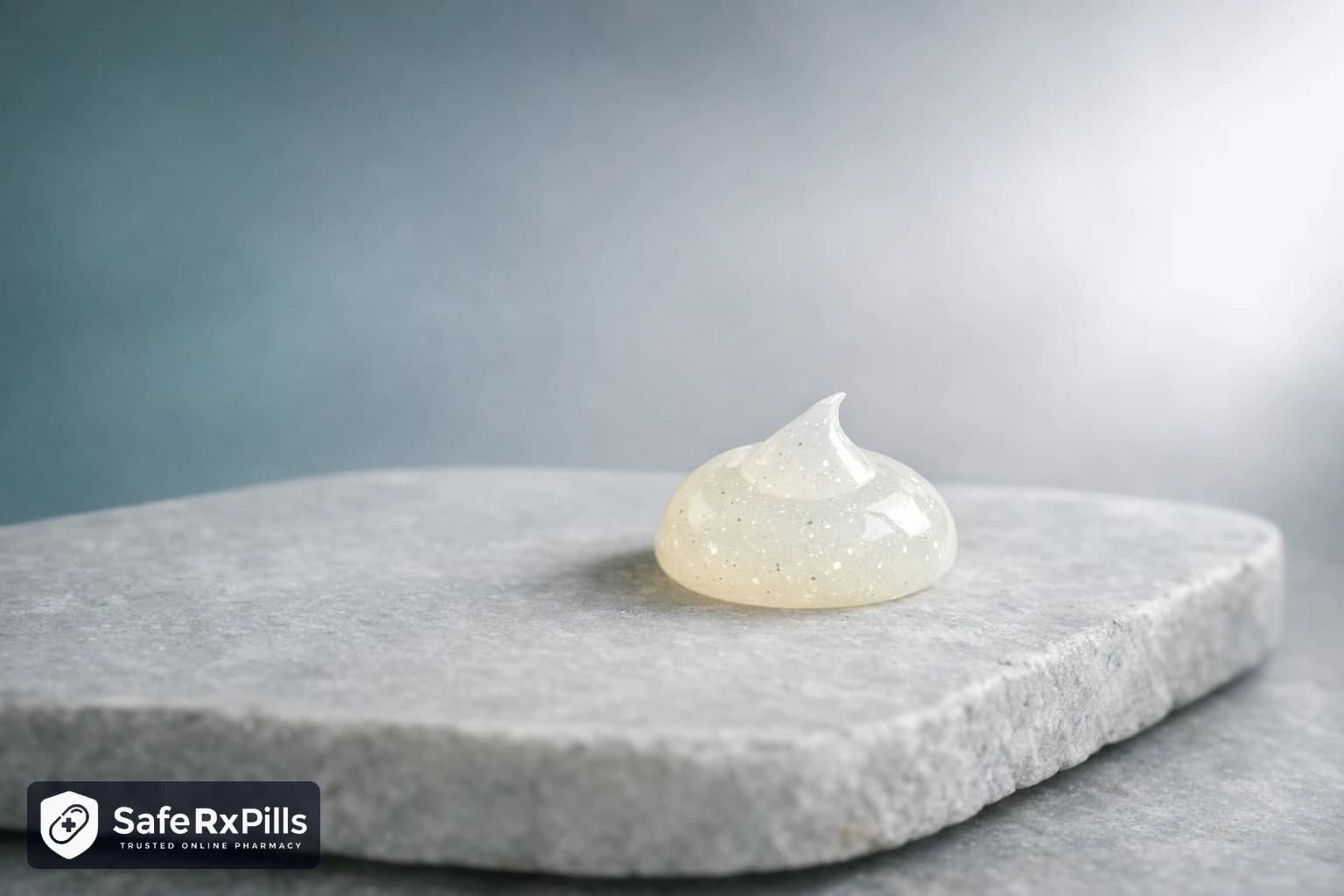
The two strengths look different. The 5% label describes "a gritty translucent material with visible drug substance particles" in a tube, and tells users to wash their hands after applying it. Aczone 7.5% is "an off-white to yellow gel with suspended particles" supplied in an airless pump in 30 g, 60 g and 90 g sizes. The Encube generic 5% label, for example, lists 60 g and 90 g laminate tubes.
Aczone and generic dapsone gel in the US
Aczone is the brand. Drugs@FDA lists two Aczone applications held by Almirall:
| Product | Application | FDA approval | Status listed |
|---|---|---|---|
| Aczone gel 5% | NDA 021794 | 7 July 2005 | Prescription |
| Aczone gel 7.5% | NDA 207154 | 24 February 2016 | Prescription |
Generics followed. openFDA lists 8 approved generic (ANDA) dapsone 5% gels, 7 marked prescription and 1 discontinued, and 8 generic 7.5% gels, 6 prescription and 2 discontinued. The earliest generic approvals in that list are Sun Pharma's 5% gel (16 October 2017) and Sun Pharma's 7.5% gel (26 June 2019). Every generic listed carries an AB rating, meaning the FDA considers it therapeutically equivalent to the brand. Some are made in India: the Encube 5% label, for example, names a manufacturing site in Goa. That FDA approval covers those specific products, not other Indian dapsone gels. Makers with current listings include Torrent, Zydus, Alembic, Mylan, Amneal, Aurobindo, Cosette, Encube and Sun.
Dapsone gel 5% vs 7.5%: what differs
The 7.5% gel was developed to cut the dose to once a day. The first 7.5% phase 3 trial paper states that the 5% gel "requires twice-daily dosing, and some patients may not adhere to this regimen," and describes the 7.5% gel as having "a 50% higher dapsone concentration." The practical differences:
| Dapsone gel 5% | Dapsone gel 7.5% (Aczone) | |
|---|---|---|
| Dapsone per gram | 50 mg | 75 mg |
| Applications per day | 2 | 1 |
| Where to apply | Acne affected areas | Entire face, plus other affected areas |
| Amount | About a pea-sized amount, thin layer | About a pea-sized amount, thin layer |
| Approved age | Not recommended under 12 | 9 years and older |
| Texture | Gritty, translucent, visible particles | Off-white to yellow gel with suspended particles |
| Pack | Tube | Airless pump |
| Trial population | Age 12+, 20 to 50 inflammatory and 20 to 100 non-inflammatory lesions | Age 12+, moderate acne, 20 to 50 inflammatory and 30 to 100 non-inflammatory lesions |
No trial in our sources compared the two strengths head to head. The labels report each against its own vehicle gel, so a choice between them usually comes down to whether once a day suits you better, the approved age, and cost.
How to apply dapsone gel
The label steps are short:
- Wash the skin gently and pat it dry.
- Apply about a pea-sized amount in a thin layer. With 5%, apply it to the acne affected areas twice daily. With 7.5%, apply it to the entire face once daily, and a thin layer to other affected areas once daily.
- Rub it in gently and completely.
- Wash your hands afterwards (the 5% label says this directly).
It is for topical use only: "Not for oral, ophthalmic, or intravaginal use." Keep it out of the eyes and mouth. Store it at room temperature (20°C to 25°C) and protect it from freezing.
How long dapsone gel takes to work
Both labels say that if there is no improvement after 12 weeks, treatment should be reassessed. In the 2007 paper on the two 5% trials (3,010 patients), reductions in inflammatory lesions favoring dapsone over vehicle "were apparent as early as 2 weeks and reached statistical significance by 4 weeks." The main results in all four trials were measured at week 12, so that is the fair point to judge it.
Results in the dapsone gel 5% trials
Two randomized, double-blind trials (1,475 and 1,525 people) compared dapsone gel 5% twice daily with the same gel without dapsone for 12 weeks. Success meant no or minimal acne on the Global Acne Assessment Score.
| Week 12 result | Study 1: dapsone 5% | Study 1: vehicle | Study 2: dapsone 5% | Study 2: vehicle |
|---|---|---|---|---|
| No or minimal acne | 291 of 699 (42%) | 223 of 687 (32%) | 253 of 729 (35%) | 206 of 738 (28%) |
| Inflammatory lesions, % reduction | 46% | 42% | 48% | 40% |
| Non-inflammatory lesions, % reduction | 31% | 24% | 30% | 21% |
| Total lesions, % reduction | 38% | 32% | 37% | 29% |
The label notes that "female subjects tended to have greater percent reductions in lesions and greater success" than males, and that results were similar across racial subgroups. The success analysis excluded people rated as minimal acne at baseline.
Results in the Aczone 7.5% trials
Two identical 12-week trials enrolled 4,340 people aged 12 and older, mostly with moderate acne according to the label; the trial papers (Stein Gold 2016 and Eichenfield 2016) required an acne grade of 3 (moderate) on the Global Acne Assessment Score for entry. Success here was stricter: a rating of none or minimal plus at least a two-grade improvement from baseline.
| Week 12 result | Trial 1: 7.5% (N=1,044) | Trial 1: vehicle (N=1,058) | Trial 2: 7.5% (N=1,118) | Trial 2: vehicle (N=1,120) |
|---|---|---|---|---|
| Success (score 0 or 1) | 30% | 21% | 30% | 21% |
| Inflammatory lesions, mean reduction | 16.1 (56%) | 14.3 (49%) | 15.6 (54%) | 14.0 (48%) |
| Non-inflammatory lesions, mean reduction | 20.7 (45%) | 18.0 (39%) | 20.8 (46%) | 18.7 (41%) |


The published trial papers report the same picture with one more decimal: success in 29.9% against 21.2% in the first trial and 29.8% against 20.9% in the second, all with P<.001. A pooled analysis of both trials gave 29.8% against 21.1%. Two points matter when reading these numbers. First, the vehicle gel helped a lot on its own, which is common in acne trials, so the gain from dapsone itself was around 7 to 10 percentage points on success. Second, the 5% and 7.5% trials used different success rules and different populations, so the 5% numbers being higher does not mean the weaker gel works better.
Who dapsone gel is approved for
Aczone 7.5% is approved for acne vulgaris in patients 9 years of age and older. Use in children 9 to 11 is supported by the adult and teenage trials plus an open label study of 100 children with acne. Dapsone gel 5% is approved for acne vulgaris; its label says safety and efficacy were not studied under 12, so it "is not recommended for use in this age group." Neither label included enough people aged 65 and over to say whether they respond differently.
Both trial programs enrolled people with inflammatory spots (papules and pustules) as well as blackheads and whiteheads, and the 7.5% trials limited entry to moderate acne (grade 3 on the Global Acne Assessment Score, per the Stein Gold and Eichenfield trial papers). Severe acne was not the population studied. The AAD 2024 guideline strongly recommends oral isotretinoin for acne that is severe, causing psychosocial burden or scarring, or failing standard therapy; see our isotretinoin for acne guide. People with G6PD deficiency or a history of methemoglobinemia need a doctor's view before starting, for the reasons below.
Dapsone gel side effects, with the label numbers
In the four 12-week 5% trials (1,819 people on dapsone, 1,660 on vehicle), the most common application site reactions were reported at the same or lower rates than with the plain gel:
| Selected adverse reactions (1% or more) | Dapsone gel 5% (N=1,819) | Vehicle (N=1,660) |
|---|---|---|
| Application site reaction NOS | 18% | 20% |
| Application site dryness | 16% | 17% |
| Application site erythema (redness) | 13% | 14% |
| Application site burning | 1% | 2% |
| Application site pruritus (itching) | 1% | 1% |
| Nasopharyngitis | 5% | 6% |
| Headache | 4% | 4% |

For Aczone 7.5% (2,161 people on dapsone, 2,175 on vehicle), only two adverse reactions reached 0.9%: application site dryness (1.1% against 1.0%) and itching (0.9% against 0.5%). The trial papers put the share of people with any adverse event at 19.1% against 20.6% in the first trial and 17.6% against 17.1% in the second.
The 5% label also lists serious adverse reactions seen in its trials, including a suicide attempt, tonic clonic movements, abdominal pain, severe vomiting, pancreatitis and severe pharyngitis. Depression was reported in 9 of 2,372 people on dapsone gel 5% and 3 of 1,660 on vehicle; psychosis in 2 of 2,372 on dapsone and none on vehicle. The label does not say these were caused by the gel. After approval, methemoglobinemia, rash and swelling of the face (lips, eyes) have been reported. Dapsone gel 5% did not cause phototoxicity or photoallergy in dermal safety studies.
Methemoglobinemia: the warning to know
Methemoglobinemia is a change in hemoglobin that stops red blood cells carrying oxygen properly. Both labels state that "cases of methemoglobinemia, with resultant hospitalization, have been reported postmarketing" with twice daily dapsone gel 5%. People with G6PD deficiency or with congenital or idiopathic methemoglobinemia are more susceptible, and the labels say to avoid the gel in people with congenital or idiopathic methemoglobinemia.
Symptoms can be "delayed some hours after exposure." The first sign is "a slate grey cyanosis" seen on the inside of the mouth, the lips and the nail beds. The labels tell patients to stop the gel and seek immediate medical attention if this happens. Risk rises when dapsone is combined with other drugs that cause methemoglobinemia (listed under interactions below).
G6PD deficiency and hemolysis
Oral dapsone causes dose-related hemolysis (breakdown of red blood cells) and hemolytic anemia. People with G6PD deficiency are more prone to it; the labels note that G6PD deficiency is most prevalent in people of African, South Asian, Middle Eastern and Mediterranean ancestry. In the gel trials there was no evidence of clinically relevant hemolysis or anemia.
A dedicated cross-over trial gave dapsone gel 5% and vehicle to 64 people with G6PD deficiency and acne:
| Mean value | Dapsone 5%: before | Dapsone 5%: 2 weeks | Dapsone 5%: 12 weeks | Vehicle: 2 weeks |
|---|---|---|---|---|
| Hemoglobin (g/dL) | 13.44 | 13.12 | 13.42 | 13.34 |
| Bilirubin (mg/dL) | 0.58 | 0.65 | 0.61 | 0.56 |
| Reticulocytes (%) | 1.30 | 1.51 | 1.48 | 1.34 |
Hemoglobin dropped by 0.32 g/dL after two weeks on dapsone and generally returned to baseline by week 12. A fall of 1 g/dL or more happened in 8 of 58 people on dapsone and 7 of 56 on vehicle. The label says some subjects "developed laboratory changes suggestive of hemolysis," but there was no clinically significant hemolytic anemia. The patient leaflets still warn that some people with G6PD deficiency using the gel have developed mild hemolytic anemia, and section 17 of both labels says to inform patients with G6PD deficiency that hemolytic anemia may occur with topical dapsone treatment. Both labels say to stop the gel if signs of hemolytic anemia appear. The patient leaflets list back pain, shortness of breath, tiredness or weakness, dark brown urine, fever, and yellow or pale skin. Neither label requires a G6PD test before starting; whether to test is a decision for the prescriber.
Drug interactions
- Oral dapsone or antimalarial medicines: avoid the gel because of the potential for hemolytic reactions.
- Trimethoprim/sulfamethoxazole (co-trimoxazole): may increase the likelihood of hemolysis in G6PD deficiency. In a study with the 5% gel, dapsone exposure rose by about 40% and dapsone hydroxylamine exposure more than doubled, although total exposure stayed about 1% of a 100 mg oral dose.
- Drugs that cause methemoglobinemia: the labels list sulfonamides, acetaminophen, acetanilide, aniline dyes, benzocaine, chloroquine, dapsone, naphthalene, nitrates and nitrites, nitrofurantoin, nitroglycerin, nitroprusside, pamaquine, para-aminosalicylic acid, phenacetin, phenobarbital, phenytoin, primaquine and quinine.
- Rifampin, anticonvulsants, St. John's wort: may increase formation of dapsone hydroxylamine, the metabolite linked to hemolysis.
- Topical benzoyl peroxide: skin discoloration (next section).
Acetaminophen and benzocaine are common over the counter products, so tell your pharmacist you use dapsone gel.
Benzoyl peroxide and the orange staining
The 5% label states that applying dapsone gel followed by benzoyl peroxide "resulted in a temporary local yellow or orange discoloration of the skin and facial hair," reported by 7 of 95 subjects in a clinical study, "with resolution in 4 to 57 days." A 2009 laboratory paper found that benzoyl peroxide products produced an "orange-brown discoloration" when mixed with dapsone. It is a chemical reaction on the skin, not an allergy, but up to eight weeks of orange facial hair is a real nuisance.
The labels do not give a timing rule for avoiding it. If you use both, ask your prescriber how and when to apply each one. Adapalene and benzoyl peroxide products are covered in our adapalene over the counter guide.
Using dapsone gel with other acne treatments
A 12-week randomized trial in 301 people added adapalene gel 0.1%, benzoyl peroxide gel 4% or a moisturizer to twice daily dapsone gel 5%. All three groups improved. The dapsone plus adapalene group did better than dapsone plus moisturizer on non-inflammatory and total lesion counts; the inflammatory lesion difference against moisturizer was not significant for either adapalene or benzoyl peroxide (P=0.052). Local reactions were minimal and mostly mild.
The American Academy of Dermatology's 2024 acne guideline (Reynolds and colleagues) makes strong recommendations for benzoyl peroxide, topical retinoids, topical antibiotics and oral doxycycline, and lists combining topical therapies with multiple mechanisms of action as good practice. The guideline abstract does not name dapsone separately. How the guideline treats each topical is covered in our prescription acne creams compared guide. If you also take an oral antibiotic, see our doxycycline for acne guide; remember that sulfonamide antibiotics are on the methemoglobinemia list above.
Pregnancy and breastfeeding
Pregnancy: both labels say there are no available data on dapsone gel use in pregnant women to inform a drug-associated risk. In animal studies, oral dapsone caused embryocidal effects at systemic exposures more than 400 times (7.5% label) or 250 times (5% label) the exposure from the maximum recommended human dose of the gel, effects the label says were probably secondary to maternal toxicity. Absorption from the gel is low compared with tablets. Tell your prescriber if you are pregnant or planning to be.
Breastfeeding: the prescribing information says there is no information on topical dapsone in breast milk, and that oral dapsone does appear in human milk and "could result in hemolytic anemia and hyperbilirubinemia especially in infants with G6PD deficiency." The FDA-approved patient leaflets for both strengths say the gel can pass into breast milk and may harm the baby, and that you should not use it and breastfeed at the same time; decide with your doctor which to do.
How little dapsone reaches the bloodstream
| Measurement | Result |
|---|---|
| 5% twice daily for 14 days, mean AUC 0 to 24 h | 415 ± 224 ng·h/mL |
| Single 100 mg dapsone tablet, mean AUC | 52,641 ± 36,223 ng·h/mL |
| Oral vs 5% gel exposure | Oral about 100 times greater |
| 7.5% once daily (2 g on face, chest, back, shoulders), day 28 | Cmax 13.0 ± 6.8 ng/mL; AUC 282 ± 146 ng·h/mL |
| 7.5% exposure vs 100 mg tablet | About 1% |
In a year-long 5% study of about 500 people, there was no evidence that exposure rose over time. Low absorption is why the gel trials did not show the blood problems seen with tablets, but the methemoglobinemia cases after approval show that low is not zero.
Generic status and US cost
Both strengths have AB-rated generics, which the FDA rates as therapeutically equivalent to Aczone. NADAC, the government survey of what US pharmacies pay to buy drugs, listed these generic prices for the week of 28 October 2026. The 2026 NADAC file had no brand-name Aczone row, so the brand's acquisition cost is not shown.
| Generic product (NADAC description) | Per gram | 60 g | 90 g |
|---|---|---|---|
| Dapsone 5% gel | $0.58278 | $34.97 | $52.45 |
| Dapsone 7.5% gel pump | $0.76991 | $46.19 | $69.29 |

These are pharmacy acquisition costs, not shelf prices. What you pay depends on insurance, coupons and pharmacy markup, and cash prices are usually higher than NADAC.
Indian dapsone gels we sell
We sell two Indian products. They are made in India and are not FDA-approved Aczone or FDA-approved generics; the FDA has not reviewed them. Prices are from our store as of 28 October 2026.
| Product | What it contains | Maker | Pack | Price | Per 15 g tube |
|---|---|---|---|---|---|
| Acnedap 15 g | Dapsone gel 5% w/w (as printed on the carton) | Cipla | 1 × 15 g | $21.00 | $21.00 |
| 3 × 15 g | $43.75 | $14.58 | |||
| 6 × 15 g | $85.00 | $14.17 | |||
| Acnewar 15 g | Dapsone gel 5% w/w (as listed by Indian pharmacies; check the carton) | Akumentis Healthcare | 3 × 15 g | $33.00 | $11.00 |
| 6 × 15 g | $64.00 | $10.67 | |||
| 12 × 15 g | $115.00 | $9.58 |
Both products are 5% dapsone gels, the same strength as US dapsone gel 5%, so the US 5% label directions (twice daily, thin layer) are the relevant reference. Per gram, Acnedap works out at $1.40 for a single tube and $0.94 in the 6-pack. Acnewar works out at $0.73 per gram in the 3-pack, $0.71 in the 6-pack ($64.00 for 90 g) and $0.64 in the 12-pack ($115.00 for 180 g). All of these are above the US NADAC acquisition cost of $0.58278 per gram for generic 5% gel. If your US insurance covers generic dapsone, a US pharmacy may well be cheaper.
Buying dapsone gel from outside the US
The FDA's personal importation page says: "In most circumstances, it is illegal for individuals to import drugs or devices into the U.S. for personal use because these products purchased from other countries often have not been approved by the FDA for use and sale in the U.S." It adds that "the FDA recommends only obtaining medicines from legal sources in the U.S." The same page lists situations where FDA staff may make a more permissive decision. You need to check your own situation before ordering, and dapsone gel should be used under a prescriber's care because of the blood warnings.
How dapsone gel compares with other acne topicals
In short: dapsone gel is an option with skin irritation close to a plain gel in its trials, against a different set of trade-offs from retinoids (irritation, pregnancy cautions), benzoyl peroxide (bleaching, irritation) and topical antibiotics (resistance, best paired with benzoyl peroxide). We do not repeat the side by side comparison here. For retinoids, Epiduo, Winlevi, azelaic acid and others by the evidence, see prescription acne creams and gels compared. For clindamycin gel and why it is paired with benzoyl peroxide, see our clindamycin gel for acne guide. For a gentle option also used in rosacea, see azelaic acid cream. More treatments are listed on our acne condition page.
When to stop and see a doctor
- Lips, nail beds or the inside of the mouth turning grey or blue: stop and get medical help right away (possible methemoglobinemia).
- Back pain, shortness of breath, tiredness or weakness, dark brown urine, fever, or yellow or pale skin: stop and tell your doctor right away (possible hemolytic anemia).
- Swelling of the face, lips or eyes, or a spreading rash.
- No improvement after 12 weeks: the labels say treatment should be reassessed.
- Pregnancy, or starting a new medicine from the interaction list.
Sources
- Aczone (dapsone) gel 7.5%, US prescribing information, Almirall. DailyMed setid 22058b7d-a578-4eaa-a476-ac982337f02a, published 17 November 2025.
- Dapsone gel 5%, US prescribing information, Encube Ethicals. DailyMed setid 4205a1a9-c459-47bb-9538-1dd559ca71f1, published 17 November 2025.
- Drugs@FDA via openFDA: NDA 021794, NDA 207154 and ANDA dapsone gel listings, accessed 28 October 2026.
- Draelos, et al. Two randomized studies demonstrate the efficacy and safety of dapsone gel, 5% for the treatment of acne vulgaris. J Am Acad Dermatol. 2007. PMID 17208334.
- Stein Gold, et al. Efficacy and safety of once-daily dapsone gel, 7.5% (first of two trials). J Drugs Dermatol. 2016;15(5):553-561. PMID 27168264.
- Eichenfield, et al. Efficacy and safety of once-daily dapsone gel, 7.5% (second of two trials). J Drugs Dermatol. 2016;15(8):962-969. PMID 27537997.
- Thiboutot, et al. Pooled analysis of two phase 3 trials of dapsone gel 7.5%. J Clin Aesthet Dermatol. 2016. PMID 27847545.
- Fleischer, et al. Dapsone gel 5% in combination with adapalene gel 0.1%, benzoyl peroxide gel 4% or moisturizer. J Drugs Dermatol. 2010. PMID 20120423.
- Dubina, et al. Interaction of topical sulfacetamide and topical dapsone with benzoyl peroxide. Arch Dermatol. 2009. PMID 19770443.
- Reynolds, et al. Guidelines of care for the management of acne vulgaris. J Am Acad Dermatol. 2024. PMID 38300170.
- CMS National Average Drug Acquisition Cost (NADAC) 2026 dataset, data.medicaid.gov, rows dated 28 October 2026.
- US Food and Drug Administration. Personal Importation, fda.gov, accessed 28 October 2026.
Related Topics:
Comments (0)
No comments yet. Be the first to share your thoughts!
Related Articles