
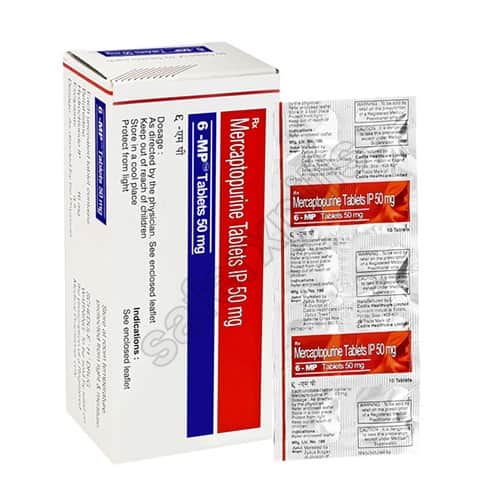
6-MP 50mg
Generic: Mercaptopurine
Select pack size
60 tablets · $0.58 per tablet
About 6-MP 50mg
6-MP 50mg is a mercaptopurine tablet made in India by Zydus Lifesciences (some Indian listings still use its former name, Cadila Healthcare). Each tablet contains 50 mg of mercaptopurine, the same strength as the US, UK, Australian and Canadian 50 mg tablets. Mercaptopurine is a cancer medicine: in the US label its use is acute lymphoblastic leukaemia (ALL, also spelled leukemia) as part of a combination chemotherapy maintenance regimen, and the UK label adds acute promyelocytic leukaemia. We sell 6-MP 50mg in packs of 60, 90 and 120 tablets, from $0.52 a tablet in the largest pack before shipping.
Please read this first. Mercaptopurine is taken under a cancer or blood specialist, with regular blood counts and liver tests, and the dose is changed according to those results. Do not start, stop or change it without the specialist who treats you. This page sets out the label facts, the price per tablet and what to check, using the current US prescribing information for mercaptopurine tablets (Hikma, revised October 2024) and the UK Summary of Product Characteristics for mercaptopurine 50 mg tablets (Aspen, revised December 2024), listed under Sources. We found no published study of the Zydus tablet itself.
6-MP 50mg at a glance
| Active ingredient | Mercaptopurine 50 mg per tablet |
| Brand and maker | 6-MP, Zydus Lifesciences, India |
| Drug class | Purine analogue (thiopurine) cancer medicine; the US label calls it a nucleoside metabolic inhibitor |
| Regulatory status | Mercaptopurine 50 mg tablets are licensed in the US, UK, Australia and Canada. We sell the Indian Zydus pack, which is not the pack registered in those countries |
| Label use | US: ALL as part of a combination chemotherapy maintenance regimen, adults and children. UK: acute lymphoblastic leukaemia and acute promyelocytic leukaemia |
| Usual dose from the label | US: starting dose 1.5 to 2.5 mg/kg once a day. UK: usually 2.5 mg/kg a day, or 50 to 75 mg/m² a day. Set and adjusted by the specialist |
| Half-life | Less than 2 hours after a single dose; the US label (section 10) says its active metabolites inside cells have "long persistence" |
| Monitoring | Blood counts throughout; liver tests weekly at first, then monthly (US label) |
| Packs | 60, 90 and 120 tablets |
| Price per tablet | $0.58 (60 pack) down to $0.52 (120 pack), before shipping |
| Delivery | 7 to 14 business days to the US, UK, Australia and Canada; $25 shipping under $149, free from $149 |
Price per tablet
Prices below are as of October 2026; the pack selector shows the current price.
| Pack | Price | Per tablet | Shipping | Per tablet with shipping |
|---|---|---|---|---|
| 60 tablets | $35 | $0.58 | $25 | $1.00 |
| 90 tablets | $50 | $0.56 | $25 | $0.83 |
| 120 tablets | $62 | $0.52 | $25 | $0.73 |
All three packs are under $149, so each single pack carries the $25 shipping charge. Two 120 packs ($124) are still under $149; an order of $149 or more ships free.
How long a pack lasts at the label dose
The dose depends on body weight and on blood counts, so there is no single answer. As an example only, using the US label's starting range of 1.5 to 2.5 mg/kg a day for an adult who weighs 70 kg:
- 1.5 mg/kg x 70 kg = 105 mg a day, about 2 tablets
- 2.5 mg/kg x 70 kg = 175 mg a day, 3.5 tablets
- At about 2 to 3.5 tablets a day, a 60 pack lasts about 17 to 30 days, a 90 pack about 26 to 45 days and a 120 pack about 34 to 60 days.
This is arithmetic, not a dose to follow. Your specialist sets the dose and changes it whenever the blood counts call for it. Some people need far less: the US label says people with two inactive copies of the TPMT or NUDT15 gene "typically require 10% or less of the recommended dosage". The US label also says a recommended dose cannot be given with 50 mg tablets to anyone under 17 kg.
Compared with US and UK mercaptopurine
| 6-MP 50mg (Zydus) | US mercaptopurine 50 mg tablets | UK mercaptopurine 50 mg tablets | |
|---|---|---|---|
| Mercaptopurine per tablet | 50 mg | 50 mg | 50 mg |
| Makers | Zydus Lifesciences, India | Purinethol NDA (first approved 1953, now sold as mercaptopurine by Florida Pharmaceutical Products) and generics such as Hikma and Dr Reddy's | Aspen (PL 39699/0047) |
| Status | Indian pack; not registered in the US, UK, Australia or Canada | FDA approved, prescription only | Licensed, prescription only medicine (POM) |
| Cost per tablet | $0.52 to $0.58 before shipping; $0.73 to $1.00 with shipping on a single pack | NADAC $1.07143 (pharmacy acquisition cost, effective 23 September 2026) | Not checked |
NADAC is what US pharmacies pay for the generic tablet, not what a patient pays at the counter, and many people being treated for leukaemia have this medicine covered by insurance or their hospital. Our per-tablet price is lower than the NADAC figure, even with shipping. That does not make importing it the better choice for most US readers: the FDA says personal importation of unapproved medicines is illegal in most circumstances, and a maintenance course should not depend on an international parcel that takes up to 14 business days. If you are in the US and have a prescription, compare US generic cash prices and your insurance cost first.
A generic tablet is approved on evidence that it matches the original product. We have no bioequivalence data comparing the Zydus tablet with US or UK tablets. The UK label notes that the mercaptopurine tablet and oral suspension are not bioequivalent for peak blood levels and advises closer blood count monitoring when switching between them. We suggest the same caution for any change of supply: tell your specialist before you switch to this or any other brand, so that your blood counts can be checked.
Tablet or oral suspension
The US tablet label says 50 mg is the only tablet strength available. A 20 mg/mL oral suspension is licensed for ALL in the US (Purixan, approved 2014, and a generic) and the UK (Xaluprine). The US tablet label says not to give tablets to people who cannot swallow them. A liquid can be measured in much smaller steps than a 50 mg tablet. Your specialist decides which form you take; do not switch between them on your own.
How to take 6-MP 50mg
- Take it once a day exactly as your specialist prescribes, usually as part of a combination treatment plan.
- Food: the US label says take it "either consistently with or without food", because food decreases how much is absorbed. The UK label also asks you to keep the same routine, and says the dose should not be taken with milk or dairy products: take it at least 1 hour before or 2 hours after them.
- Time of day: the UK label says the daily dose should be taken in the evening, because studies in children with ALL suggested that evening dosing lowered the risk of relapse.
- Missed dose: the US label says carry on with the next scheduled dose. Do not take two doses to make up for it.
- Blood tests: keep every appointment. The US label says to check blood counts and adjust the dose, and to check liver tests weekly when treatment starts and monthly after that; the UK label says liver tests should be monitored weekly during treatment.
- Sun: both labels say to limit sun exposure. The UK label recommends protective clothing and a high protection factor sunscreen.
- Vaccines: tell every doctor, nurse or pharmacist who vaccinates you that you take mercaptopurine (see the vaccines section below).
Handling the tablets safely
Mercaptopurine is a cytotoxic drug. The UK label says anyone handling it should wash their hands before and after giving a dose, parents and carers should wear disposable gloves, and women who are pregnant, planning a pregnancy or breastfeeding should not handle it. If it touches skin, wash it off straight away with soap and water. Keep it out of the reach and sight of children, preferably in a locked cupboard: the UK label warns that "Accidental ingestion can be lethal for children." Ask your hospital pharmacy how to dispose of unused tablets.
Dose changes for some groups
- TPMT or NUDT15 deficiency: these inherited enzyme differences make the blood count drop much more on a usual dose. The US label says to consider testing in people with severe or repeated low blood counts, and that most people with one inactive copy tolerate the usual dose while some need less. The UK label says NUDT15 testing may be considered before starting. In the US label's study of 1,028 children with ALL, the tolerated dose was about 50% to 90% of the planned dose with one inactive TPMT or NUDT15 copy, 30% to 50% with one inactive copy of each, and 5% to 10% with two inactive copies of either. The US label gives NUDT15 deficiency as more common in people of East Asian ancestry (2% with two inactive copies, about 21% with one). The Clinical Pharmacogenetics Implementation Consortium (CPIC) publishes genotype-based starting dose recommendations.
- Kidney impairment (creatinine clearance under 50 mL/min): the US label says use the lowest recommended starting dose, or give it every 36 to 48 hours, and adjust to the blood counts.
- Liver impairment: the US label says use the lowest recommended starting dose.
- With allopurinol: the US label says reduce mercaptopurine to one third to one quarter of the current dose. The UK label says only 25% of the usual dose should be given with allopurinol, oxipurinol or thiopurinol.
- Older adults: the US label advises cautious dose selection, usually starting at the low end of the range.
Side effects
The US label's figures come from multicentre cooperative group trials in ALL, where mercaptopurine was given with other medicines:
| How often (US label 6.1) | Side effects |
|---|---|
| More than 20% of patients | Low blood counts (myelosuppression): anaemia, low neutrophils, low lymphocytes, low platelets |
| 5% to 20% | Loss of appetite, nausea, vomiting, diarrhoea, feeling unwell (malaise), rash |
| Less than 5% | Hives, raised uric acid, mouth sores, raised liver enzymes, raised bilirubin, darker skin (hyperpigmentation), infections, pancreatitis |
| Delayed or late | Liver scarring (hepatic fibrosis), raised bilirubin, hair loss, lung scarring (pulmonary fibrosis), low sperm count, second cancers |
The US label also lists drug fever, sensitivity to sunlight, low blood sugar and raised pressure in the liver's portal vein. The UK label says frequencies are estimates because modern clinical data are lacking, and adds allergic reactions (joint pain, rash, fever, and rarely facial swelling), pellagra (a niacin deficiency with a pigmented rash, gut upset or confusion) and erythema nodosum.
The main warnings
- Low blood counts are the most consistent side effect and depend on the dose (US 5.1). The UK label adds that white cell and platelet counts keep falling after treatment stops.
- Liver damage: "Mercaptopurine is hepatotoxic. There are reports of deaths attributed to hepatic necrosis" (US 5.2). Jaundice usually appears in the first 1 to 2 months but has been reported from 1 week to 8 years after starting. The UK label says patients should be told to stop the tablets immediately if jaundice appears; contact your specialist the same day.
- Infections and vaccines: mercaptopurine weakens the immune system, so vaccines may work less well and live vaccines carry a risk of infection (US 5.3). The UK label contraindicates the yellow fever vaccine and says other live vaccines are not recommended.
- Second cancers: people on immunosuppressive treatment including mercaptopurine have a higher risk of lymphomas and other cancers, notably skin cancers (US 5.4, UK 4.4). Hepatosplenic T-cell lymphoma, which the UK label says "has an aggressive disease course and is usually fatal", has been reported in people treated with mercaptopurine or azathioprine for inflammatory bowel disease.
- Macrophage activation syndrome, a life-threatening immune overreaction, may develop in people with autoimmune conditions, particularly inflammatory bowel disease. Both labels say to stop mercaptopurine if it occurs or is suspected.
- Low blood sugar in young children: symptomatic hypoglycaemia has been reported in children with ALL, mostly under 6 years old or with a low body mass index (US 8.4).
- Pancreatitis: the UK label rates it rare in the licensed uses but common in people treated for inflammatory bowel disease.
When to get urgent help
Contact your specialist team or emergency services straight away (911 in the US and Canada, 999 in the UK, 000 in Australia) if you have:
- Fever, chills, a sore throat, or any sign of infection. The US label lists fever, sore throat and signs of local infection as reasons to contact your healthcare provider; with low white cells an infection can become serious quickly.
- Bleeding from any site, nosebleeds or bleeding gums, unusual bruising or tiny red spots on the skin.
- Unusual tiredness, breathlessness or paleness, which can be signs of anaemia.
- Yellow skin or eyes, dark urine, itching, or swelling of the abdomen, which can mean liver damage.
- Repeated vomiting, or severe upper abdominal pain. Pancreatitis is listed in both labels; pain that spreads to the back is a general warning sign of it, not label wording.
- Signs of a serious allergic reaction. The labels list rash, hives and (UK, rare) facial swelling; swelling of the lips, tongue or throat and trouble breathing or swallowing are general warning signs that need emergency care.
- In a young child, signs that could be low blood sugar, which the US label reports in children with ALL. General warning signs include sweating, shakiness, drowsiness or confusion.
If a child swallows any tablets, or someone takes more than prescribed, call emergency services or a poison line at once (US Poison Help 1-800-222-1222; Australian Poisons Information Centre 13 11 26; in the UK call 999 or NHS 111), even if there are no symptoms. Early signs of overdose are loss of appetite, nausea, vomiting and diarrhoea; the main harm, low blood counts and liver damage, can come later. The UK label says there is no known antidote and that activated charcoal may not work unless given within 60 minutes. Tell the emergency staff that it was mercaptopurine, how much and when.
Who should not take 6-MP 50mg
Never take it if (UK label contraindications; the US label lists none):
- you are allergic to mercaptopurine or any ingredient of the tablet
- you are having the yellow fever vaccine
Not recommended or not advised (UK label wording unless stated):
- live vaccines other than yellow fever: "not recommended" in immunocompromised people
- febuxostat: the UK label says use with mercaptopurine "is not recommended as data are insufficient to determine an adequate dose reduction" (4.5) and "should be avoided" (4.2)
- ribavirin: "not advised", because severe low blood counts have been reported
- Lesch-Nyhan syndrome: use is "not recommended"
- rare inherited galactose intolerance, total lactase deficiency or glucose-galactose malabsorption: the UK tablet contains lactose and the label says these patients "should not take this medicine". The Zydus pack's ingredients were not on the listings we checked, so read the carton.
Pregnancy, breastfeeding and fertility:
- The US label says mercaptopurine "can cause fetal harm", with more miscarriages after use in the first trimester, and asks for a pregnancy check before starting. The UK label says it should not be given to anyone who is pregnant or likely to become pregnant "without careful assessment of risk versus benefit".
- Contraception: the US label says women should use effective contraception during treatment and for 6 months after the last dose, and men with a partner who could become pregnant for 3 months after. The UK label says both men and women for at least 3 months after the last dose.
- Breastfeeding: the US label says do not breastfeed during treatment and for 1 week after the last dose; the UK label says women taking mercaptopurine should not breastfeed.
- Fertility: the US label says mercaptopurine can impair fertility in women and men; the UK label says its effect on human fertility is unknown and reports short-lived very low sperm counts.
Talk to your specialist first if you have liver or kidney disease, a known TPMT or NUDT15 result, a past reaction to azathioprine (the UK label says azathioprine is broken down into mercaptopurine, so an allergy to one needs assessment before using the other), hepatitis B, or no history of chickenpox or chickenpox vaccination (the UK label asks for these to be considered before starting).
Medicines that interact with mercaptopurine
- Allopurinol (and oxipurinol or thiopurinol in the UK label): raises mercaptopurine levels, with more risk of low blood counts, nausea and vomiting. Dose reduction as above.
- Febuxostat: not recommended (UK label; the US label does not mention it).
- Warfarin: mercaptopurine may reduce warfarin's effect; INR should be monitored and the warfarin dose adjusted (US 7.2, UK 4.5).
- Other medicines that lower blood counts, including trimethoprim with sulfamethoxazole (co-trimoxazole): blood counts should be monitored and the mercaptopurine dose adjusted (US 7.3).
- Aminosalicylates such as mesalazine (mesalamine), olsalazine and sulfasalazine: they may block TPMT. The US label says use the lowest possible doses of each and monitor blood counts more often.
- Medicines that can harm the liver: liver tests should be checked more often (US 7.5).
- Methotrexate: raised mercaptopurine exposure by about 31% at 20 mg/m² by mouth, and by 69% and 93% at high intravenous doses; the UK label says the dose may need adjustment with high-dose methotrexate.
- Ribavirin: not advised (UK label).
- Phenytoin and other epilepsy medicines: the UK label says blood levels should be monitored.
- Infliximab: the UK label describes a short-lived rise in active metabolite levels and a fall in white cells with azathioprine after infliximab.
- Live vaccines: see above.
Tell your specialist and pharmacist about every medicine, vaccine and supplement you take, including anything bought without a prescription.
Mercaptopurine and inflammatory bowel disease
Mercaptopurine is also used by gastroenterologists for Crohn's disease and ulcerative colitis, but this is not a label use: the US label calls it "an unapproved use" and the UK label "an unlicensed indication". The British Society of Gastroenterology 2019 guideline recommends that "azathioprine or mercaptopurine can be used as monotherapy in the maintenance of remission in Crohn's disease", says thiopurines should not be used to bring active Crohn's disease into remission, and recommends checking TPMT before any thiopurine. Its usual mercaptopurine dose with normal TPMT is 1 to 1.25 mg/kg a day, lower than the leukaemia dose. The labels link their warnings about hepatosplenic T-cell lymphoma, macrophage activation syndrome and (in the UK label) common pancreatitis to people treated for inflammatory bowel disease. If you take mercaptopurine for Crohn's disease or colitis, your gastroenterologist decides the dose and the blood test schedule.
Prescription and legal status
Mercaptopurine is a prescription-only medicine in every country we ship to. In the US, mercaptopurine 50 mg tablets are FDA approved and labelled "Rx only", and the FDA says personal importation of unapproved medicines is illegal in most circumstances; the Zydus pack is not FDA approved. In the UK, mercaptopurine 50 mg tablets (Aspen) and Xaluprine oral suspension are prescription only medicines on the electronic medicines compendium. In Australia, Puri-Nethol 50 mg tablets are on the TGA register (ARTG 10993), and healthdirect lists mercaptopurine 50 mg tablets as Schedule 4 (prescription only) and on the PBS. In Canada, Purinethol (Teva) and a Sterimax generic are marketed as prescription medicines. Indian pharmacy listings we checked mark 6-MP as a prescription medicine. The molecule is licensed in all four countries, but the Zydus 6-MP pack is not registered by the FDA, the MHRA, the TGA or Health Canada. Check the rules where you live.
Buying genuine 6-MP
The MHRA warns: "Any medicine not authorised for sale in the UK can be unsafe or ineffective and there is no way of knowing what is in them or the negative health effects they can have." It advises UK buyers to "Only use UK-registered pharmacies, including online pharmacies displaying the official green cross logo." That warning covers the Zydus 6-MP pack, which is not authorised in the UK. When your order arrives, read the strip: it should name 6-MP and mercaptopurine 50 mg, name Zydus Lifesciences or Cadila Healthcare, and show a batch number and an expiry date. PharmEasy and Apollo list it in strips of 10. These checks cannot prove that tablets are genuine, because counterfeiters copy packaging. Tell your specialist before the first dose from any new supply, so your blood counts can be watched. If a batch causes unusual symptoms, seek medical advice and report it to your medicines regulator (the MHRA Yellow Card scheme in the UK, FDA MedWatch in the US, the TGA in Australia or Health Canada) as well as to us.
Delivery
We ship 6-MP 50mg to the US, UK, Australia and Canada in plain packaging with tracking. Standard delivery takes 7 to 14 business days to most countries. Shipping costs a flat $25 on orders under $149 and is free from $149. Missing doses of leukaemia maintenance treatment matters, so never let your supply run low while you wait for a parcel, and keep your hospital or local pharmacy as your main source. See our shipping page and refund policy.
Sources
- Mercaptopurine Tablets USP 50 mg, US prescribing information, Hikma Pharmaceuticals USA, revised October 2024 (DailyMed setid c3b5b8b0-bc5c-4ce9-bbdc-febba60c2658, version 14): sections 1, 2, 4, 5, 6, 7, 8, 10, 12, 16 and 17. DailyMed
- PURIXAN (mercaptopurine) oral suspension 20 mg/mL, US prescribing information, Nova Laboratories (DailyMed setid 9fd27952-7787-47d9-b6cf-7af2dc38217b, version 30, effective 20 July 2026). DailyMed
- US Food and Drug Administration, openFDA drug approvals and NDC directory: Purinethol NDA 009053 (1953), Purixan NDA 205919 (2014), mercaptopurine ANDAs, searched 20 October 2026.
- Mercaptopurine 50 mg tablets, Summary of Product Characteristics, Aspen Pharma Trading Ltd, PL 39699/0047, revised December 2024: sections 4.1 to 4.9 and 6.6. emc
- Xaluprine 20 mg/ml oral suspension, Summary of Product Characteristics, Nova Laboratories, PLGB 13581/0002. emc
- Centers for Medicare and Medicaid Services, National Average Drug Acquisition Cost (NADAC): mercaptopurine 50 mg tablet, $1.07143 per tablet for four NDCs, effective 23 September 2026 (as of 14 October 2026). data.medicaid.gov
- Health Canada Drug Product Database: Purinethol DIN 00004723 and mercaptopurine tablets USP DIN 02415275, searched 20 October 2026. Health Canada
- Therapeutic Goods Administration, ARTG 10993, Puri-Nethol mercaptopurine 50 mg tablet. TGA
- healthdirect, Mercaptopurine (Link) 50 mg tablets: Schedule 4, PBS. healthdirect
- Lamb CA et al. British Society of Gastroenterology consensus guidelines on the management of inflammatory bowel disease in adults. Gut 2019. PMID 31562236.
- Relling MV et al. Clinical Pharmacogenetics Implementation Consortium guideline for thiopurine dosing based on TPMT and NUDT15 genotypes: 2018 update. Clinical Pharmacology and Therapeutics 2019. PMID 30447069.
- Indian pharmacy listings for 6-MP 50mg (PharmEasy, Apollo Pharmacy), checked 20 October 2026; The Pharma Letter, Cadila Healthcare changes name to Zydus Lifesciences, 24 February 2022.
- MHRA. 20 million illegal erectile dysfunction pills seized as MHRA warns against risky online buys, 13 February 2026. GOV.UK
- US Food and Drug Administration. Personal Importation. FDA
This page is for information and is not medical advice. Mercaptopurine is a prescription cancer medicine. Take it only as prescribed by the specialist who treats you, with the blood tests they arrange, and do not start, stop or change the dose without their advice.
Key Information
- ✓Active Ingredient: Mercaptopurine
- ✓Category: Life Saving Drugs
- ✓Form: Tablet
- ✓Brand: Zydus Lifesciences
- ✓Manufacturer: Zydus Lifesciences
Frequently Asked Questions
What is 6-MP 50mg?
6-MP 50mg is a mercaptopurine 50 mg tablet made in India by Zydus Lifesciences (formerly Cadila Healthcare). Mercaptopurine is a cancer medicine. The US label use is acute lymphoblastic leukaemia (ALL) in adults and children as part of a combination chemotherapy maintenance regimen; the UK label also covers acute promyelocytic leukaemia. It is taken under a specialist with regular blood tests.
Is 6-MP the same as Purinethol or US and UK mercaptopurine tablets?
It contains the same amount of mercaptopurine, 50 mg per tablet. We have no bioequivalence data comparing the Zydus tablet with Purinethol or with US or UK generics, so tell your specialist before switching to it so your blood counts can be checked. The UK label already advises closer blood count monitoring when switching between mercaptopurine tablets and oral suspension.
What does 6-MP 50mg cost per tablet?
As of October 2026 it costs $0.58 a tablet in the 60 pack ($35), $0.56 in the 90 pack ($50) and $0.52 in the 120 pack ($62), before shipping. Each single pack is under $149, so $25 shipping applies, giving $1.00, $0.83 or $0.73 a tablet. US pharmacies pay about $1.07 a tablet for the generic (NADAC, effective 23 September 2026), but insurance often covers it and importing is illegal in most circumstances. The pack selector shows the current price.
How do I take 6-MP 50mg?
Once a day, exactly as your specialist prescribes. The US label says take it consistently either with or without food. The UK label says keep the same routine, do not take it with milk or dairy (take it at least 1 hour before or 2 hours after them) and take it in the evening. If you miss a dose, the US label says carry on with the next scheduled dose; do not double up.
What dose of mercaptopurine is usual?
The US label starting dose is 1.5 to 2.5 mg/kg once a day; the UK label gives 2.5 mg/kg a day or 50 to 75 mg/m2. For a 70 kg adult that is about 2 to 3.5 tablets a day, but the specialist adjusts the dose to blood counts. People with TPMT or NUDT15 deficiency can need much less: the US label says those with two inactive copies typically need 10% or less of the usual dose.
How long does a pack last?
It depends on the prescribed dose. As arithmetic only, at about 2 to 3.5 tablets a day (about the US label range for a 70 kg adult), a 60 pack lasts about 17 to 30 days, a 90 pack about 26 to 45 days and a 120 pack about 34 to 60 days. Order well before you run low, because delivery takes 7 to 14 business days.
What blood tests do I need?
Regular full blood counts, because low blood counts are the most consistent side effect, and liver tests. The US label says check liver tests weekly when treatment starts and monthly after that; the UK label says weekly during treatment. Your specialist may also test TPMT and NUDT15, the enzymes that decide how much of the drug builds up.
What are the side effects of mercaptopurine?
In the US label, low blood counts affected more than 20% of patients in ALL trials; loss of appetite, nausea, vomiting, diarrhoea, malaise and rash affected 5% to 20%. Serious risks include liver damage (deaths have been reported), infections, second cancers, macrophage activation syndrome and pancreatitis. Get urgent help for fever or signs of infection, bleeding or bruising, yellow skin or eyes, severe vomiting or abdominal pain, or allergy signs.
Who should not take 6-MP 50mg?
The UK label contraindicates it in anyone allergic to mercaptopurine or the tablet's ingredients and with the yellow fever vaccine (the US label lists no contraindications). The UK label says other live vaccines and febuxostat are not recommended and ribavirin is not advised. With allopurinol the dose must be cut to one third to one quarter (US) or 25% (UK). It can harm an unborn baby: the US label advises contraception for 6 months after the last dose for women and 3 months for men, and no breastfeeding during treatment and for 1 week after.
Do I need a prescription for 6-MP 50mg?
Mercaptopurine is prescription only in the US, UK, Australia (Schedule 4) and Canada, and Indian listings mark 6-MP as a prescription medicine. The molecule is licensed in all four countries, but the Zydus pack is not registered by the FDA, MHRA, TGA or Health Canada, and the FDA says personal importation of unapproved medicines is illegal in most circumstances. Use it only as prescribed by your specialist.
How long does delivery take?
Standard delivery takes 7 to 14 business days to the US, UK, Australia and Canada, in plain packaging with tracking. Shipping is $25 on orders under $149 and free from $149. Do not let your supply run low while you wait: missing doses of leukaemia maintenance treatment matters, so keep your hospital or local pharmacy as your main source.
Medical References
Sources: U.S. National Library of Medicine (DailyMed, PubMed), openFDA
Related Products
View all
Customer Reviews
No reviews yet. Be the first to review 6-MP 50mg.
Related Articles
Health guides about Mercaptopurine, written by pharmacists
Brand vs Generic Drug Prices: What US Pharmacies Pay for Viagra, Cialis, Latisse and More (NADAC, October 2026)
CMS NADAC data for the week of 14 October 2026 shows what US pharmacies pay for brand and generic versions of Viagra, Cialis, Propecia, Latisse, Lumigan and Stromectol. Generic ED and hair loss tablets cost under 2% of the brand price, while eye and lash generics cost 41% to 65%. Includes 2026 trends, supplier counts and the full method.
Buy Amaryl (Glimepiride) Online: Dosing, Hypoglycaemia Risk and What to Verify First
Amaryl is brand name glimepiride, a sulfonylurea that lowers blood sugar effectively and cheaply but carries real hypoglycaemia risk. Dosing, the CAROLINA trial evidence, interactions, and what to verify before ordering online.

Generic vs Branded Medicines: What You Really Need to Know
Many patients assume branded drugs are superior to generics. The truth, backed by decades of FDA research, is more nuanced.