
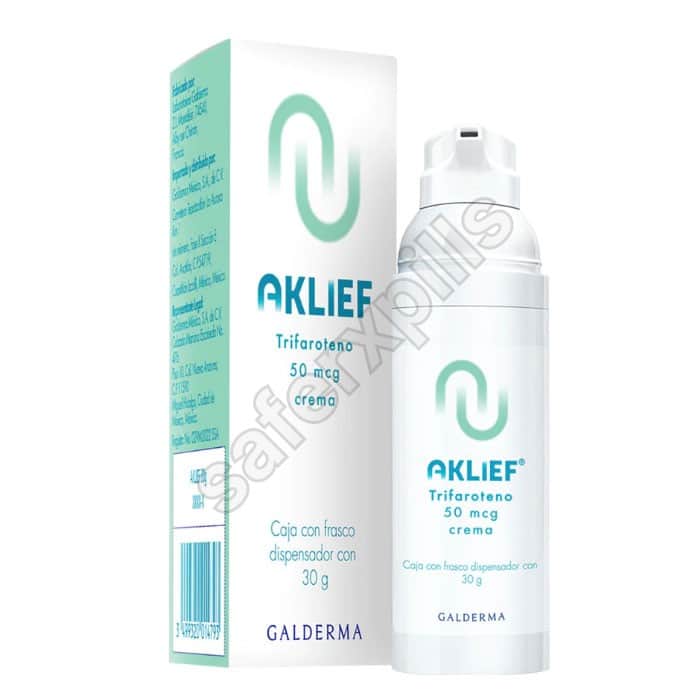
Aklief 30g
Generic: Trifarotene
Select pack size
1 cream
About Aklief 30g
Aklief is a trifarotene 0.005% cream for acne on the face and body, sold in India by Galderma India in a 30 g pack. Each gram contains 50 micrograms of trifarotene, the same strength as Aklief in the US, UK, Canada and Australia. We sell it as 1, 3 or 6 packs of 30 g, from $49.17 a pack in the largest order. That works out at $1.64 a gram, against a US pharmacy acquisition cost of about $16.30 a gram for Aklief, which has no US generic.
This page covers what Aklief is, how to apply it, what the two main trials found on the face and on the back, chest and shoulders, the irritation to expect in the first weeks, the pregnancy rules (which differ between countries), and the price per pack. Clinical figures come from the US prescribing information and the UK, Canadian and Australian labels, listed at the end. The Indian pack itself has not been tested in a separate published trial.
Aklief 30g at a glance
| Active ingredient | Trifarotene 0.005% (50 micrograms per gram), a topical retinoid with particular activity at the gamma subtype of the retinoic acid receptor (US label 12.1) |
| Brand and maker | Aklief, Galderma India Pvt Ltd (Apollo Pharmacy, PharmEasy and Medkart listings). PharmEasy gives a Laboratoires Galderma address in France as the manufacturer address but India as the country of origin, so the site of manufacture is not confirmed |
| Used for | Acne vulgaris of the face and trunk (back, chest and shoulders) |
| Regulatory status | Aklief is licensed in the US (FDA, 2019), the UK (MHRA, 2020), Canada (2019) and Australia (TGA, 2021). This Indian pack is not registered with the FDA, MHRA, TGA or Health Canada |
| Age | US label: 9 years and older. UK, Canadian and Australian labels: 12 years and older |
| Usual use from the labels | A thin layer on the affected areas once a day, in the evening, on clean and dry skin |
| When results show | The main trials measured results at 12 weeks. The Canadian monograph expects improvement between 4 and 8 weeks; the UK and Australian labels advise a doctor's review after three months |
| Packs | 1, 3 or 6 packs of 30 g (PharmEasy lists the Indian 30 g pack as a bottle) |
| Price per 30 g pack | $58 (1 pack) down to $49.17 (6 packs), before shipping |
| Delivery | 7 to 14 business days to the US, UK, Australia and Canada; $25 shipping under $149, free from $149 |
Price per pack
Prices below are as of October 2026; the pack selector shows the current price.
| Order | Price | Per 30 g pack | Shipping | Per pack with shipping | Per gram with shipping |
|---|---|---|---|---|---|
| 1 pack (30 g) | $58 | $58.00 | $25 | $83.00 | $2.77 |
| 3 packs (90 g) | $155 | $51.67 | Free | $51.67 | $1.72 |
| 6 packs (180 g) | $295 | $49.17 | Free | $49.17 | $1.64 |
The 3 and 6 pack orders are cheaper per pack before shipping too, and they also cross the $149 free shipping line, so a single pack costs much more per gram once the $25 shipping is added.
How long a pack lasts. The labels say one pump of cream should be enough for the face, two pumps for the upper trunk (the reachable upper back, shoulders and chest) and one more pump for the middle and lower back if acne is there. They do not say how many grams one pump gives, so we cannot work out how long a pack lasts for the face alone. In the US label's absorption study, adults treating the face, shoulders, chest and upper back used 1.5 to 2 g a day. At 2 g a day a 30 g pack would last about 15 days, and at 1.5 g a day about 20 days; face-only use needs far less. This is our arithmetic from the study amount, not a label figure.
Compared with Aklief in the US
| Aklief 30g (Indian pack, from us) | Aklief cream 0.005%, US | |
|---|---|---|
| Trifarotene per gram | 50 micrograms (0.005% w/w on the Apollo listing) | 50 micrograms |
| Maker | Galderma India (listings) | Galderma Laboratories, made in Canada (US label) |
| FDA approved | No (this pack is not registered with the FDA) | Yes, NDA 211527, approved 4 October 2019 |
| Pack | 30 g | 45 g pump (the only pack in the current US label) |
| Cost per gram | $1.64 to $1.93 before shipping | $16.30438 per gram (NADAC pharmacy acquisition cost, effective 21 October 2026); about $733.70 for the 45 g pump (our arithmetic) |
We found no generic trifarotene in the US: DailyMed lists one Aklief label, Drugs@FDA lists one application (Galderma's), and NADAC has a single Aklief row and no generic row. NADAC is what US pharmacies pay, not a retail price, and insurance or savings schemes can change what you pay. If you are in the US and have a prescription, ask your pharmacy for its price before you order from abroad. The Indian pack and the US pack share the active ingredient and strength, but we have not seen the full ingredient list for the Indian pack, and no study has compared the two.
Which strength to choose
Trifarotene comes in one strength, 0.005%, in every country we checked, and we sell only this one. There is no stronger or weaker version to step up or down to. If trifarotene does not suit you, a doctor may suggest another topical retinoid instead:
| Product | Retinoid | Note |
|---|---|---|
| Aklief 30g (this page) | Trifarotene 0.005% cream | Labelled for the face and the trunk |
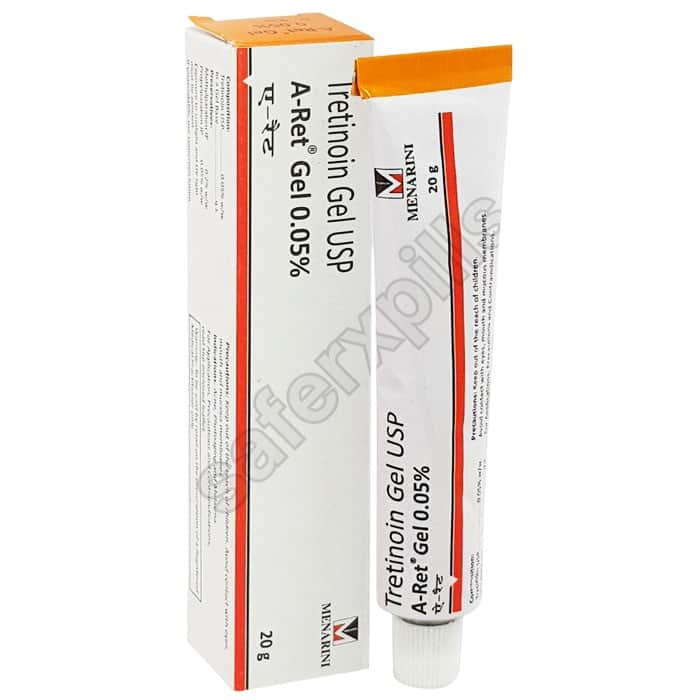
| A Ret Gel 0.05% | Tretinoin 0.05% gel | An older retinoid, used on the areas where acne appears |
| Adaferin 15g | Adapalene | Another retinoid acne treatment |
The labels do not compare trifarotene with these products, and we have not found a published head to head trial, so this table is not a ranking. Our retinoid strength chart explains how the older retinoids compare.
How to apply Aklief
- Wash the area and pat it dry. All the labels say to apply it to clean, dry skin.
- Once a day, in the evening, apply a thin layer over the affected areas. The labels say one pump should cover the face (forehead, cheeks, nose and chin), two pumps the upper trunk, and one more pump the middle and lower back if acne is present. The UK and Australian labels say to prime a new pump by pressing it several times (up to 10) until cream comes out.
- Keep it away from the eyes, lips, the creases beside the nose and mucous membranes (US label 2). If it gets into the eye, the UK label says to wash it out straight away with plenty of lukewarm water.
- Do not apply it to cuts, abrasions, eczema or sunburned skin (US label 5.1).
- Use a moisturiser from the first day, as often as you need (US label 2). The UK label says to leave enough time before and after applying Aklief for the skin to dry. In the US trials people left about an hour between the moisturiser and the cream.
- Wash your hands after applying it (UK label 4.2 and Canadian monograph).
- Avoid waxing as a way of removing hair on treated skin (US label 5.1).
- Keep sun exposure low and avoid sunlamps, tanning beds and ultraviolet light. When you cannot avoid the sun, the US patient information says to use sunscreen of SPF 15 or more with protective clothing and a wide brimmed hat; the UK label recommends a broad spectrum, water resistant sunscreen of SPF 30 or higher.
- Avoid other products that dry or irritate the skin, such as medicated or abrasive soaps and cleansers, strongly drying cosmetics and products with a lot of alcohol (US patient information). The Canadian monograph says using other topical acne treatments at the same time is not recommended because irritation may add up; the UK label says to use caution.
- If you miss an evening, carry on as usual the next evening with the usual amount (Canadian monograph). Using more does not help: the Canadian monograph says that if too much is applied, results will be neither faster nor better, and marked redness, scaling or discomfort may occur.
Topical trifarotene did not change blood levels of a combined pill containing ethinylestradiol and levonorgestrel (US label 7, UK label 4.5). The Canadian monograph advises caution if you also take medicines that make the skin more sensitive to light, such as thiazides, tetracyclines, fluoroquinolones, phenothiazines or sulfonamides.
What the trials found
Aklief was tested in two 12 week trials of identical design (Study 1 and Study 2 in the US label, reported at the time as PERFECT 1 and 2). They enrolled 2,420 people aged 9 and over with moderate acne on the face, and 99% also had moderate acne on the trunk. Success meant clear or almost clear skin with at least a two grade improvement. The results below are copied from the US label, section 14.
| Face, week 12 | Study 1: Aklief | Study 1: plain cream | Study 2: Aklief | Study 2: plain cream |
|---|---|---|---|---|
| Success (clear or almost clear, 2 grades better) | 29.4% | 19.5% | 42.3% | 25.7% |
| Inflamed spots, change | -54.4% | -44.8% | -66.2% | -51.2% |
| Blackheads and whiteheads, change | -49.7% | -35.7% | -57.7% | -43.9% |
| Trunk, week 12 | Study 1: Aklief | Study 1: plain cream | Study 2: Aklief | Study 2: plain cream |
|---|---|---|---|---|
| Success (clear or almost clear, 2 grades better) | 35.7% | 25.0% | 42.6% | 29.9% |
| Inflamed spots, change | -57.4% | -50.0% | -65.4% | -51.1% |
| Blackheads and whiteheads, change | -49.1% | -40.3% | -55.2% | -45.1% |
The lesion figures are adjusted (least squares) mean percentage changes from the start, as the label presents them. In our reading, the plain cream (vehicle) also helped a good deal, so the gain from trifarotene is the gap between the two columns. People in the trials were encouraged to use a moisturiser. The UK label adds that only 34 children aged 9 to 11 were in the trials, too few for efficacy to be shown in that group, which in our reading helps explain why the UK, Canadian and Australian labels start at 12. The UK label also describes a 24 week study (START, 121 people) in which atrophic acne scar counts fell by an average of 5.9 on the treated half of the face against 2.7 on the half treated with plain cream.
In a one year open study of 453 people, 12.6% had at least one side effect and 2.9% stopped because of one (US label 6.1).
Side effects
Irritation is the main problem. The US label says redness, scaling, dryness and stinging or burning were typically worst within the first 4 weeks and eased with continued use. On the face the scores peaked at week 1, and on the trunk at weeks 2 to 4.
| Side effect (12 week trials) | Aklief (1,220 people) | Plain cream (1,200 people) |
|---|---|---|
| Application site irritation | 7.5% | 0.3% |
| Sunburn | 2.6% | 0.5% |
| Application site itching | 2.4% | 0.8% |
Source: US label, section 6.1, Table 1 (all reactions at 1% or more where Aklief exceeded the plain cream). Less common reactions included pain, dryness, discolouration, rash, swelling and erosion at the application site, allergic dermatitis and redness.
The trials also checked the skin directly at each visit. Table 2 of the US label shows how often each sign got worse than at the start, at its worst during treatment, on the face:
| Face | Aklief: moderate | Aklief: severe | Plain cream: moderate | Plain cream: severe |
|---|---|---|---|---|
| Redness | 28.4% | 6.2% | 6.8% | 0.8% |
| Scaling | 27.1% | 4.9% | 5.9% | 0.3% |
| Dryness | 29.7% | 4.8% | 6.8% | 0.8% |
| Stinging or burning | 20.6% | 5.9% | 3.8% | 0.5% |
Selected columns from US label Table 2: the mild column is left out (mild worsening was reported in 30.6% to 39% of people on Aklief and 15.9% to 29.9% on the plain cream). On the trunk the same signs reached moderate in up to 19% and severe in up to 5%; the Canadian monograph says Aklief was better tolerated on the trunk than on the face. If irritation is a problem, the labels say to use a moisturiser, apply it less often or stop for a while; if severe reactions persist, treatment may be stopped. The Canadian monograph suggests restarting every other day once a severe reaction has settled. Our guide to using tretinoin and retinoid purge guide cover managing retinoid irritation in general.
Pregnancy: the labels disagree
- UK, Australia and Canada: Aklief is contraindicated in pregnancy and in women planning a pregnancy (UK label 4.3 and 4.6, Australian label 4.3 and 4.6, Canadian monograph). If it is used during pregnancy, or you become pregnant while using it, treatment should be stopped. The UK leaflet says: "DO NOT use Aklief if you are pregnant or thinking of becoming pregnant." The Canadian monograph also says women who could become pregnant should use effective birth control, and that pregnancy should be ruled out before starting and before each new course.
- US: pregnancy is not a contraindication. The US label (8.1) says clinical trial data in pregnant women "have not identified a drug-associated risk", notes case reports of birth defects with other topical retinoids that "do not establish a pattern or association", and reports harm to the fetus in rats and rabbits given trifarotene by mouth at exposures more than 800 times the exposure at the maximum recommended human dose. The US patient information says: "It is not known if AKLIEF Cream can harm your unborn baby."
Our advice: because three of the four labels say not to use it in pregnancy or when planning one, do not use Aklief if you are pregnant or trying to conceive, and stop it and speak to a doctor straight away if you find you are pregnant.
Breastfeeding. It is not known whether trifarotene passes into breast milk. The US label says to use it on the smallest area for the shortest time and never on the nipple and areola. The UK label says a decision must be made between stopping breastfeeding and not using Aklief, and that nursing women should not apply it to the chest or breast area.
When to stop and get help
- Signs of a serious allergic reaction, such as swelling of the face, lips, tongue or throat, trouble breathing or swallowing, or widespread hives: get urgent medical help. The UK, Australian and Canadian labels say to stop Aklief if a reaction suggesting sensitivity to any ingredient occurs; the urgent help step is our general safety advice.
- Severe redness, burning, blistering or swelling that does not settle: stop using it and speak to a doctor.
- If someone swallows the cream: the Canadian monograph says swallowing trifarotene may cause the same effects as too much vitamin A, including harm to an unborn baby, and advises monitoring, supportive care and a pregnancy test in women who could be pregnant. Call a poison line (US 1-800-222-1222, Australia 13 11 26) or your local emergency number.
- If you become pregnant while using it: stop and contact a doctor straight away (UK leaflet).
Who should not use Aklief
Never use it if (contraindications):
- You are allergic to trifarotene or any ingredient of the cream (UK, Australian and Canadian labels; the US label lists no contraindications).
- You are pregnant or planning a pregnancy (UK, Australian and Canadian labels; see the pregnancy section for the US position).
- You have eczema or seborrhoeic dermatitis (Canadian monograph only; the US and UK labels say not to apply it to eczematous skin).
Do not apply it to cuts, abrasions, eczema or sunburned skin (all labels). The Canadian monograph says not to cover treated skin with dressings or bandages.
Talk to a doctor first if it is for a child (the US label covers age 9 and over; the UK, Canadian and Australian labels age 12 and over), you are breastfeeding, you normally get a lot of sun or your skin is naturally sensitive to sunlight (the US and Canadian labels advise caution), or you are 65 or over (the trials included no one of that age). The UK label notes that the cream contains propylene glycol, which may irritate the skin, and alcohol, which may cause burning on damaged skin; we have not seen the Indian pack's ingredient list, so check the carton.
Prescription and legal status
Aklief is a prescription medicine in the US (Rx), the UK (prescription only medicine), Australia (Schedule 4) and Canada (prescription). Apollo Pharmacy and PharmEasy list the Indian pack as a prescription medicine too. The Indian pack is not registered with the FDA, the MHRA, the TGA or Health Canada, and in the US the FDA says personal importation of unapproved medicines is illegal in most circumstances. See a doctor before you start, and check the rules where you live. Our guides to retinoid prescriptions in the UK and in Australia explain the local routes for tretinoin, which are similar.
Buying genuine Aklief
The MHRA warns: "Any medicine not authorised for sale in the UK can be unsafe or ineffective and there is no way of knowing what is in them or the negative health effects they can have." That warning covers this pack, which is not the one authorised in the UK, and the MHRA advises: "Only use UK-registered pharmacies, including online pharmacies displaying the official green cross logo". When your order arrives, check that the carton names Galderma and shows trifarotene, the strength, a batch number and an expiry date, and that the pack is sealed. These checks cannot prove a pack is genuine, because counterfeiters copy packaging. If a pack causes unusual symptoms, stop using it, seek medical advice, and report it to the MHRA Yellow Card scheme, FDA MedWatch, the TGA or Health Canada, as well as to us.
Storage. The US label says store at 20 to 25 C, with short periods at 15 to 30 C allowed, and keep away from heat; the UK label needs no special storage and says to use it within 6 months of first opening; the Australian label says below 25 C; the Canadian monograph says 15 to 30 C and do not freeze. Indian listings say room temperature (Apollo: 20 to 25 C; Medkart) or a cool, dry place (PharmEasy). None of these says to refrigerate it.
Delivery
We ship Aklief to the US, UK, Australia and Canada in plain packaging with tracking. Standard delivery takes 7 to 14 business days to most countries. Shipping costs a flat $25 on orders under $149 and is free from $149. See our shipping page and refund policy.
Related guides
- Retinoid strength chart: adapalene, tretinoin, tazarotene and retinol
- Adapalene vs tretinoin: what the head to head trials show
- How to use tretinoin and manage irritation
- Retinoid purge: what it is and why it happens
- Isotretinoin for severe acne
- Doxycycline for acne
Other acne treatments we stock: A Ret Gel 0.05%, Adaferin and Epiduo Gel.
Sources
- AKLIEF (trifarotene) cream 0.005%, US prescribing information and patient information, Galderma Laboratories, DailyMed setid 62d910db-85a6-4696-b69b-4bd2f3080cfc, version 7, effective 16 September 2024; sections 1, 2, 4, 5, 6.1, 7, 8, 12, 14, 16 and 17. DailyMed
- Aklief 50 microgram/g cream, UK Summary of Product Characteristics and patient leaflet, Galderma (UK), PL 10590/0071, text revised 27 August 2026 (sections 4.1 to 4.8, 5.1, 6.3, 6.4). emc
- AKLIEF trifarotene cream, Canadian product monograph, Galderma Canada, 25 November 2019; Health Canada Drug Product Database, DIN 02494175. Product monograph
- Australian product information, Aklief (trifarotene) cream, Galderma Australia, AUST R 332220 and 340375, revised 18 November 2024. Galderma Australia
- Tan J, et al. Randomized phase 3 evaluation of trifarotene 50 μg/g cream treatment of moderate facial and truncal acne. J Am Acad Dermatol 2019. PMID 30802558. ClinicalTrials.gov NCT02566369 and NCT02556788.
- Jancin B. Trifarotene cream for acne meets all endpoints in twin phase 3 trials. MDedge, 21 September 2018 (PERFECT 1 and 2).
- Drugs@FDA, NDA 211527 (Aklief, approved 4 October 2019), via openFDA.
- Centers for Medicare and Medicaid Services. National Average Drug Acquisition Cost (NADAC), Aklief 0.005% cream, NDC 00299593545, effective 21 October 2026. data.medicaid.gov
- Indian pack details: Apollo Pharmacy, PharmEasy and Medkart listings for Aklief Cream 30 g, checked 27 October 2026.
- MHRA. 20 million illegal erectile dysfunction pills seized as MHRA warns against risky online buys, 13 February 2026. GOV.UK.
- US Food and Drug Administration. Personal Importation. FDA
This page is for information and is not medical advice. Aklief is a prescription medicine; talk to a doctor or pharmacist before using it.
Key Information
- ✓Active Ingredient: Trifarotene
- ✓Category: Skin Care
- ✓Form: Cream
- ✓Brand: Galderma India Pvt Ltd
- ✓Manufacturer: Galderma India Pvt Ltd
Frequently Asked Questions
What is Aklief 30g?
Aklief is a trifarotene 0.005% cream (50 micrograms per gram) for acne vulgaris on the face and trunk. This 30 g pack is sold in India by Galderma India. Trifarotene is a topical retinoid that acts mainly on the gamma subtype of the retinoic acid receptor (US label 12.1).
Is the Indian Aklief the same as Aklief in the US or UK?
It has the same active ingredient at the same strength, 50 micrograms of trifarotene per gram, and the same Galderma brand. But it is the Indian pack, which is not registered with the FDA, MHRA, TGA or Health Canada, we have not seen its full ingredient list, and no study has compared it with the US or UK pack.
How much does Aklief cost per pack?
As of October 2026, one 30 g pack is $58, three packs are $155 ($51.67 each) and six packs are $295 ($49.17 each), before shipping. Shipping is $25 under $149 and free from $149, so one pack costs $83 delivered. The pack selector shows the current price. For comparison, the US pharmacy acquisition cost (NADAC) for Aklief is $16.30438 per gram, effective 21 October 2026, and there is no US generic.
How do I apply Aklief?
Once a day in the evening, apply a thin layer to the affected areas on clean, dry skin. The labels say one pump should cover the face, two pumps the upper back, shoulders and chest, and one more pump the middle and lower back if needed. Avoid the eyes, lips, the creases beside the nose and mucous membranes, use a moisturiser from the start, and wash your hands afterwards.
How long does Aklief take to work?
The main trials measured results after 12 weeks. The Canadian monograph says improvement is expected between 4 and 8 weeks, and the UK and Australian labels advise a doctor's review after three months. Irritation is usually worst in the first 4 weeks (US label 5.1).
How well did Aklief work in the trials?
In two 12 week trials (US label section 14), clear or almost clear facial skin with at least a two grade improvement was reached by 29.4% and 42.3% of people on Aklief, against 19.5% and 25.7% on the plain cream. On the trunk the figures were 35.7% and 42.6%, against 25.0% and 29.9%.
Is there a stronger Aklief?
No. Trifarotene comes in one strength, 0.005%, in every country we checked, and the Canadian monograph says that applying too much gives neither faster nor better results and can cause marked redness, scaling or discomfort. If it does not suit you, a doctor may suggest a different retinoid such as tretinoin or adapalene.
What are the side effects of Aklief?
Skin irritation is the main one. In the 12 week trials, application site irritation affected 7.5% (against 0.3% on plain cream), sunburn 2.6% (0.5%) and itching 2.4% (0.8%). When the skin was checked directly, redness, scaling, dryness or stinging became moderate in up to 30% and severe in up to 6% of people on the face (US label 6.1). In the trials its severity decreased with continued use.
Can I use Aklief if I am pregnant?
The UK, Australian and Canadian labels say Aklief is contraindicated in pregnancy and in women planning a pregnancy. The US label does not list it as a contraindication but says it is not known if it can harm an unborn baby. Our advice is not to use it if you are pregnant or trying to conceive, and to stop and speak to a doctor straight away if you become pregnant.
Who should not use Aklief?
Do not use it if you are allergic to trifarotene or any ingredient, or if you are pregnant or planning a pregnancy (UK, Australian and Canadian labels). The Canadian monograph also contraindicates it in eczema or seborrhoeic dermatitis. Do not apply it to cuts, abrasions, eczema or sunburned skin. The US label covers age 9 and over; the UK, Canadian and Australian labels cover age 12 and over.
Do I need a prescription, and how long is delivery?
Aklief is prescription only in the US, UK, Australia and Canada, and the Apollo Pharmacy and PharmEasy listings describe the Indian pack as a prescription medicine. In the US the FDA says personal importation of unapproved medicines is illegal in most circumstances. We ship in plain packaging with tracking in 7 to 14 business days; shipping is $25 under $149 and free from $149.
Medical References
- 1.DailyMed (U.S. National Library of Medicine)
- 2.PubMed (NCBI) (PMID: 36927117) — 2023
- 3.PubMed (NCBI) (PMID: 39578046) — 2024
- 4.PubMed (NCBI) (PMID: 34345173) — 2021
- 5.PubMed (NCBI) (PMID: 31713811) — 2019
- 6.PubMed (NCBI) (PMID: 30802558) — 2019
Sources: U.S. National Library of Medicine (DailyMed, PubMed), openFDA
Related Products
View all
Customer Reviews
No reviews yet. Be the first to review Aklief 30g.
Related Articles
Health guides about Trifarotene, written by pharmacists
Epiduo vs Epiduo Forte: How Adapalene and Benzoyl Peroxide Gel Works, Results Timeline, Side Effects and Cost
Epiduo combines adapalene with benzoyl peroxide 2.5% in one once-daily acne gel, in 0.1% and 0.3% (Forte) strengths. This guide covers how the two strengths differ in the trials, how to apply the gel, what to expect week by week, the irritation rates from the US labels, bleaching of fabric and hair, the exact pregnancy wording, the over-the-counter Differin Epiduo, and what US pharmacies pay for brand and generic versions.
Dapsone Gel (Aczone) 5% vs 7.5%: How to Use It, Results, Side Effects, Warnings and Cost
Dapsone gel (Aczone) is a prescription acne gel in two strengths: 5% twice daily and 7.5% once daily. This guide covers how to apply each, who it is approved for, what the four label trials showed against vehicle, side effects with label rates, the methemoglobinemia and G6PD warnings, the orange staining with benzoyl peroxide, pregnancy and breastfeeding, generic approvals and what US pharmacies pay per gram.
Generic Otezla (Apremilast): Is It Available in the US, What It Costs, Dosing and Side Effects
The FDA has approved generic apremilast from 13 companies, but none is on sale in US pharmacies as of October 2026. This guide covers the patent dates, what apremilast treats, the 5-day starting schedule, kidney dosing, trial results, side effects and warnings, and what a month of Otezla costs pharmacies compared with Indian apremilast.
Related Health Guide
Understanding Acne & Skin Care: Complete Guide