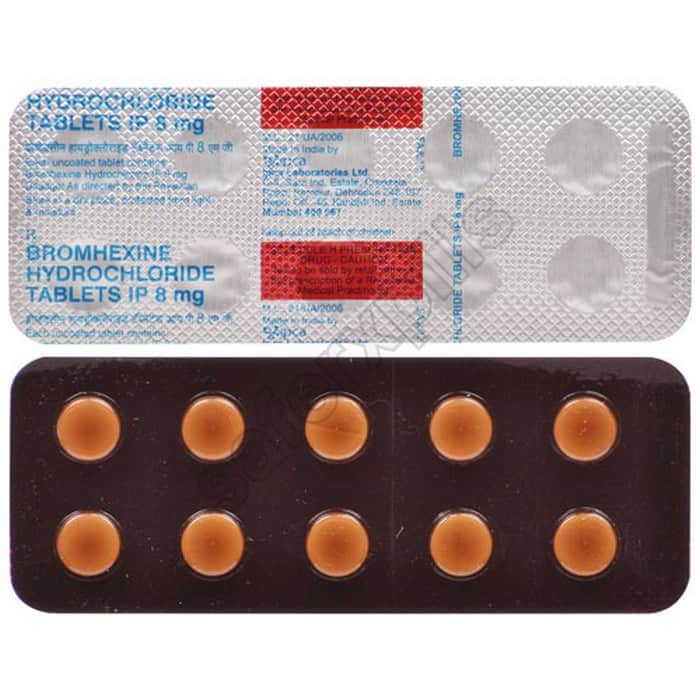
Bromhexine Hydrochloride 8mg
Generic: Bromhexineby Ipca Laboratories Ltd
Select pack size
Similar medicines
View all
About Bromhexine Hydrochloride 8mg
Bromhexine Hydrochloride 8mg is an Indian tablet of bromhexine, a mucolytic (a medicine meant to thin sticky mucus so it is easier to cough up). Indian pharmacy listings (PharmEasy, Truemeds, Apollo Pharmacy) show it as Ipca Laboratories' product, sold in strips of 10 tablets of 8 mg. We sell packs of 100, 200 and 300 tablets, from $0.32 a tablet in the largest pack, before shipping.
Four points first. Bromhexine is not an asthma medicine and does not open the airways; if you have asthma or COPD, your inhalers come first. The licensed label we use (Bisolvon Chesty Forte, New Zealand data sheet) is for short-term use when needed, with medical advice if symptoms do not improve after 4 to 5 days, and even our smallest pack is far more than one course. The evidence that mucolytics help an ordinary chesty cough is weak, and NICE in the UK tells clinicians not to offer one for acute cough. And in 2015 the EU safety committee recommended a warning about rare severe skin reactions and allergic reactions, which EU labels now carry; stop the tablets at once if a rash appears. We set out each of these below.
Bromhexine Hydrochloride 8mg at a glance
| Active ingredient | Bromhexine hydrochloride 8 mg per tablet, a mucolytic (expectorant). Ambroxol is one of its breakdown products in the body |
| Brand and maker | Sold under the generic name by Ipca Laboratories Ltd (PharmEasy, Truemeds, Apollo Pharmacy). The best known licensed brand is Bisolvon |
| Regulatory status | Not approved by the FDA (we found no bromhexine product in Drugs@FDA) or Health Canada (none in the Drug Product Database). We found no UK licence (the emc lists none). In Australia, Bisolvon Chesty Forte 8 mg tablets are registered as a Schedule 2 pharmacy medicine, but this Indian pack is not registered with the TGA |
| Usual dose from the label | Adults and children 12 and over: one 8 mg tablet three times a day when necessary; may be increased to two tablets three times a day for the first seven days (New Zealand Bisolvon Chesty Forte data sheet, 4.2) |
| How long to take it | Seek medical advice if symptoms of an acute chest illness do not improve after 4 to 5 days or get worse (data sheet 4.2) |
| Packs | 100, 200 and 300 tablets (Indian strips hold 10) |
| Price per tablet | $0.40 (100 pack) down to $0.32 (300 pack), before shipping |
| Delivery | 7 to 14 business days to the US, UK, Australia and Canada; $25 shipping under $149, free from $149 |
Price per tablet
Prices below are as of October 2026; the pack selector shows the current price.
| Pack | Price | Per tablet | Shipping | Per tablet with shipping |
|---|---|---|---|---|
| 100 tablets | $40 | $0.40 | $25 | $0.65 |
| 200 tablets | $72 | $0.36 | $25 | $0.49 |
| 300 tablets | $96.20 | $0.32 | $25 | $0.40 |
All three packs are under the $149 free shipping line, so each carries $25 shipping. The larger packs are cheaper per tablet before shipping too.
How long a pack lasts, and why that matters. At the label dose of one tablet three times a day, the 100 pack lasts about 33 days, the 200 pack about 67 days and the 300 pack 100 days. A 5 day course at that dose uses 15 tablets, or 30 tablets if the higher starting dose of two tablets three times a day is used. That is our arithmetic from the label dose, not a label figure. The label is written for short-term use when needed, so even our smallest pack holds several courses. Do not treat that as a reason to keep taking it: if a cough has not improved after 4 to 5 days, the label says to get medical advice, and NICE says to seek help if a cough is not better after 3 to 4 weeks. Please do not keep leftover tablets to treat future coughs without advice.
Compared with Bisolvon and what you can buy locally
| Bromhexine 8mg, Ipca (ours) | Bisolvon Chesty Forte 8 mg (Australia, New Zealand) | Guaifenesin (US, UK over the counter) | |
|---|---|---|---|
| What it is | Indian bromhexine hydrochloride 8 mg tablet | Licensed bromhexine hydrochloride 8 mg tablet, same strength | A different expectorant medicine |
| Status | Not approved by the FDA or Health Canada; no UK licence found; this Indian pack is not registered with the TGA | Australia: Schedule 2 pharmacy medicine. New Zealand: pharmacy only medicine | US: the only expectorant active ingredient in the over-the-counter cough and cold rules (21 CFR 341.18) |
| Cost | $0.32 to $0.40 a tablet before shipping | Sold in pharmacies in packs of 10 to 100; ask your pharmacist | US pharmacy acquisition cost (NADAC) $0.06917 per 400 mg tablet and $0.27400 per 600 mg extended-release tablet, effective 21 October 2026 |
There is no US bromhexine product, so there is no NADAC price for it. NADAC is what US pharmacies pay, not the shelf price, and guaifenesin is a different medicine, so the row above is a guide, not a like-for-like comparison. If you live in Australia or New Zealand, the licensed 8 mg tablet is sold at pharmacies without a prescription, and a pharmacist can check whether it suits you; that is likely to be quicker than our 7 to 14 business days. In the UK, NICE lists over-the-counter cough medicines containing guaifenesin (for people 12 and over) among self-care options with "limited evidence of some benefit" (NG120, 1.2.1), and guaifenesin is also the US over-the-counter expectorant. We have not found a study comparing the Ipca tablet with Bisolvon, so we cannot say they behave the same; the strength is the same.
Which dose to choose
| Who | Label dose | Source |
|---|---|---|
| Adults and children 12 and over | One 8 mg tablet three times a day when necessary | New Zealand data sheet 4.2 |
| Adults and children 12 and over, first seven days only | May be increased to two tablets (16 mg) three times a day. This is the highest dose in the label; after seven days it goes back to one tablet three times a day | New Zealand data sheet 4.2 |
| Children 6 to 11 years | One tablet three times a day when necessary, and only on the advice of a doctor, pharmacist or nurse practitioner | New Zealand data sheet 4.2 |
| Children under 6 years | Do not use (a contraindication) | New Zealand data sheet 4.2, 4.3 |
We sell only one strength, 8 mg. Do not go above six tablets a day, and do not take two tablets three times a day for longer than the first seven days.
What the evidence says
The EU review (2015). The European Medicines Agency's safety committee (PRAC) reviewed ambroxol and bromhexine medicines in 2014 and 2015. It concluded that "although modest positive results were reported in secretolytic therapy" (and in some other uses), "the evidence of efficacy of ambroxol and bromhexine suffered from a number of limitations and deficiencies." Taking these limitations and the weak evidence of a safety issue into account, "the PRAC could not conclude from the available evidence that risks outweighed benefits", and it judged the benefit and risk balance "remains favourable subject to the agreed changes to the product information." Not every member agreed: a divergent statement signed by the Belgian and Luxembourg PRAC members said the benefit and risk balance of all bromhexine formulations "in all its indications is negative in all age groups of patients for which it is indicated." The EU medicines coordination group (CMDh) then backed the majority view by majority vote, and the European Commission decision followed on 14 January 2016.
Acute cough (colds, flu, chest infections). A Cochrane review of over-the-counter cough medicines (Smith 2014, PMID 25420096; 29 trials, 4,835 people) concluded: "There is no good evidence for or against the effectiveness of OTC medicines in acute cough." In adults, one trial found that a mucolytic reduced cough frequency and symptom scores. NICE guideline NG120 (UK) says: "Do not offer a mucolytic (for example acetylcysteine or carbocisteine) to treat an acute cough associated with an upper respiratory tract infection or acute bronchitis." NICE adds that an acute cough "is usually self-limiting and gets better within 3 to 4 weeks without antibiotics".
Chronic bronchitis and COPD. A Cochrane review of mucolytics against placebo (Poole 2019, PMID 31107966; 38 trials, 10,377 people) concluded: "we are moderately confident that treatment with mucolytics leads to a small reduction in the likelihood of having an acute exacerbation, in days of disability per month and possibly hospitalisations". It also found "limited impact on lung function or health-related quality of life", and warned that "benefits of treatment may not be as great as was suggested by previous evidence." The abstract lists N-acetylcysteine, carbocysteine, erdosteine and ambroxol among the mucolytics studied; it does not name bromhexine, so these results may not apply to it. NICE guideline NG115 (UK, COPD) says: "Consider oral mucolytic therapy for people with a chronic cough productive of sputum", "Only continue mucolytic therapy if there is symptomatic improvement", and "Do not routinely use mucolytic therapy to prevent exacerbations in people with stable COPD."
COVID-19. Bromhexine has been tested in COVID-19 trials, for example a 1,200-person community trial in which it was given with fluvoxamine or niclosamide (ClinicalTrials.gov NCT05087381). None of the labels we used lists COVID-19 as a use, and we do not sell it for that.
Our view: bromhexine may make mucus easier to clear for some people, but the proof is thin. For a short chesty cough, NICE says most get better on their own within 3 to 4 weeks. If you have chronic bronchitis or COPD, ask your doctor which mucolytic, if any, is worth a trial, and stop it if it does not help.
How to take Bromhexine Hydrochloride 8mg
- Take one tablet three times a day when needed (adults and children 12 and over). For the first seven days the label allows two tablets three times a day.
- Take it with or without food (data sheet 4.2). Truemeds suggests taking it with food to reduce nausea, and Apollo Pharmacy says swallow the tablet whole with water, without crushing or chewing it.
- Expect more mucus at first. The label says patients "should be advised to expect an increase in the flow of mucus secretions" (data sheet 4.4).
- Do not take it with a cough suppressant (such as codeine, pholcodine or dextromethorphan) unless a doctor advises it. The South African Bisolvon label says this combination "may lead to the development of a dangerous accumulation of secretions owing to attenuation of the cough reflex" (4.5).
- Get medical advice if your symptoms do not improve after 4 to 5 days or get worse (data sheet 4.2).
- Store it in the strip, below 30 °C (New Zealand data sheet 6.4 for Bisolvon tablets; Truemeds and Apollo for the Ipca tablet), away from moisture and out of reach of children. The Australian register gives below 25 °C for Bisolvon Chesty Forte tablets.
Take extra care in some groups
- Severe liver disease or severe kidney failure: the label says it "should be used with caution" (data sheet 4.4). It also says there are no pharmacokinetic data in people with kidney or liver insufficiency or in older people (5.2). Ask your doctor first.
- Stomach ulcer: "Use with caution in patients with gastric ulceration" (data sheet 4.4).
- Asthma: bronchospasm (tightening of the airways) is listed as a side effect (data sheet 4.8), and the South African Bisolvon label says "Care is advisable in asthmatic patients." Bromhexine does not treat asthma. If your asthma is worse, follow your asthma action plan and see your doctor; our guide to asthma devices explains how inhaled medicines are taken.
- Lactose: one Bisolvon Chesty Forte tablet contains 74 mg of lactose, and the label says people with rare hereditary galactose intolerance (for example galactosaemia) "should not take this product" (data sheet 4.4). We do not know the lactose content of the Ipca tablet; read the strip or ask us.
- Colour additive: Truemeds says the Ipca tablet contains sunset yellow FCF, which may cause allergic reactions. Bisolvon tablets are white, so the Ipca tablet may look different.
Side effects
| Frequency | Effect | Source |
|---|---|---|
| Rare (up to 1 in 1,000 people) | Hypersensitivity reactions; rash, urticaria (hives) | EU agreed wording, EMA 2015 review, Annex III (4.8) |
| Not known | Anaphylactic reactions including anaphylactic shock, angioedema and pruritus (itching) | EU agreed wording, Annex III (4.8) |
| Not known | Severe cutaneous adverse reactions (including erythema multiforme, Stevens-Johnson syndrome/toxic epidermal necrolysis and acute generalised exanthematous pustulosis) | EU agreed wording, Annex III (4.8) |
| No frequency given | Nausea, vomiting, diarrhoea and upper abdominal pain; bronchospasm | New Zealand data sheet 4.8 (which also lists hypersensitivity, anaphylactic reaction and shock, angioedema, rash, urticaria and pruritus, all without frequencies) |
Indian listings also mention headache, dizziness and drowsiness (Truemeds, Apollo Pharmacy). The New Zealand label has no driving studies (4.7); the South African Bisolvon label says it may cause dizziness and that patients who feel dizzy should avoid driving and using machines. In overdose, the New Zealand label says the symptoms seen were consistent with the known side effects and may need symptomatic treatment (4.9).
The 2015 EU warning on skin and allergic reactions
The EMA review was started at Belgium's request. Its public summary says the PRAC "confirmed the previously known risk of allergic reactions and also identified a small risk of SCARs, a group of skin conditions which include erythema multiforme and Stevens-Johnson syndrome." It adds: "Reports of severe allergic reactions and SCARs in patients taking the medicines are rare, and the frequencies of these side effects are unknown." Because "ambroxol is a metabolite of bromhexine, the risk of anaphylactic and severe cutaneous reactions is considered to apply also to bromhexine."
The wording agreed for EU labels says: "If symptoms or signs of a progressive skin rash (sometimes associated with blisters or mucosal lesions) are present, <active substance> treatment should be discontinued immediately and medical advice should be sought." The EU patient leaflet wording is: "If you develop a skin rash (including lesions of the mucous membranes such as mouth, throat, nose, eyes, genitals), stop using <invented name> and contact your doctor immediately." EMA's advice to patients: "If you experience skin reactions such as skin swellings or rash, stop treatment immediately and contact your doctor."
The New Zealand label also warns that the early phase of Stevens-Johnson syndrome or toxic epidermal necrolysis can look like flu ("fever, aching body, rhinitis, cough and sore throat"), which is why people may start a cough medicine at that point (4.4). In plain terms: if you develop a rash or sore patches in the mouth, eyes or genitals while taking bromhexine, stop it and get medical advice the same day.
Ambroxol is in our Roxid M combination (roxithromycin with ambroxol). Do not take bromhexine and an ambroxol product together unless a doctor advises it; that is our advice, because you would be doubling up on the same active substance.
When to get urgent help
Call emergency services (911 in the US and Canada, 999 in the UK, 000 in Australia) if you have:
- Swelling of the lips, tongue, face or throat, trouble breathing or swallowing, wheezing, or hives spreading over the body after a dose. Stop the tablets. Anaphylaxis and angioedema are listed in the EU wording.
- A spreading rash with blisters, peeling skin, or sores in the mouth, eyes, nose or genitals, especially with fever. Stop the tablets and get medical help at once (EU agreed wording; the urgency is our advice).
- Severe breathlessness, chest pain, coughing up blood, confusion, or a high fever with shivering. These are not symptoms to treat with a mucolytic. NICE NG120 says people with signs of a more serious illness, such as sepsis, a pulmonary embolism or lung cancer, should be referred to hospital or specialist care.
If a child swallows tablets, or someone takes much more than the label dose, contact a poison line (US 1-800-222-1222, Australia 13 11 26, UK NHS 111) or your local emergency service, and take the pack with you.
See a doctor within days (our advice) if a cough lasts more than 3 weeks, keeps coming back, or comes with weight loss, night sweats or a change in your voice.
Who should not take it, and who should talk to a doctor first
Never take it if (New Zealand data sheet 4.3):
- you are allergic to bromhexine or any ingredient of the tablet
- it is for a child under 6 years of age
The label also says:
- Breastfeeding: it "should not be used during breast-feeding" (data sheet 4.6), because animal studies showed bromhexine or its metabolites pass into milk.
- Pregnancy: "As a precautionary measure, it is preferable to avoid the use of BISOLVON CHESTY FORTE during pregnancy" (data sheet 4.6). Australia's healthdirect, citing the Australian Health Thesaurus, says it is "generally considered safe during pregnancy if taken as directed" and advises discussing it with your doctor or pharmacist. The two sources differ, so ask a doctor or pharmacist before using it in pregnancy.
- Hereditary galactose intolerance: should not take Bisolvon tablets, which contain lactose (4.4; see above).
Talk to a doctor first if:
- you have severe liver disease, severe kidney failure or a stomach ulcer (caution, data sheet 4.4)
- you have asthma, COPD or another long-term lung condition
- it is for a child aged 6 to 11 (label: only on the advice of a doctor, pharmacist or nurse practitioner)
- you have had a severe skin reaction to any medicine before (our advice)
- you take an anticoagulant or digoxin: interaction studies with these "were not performed" (data sheet 4.5)
- your cough has lasted more than 3 weeks, or you are coughing up green, rusty or blood-stained mucus (our advice)
Medicines that interact
- Cough suppressants (for example codeine, pholcodine, dextromethorphan): the South African Bisolvon label says the combination is "not recommended" (4.4) and should be used "only after very careful risk-benefit assessment" (4.5).
- Antibiotics: bromhexine raises concentrations of amoxicillin, erythromycin and oxytetracycline in sputum and lung secretions (data sheet 5.2). The label reports no clinically relevant unfavourable interactions with ampicillin, oxytetracycline or erythromycin (4.5). When an infection is present, the label says antibiotics "could be indicated" in addition (4.2); bromhexine does not treat infection. NICE says most acute coughs get better without antibiotics; see our guide to antibiotic resistance.
- Oral anticoagulants and digoxin: not studied (4.5).
- Ambroxol products: ambroxol is a metabolite of bromhexine (5.2); do not combine them yourself (our advice).
Prescription and legal status
United States: openFDA lists no bromhexine product in Drugs@FDA and no bromhexine drug label; the only bromhexine entry in the NDC directory is a bulk ingredient marked export only (searched 22 October 2026). The US over-the-counter cough rules name guaifenesin as the expectorant active ingredient (21 CFR 341.18). The FDA says personal importation of unapproved drugs is illegal in most circumstances.
United Kingdom: the emc returns no result for bromhexine, and we found no UK licence; the emc is not the full MHRA register. The MHRA warns that "Any medicine not authorised for sale in the UK can be unsafe or ineffective and there is no way of knowing what is in them or the negative health effects they can have."
Australia: healthdirect lists Bisolvon Chesty Forte 8 mg tablets (packs of 30, 50 and 100) and says: "It is Schedule 2: Pharmacy Medicine." It is not on the PBS. This Indian pack is not registered with the TGA.
Canada: Health Canada's Drug Product Database returns no bromhexine product (searched 22 October 2026).
India: Truemeds and Apollo Pharmacy mark it prescription required; PharmEasy says orders depend on a valid prescription "where applicable". In New Zealand, Bisolvon Chesty Forte is a pharmacy only medicine; this Indian pack is not registered with Medsafe. Check the rules where you live.
Buying genuine Bromhexine 8mg
The MHRA warning quoted above covers this Indian pack, and the MHRA advises UK buyers to "Only use UK-registered pharmacies, including online pharmacies displaying the official green cross logo". When your order arrives, read the strip: it should say bromhexine hydrochloride 8 mg and name Ipca Laboratories, with a batch number and an expiry date. PharmEasy lists Ipca's address as C-6, Sara Industrial Estate, Chakrata Road, Rampur, Dehradun. These checks cannot prove that tablets are genuine, because counterfeiters copy packaging. If a batch causes unusual symptoms, seek medical advice and report it to your medicines regulator (the MHRA Yellow Card scheme in the UK, FDA MedWatch in the US, the TGA in Australia or Health Canada) as well as to us.
Delivery
We ship Bromhexine Hydrochloride 8mg to the US, UK, Australia and Canada in plain packaging with tracking. Standard delivery takes 7 to 14 business days, which is longer than most acute coughs last. Shipping costs a flat $25 on orders under $149 and is free from $149. See our shipping page and refund policy.
Related guides
Sources
- Bisolvon Chesty Forte tablets and oral solution, New Zealand data sheet, date of revision 20 December 2021: sections 4.1 to 4.9, 5.2, 6.4, 6.5, 7. Medsafe
- European Medicines Agency. Ambroxol and bromhexine-containing medicines, Article 31 referral: overview (PRAC recommendation 10 September 2015, CMDh position 18 November 2015, European Commission decision 14 January 2016). EMA
- EMA. Annex III: amendments to relevant sections of the summary of product characteristics and package leaflets (sections 4.4 and 4.8). EMA
- EMA PRAC. Revised assessment report, EMA/PRAC/800767/2015, 10 September 2015: sections 2.4, 2.5, 3 and divergent statement. EMA
- Bisolvon 0.2% solution, South African professional information, Sanofi, March 2022: sections 4.4, 4.5, 4.7. SAHPRA
- Smith SM, Schroeder K, Fahey T. Over-the-counter (OTC) medications for acute cough in children and adults in community settings. Cochrane Database Syst Rev 2014. PMID 25420096.
- Poole P, Sathananthan K, Fortescue R. Mucolytic agents versus placebo for chronic bronchitis or chronic obstructive pulmonary disease. Cochrane Database Syst Rev 2019. PMID 31107966.
- NICE. Cough (acute): antimicrobial prescribing, NG120, recommendations 1.1.1, 1.1.4, 1.1.5, 1.1.7, 1.2.1. NICE
- NICE. Chronic obstructive pulmonary disease in over 16s, NG115, recommendations 1.2.39 to 1.2.41. NICE
- healthdirect Australia. Bisolvon Chesty Forte (ARTG and PBS data updated 1 October 2026). healthdirect
- US Code of Federal Regulations, 21 CFR 341.18, expectorant active ingredient. eCFR
- openFDA Drugs@FDA, drug label and NDC searches for bromhexine, 22 October 2026; Health Canada Drug Product Database search for bromhexine, 22 October 2026; emc search for bromhexine, 22 October 2026.
- NADAC (National Average Drug Acquisition Cost), data.medicaid.gov: guaifenesin 400 mg tablet and guaifenesin ER 600 mg tablet rows effective 21 October 2026; no bromhexine rows.
- ClinicalTrials.gov NCT05087381, community trial of early COVID-19 treatment with fluvoxamine, bromhexine, cyproheptadine and niclosamide. ClinicalTrials.gov
- Indian pharmacy listings for Bromhexine 8 mg tablets (PharmEasy, Truemeds, Apollo Pharmacy), checked 22 October 2026.
- MHRA. 20 million illegal erectile dysfunction pills seized as MHRA warns against risky online buys, 13 February 2026. GOV.UK
- US Food and Drug Administration. Personal Importation. FDA
This page is for information and is not medical advice. Stop bromhexine and get medical help if you develop a rash, blisters or swelling, and see a doctor if a cough does not improve, gets worse or lasts more than 3 weeks.
Frequently asked questions
What is Bromhexine Hydrochloride 8mg?
It is an Indian tablet containing 8 mg of bromhexine hydrochloride, a mucolytic meant to thin sticky mucus so it is easier to cough up. Indian pharmacy listings (PharmEasy, Truemeds, Apollo Pharmacy) show it as Ipca Laboratories' product in strips of 10. It is not an asthma medicine, it does not open the airways and it does not treat infection.
Is it the same as Bisolvon?
It has the same active ingredient and strength as Bisolvon Chesty Forte 8 mg tablets, which are licensed in Australia and New Zealand. We have not found a study comparing the Ipca tablet with Bisolvon, so we cannot say they behave the same. The Ipca tablet contains a colour additive (sunset yellow FCF, per Truemeds), so it may look different from the white Bisolvon tablet.
How much does it cost per tablet?
As of October 2026, $0.40 a tablet in the 100 pack, $0.36 in the 200 pack and $0.32 in the 300 pack, before shipping. Every pack is under $149, so $25 shipping applies, which brings the cost to $0.65, $0.49 and $0.40 a tablet. The pack selector shows the current price. There is no US bromhexine product, so there is no US price to compare.
How do I take it?
The New Zealand Bisolvon Chesty Forte label says adults and children 12 and over take one 8 mg tablet three times a day when necessary, with or without food. Expect more mucus at first. Do not take it with a cough suppressant such as codeine or dextromethorphan unless a doctor advises it, because the South African Bisolvon label warns that secretions can build up.
Which dose should I take?
One tablet three times a day is the usual label dose for adults and children 12 and over. For the first seven days only, the label allows two tablets three times a day, which is the highest dose. Children 6 to 11 take one tablet three times a day, only on the advice of a doctor, pharmacist or nurse practitioner. Do not give it to children under 6.
How long should I take it for?
The label is for short-term use when needed. It says to seek medical advice if symptoms of an acute chest illness do not improve after 4 to 5 days or get worse. NICE says an acute cough usually gets better within 3 to 4 weeks. Our smallest pack (100 tablets) lasts about 33 days at the label dose, which is far more than one course, so please do not keep leftovers for future coughs without advice.
Can I take a higher dose?
Only within the label: two tablets three times a day for the first seven days, then back to one tablet three times a day. That means no more than six tablets in a day. If your cough is not improving, see a doctor rather than taking more.
What are the side effects?
The New Zealand label lists allergic reactions (including anaphylaxis and angioedema), rash, hives, itching, bronchospasm, nausea, vomiting, diarrhoea and upper abdominal pain, without frequencies. The EU wording agreed in 2015 lists hypersensitivity reactions, rash and hives as rare, and anaphylaxis, angioedema and severe skin reactions (including Stevens-Johnson syndrome) with unknown frequency. If a rash, blisters or mouth sores appear, stop the tablets and get medical advice at once.
Who should not take it?
Never take it if you are allergic to bromhexine or any ingredient, and do not give it to children under 6 (New Zealand label 4.3). The label says it should not be used during breastfeeding, that it is preferable to avoid it in pregnancy, and that people with hereditary galactose intolerance should not take the lactose-containing Bisolvon tablet. Talk to a doctor first if you have severe liver or kidney disease, a stomach ulcer or asthma.
Do I need a prescription?
Bromhexine is not approved by the FDA or Health Canada, and we found no UK licence. In Australia, Bisolvon Chesty Forte is a Schedule 2 pharmacy medicine sold without a prescription, but this Indian pack is not registered with the TGA. Truemeds and Apollo Pharmacy mark it prescription required in India. The FDA says personal importation of unapproved drugs is illegal in most circumstances. Check the rules where you live.
How long does delivery take?
Standard delivery to the US, UK, Australia and Canada takes 7 to 14 business days in plain packaging with tracking. Shipping is a flat $25 on orders under $149 and free from $149. That is longer than most acute coughs last, so if you need something now, a local pharmacist can advise on options sold where you live.
Medical References
Sources: U.S. National Library of Medicine (DailyMed, PubMed), openFDA
Related articles
Brand vs Generic Drug Prices: What US Pharmacies Pay for Viagra, Cialis, Latisse and More (NADAC, October 2026)
CMS NADAC data for the week of 28 October 2026 shows what US pharmacies pay for brand and generic versions of Viagra, Cialis, Propecia, Latisse, Lumigan and Stromectol. Generic ED and hair loss tablets cost under 2% of the brand price, while eye and lash generics cost 42% to 65%. Includes 2026 trends, supplier counts and the full method.
Read article
Buy Amaryl (Glimepiride) Online: Dosing, Hypoglycaemia Risk and What to Verify First
Amaryl is brand name glimepiride, a sulfonylurea that lowers blood sugar effectively and cheaply but carries real hypoglycaemia risk. Dosing, the CAROLINA trial evidence, interactions, and what to verify before ordering online.
Read article
Generic vs Branded Medicines: What You Really Need to Know
Many patients assume branded drugs are superior to generics. The truth, backed by decades of FDA research, is more nuanced.
Read articleCustomer Reviews
No reviews yet. Bought Bromhexine Hydrochloride 8mg? Tell other buyers how it went.