
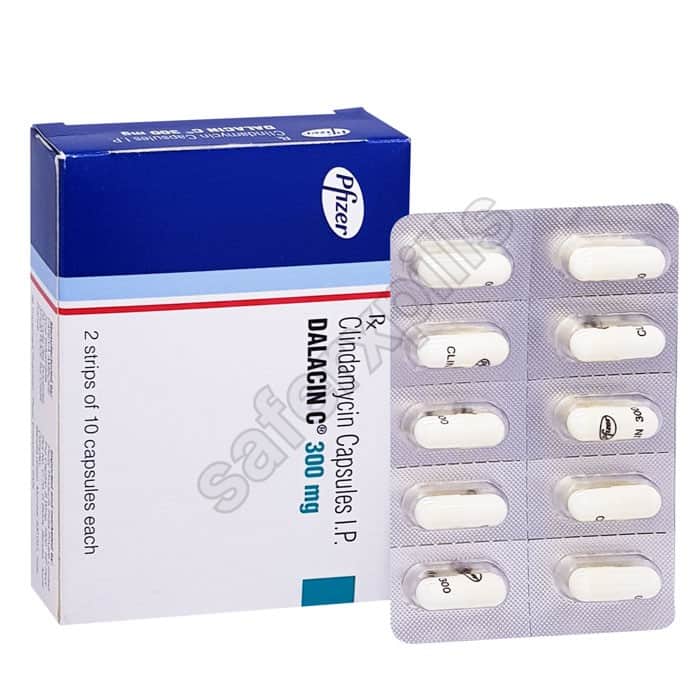
About Dalacin C 300mg
Dalacin C 300mg is Pfizer's clindamycin capsule for the Indian market. Each hard capsule contains clindamycin hydrochloride equivalent to 300 mg of clindamycin, a lincosamide antibiotic. Pfizer's Indian prescribing information names Fareva Amboise in France as the manufacturer and Pfizer Products India Private Limited, Mumbai, as the importer and marketer. We sell it in packs of 30, 60 and 90 capsules, from $1.63 a capsule in the largest pack before shipping.
Read this first. The US label for Pfizer's Cleocin HCl capsules (the same medicine in the US) carries a boxed warning: clindamycin has been associated with severe colitis "which may end fatally", so "it should be reserved for serious infections where less toxic antimicrobial agents are inappropriate". The same box says it "should not be used in patients with nonbacterial infections such as most upper respiratory tract infections". The UK label says it "should only be used in the treatment of serious infections". Clindamycin is not a medicine to keep at home for a sore throat, a toothache or a spot on the skin, and it needs a clinician's diagnosis. Diarrhoea caused by Clostridioides difficile (C. difficile) can start during the course or more than two months after it, and can be fatal; the warning signs are in the urgent help section below. This page uses Pfizer's Indian prescribing information for Dalacin C (November 2024), the current US label for Cleocin HCl capsules (September 2026), the UK label for Dalacin C 150 mg capsules (July 2026) and the Australian Dalacin C label (May 2026), all listed at the end.
Dalacin C 300mg at a glance
| Active ingredient | Clindamycin 300 mg (as clindamycin hydrochloride) per hard gelatin capsule |
| Brand and maker | Dalacin C, a Pfizer brand. Pfizer's Indian leaflet names Fareva Amboise, France, as the capsule manufacturer, imported and marketed in India by Pfizer Products India Private Limited, Mumbai |
| Drug class | Lincosamide antibiotic; bacteriostatic (it stops bacteria multiplying) at usual doses |
| Regulatory status | Clindamycin capsules are licensed in the US, UK, Canada and Australia, but this Indian Dalacin C pack is not registered with the FDA, MHRA, TGA or Health Canada. Prescription only in all four countries and in India |
| Usual adult dose (labels) | US: 150 to 300 mg every 6 hours for serious infections, 300 to 450 mg every 6 hours for more severe infections. India: 600 to 1800 mg a day in 3 or 4 doses |
| Half-life | About 2.4 hours on average (US label) |
| Packs | 30, 60 and 90 capsules (Indian strips hold 10 capsules) |
| Price per capsule | $2.24 (30 pack) down to $1.63 (90 pack), before shipping |
| Delivery | 7 to 14 business days to the US, UK, Australia and Canada; $25 shipping under $149, free from $149 |
Price per capsule
Prices below are as of October 2026; the pack selector shows the current price.
| Pack | Price | Per capsule | Shipping | Per capsule with shipping |
|---|---|---|---|---|
| 30 capsules | $67.20 | $2.24 | $25 | $3.07 |
| 60 capsules | $100.80 | $1.68 | $25 | $2.10 |
| 90 capsules | $146.40 | $1.63 | $25 | $1.90 |
All three packs are under $149, so each one alone carries the $25 shipping charge. The larger packs are cheaper per capsule before shipping as well as after it.
How long does a pack last at the label dose? This is our arithmetic, not a label figure. At 300 mg every 6 hours (four capsules a day, within the US and UK dose ranges), 30 capsules last about 7 days, 60 about 15 days and 90 about 22 days. At the top of the Indian range (1800 mg a day, six capsules), 90 capsules last 15 days. For comparison, the NICE cellulitis guideline gives clindamycin courses of 7 days, which at 300 mg four times a day is 28 capsules, and the US and UK labels say infections caused by beta-haemolytic streptococci should be treated for at least 10 days (40 capsules at that dose). So the 30 pack is about one 7 day course at 300 mg four times a day, and the 60 and 90 packs are more than one 7 to 10 day course at that dose. Please do not keep leftover capsules to treat yourself next time: a new infection needs a new diagnosis, and the UK leaflet says the medicine "has been prescribed for you only" and should not be passed on.
Compared with the brand and US generics
| Dalacin C 300mg (India) | Cleocin HCl 300 mg (US brand) | Clindamycin HCl 300 mg capsule (US generic) | |
|---|---|---|---|
| Contents | Clindamycin 300 mg | Clindamycin 300 mg | Clindamycin 300 mg |
| Maker | Pfizer (made by Fareva Amboise, France) | Pharmacia & Upjohn (Pfizer) | Several US generic makers |
| Status | Not registered with the FDA, MHRA, TGA or Health Canada | FDA approved (NDA 050162), Rx only | FDA approved, Rx only |
| Cost per capsule | $1.63 to $2.24 before shipping | No NADAC row | $0.17855 (NADAC) |
NADAC is the US National Average Drug Acquisition Cost: what US pharmacies pay for a medicine, not the cash price you pay at the counter. The generic figure is $0.17855 per capsule, the rate in all ten per-NDC rows for clindamycin HCl 300 mg capsules effective 21 October 2026. The NADAC file has no row for Cleocin HCl capsules. Our price per capsule is about 9 to 13 times what US pharmacies pay for generic clindamycin 300 mg (our arithmetic). If you are in the US and a doctor prescribes clindamycin, a local generic with a prescription is the regulated route and will almost certainly cost less; compare US generic cash prices first.
We have not found a published study comparing the Indian Dalacin C capsule with the US or UK capsules. It is the same active ingredient at the same strength under the same Pfizer brand name, but made for the Indian market with its own excipients (the Indian leaflet lists lactose, maize starch, talc and magnesium stearate, with titanium dioxide, indigo carmine and erythrosine in the 300 mg capsule shell).
Which strength to choose
| Product | Per capsule | How it fits the labels | Price per capsule (before shipping) |
|---|---|---|---|
| Dalacin C 150mg (Pfizer) | Clindamycin 150 mg | The low end of the adult range (150 mg every 6 hours); also gives 450 mg doses as three capsules, and finer steps for weight-based doses in children who can swallow capsules | $1.23 to $1.68 |
| Dalacin C 300mg (Pfizer) | Clindamycin 300 mg | 300 mg every 6 hours is inside the US range for serious infections and the UK range for moderately severe infections | $1.63 to $2.24 |
| Dalaheal 300mg (Healing Pharma) | Clindamycin 300 mg | Same dose as Dalacin C 300mg from a different Indian maker | $1.35 to $1.67 |
Two Dalacin C 150 capsules cost $2.45 to $3.36 for 300 mg, more than one Dalacin C 300 (our arithmetic). The dose is your prescriber's decision: the labels say it depends on how serious the infection is, the patient's condition and how sensitive the bacteria are. Never take more than your prescriber set. The US label says doses of up to 2 grams a day for 14 days were well tolerated by healthy volunteers, "except that the incidence of gastrointestinal side effects is greater with the higher doses".
How to take Dalacin C 300mg
- Take it only as prescribed, for the length of time prescribed. The Indian leaflet says the dose and route "should be determined by the seriousness of the infection, the patient's condition and the sensitivity of the disease causing germ".
- Usual adult dose: US label, 150 to 300 mg every 6 hours for serious infections and 300 to 450 mg every 6 hours for more severe infections; UK label, 150 to 300 mg every six hours for moderately severe infection and 300 to 450 mg every six hours for severe infection; Indian leaflet, 600 to 1800 mg a day divided into 3 or 4 doses.
- Swallow the capsule whole with a full glass of water, and do not lie down for at least 30 minutes afterwards. The US label says a full glass is 6 to 8 ounces, about 200 to 250 mL, and gives the reason: to reduce the risk of irritation of the food pipe. Inflammation and ulcers of the food pipe have been reported, the US label says "particularly when taken in a lying position or with a small amount of water". So do not take a dose just before going to bed.
- Food: the US label says food "does not appreciably modify" blood levels, and the UK label says absorption is "not appreciably modified by the presence of food". On our reading you can take it with or without food.
- Space the doses evenly through the day, for example every 6 hours if you take four doses a day.
- If you forget a dose, the UK leaflet says: if it is just a few hours late, take it straight away; if it is nearly time for the next dose, miss out the forgotten one. "Do not take a double dose to make up for a missed dose."
- Take the whole course you were prescribed, even if you feel better early. The US label says skipping doses or not completing the course may make treatment less effective and make resistance more likely. For beta-haemolytic streptococcal infections, the US and UK labels say treatment should continue for at least 10 days; the UK label says this is to reduce the chance of later rheumatic fever or kidney inflammation (glomerulonephritis).
- Children: the dose is worked out by body weight (US 8 to 20 mg/kg a day, UK 12 to 25 mg/kg a day, India 8 to 25 mg/kg a day). The US and Indian labels say capsules are not suitable for children who cannot swallow them whole. A child's dose must be set by their doctor.
Lower doses and extra care for some groups
- Kidney problems: no dose change is needed (US, UK and Indian labels), but the US label says clindamycin "is potentially nephrotoxic", that acute kidney injury has been reported, and that monitoring of kidney function should be considered, particularly in people with existing kidney problems or taking other medicines that can harm the kidneys.
- Liver problems: the US label says dose changes may not be necessary in liver disease, but "periodic liver enzyme determinations should be made when treating patients with severe liver disease". The Indian leaflet says clindamycin should be given cautiously in serious kidney or liver disorders with serious metabolic conditions, with blood levels monitored if high doses are needed.
- Older people: the US label says antibiotic-associated colitis and C. difficile diarrhoea occur more often in people over 60 and may be more severe, so they should be carefully monitored for diarrhoea. It also says some older patients with severe illness "may tolerate diarrhea less well". No dose change is needed for age alone: the US label says so for older people with normal liver and kidney function, and the UK label says dosage "should not be influenced by age alone".
- Gut disease: all three labels say to prescribe it with caution to people with a history of gastrointestinal disease, particularly colitis.
- Long courses: the US label says periodic liver and kidney function tests and blood counts should be done during prolonged therapy. The UK leaflet says not to miss these check-ups, and that long-term use can make other infections that do not respond to the medicine more likely. The US label says clindamycin occasionally leads to overgrowth of organisms it does not kill, particularly yeasts.
Side effects
None of the labels gives side effect percentages from controlled trials. The UK Dalacin C 150 mg capsule label groups effects by how often they were reported:
| How often (UK Dalacin C capsules label 4.8) | Selected side effects |
|---|---|
| Common (1 in 100 to 1 in 10) | Diarrhoea, abdominal pain, pseudomembranous colitis, abnormal liver function tests |
| Uncommon (1 in 1,000 to 1 in 100) | Nausea, vomiting, maculopapular rash, hives (urticaria) |
| Not known (frequency cannot be estimated) | C. difficile colitis, vaginal infection; low white cell or platelet counts, agranulocytosis, eosinophilia; anaphylactic shock and other allergic reactions, Kounis syndrome; taste disturbance; inflammation or ulcers of the food pipe; jaundice; toxic epidermal necrolysis, Stevens-Johnson syndrome, DRESS, acute generalised exanthematous pustulosis (AGEP), angioedema, exfoliative and bullous dermatitis, cutaneous vasculitis, erythema multiforme, itching; acute kidney injury |
This table is selected from the UK label, which lists more effects. The US label says mild to moderate measles-like (morbilliform, maculopapular) skin rashes are the most frequently reported adverse reactions, and also lists an unpleasant or metallic taste after oral doses, vaginitis and polyarthritis. The Indian and UK labels say clindamycin has no or negligible influence on the ability to drive or use machines.
C. difficile colitis. The US boxed warning says C. difficile infection has been reported with nearly all antibiotics, including clindamycin, and "may range in severity from mild diarrhea to fatal colitis". Strains that make more toxin "can be refractory to antimicrobial therapy and may require colectomy" (removal of the colon). It has been reported more than two months after a course. The UK label says that if allowed to progress, colitis may produce peritonitis, shock and toxic megacolon, and "This may be fatal." It also says "The appearance of marked diarrhoea should be regarded as an indication that the product should be discontinued immediately." The Indian leaflet says medicines that slow the gut ("Drugs inhibiting peristalsis") are contraindicated in this situation.
Severe skin and allergic reactions. The US label says severe hypersensitivity reactions, including toxic epidermal necrolysis, DRESS and Stevens-Johnson syndrome, "some with fatal outcome", have been reported, as has acute myocardial ischaemia (reduced blood supply to the heart) with or without a heart attack as part of an allergic reaction. If such a reaction occurs, the US label says to "discontinue treatment permanently". The warnings sections of the Indian and UK labels also name AGEP, and the UK label adds Kounis syndrome.
When to get urgent help
Stop taking Dalacin C and get medical help straight away if you have:
- Watery or bloody diarrhoea, with or without stomach cramps and fever, during the course or even two or more months after the last dose. The US label says to contact your doctor "as soon as possible"; the UK leaflet says to tell your doctor immediately about severe, persistent or bloody diarrhoea. Do not take medicines that stop diarrhoea (such as loperamide, our example) unless a doctor tells you to: the Indian leaflet says medicines that slow the gut must be avoided in this situation.
- Signs of a severe allergic reaction: sudden wheeziness, difficulty breathing, dizziness, swelling of the eyelids, face, lips, throat or tongue, or a rash or itching over the whole body (UK leaflet). Call emergency services (911 in the US and Canada, 999 in the UK, 000 in Australia).
- Chest pain during an allergic reaction, which the UK leaflet says may be an allergy-triggered heart attack (Kounis syndrome). Call emergency services.
- Blistering or peeling of large areas of skin, especially around the mouth, nose, eyes or genitals; many small pus-filled spots on red skin; target-like spots; or fever with swollen glands and a rash. These can be signs of Stevens-Johnson syndrome, toxic epidermal necrolysis, AGEP, erythema multiforme or DRESS, which the UK leaflet says can be severe and life threatening.
- Yellow skin or eyes (jaundice).
- Passing much less urine, swelling of the legs, ankles or feet, shortness of breath or nausea: the UK leaflet says these can be signs of a kidney problem and to contact your doctor immediately.
- Pain on swallowing or pain behind the breastbone after a dose, which can be a sign of food pipe inflammation or ulcer (labels); contact a doctor the same day (our advice).
- Unusual bruising or bleeding, especially if you take warfarin or a similar blood thinner: the Indian and UK labels say bleeding has been reported with this combination.
- Taking too many capsules: the UK leaflet says to contact your doctor at once or go to the nearest hospital casualty department, and to take the pack with you. The US label says dialysis does not remove clindamycin from the blood.
Tell the emergency staff that you took clindamycin, how much and when.
Who should not take Dalacin C 300mg
Never take it if you have ever had an allergic reaction to clindamycin, to lincomycin or to any ingredient of the capsule. This is the contraindication in the US, UK and Indian labels (the US label names clindamycin and lincomycin; the UK and Indian labels add the excipients). The Indian leaflet also lists infectious meningitis as a contraindication, and the US label says clindamycin "should not be used in the treatment of meningitis" because it does not reach the fluid around the brain in adequate amounts.
The labels say it should not be used, or should be avoided:
- for infections that are not bacterial: the US boxed warning says it "should not be used in patients with nonbacterial infections such as most upper respiratory tract infections". Colds, most sore throats and most coughs are examples (ours).
- together with erythromycin: the Indian leaflet says antagonism between the two was shown in the laboratory and "both drugs should not be used simultaneously".
- if you have galactose intolerance, Lapp lactase deficiency or glucose-galactose malabsorption: the Indian leaflet says patients with these rare hereditary problems "should not take this medicine", because the capsules contain lactose. This is not about ordinary lactose intolerance.
- in children who cannot swallow capsules whole (US and Indian labels).
- in early pregnancy, unless clearly needed: the Indian leaflet says "it is preferable to avoid the use of clindamycin during the first trimester of pregnancy"; the US label says it should be used in the first trimester "only if clearly needed"; the UK label says it "should be used in pregnancy only if clearly needed". The labels say use in the second and third trimesters has not been linked with more birth defects.
- while breastfeeding, if another option exists: the Indian leaflet says "If possible clindamycin should not be used during breastfeeding". The US and UK labels say it is not a reason to stop breastfeeding, "but an alternate drug may be preferred". The Indian leaflet adds that pausing breastfeeding for the length of the course may be considered. If it is used, the US label says to watch the baby for diarrhoea, thrush, nappy rash or blood in the stool, and the Indian leaflet says to stop breastfeeding if the baby has side effects.
Talk to a doctor first if:
- you have had colitis or another bowel disease, or you usually get diarrhoea with antibiotics
- you have kidney or liver problems
- you have asthma, eczema or hay fever (the US and UK labels advise caution in atopic people)
- you are pregnant, planning a pregnancy or breastfeeding
- you are over 60, or frail
- you take any of the medicines in the next section
Medicines that interact with clindamycin
- Muscle relaxants used in surgery (neuromuscular blockers): clindamycin can strengthen their effect; use with caution (all three labels). The Indian leaflet names vecuronium, rocuronium, rapacuronium and pancuronium, and gentamicin. Tell the anaesthetist if you are taking it before an operation.
- Medicines that block CYP3A4: they can raise clindamycin levels. The Indian leaflet names ritonavir, lopinavir, indinavir, cobicistat, ketoconazole, itraconazole, voriconazole, posaconazole, clarithromycin, telithromycin, nefazodone and grapefruit juice. The US label says to monitor for side effects with strong CYP3A4 inhibitors.
- Rifampicin and other strong CYP3A4 inducers: they can lower clindamycin levels; the labels say to monitor for loss of effectiveness.
- Warfarin and similar blood thinners (vitamin K antagonists such as acenocoumarol and fluindione): raised clotting test results (PT/INR) and bleeding have been reported; the Indian and UK labels say clotting tests should be monitored frequently.
- Erythromycin and related macrolides: the Indian leaflet says antagonism was shown and the two should not be used together.
- Contraceptive pills: the UK leaflet says to use extra contraception such as condoms while taking it and for seven days afterwards. This advice is in the UK leaflet only; the US label and the Indian leaflet do not mention it.
- Medicines that slow the gut: avoid if diarrhoea develops (Indian leaflet; see urgent help).
Tell your doctor or pharmacist about every medicine and supplement you take before you start.
Using an antibiotic responsibly
Clindamycin is an important antibiotic, but the labels and guidelines place it as a choice for particular situations, not a first reach:
- US label: for infections caused by streptococci, pneumococci and staphylococci, "Its use should be reserved for penicillin-allergic patients or other patients for whom, in the judgment of the physician, a penicillin is inappropriate." It asks the physician to consider "the suitability of less toxic alternatives (e.g., erythromycin)" because of the colitis risk, and says bacteriologic studies should be done to find the cause and its susceptibility.
- Indian leaflet: for aerobic infections, clindamycin "is an alternative if other antimicrobial drugs are inactive or contraindicated"; for anaerobic infections it "can be considered as a first choice drug".
- NICE (England): in its cellulitis and erysipelas guideline (NG141), the first choice is flucloxacillin (co-amoxiclav for infection near the eyes or nose), with clarithromycin, erythromycin (in pregnancy) or doxycycline for penicillin allergy. Clindamycin appears only among the alternative choices for severe infection, for 7 days.
- Resistance: the UK label says up to 50% of methicillin-susceptible Staphylococcus aureus have been reported to be resistant to clindamycin in some areas, and that more than 90% of MRSA are resistant, so "it should not be used while awaiting susceptibility test results if there is any suspicion of MRSA".
- WHO: the 2025 AWaRe classification puts clindamycin in its Access group. That is about a sensible choice for a diagnosed infection, not about using it without a prescription.
None of the three capsule labels lists acne. Clindamycin products for acne are applied to the skin, as gels and lotions; see our topical antibiotics for acne guide. For a tooth infection, see a dentist; the US label says "Indicated surgical procedures should be performed in conjunction with antibacterial drug therapy." Do not keep leftover capsules or pass them on. Our antibiotic resistance guide explains why unneeded courses matter beyond one person.
Prescription and legal status
Clindamycin capsules are prescription medicines in every country we ship to, and this Indian Dalacin C pack is not registered with the FDA, MHRA, TGA or Health Canada.
- US: Cleocin HCl capsules (Pharmacia & Upjohn, a Pfizer company) and generic clindamycin HCl capsules are FDA approved and "Rx only". The FDA says personal importation of unapproved medicines is illegal in most circumstances.
- UK: the UK medicines compendium lists Dalacin C 150 mg capsules (Pfizer) as a prescription only medicine, along with Dalacin C 75 mg capsules and clindamycin 300 mg capsules from Brown & Burk, Morningside and Viatris. The compendium is not the full MHRA register.
- Canada: Health Canada's drug database shows Dalacin C 300 mg capsules (DIN 02182866) as cancelled post market since October 2024, while generic clindamycin 300 mg capsules, for example Auro-Clindamycin, are marketed as prescription medicines.
- Australia: the Australian Dalacin C label covers 150 mg capsules and lists them as Schedule 4 (Prescription Only Medicine). We did not find a 300 mg clindamycin capsule in the Australian sources we checked.
- India: Pfizer's leaflet is "For the use only of a Registered Medical Practitioner or a Hospital or a Laboratory", and Tata 1mg and Truemeds mark Dalacin C 300 as prescription required.
Antibiotics should be taken only for an infection a clinician has diagnosed, at the dose and for the length of time prescribed. Check the rules where you live.
Buying genuine Dalacin C
The MHRA warns: "Any medicine not authorised for sale in the UK can be unsafe or ineffective and there is no way of knowing what is in them or the negative health effects they can have." That warning covers this Indian Dalacin C pack. The MHRA advises UK buyers to "Only use UK-registered pharmacies, including online pharmacies displaying the official green cross logo". When your order arrives, read the strip: it should say Dalacin C and clindamycin 300 mg, name Pfizer and show a batch number and an expiry date. Pfizer's Indian leaflet describes cartons of two blister strips of 10 capsules, and Tata 1mg, Truemeds and PharmEasy list strips of 10. Tata 1mg and Truemeds name Pfizer Ltd and France as the country of origin; PharmEasy says "Made by CIPLA LIMITED" but gives the Fareva Amboise address in France, so the maker line on listings varies. Pfizer's leaflet says to store the capsules below 30 C. These checks cannot prove that capsules are genuine, because counterfeiters copy packaging. If a batch causes unusual symptoms, seek medical advice and report it to your medicines regulator (the MHRA Yellow Card scheme in the UK, FDA MedWatch in the US, the TGA in Australia or Health Canada) as well as to us.
Delivery
We ship Dalacin C 300mg to the US, UK, Australia and Canada in plain packaging with tracking. Standard delivery takes 7 to 14 business days to most countries. Shipping costs a flat $25 on orders under $149 and is free from $149. A serious infection cannot wait two weeks for capsules to arrive, so if you have symptoms now, see a doctor, dentist or urgent care service locally. See our shipping page and refund policy.
Related guides
- Antibiotic resistance: when antibiotics do not work and what you can do
- Topical antibiotics for acne: complete treatment guide
- Amoxicillin and clavulanate dosage: why two 250 mg tablets are not one 500 mg
Other strength: Dalacin C 150mg. Another antibiotic we sell: Augmentin 625mg (amoxicillin with clavulanic acid).
Sources
- Pfizer Products India. DALACIN C Clindamycin Capsules I.P. and Clindamycin Injection I.P., prescribing information, LPDDAL112024, date of revision November 2024: sections 2, 4.1 to 4.9, 5.3, 8.2 to 8.4, 9, 10. Pfizer
- CLEOCIN HCl (clindamycin hydrochloride) capsules, Pharmacia & Upjohn (Pfizer), US prescribing information, LAB-0040-32.0, revised 9/2026 (DailyMed setid df9a2a41-b132-4f43-8940-b2d773b1369a, version 41; NDA 050162): boxed warning, clinical pharmacology, indications and usage, contraindications, warnings, precautions, adverse reactions, overdosage, dosage and administration. DailyMed
- Dalacin C 150 mg Capsules, Pfizer Limited, UK summary of product characteristics, PL 00057/0957, revised 07/2026, last updated on emc 24 July 2026: sections 4.1 to 4.9, 5.1, 5.2; and the patient leaflet. emc
- Pfizer Australia. Australian product information, DALACIN C (clindamycin hydrochloride) capsules, revised 7 May 2026: sections 2, 6.5, 7. medsinfo
- NICE guideline NG141. Cellulitis and erysipelas: antimicrobial prescribing (2019): antibiotic tables 1 and 2. NICE
- World Health Organization. AWaRe antibiotic classification 2025 (B09489), entry for clindamycin and the Access group definition. WHO
- Medicaid NADAC (National Average Drug Acquisition Cost), per-NDC rows for clindamycin HCl 300 mg and 150 mg capsules, effective 21 October 2026. data.medicaid.gov
- Health Canada Drug Product Database, Dalacin C and clindamycin products, status and schedule, searched 21 October 2026. Health Canada
- Australian Commission on Safety and Quality in Health Care, Medicine Finder, Clindamyk (clindamycin 150 mg capsules), checked 21 October 2026. ACSQHC
- Tata 1mg, Truemeds and PharmEasy listings for Dalacin C 300mg capsule, checked 21 October 2026.
- MHRA. 20 million illegal erectile dysfunction pills seized as MHRA warns against risky online buys, 13 February 2026. GOV.UK
- US Food and Drug Administration. Personal Importation. FDA
This page is for information and is not medical advice. Clindamycin is a prescription antibiotic in India, the US, the UK, Canada and Australia. Take it only for an infection a clinician has diagnosed, and do not start, stop or change an antibiotic course without a clinician's advice.
Key Information
- ✓Active Ingredient: Clindamycin
- ✓Category: Skin Care
- ✓Form: Capsule
- ✓Brand: Pfizer India Ltd
- ✓Manufacturer: Pfizer India Ltd
Frequently Asked Questions
What is Dalacin C 300mg?
It is Pfizer's Dalacin C capsule for the Indian market: clindamycin hydrochloride equivalent to 300 mg of clindamycin, a lincosamide antibiotic. Pfizer's Indian leaflet names Fareva Amboise in France as the manufacturer and Pfizer Products India as the importer and marketer. It treats bacterial infections only, and the US label says clindamycin should be reserved for serious infections where less toxic antibiotics are inappropriate. It is a prescription medicine in India, the US, the UK, Canada and Australia.
Is it the same as US Cleocin HCl or UK Dalacin C?
It has the same active ingredient at the same strength under a Pfizer brand, but it is made for the Indian market with its own excipients and label. We have not found a published study comparing it with the US or UK capsules. Clindamycin capsules are licensed in the US, UK, Canada and Australia, but this Indian pack is not registered with the FDA, MHRA, TGA or Health Canada.
How much does Dalacin C 300mg cost per capsule?
As of October 2026 it costs $2.24 a capsule in the 30 pack, $1.68 in the 60 pack and $1.63 in the 90 pack, before shipping. All three packs are under $149, so each carries $25 shipping on its own, which makes $3.07, $2.10 and $1.90 a capsule. US pharmacies pay about $0.18 a capsule for generic clindamycin 300 mg (NADAC, 21 October 2026), so with a US prescription a local generic will almost certainly cost less. The pack selector shows the current price.
How do I take it?
Exactly as prescribed. The US label gives 150 to 300 mg every 6 hours for serious infections and 300 to 450 mg every 6 hours for more severe ones; the Indian leaflet gives 600 to 1800 mg a day in 3 or 4 doses. Swallow each capsule whole with a full glass of water (about 200 to 250 mL) and do not lie down for at least 30 minutes, because the capsules can irritate or ulcerate the food pipe. Food does not appreciably change absorption, according to the US and UK labels.
Should I choose 150 mg or 300 mg?
Your prescriber sets the dose. One 300 mg capsule every 6 hours sits inside the US and UK adult ranges. Dalacin C 150mg suits 150 mg doses, 450 mg doses (three capsules, or one of each) and weight-based doses for children who can swallow capsules. Two 150 mg capsules cost more than one 300 mg capsule on our current prices.
How long is a course, and how long does a pack last?
The prescriber decides the length. NICE gives 7 day clindamycin courses for severe cellulitis, and the US and UK labels say infections caused by beta-haemolytic streptococci should be treated for at least 10 days. At 300 mg four times a day, our arithmetic is that 30 capsules last about 7 days, 60 about 15 days and 90 about 22 days. Finish the course you were prescribed, and do not keep leftovers for later.
Can I take it for a sore throat, a toothache or acne?
Not on your own. The US boxed warning says clindamycin should not be used for nonbacterial infections such as most upper respiratory tract infections, and most sore throats are viral. A tooth infection needs a dentist, and the US label says needed surgical procedures should go alongside antibiotics. None of the three capsule labels lists acne; clindamycin for acne is applied to the skin. If you have an infection now, see a doctor or dentist locally rather than waiting 7 to 14 business days for delivery.
What is the C. difficile warning?
The US label has a boxed warning that clindamycin has been associated with severe colitis which may end fatally. C. difficile diarrhoea can range from mild diarrhoea to fatal colitis and has been reported more than two months after a course. Contact a doctor straight away if you get watery or bloody diarrhoea, with or without cramps and fever, during or after treatment, and do not take anti-diarrhoea medicines unless a doctor says so; the Indian leaflet says medicines that slow the gut must be avoided in this situation.
Who should not take Dalacin C?
Anyone who has had an allergic reaction to clindamycin, lincomycin or any ingredient of the capsule. The Indian leaflet also lists infectious meningitis, and says it should not be used together with erythromycin, and that people with galactose intolerance, Lapp lactase deficiency or glucose-galactose malabsorption should not take it. Talk to a doctor first if you have had colitis, have kidney or liver problems, are over 60, are pregnant or breastfeeding, or take warfarin, muscle relaxants used in surgery, rifampicin or medicines such as ritonavir or ketoconazole.
Do I need a prescription?
Yes. Clindamycin capsules are prescription only in the US, the UK, Canada and Australia, and Pfizer's Indian leaflet is for the use of a registered medical practitioner, a hospital or a laboratory. The FDA says personal importation of unapproved medicines is illegal in most circumstances, and the MHRA advises UK buyers to use only UK-registered pharmacies. Check the rules where you live.
How long does delivery take?
Standard delivery to the US, UK, Australia and Canada takes 7 to 14 business days, in plain packaging with tracking. Shipping is a flat $25 on orders under $149 and free from $149. Because a serious infection cannot wait that long, anyone with symptoms now should see a clinician locally.
Medical References
- 1.DailyMed (U.S. National Library of Medicine)
- 2.PubMed (NCBI) (PMID: 34674160) — 2022
- 3.PubMed (NCBI) (PMID: 38564399) — 2024
- 4.PubMed (NCBI) (PMID: 32547394) — 2020
- 5.PubMed (NCBI) (PMID: 26598097) — 2015
- 6.PubMed (NCBI) (PMID: 3320618) — 1987
Sources: U.S. National Library of Medicine (DailyMed, PubMed), openFDA
Related Products
View all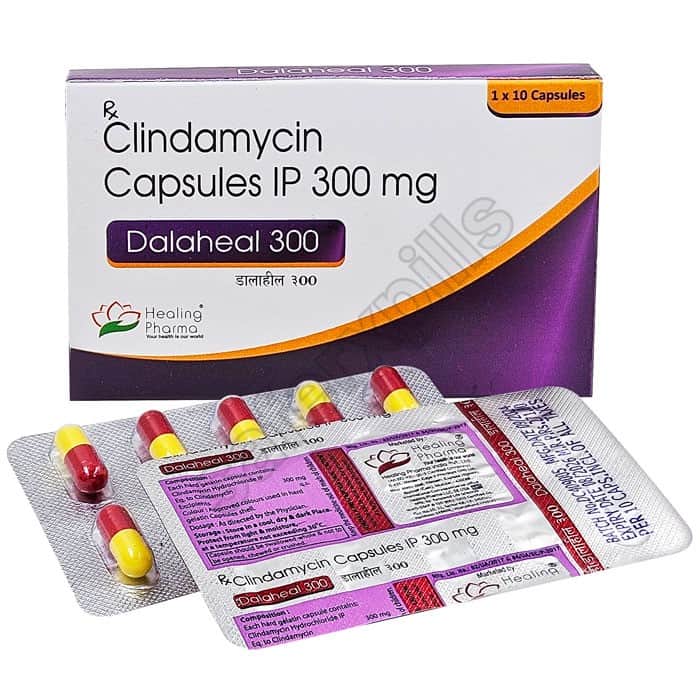
Customer Reviews
No reviews yet. Be the first to review Dalacin C 300mg.
Related Articles
Health guides about Clindamycin, written by pharmacists
Prescription Acne Creams and Gels Compared: Aklief, Epiduo, Aczone, Winlevi, Tretinoin and Clindamycin by the Evidence
Which prescription acne cream or gel suits which acne? This guide sets out the 2024 AAD guideline grades for each topical, the week 12 results each medicine achieved against its own vehicle in its US approval trials, the key safety rules (tazarotene in pregnancy, dapsone and G6PD, clascoterone and the adrenal axis), and which ones are now sold over the counter in the US.
Clindamycin Gel for Acne: How It Works, Why It Is Paired With Benzoyl Peroxide, Side Effects and Cost
Clindamycin 1% gel is a prescription topical antibiotic for acne. This guide covers the label directions, who must not use it, the colitis warning, side effects with label numbers, what the Acanya, Duac, Ziana and Cabtreo trials showed against each ingredient alone, why the 2024 AAD guideline says not to use it on its own, and what each form costs US pharmacies.
Epiduo vs Epiduo Forte: How Adapalene and Benzoyl Peroxide Gel Works, Results Timeline, Side Effects and Cost
Epiduo combines adapalene with benzoyl peroxide 2.5% in one once-daily acne gel, in 0.1% and 0.3% (Forte) strengths. This guide covers how the two strengths differ in the trials, how to apply the gel, what to expect week by week, the irritation rates from the US labels, bleaching of fabric and hair, the exact pregnancy wording, the over-the-counter Differin Epiduo, and what US pharmacies pay for brand and generic versions.
Related Health Guide
Understanding Acne & Skin Care: Complete Guide