

About Benoquin 100g
Benoquin 100g is a monobenzone cream made in India, sold in a 100 g tube. Monobenzone is a depigmenting agent: it removes skin colour permanently. Its one licensed use, in the old US Benoquin label, is final depigmentation of the remaining normal skin in people whose vitiligo already covers more than half of the body. It is not a skin lightener, and it is not a treatment for melasma, freckles, sun spots or dark patches. We sell single tubes and packs of 3 and 6, from $60.00 a tube in the 6 pack.
Read three things before you buy. First, the effect is permanent and can spread to skin you did not treat. Second, the Indian listings we found for a 100 g Benoquin tube describe it as monobenzone 40%, twice the 20% strength of the Benoquin cream that was licensed in the US and Canada; we have not confirmed the strength printed on our own stock, so read the carton. Third, this is a treatment to start only with a dermatologist who has confirmed how much of your skin vitiligo covers. We would not recommend buying it to use on your own.
Benoquin 100g at a glance
| Active ingredient | Monobenzone (the monobenzyl ether of hydroquinone). Indian listings for the 100 g tube state 40% (Truemeds; IndiaMART suppliers). The licensed US Benoquin cream was 20%. |
| Brand and maker | Benoquin. Truemeds names Brinton Healthcare Limited, Pune; IndiaMART suppliers name Brinton Pharmaceuticals Pvt Ltd. Our listing says Mac Medilife Pvt Ltd, which we could not confirm. |
| Used for | Final depigmentation in extensive vitiligo covering more than 50% of the body surface (US Benoquin label). Nothing else. |
| Regulatory status | This Indian pack is not registered with the FDA, MHRA, TGA or Health Canada. The FDA lists US Benoquin as discontinued, and the Canadian product was cancelled in 2014. Prescription required on Indian listings. |
| Usual use (label) | A thin layer rubbed into the pigmented skin two or three times daily, or as your doctor directs (US label, 20% cream) |
| Time to effect | Usually one to four months on the US label; stop if results are not satisfactory after four months |
| Storage | Below 30 °C (Truemeds; Tata 1mg for the 30 g cream). No refrigeration. |
| Packs | 1, 3 and 6 tubes of 100 g |
| Price per tube | $75.00 (1 tube) down to $60.00 (6 pack) |
| Delivery | 7 to 14 business days to the US, UK, Australia and Canada; $25 shipping under $149, free from $149 |
Price per tube
Prices below are as of October 2026; the pack selector shows the current price.
| Pack | Price | Per tube | Shipping | Per tube with shipping | Per gram with shipping |
|---|---|---|---|---|---|
| 1 tube (100 g) | $75.00 | $75.00 | $25 | $100.00 | $1.00 |
| 3 tubes (300 g) | $200.00 | $66.67 | Free | $66.67 | $0.67 |
| 6 tubes (600 g) | $360.00 | $60.00 | Free | $60.00 | $0.60 |
The 3 and 6 packs are cheaper per tube before shipping as well, so free shipping is not the only reason they cost less. We cannot tell you how many tubes a course needs: the label gives no amount per application, and the amount depends on how much pigmented skin is left to treat. Do not buy a multi tube pack before a dermatologist has seen how your skin reacts. For comparison, our Benoquin 30g (listed in India as 20%) costs $20.00 a tube, about $0.67 a gram before shipping, and the 20 g Benzocan 20g monobenzone cream costs $15.00 a tube before shipping.
What regulators licensed, and what is on sale now
Monobenzone was licensed in the US as Benoquin Cream 20% (NDA 008173, first approved in 1952). The FDA's database now lists Benoquin as discontinued, and we found no Federal Register notice giving a reason. In the FDA's drug listing data, the only monobenzone entry is a bulk ingredient (Darmerica), not a finished cream, and there is no monobenzone row in NADAC, the US pharmacy acquisition cost survey. So we cannot give a US price comparison. If you are in the US and a dermatologist agrees that depigmentation is right for you, ask them how they source monobenzone locally before ordering from abroad.
In Canada, Benoquin Crm 20% (DIN 01966391) was cancelled post market on 30 July 2014; Health Canada's database lists no other monobenzone product. In the UK, a search of the emc medicines database for monobenzone returns no results (emc is not the full MHRA register). In Australia, monobenzone is a Schedule 4 (prescription only) substance in the Poisons Standard; we did not confirm any product on the ARTG.
Monobenzone is also banned as a cosmetic ingredient. It is entry 178 (4-benzyloxyphenol) on the list of substances prohibited in cosmetic products in the UK and EU Cosmetics Regulation (Annex II), and Health Canada's Cosmetic Ingredient Hotlist lists 4-benzyloxyphenol (monobenzone) as prohibited. Any cream sold for skin whitening that contains it is being sold for a use regulators forbid. One Indian trade listing we found sells this same 100 g Benoquin 40% "For Skin Whitening". That is wrong, and it is not how we sell it.
20% or 40%: which Benoquin is this?
| Product | Strength on Indian listings | Compared with the label |
|---|---|---|
| Benoquin 30g | Monobenzone 20% w/w (Tata 1mg, PharmEasy, Apollo) | Same strength as the licensed US Benoquin 20% cream |
| Benoquin 100g (this page) | Monobenzone 40% (Truemeds; IndiaMART suppliers). We found no 100 g pack of a 20% cream. | Twice the licensed strength. No regulator label covers a 40% cream, and we found no published trial of one. |
| Benzocan 20g | Monobenzone, Healing Pharma (strength not confirmed by us) | Check the carton |
Because the 100 g tube appears to be the 40% cream, we would not recommend Benoquin 100g as a starting product. A stronger cream does not make permanent depigmentation safer, and the label already warns that the effect is erratic and can reach skin you did not treat. If your dermatologist prescribes monobenzone, ask which strength they want, and check the strength on the tube before the first application.
Who depigmentation is for
Depigmentation is a last step for a small group of people with vitiligo, not a routine treatment:
- The US Benoquin label says it is "indicated for final depigmentation in extensive Vitiligo", applied to "permanently depigment normal skin surrounding vitiliginous lesions in patients with disseminated (greater than 50 percent of body surface area) idiopathic vitiligo."
- The British Association of Dermatologists 2021 guideline says: "Consider depigmentation therapies in people with extensive vitiligo on visible sites, in whom the condition is having a negative psychological impact. This should be done after adequate psychological assessment and/or intervention." It is a good practice point, not a recommendation based on trials.
- The American Academy of Dermatology says depigmentation is rarely used, is for people who have lost most of their natural skin colour, and is considered permanent. It advises talking through the pros and cons with a board certified dermatologist first.
The evidence is thin. A 2011 review found that dermatologists use different thresholds for how much vitiligo justifies depigmentation, and that no trials have compared the depigmentation agents or techniques; it described monobenzone as the most widely used agent, with few side effects (AlGhamdi 2011, PMID 21054565). Most other reports are single cases or small series.
A dermatologist needs to confirm that the white patches are vitiligo and measure how much of your body they cover before you start. Other conditions can look like vitiligo, and depigmenting skin that should have been treated differently cannot be undone.
How Benoquin is used
These steps come from the US Benoquin 20% label unless another source is named. There is no regulator label for a 40% cream; follow your dermatologist's plan.
- Before the first full application, test a small patch of unbroken skin and stop if itching, excessive inflammation or swelling occurs (Tata 1mg listing).
- Apply a thin layer and rub it into the pigmented skin two or three times daily, "or as directed by physician". Apply it only to healthy skin, not to cuts or wounds (PharmEasy listing).
- Avoid prolonged sun exposure during treatment, or use a sunscreen. The label explains that sunlight reduces the depigmenting effect.
- Depigmentation "is usually accomplished after one to four months". The AAD says removing all remaining colour can take 1 to 4 years. Expect a slow and uneven change.
- "If satisfactory results are not obtained after four months of Benoquin Cream 20% treatment, the drug should be discontinued."
- Once the desired degree of depigmentation is reached, the label says to apply it only as often as needed to keep it, usually only two times weekly.
- Wash your hands before and after use unless your hands are being treated (Tata 1mg and PharmEasy listings), and keep it out of the eyes; rinse with water if it gets in (Tata 1mg listing).
- Our caution: let the cream absorb before skin touches another person, because the cream acts on any pigmented skin it reaches.
After depigmentation: sun protection for life
The US label says: "Following therapy with Benoquin Cream 20%, the skin will be sensitive for the rest of the patient's life. He/she must use sunscreens during exposure to the sun." Depigmented skin has no melanin left to protect it. The BAD guideline advises sunscreen with a 4 star or 5 star UVA rating and SPF 50 for people with vitiligo. Plan for daily sunscreen, clothing and shade from now on, not only during the course.
The result may also be patchy, and colour can return in places; the BAD guideline lists the risk of repigmentation as one of the outcomes that matter for depigmentation treatment.
Side effects
The US label gives no side effect table or percentages. It says:
- "Mild, transient skin irritation and sensitization, including erythematous and eczematous reactions have occurred". Treatment "should be discontinued if irritation, a burning sensation, or dermatitis occur."
- "Areas of normal skin distant to the site of Benoquin Cream 20% application frequently have become depigmented, and irregular, excessive, unsightly, and frequently permanent depigmentation has occurred."
Contact allergy to monobenzone used to treat vitiligo has been reported (Lyon 1998, PMID 9771988). The Indian listings for the 30 g cream add burning, itching and redness (PharmEasy and Apollo) and dryness or peeling of treated skin (Apollo); Tata 1mg lists skin irritation, erythematous rash and eczematous eruptions. Monobenzone also causes unwanted depigmentation when it is misused: in a published case series of 32 people with chemical vitiligo, 18 had used monobenzone cream, mostly for facial pigmentation such as melasma, and developed confetti like white patches 3 to 6 months after starting (Sharquie 2023).
When to stop and get help
- Swelling of the face, lips, tongue or throat, trouble breathing or swallowing, or widespread hives: get emergency help. This is general safety advice; the label lists only sensitization and eczematous reactions.
- Blistering, oozing, severe burning or a spreading rash: stop the cream and see your dermatologist promptly (the label says to discontinue for irritation, burning or dermatitis).
- White patches appearing in places you did not treat: stop and tell your dermatologist before the next application (our advice; the label warns this happens frequently).
- Cream in the eyes: rinse with plenty of water, and get medical advice if pain or redness persists (rinsing is from the Tata 1mg listing).
- Swallowed by accident, by a child or anyone else: the label says "call a physician or a Poison Control Center immediately" (US 1-800-222-1222, Australia 13 11 26).
Who should not use Benoquin
The US Benoquin label lists these as contraindications:
- Any condition other than disseminated vitiligo. The label says it "is not a cosmetic skin bleach" and is "contraindicated in any conditions other than disseminated vitiligo". That rules out cosmetic lightening of the face or body, age spots, sun spots and uneven skin tone.
- As a substitute for hydroquinone: "it must not be used as a substitute for hydroquinone."
- Anyone with "a history of sensitivity or allergic reactions to this product, or any of its ingredients".
The label also says it is "not recommended in freckling; hyperpigmentation caused by photosensitization following the use of certain perfumes (berlock dermatitis); melasma (chloasma) of pregnancy; or hyperpigmentation resulting from inflammation of the skin", and that it is not effective for cafe au lait spots, pigmented moles (naevi), malignant melanoma, or pigment that is not melanin. For melasma and dark spots, see our skin lightening creams guide and hydroquinone guide; hydroquinone fades pigment, while the monobenzone label says it may destroy the pigment cells and cause permanent depigmentation.
Other groups in the label:
- Children: safety and effectiveness below the age of 12 years "have not been established".
- Pregnancy: no animal reproduction studies have been done and it is not known whether it can harm an unborn baby; it "should be given to a pregnant woman only if clearly needed."
- Breastfeeding: it is not known whether it passes into milk, and "caution should be exercised".
Prescription and legal status
- India: Truemeds marks the 100 g tube "Prescription required"; Tata 1mg and Apollo list the 30 g cream as prescription.
- US: Benoquin was a prescription drug, and the FDA now lists it as discontinued. This Indian pack is not registered with the FDA. The FDA says personal importation of unapproved medicines is illegal in most circumstances.
- UK: we found no licensed monobenzone medicine on emc, and this pack is not registered with the MHRA. Monobenzone is prohibited in cosmetic products.
- Australia: monobenzone is Schedule 4, Prescription Only, in the Poisons Standard. This pack is not registered with the TGA.
- Canada: the only Canadian product, Benoquin Crm 20%, was cancelled in 2014, and monobenzone is prohibited in cosmetics. This pack is not registered with Health Canada.
Check the rules where you live, and do not start it without a dermatologist.
Buying genuine Benoquin
The MHRA warns: "Any medicine not authorised for sale in the UK can be unsafe or ineffective and there is no way of knowing what is in them or the negative health effects they can have." It advises UK buyers: "Only use UK-registered pharmacies, including online pharmacies displaying the official green cross logo". That warning covers Benoquin, which is not authorised in the UK. When your order arrives, check that the carton and tube name Benoquin and the maker, show the monobenzone strength (20% or 40%), a batch number and an expiry date, and that the tube is sealed. These checks cannot prove a tube is genuine, because counterfeiters copy packaging. If a tube causes unusual symptoms, stop using it, seek medical advice, and report it to your medicines regulator (the MHRA Yellow Card scheme in the UK, FDA MedWatch in the US, the TGA in Australia or Health Canada) as well as to us. Store it below 30 °C with the cap closed, out of the reach of children.
Delivery
We ship Benoquin to the US, UK, Australia and Canada in plain packaging with tracking. Standard delivery takes 7 to 14 business days to most countries. Shipping costs a flat $25 on orders under $149 and is free from $149. See our shipping page and refund policy.
Related guides
- Skin lightening creams compared: what works for melasma and dark spots
- Hydroquinone cream guide
- Is it safe to buy medicine online?
Sources
- BENOQUIN Cream 20% (monobenzone cream, USP) US label, ICN Pharmaceuticals, Rev. 8-00, NDA 008173 labeling supplement approved 26 March 2003: Indications and Usage, Contraindications, Warnings, Precautions, Adverse Reactions, Dosage and Administration, How Supplied. FDA
- FDA Drugs@FDA (openFDA), NDA 008173 Benoquin, marketing status Discontinued; openFDA NDC directory, monobenzone (bulk ingredient only). Checked 21 October 2026.
- Centers for Medicare and Medicaid Services, NADAC 2026 dataset: no monobenzone rows. Checked 21 October 2026. data.medicaid.gov
- Health Canada Drug Product Database, Benoquin Crm 20%, DIN 01966391, cancelled post market 30 July 2014; Health Canada Cosmetic Ingredient Hotlist, 4-benzyloxyphenol (monobenzone), prohibited (page modified 13 August 2025).
- UK Cosmetics Regulation (retained Regulation (EC) No 1223/2009), Annex II entry 178, 4-benzyloxyphenol. legislation.gov.uk; emc search for monobenzone, no results, 21 October 2026.
- Therapeutic Goods (Poisons Standard, October 2025) Instrument 2025 (F2025L01181), Schedule 4 entry: MONOBENZONE and alkyl ethers of hydroquinone for human therapeutic use or cosmetic use. Federal Register of Legislation, checked 21 October 2026.
- Eleftheriadou V, et al. British Association of Dermatologists guidelines for the management of people with vitiligo 2021. Br J Dermatol 2022;186:18 to 29. PMID 34160061 (R9, R16).
- American Academy of Dermatology. Vitiligo: diagnosis and treatment (updated 15 April 2026). AAD
- AlGhamdi KM, Kumar A. Depigmentation therapies for normal skin in vitiligo universalis. J Eur Acad Dermatol Venereol 2011;25:749 to 757. PMID 21054565.
- Lyon CC, Beck MH. Contact hypersensitivity to monobenzyl ether of hydroquinone used to treat vitiligo. Contact Dermatitis 1998;39:132 to 133. PMID 9771988.
- Sharquie KE, Abdulwahhab W. Monobenzone is still the main culprit of chemical vitiligo. J Pak Assoc Dermatol 2023;33(2):429 to 436.
- Indian listings for Benoquin (100 g: Truemeds and IndiaMART suppliers; 30 g: Tata 1mg, PharmEasy, Apollo Pharmacy), checked 21 October 2026.
- MHRA. 20 million illegal erectile dysfunction pills seized as MHRA warns against risky online buys, 13 February 2026. GOV.UK.
- US Food and Drug Administration. Personal Importation. FDA
This page is for information and is not medical advice. Monobenzone causes permanent loss of skin colour; use it only under the care of a dermatologist.
Key Information
- ✓Active Ingredient: Monobenzone
- ✓Category: Skin Care
- ✓Form: Cream
- ✓Brand: Mac Medilife Pvt Ltd
- ✓Manufacturer: Mac Medilife Pvt Ltd
Frequently Asked Questions
What is Benoquin 100g?
Benoquin 100g is an Indian monobenzone cream in a 100 g tube. Monobenzone removes skin colour permanently. Its licensed use, in the old US Benoquin label, is final depigmentation of the remaining normal skin in people whose vitiligo covers more than 50% of the body. Truemeds names Brinton Healthcare Limited as the maker.
Is Benoquin 100g a 20% or a 40% cream?
The Indian listings we found for a 100 g Benoquin tube (Truemeds and IndiaMART suppliers) describe it as monobenzone 40%, and we found no 100 g pack of a 20% cream. The US Benoquin cream was 20%, and no regulator label covers a 40% cream. We have not confirmed the strength on our own stock, so read the carton and tell your dermatologist which strength you have.
Can I use Benoquin to lighten my skin, melasma or dark spots?
No. The US label says it is a potent depigmenting agent, "not a cosmetic skin bleach", and is contraindicated in any condition other than disseminated vitiligo. It is not recommended for freckles or melasma of pregnancy, and it must not be used as a substitute for hydroquinone. Monobenzone is also banned in cosmetic products in the UK, EU and Canada. Used on the face for melasma, it has caused confetti like white patches (Sharquie 2023).
Is the depigmentation permanent?
Yes. The label says Benoquin frequently produces irreversible depigmentation, and that normal skin far from where it was applied frequently becomes depigmented, and that irregular, excessive and frequently permanent depigmentation has occurred. Treated skin stays sensitive to the sun for the rest of your life, so you will need sunscreen whenever you are in the sun.
How much does Benoquin 100g cost?
As of October 2026, a single 100 g tube is $75.00 ($100.00 with the $25 shipping), 3 tubes are $200.00 ($66.67 a tube) and 6 tubes are $360.00 ($60.00 a tube), with free shipping from $149. The pack selector shows the current price. There is no US price to compare: the FDA lists Benoquin as discontinued, its drug listing data show no finished monobenzone cream, and NADAC has no monobenzone rows.
How is Benoquin used?
The US label (20% cream) says to rub a thin layer into the pigmented skin two or three times daily, or as your doctor directs, and to avoid prolonged sun or use sunscreen during treatment. Depigmentation usually takes one to four months; stop if results are not satisfactory after four months. Once the result is reached, it is used only as needed to keep it, usually twice weekly. Follow your dermatologist's plan, especially for a 40% cream.
Who should consider depigmentation?
Only people with extensive vitiligo. The US label limits it to vitiligo covering more than 50% of the body. The British Association of Dermatologists says to consider it for extensive vitiligo on visible sites that is having a negative psychological impact, after adequate psychological assessment. A dermatologist should confirm the diagnosis and the extent first.
What are the side effects?
The label lists mild, transient skin irritation and sensitization, including red and eczema like reactions, and says to stop if irritation, burning or dermatitis occurs. It also warns that skin far from the treated area often loses colour. Indian listings add burning, itching, redness, dryness and peeling. Get emergency help for swelling of the face, lips or throat or trouble breathing.
Who should not use Benoquin?
Anyone without disseminated vitiligo, anyone allergic to monobenzone or any ingredient of the cream, and anyone looking for a cosmetic lightener or a hydroquinone substitute (US label contraindications). Safety in children under 12 has not been established. In pregnancy the label says use only if clearly needed, and it advises caution when breastfeeding.
Do I need a prescription for Benoquin?
Indian listings mark it prescription required. Monobenzone is Schedule 4 (prescription only) in Australia, and US Benoquin was a prescription drug. This Indian pack is not registered with the FDA, MHRA, TGA or Health Canada, and the FDA says personal importation of unapproved medicines is illegal in most circumstances. Start it only with a dermatologist.
How long does delivery take?
Standard delivery takes 7 to 14 business days to the US, UK, Australia and Canada, in plain packaging with tracking. Shipping is a flat $25 on orders under $149 and free from $149.
Medical References
- 1.PubMed (NCBI) (PMID: 21689385) — 2011
- 2.PubMed (NCBI) (PMID: 38542385) — 2024
- 3.PubMed (NCBI) (PMID: 40707941) — 2025
- 4.PubMed (NCBI) (PMID: 39313936) — 2024
- 5.PubMed (NCBI) (PMID: 27287410) — 2016
- 6.PubMed (NCBI) (PMID: 33935733) — 2021
- 7.PubMed (NCBI) (PMID: 29632737) — 2018
Sources: U.S. National Library of Medicine (DailyMed, PubMed), openFDA
Related Products
View all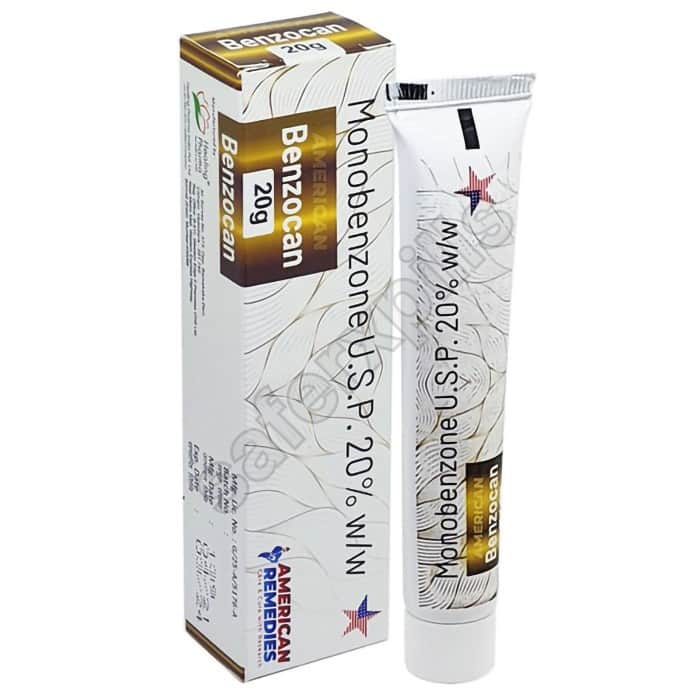
Customer Reviews
No reviews yet. Be the first to review Benoquin 100g.
Related Articles
Health guides about Monobenzone, written by pharmacists
Epiduo vs Epiduo Forte: How Adapalene and Benzoyl Peroxide Gel Works, Results Timeline, Side Effects and Cost
Epiduo combines adapalene with benzoyl peroxide 2.5% in one once-daily acne gel, in 0.1% and 0.3% (Forte) strengths. This guide covers how the two strengths differ in the trials, how to apply the gel, what to expect week by week, the irritation rates from the US labels, bleaching of fabric and hair, the exact pregnancy wording, the over-the-counter Differin Epiduo, and what US pharmacies pay for brand and generic versions.
Dapsone Gel (Aczone) 5% vs 7.5%: How to Use It, Results, Side Effects, Warnings and Cost
Dapsone gel (Aczone) is a prescription acne gel in two strengths: 5% twice daily and 7.5% once daily. This guide covers how to apply each, who it is approved for, what the four label trials showed against vehicle, side effects with label rates, the methemoglobinemia and G6PD warnings, the orange staining with benzoyl peroxide, pregnancy and breastfeeding, generic approvals and what US pharmacies pay per gram.
Generic Otezla (Apremilast): Is It Available in the US, What It Costs, Dosing and Side Effects
The FDA has approved generic apremilast from 13 companies, but none is on sale in US pharmacies as of October 2026. This guide covers the patent dates, what apremilast treats, the 5-day starting schedule, kidney dosing, trial results, side effects and warnings, and what a month of Otezla costs pharmacies compared with Indian apremilast.
Related Health Guide
Understanding Acne & Skin Care: Complete Guide