
Kenadion 10mg Injection
Generic: Phytomenadioneby Samarth Life Sciences Pvt Ltd
Similar medicines
View all
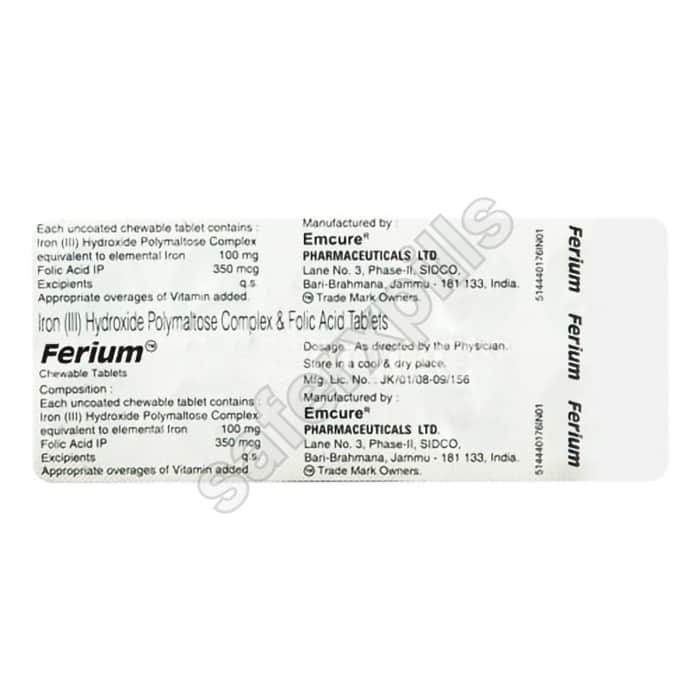
About Kenadion 10mg Injection
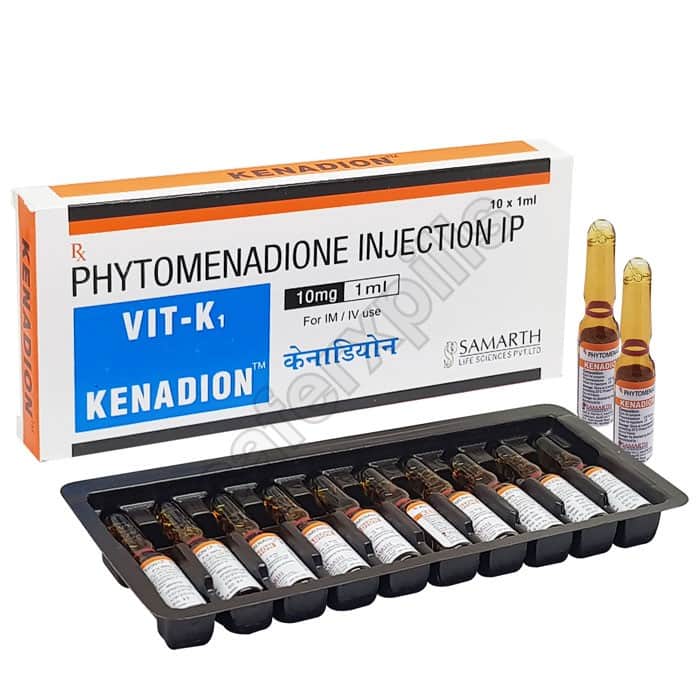
Kenadion 10mg Injection is a 1 mL ampoule containing 10 mg of phytomenadione, also called phytonadione or vitamin K1, made by Samarth Life Sciences in India. Vitamin K1 lets the liver make the clotting factors II, VII, IX and X. As an injection it is used to correct clotting problems caused by too little vitamin K or by coumarin blood thinners such as warfarin, and, in smaller doses from paediatric products, to protect newborn babies from vitamin K deficiency bleeding. We sell it in packs of 10, 20 and 30 ampoules, from $1.80 an ampoule in the largest pack.
Three points first. This is not a home medicine. Every label we checked describes an injection given by a doctor or nurse, the US label carries a boxed warning about fatal allergic reactions with injection into a vein or muscle, and the UK label for the matching 10 mg ampoule is for slow injection into a vein only. Second, bleeding while you take warfarin or another blood thinner is an emergency: call emergency services or go to an emergency department, and do not wait for a parcel. A high INR without bleeding is a decision for your anticoagulation clinic or doctor, who will check your INR before and after any vitamin K. Third, newborn vitamin K is usually given at birth by the midwife or hospital team from a paediatric product (our summary of usual practice), and the UK label says neonates and babies should get the paediatric 2 mg/0.2 ml ampoule. In our view you should only order this product if the doctor or clinic that will give it has asked you to supply it. This page sets out the doses, warnings and storage rules from the current US phytonadione labels and UK product information, listed at the end.
Kenadion 10mg Injection at a glance
| Active ingredient | Phytomenadione (vitamin K1) 10 mg in 1 mL, one ampoule |
| Brand and maker | Kenadion, Samarth Life Sciences Pvt Ltd, India |
| Who gives it | A doctor or nurse. Indian listings describe injection into a muscle, under the skin or into a vein by a health professional (Medkart for the 10 mg ampoule, Apollo for the 1 mg ampoule); Tata 1mg says "Kindly do not self administer" |
| Regulatory status | Phytomenadione injection is licensed in the US, UK, Canada and Australia. This Indian Kenadion pack is not registered with the FDA, MHRA, TGA or Health Canada |
| Usual dose from the labels | US: 2.5 mg to 10 mg or more for blood thinner effects, with the INR checked; newborn prevention 0.5 mg to 1 mg within one hour of birth. UK (10 mg ampoule): 5 mg to 10 mg by slow injection into a vein for major or life threatening warfarin bleeding, with clotting factor concentrate, and no more than 40 mg in 24 hours |
| How fast it works | Not immediate: the US label says INR improvement may take 1 to 8 hours, and a normal INR may often be reached in 12 to 14 hours after a dose into a vein |
| Half-life | About 1.5 to 3 hours in plasma (UK label 5.2) |
| Storage | Indian listings: below 25 C (Tata 1mg, Truemeds) or 15 to 25 C away from direct light (GNH India). Protect from light (US and UK labels). Not a refrigerated product |
| Packs | 10, 20 and 30 ampoules |
| Price per ampoule | $2.30 (10 pack) down to $1.80 (30 pack), before shipping |
| Delivery | 7 to 14 business days to the US, UK, Australia and Canada, without temperature control; $25 shipping under $149, free from $149 |
Price per ampoule
Prices below are as of October 2026; the pack selector shows the current price.
| Pack | Price | Per ampoule | Shipping | Per ampoule with shipping |
|---|---|---|---|---|
| 10 ampoules | $23 | $2.30 | $25 | $4.80 |
| 20 ampoules | $38 | $1.90 | $25 | $3.15 |
| 30 ampoules | $54 | $1.80 | $25 | $2.63 |
All three packs are under the $149 free shipping line, so each single pack carries $25 shipping. The larger packs are cheaper per ampoule before shipping too. In India, Tata 1mg and Truemeds list a single Kenadion 10mg ampoule at Rs 56.68 (shown as the MRP on Truemeds).
Do you need a pack this size? Usually not. The labels describe single doses or short courses guided by INR tests, not daily use. Under the UK label, an adult with major warfarin bleeding gets 5 mg, and the suggested dose for an adult with a high INR and no or mild bleeding is 0.5 mg to 1 mg, which this 10 mg ampoule cannot measure easily; the UK label points to the 2 mg/0.2 ml paediatric ampoule for small doses. Each ampoule is single use: the US label says to discard unused contents of the ampule. So buy only the number of ampoules the doctor or clinic giving them has asked for, and check that the expiry date covers when they will be used. That is our advice, not a label figure.
Compared with US, UK and Canadian vitamin K1 injections
| Kenadion 10mg (ours) | US phytonadione 10 mg/mL | UK Konakion MM 10 mg/ml | |
|---|---|---|---|
| Maker | Samarth Life Sciences, India | Several, for example Hospira, Amneal, Cipla, Dr. Reddy's | Neon Healthcare |
| Registered with that country's regulator | No: this Indian pack is not registered with the FDA, MHRA, TGA or Health Canada | Yes, FDA, prescription only | Yes, MHRA, prescription only medicine |
| Routes in the label | Muscle, under the skin or vein (Indian listings) | Under the skin preferred; vein or muscle only if under the skin is not feasible | Vein only; must not be given into muscle |
| Ingredients besides vitamin K1 | Not confirmed (we have not seen Samarth's leaflet) | Hospira: polyoxyethylated fatty acid derivative, dextrose, benzyl alcohol 9 mg per mL | Glycocholic acid and lecithin (mixed micelles), no benzyl alcohol listed |
| Cost per ampoule | $1.80 to $2.30 before shipping | No NADAC rate (see below) | Not checked |
NADAC is the average price US pharmacies pay to buy a medicine, published by the US Medicaid programme. The NADAC file effective 21 October 2026 has no rows for phytonadione injection; the only phytonadione rows are 5 mg tablets ($9.30055 a tablet), which are a different product. So we cannot give a fair US price comparison for the injection. In our understanding, and not from a label, vitamin K1 injections in the US, UK and Canada are usually given from the clinic's or hospital's own stock. If you are in one of these countries, ask the team treating you whether they will give it from their own supply before you order.
US generic vitamin K1 injections were approved through abbreviated applications (ANDAs). We have not seen any data comparing the Indian Kenadion ampoule with US, UK or Canadian products.
Which strength to choose
| Use | Dose in the labels | Does a 10 mg/1 mL ampoule fit? |
|---|---|---|
| Preventing bleeding in a healthy newborn | US: 0.5 mg to 1 mg within one hour of birth. UK: 1 mg into a muscle, or 2 mg by mouth with further doses, from the paediatric product | No. The UK label says neonates and babies should get Konakion MM Paediatric 2 mg/0.2 ml, and the US 1 mg/0.5 mL ampoule is labelled "Neonatal Concentration". The UK paediatric label warns that 10 times dosing errors are common |
| High INR on warfarin, no bleeding or mild bleeding | UK: 0.5 mg to 1 mg into a vein (INR 5 to 9), 1 mg (INR over 9) | Poorly. The UK label says the 2 mg/0.2 ml ampoule can be used for small doses |
| Major or life threatening warfarin bleeding | UK: 5 mg to 10 mg slowly into a vein with prothrombin complex concentrate. US: 2.5 mg to 10 mg or more, up to 25 mg to 50 mg as a single dose | Yes, in hospital |
| Vitamin K deficiency from other causes (antibiotics, poor absorption, salicylates) | US: 2.5 mg to 25 mg or more, up to 50 mg as a single dose, INR checked after 6 to 8 hours | Yes, given by a health professional |
Kenadion also comes as a 1 mg in 0.5 mL injection and as tablets, which are different products. Never use the 10 mg ampoule for a baby, and never swap between strengths or forms without the doctor who is treating you.
How Kenadion 10mg Injection is given
This section is for you and the professional giving the injection. It summarises the labels; it is not a guide to injecting yourself.
- Route. The US labels say: "Whenever possible, administer Vitamin K1 Injection by the subcutaneous route", and when injection into a vein is unavoidable, "inject the drug very slowly, not exceeding 1 mg per minute" (2.1). The UK label for Konakion MM 10 mg/ml says it "is for intravenous injection", diluted with 55 ml of 5% glucose and infused slowly, and that it should not be given into a muscle (4.2, 4.3). The two labels differ, and Kenadion's own leaflet should be checked for its approved routes.
- Dilution. The US label lists 0.9% sodium chloride, 5% dextrose, or 5% dextrose and sodium chloride, and says to avoid diluents that may contain benzyl alcohol (2.4).
- Light. "Protect Vitamin K1 Injection from light at all times" (US 2.4). The UK label says the diluted solution should be freshly prepared and protected from light (4.2).
- Look at the ampoule. The UK label says the contents should be clear, and that after incorrect storage they may become turbid or separate, in which case "the ampoule must no longer be used" (4.4).
- INR checks. The US label says to monitor INR regularly, use the lowest effective dose, and recheck INR 6 to 8 hours after a dose for deficiency from other causes (2.1, 2.2). The UK label says to recheck INR three hours after a dose for severe bleeding, and to monitor clotting daily until it is acceptable (4.2).
- Severe bleeding needs more than vitamin K. The US label says the effect is not immediate and "interim use of whole blood or component therapy may also be necessary if bleeding is severe" (2.1). The UK label pairs vitamin K with prothrombin complex concentrate, or fresh frozen plasma if that is not available (4.2).
- Monitoring after the injection. Because the serious allergic reactions in the US boxed warning happened during and immediately after injection, the injection should be given where staff can treat anaphylaxis. That is our reading of the label, not label wording.
Warfarin reversal and going back on a blood thinner
Reversing warfarin is a clinical decision, made from your INR, the reason you take a blood thinner and your bleeding risk. The UK label says treatment of a high INR without symptoms depends on the reason for anticoagulation, the INR value, the time spent outside the target range, age, other illnesses and medicines, and the risk of major bleeding (4.2).
- Your clot risk comes back. The US label says that when vitamin K is used and a blood thinner is still needed, "the patient is again faced with the clotting hazards existing prior to starting the anticoagulant therapy", and that overzealous treatment "may restore conditions which originally permitted thromboembolic phenomena" (2.1).
- Warfarin may work less well afterwards. The US label says vitamin K1 "may induce temporary resistance to prothrombin-depressing anticoagulants, especially when larger doses" are used, so higher anticoagulant doses or a switch to heparin may be needed (7). The UK label says vitamin K is likely to interfere with warfarin for 2 to 3 weeks (4.2, children) and that large doses should be avoided if anticoagulation is to continue (4.4).
- Injection into a muscle. The UK label says Konakion MM 10 mg should not be given into a muscle because it acts as a depot, which makes restarting anticoagulation difficult, and because muscle injections in people on blood thinners risk a haematoma (bruise or blood collection) (4.3).
- Mechanical heart valves. The UK label says vitamin K1 in people with mechanical heart valves "is generally to be avoided, unless there is major bleeding" (4.4).
- Other blood thinners. The US label says vitamin K1 does not affect heparin (7), and the UK label says it "is not an antidote to heparin" (4.4). The UK label also says there are limited data for acenocoumarol and phenprocoumon. Neither label lists the newer blood thinners (apixaban, rivaroxaban, edoxaban, dabigatran) among its uses; ask your doctor what applies to the medicine you take.
Vitamin K for newborn babies
Newborn vitamin K is normally given at birth by the midwife or hospital team; that is our summary of usual practice, not label text. The US label dose is 0.5 mg to 1 mg within one hour of birth (2.3). The UK paediatric label gives healthy babies of 36 weeks or more either 1 mg into a muscle, or 2 mg by mouth with further 2 mg doses at 4 to 7 days and at 1 month (the 1 month dose can be left out in babies fed only formula), and smaller weight-based doses for preterm babies (4.2). It also says babies with cholestatic liver disease must get it by injection, because oral absorption is impaired (4.4).
Two label warnings matter for babies. Benzyl alcohol: the US label says "Serious and fatal adverse reactions including 'gasping syndrome' can occur in neonates and infants treated with benzyl alcohol-preserved drugs", and advises benzyl alcohol-free products in neonates and infants if available (5.2). We have not been able to confirm whether Kenadion contains benzyl alcohol. Dose: the 10 mg ampoule is ten times the usual newborn dose. This product is not suitable for a baby.
Lower doses and extra care for some groups
- Older people. The UK label says elderly patients "tend to be more sensitive to reversal of anticoagulation" and the dose should be at the lower end of the ranges (4.2).
- Liver disease. The US label says repeated large doses "are not warranted in liver disease if the initial response is unsatisfactory" (2.2). The UK label says each Konakion MM 10 mg ampoule contains 54.6 mg glycocholic acid, which may displace bilirubin, so INR needs careful monitoring in severe liver impairment (4.4). That warning is about the UK formulation; Kenadion's ingredients are not confirmed.
- Children aged 1 to 18 years. The UK label advises consulting a haematologist for any child in whom the 10 mg ampoule is considered (4.2).
- Pregnancy. The UK label says use only if the benefits outweigh the risks and that it "is not recommended for pregnant women as prophylaxis of vitamin K deficiency bleeding in the newborn" (4.6). The US label says to consider a benzyl alcohol-free product if one is needed in pregnancy (8.1).
- Breastfeeding. The US label says phytonadione is present in breast milk and recommends a preservative-free product if one is needed during breastfeeding (8.2).
Side effects
The labels give no table of side effect rates for vitamin K1 injection, so there is no chart on this page. These are the effects the labels list.
| Effect | What the label says | Source |
|---|---|---|
| Severe allergic reactions, including anaphylaxis | Fatal reactions have occurred during and immediately after injection into a vein or muscle, despite dilution and with the first dose; reported features include shock, cardiorespiratory arrest, flushing, sweating, chest pain, fast heartbeat, bluish skin, weakness and shortness of breath | US boxed warning, 5.1 |
| Anaphylactoid reactions | Reported after injection into a vein | UK 4.8 |
| Delayed skin reactions | Eczema-like reactions, scleroderma-like patches, hives and delayed allergy, starting from 1 day to a year after the injection | US 5.3, 17 |
| Injection site | Pain, swelling and tenderness (US). Vein irritation or phlebitis very rarely (UK 10 mg). Rarely severe injection site reactions including inflammation, atrophy and necrosis (UK paediatric) | US 6.2; UK 4.8 |
| Heart and circulation | Fast heartbeat, low blood pressure, bluish skin (cyanosis) | US 6.2 |
| Other reports after approval | Generalised flushing, raised bilirubin, taste changes, dizziness, shortness of breath, redness, itchy plaques, erythema perstans | US 6.2 |
| Newborns | Haemolysis, jaundice and raised bilirubin may follow an overdose, particularly in premature babies (US 10). Injection in premature babies under 2.5 kg may increase the risk of kernicterus (UK paediatric 4.4) | US 10; UK paediatric 4.4 |
The US list comes from voluntary reports after approval, so the label says it is not always possible to reliably estimate how often they happen. The UK label says hypervitaminosis of vitamin K1 is unknown, but that restarting anticoagulation may be affected after an overdose (4.9).
When to get urgent help
Get emergency help straight away, or tell the staff at once if you are still in the clinic, if any of these happen during or after the injection:
- Swelling of the lips, tongue, face or throat, hives, or trouble breathing or swallowing.
- Chest pain or tightness, a racing heartbeat, fainting or feeling faint, or collapse.
- Sudden flushing, sweating, weakness, or a blue tinge to the lips or skin. The US label lists flushing, sweating, chest pain, fast heartbeat, bluish skin, weakness and shortness of breath among the features of fatal and severe reactions (5.1).
Also get emergency help if you take warfarin or another blood thinner and have bleeding that will not stop, vomit blood, pass black or bloody stools or red urine, cough up blood, have a sudden severe headache, or hit your head. This list is our general safety advice, not label text. Do not try to treat bleeding on a blood thinner with an injection at home.
For a baby, get urgent help for any bleeding, bruising, blood in the nappy, pale or yellow skin, or unusual sleepiness or gasping breaths.
A new rash in the weeks or months after an injection is not usually an emergency, but the US label says to report it, because skin reactions can be delayed for up to a year (17). Tell the emergency staff that you were given vitamin K1 (phytomenadione, Kenadion), how much, when and by which route.
Who should not use Kenadion 10mg Injection
Never use it if:
- you have had an allergic reaction to phytomenadione or any other ingredient of the injection (US label 4; UK labels 4.3).
- the plan is to inject it into a muscle when the UK Konakion MM 10 mg label applies: that label lists muscle injection under contraindications, for the depot and haematoma reasons above (4.3).
Avoid, not recommended, or only with care:
- Injection into a vein or muscle when under the skin is possible: the US boxed warning says "Avoid the intravenous and intramuscular routes of administration unless the subcutaneous route is not feasible and the serious risk is justified."
- Newborns and infants: the US label says to use benzyl alcohol-free products if available (5.2); the UK label says neonates and babies should get the paediatric product (4.2).
- Mechanical heart valves: "generally to be avoided, unless there is major bleeding" (UK 4.4).
- Continuing on a blood thinner: large doses "should be avoided" (UK 4.4); the US label says keep the dose as low as possible (2.1).
- Pregnancy, as prevention for the baby: "not recommended" (UK 4.6).
- Heparin: vitamin K1 is not an antidote to heparin (UK 4.4; US 7).
Ingredients and what we could not confirm
Indian listings give the composition only as phytomenadione 10 mg; none we checked lists the other ingredients, and Tata 1mg's Gujarati page notes that some vitamin K products contain benzyl alcohol. Labels for other phytonadione injections show why this matters. The Hospira US product contains a polyoxyethylated fatty acid derivative, dextrose and 9 mg of benzyl alcohol per mL (US label 11). The IMS US 1 mg product contains polysorbate 80 and propylene glycol. UK Konakion MM uses glycocholic acid and lecithin. Before Kenadion is given, the person giving it should read the ingredient list on the carton or leaflet, especially for babies, pregnancy, breastfeeding, severe liver disease or a past reaction to an injection.
Storage and light
- Temperature. Tata 1mg and Truemeds list Kenadion 10mg as "Store below 25 C"; GNH India lists 15 to 25 C and room temperature away from direct light; Medkart lists room temperature. US labels say 20 C to 25 C; the UK Konakion MM label gives 25 C as the maximum. It does not need a fridge.
- Light. The Hospira US label says "Protect from light. Keep ampuls in tray until time of use."; the IMS US label says to protect from light and keep the container in its closed original carton. The UK paediatric label says protect from light and do not freeze.
- In transit. Our parcels travel for 7 to 14 business days without temperature control, and can be exposed to heat above 25 C in summer. Keep the ampoules in their carton, away from light and heat, when they arrive, and do not use any ampoule whose contents look cloudy or separated. That is our advice, based on the UK label's turbidity warning (4.4).
Prescription and legal status
In the US, phytonadione injection is a prescription medicine ("Rx only") sold as FDA-approved generics, and the FDA says personal importation of unapproved medicines is illegal in most circumstances. In the UK, Konakion MM 10 mg/ml is a prescription only medicine. In Canada, Sandoz Vitamin K1 10 mg/mL is marketed as a prescription product. In Australia, Konakion MM Adult 10 mg/mL is on the ARTG; healthdirect lists it as Not Scheduled, and the PBS lists it as a Prescriber Bag item. In India, Tata 1mg and Truemeds mark Kenadion 10mg Injection as prescription required. Whatever the schedule where you live, the labels describe an injection given by a health professional. Check the rules where you live.
Buying genuine Kenadion
The MHRA warns that "Any medicine not authorised for sale in the UK can be unsafe or ineffective and there is no way of knowing what is in them or the negative health effects they can have", and it advises UK buyers to use only UK-registered pharmacies. That warning covers this Indian Kenadion pack. When your order arrives, check that each ampoule and carton says Kenadion and phytomenadione 10 mg in 1 mL, with Samarth Life Sciences, a batch number and an expiry date, and that the liquid is clear. These checks cannot prove that an injection is genuine or sterile, because counterfeiters copy packaging. If a batch causes unusual symptoms, seek medical advice and report it to your medicines regulator (the MHRA Yellow Card scheme in the UK, FDA MedWatch in the US, the TGA in Australia or Health Canada) as well as to us.
Delivery
We ship Kenadion 10mg Injection to the US, UK, Australia and Canada in plain packaging with tracking. Standard delivery takes 7 to 14 business days, so this product can never be used for an emergency. Shipping costs a flat $25 on orders under $149 and is free from $149. See our shipping page and refund policy.
Related guides
Sources
- Vitamin K1 Injection (phytonadione injectable emulsion, USP), US prescribing information, Hospira, DailyMed setid e8808230-2c44-44c6-8cab-8f29b6b34051, version 23, effective 9 August 2026: boxed warning, sections 1.1, 1.2, 2.1 to 2.4, 3, 4, 5.1 to 5.3, 6.2, 7, 8.1, 8.2, 8.4, 10, 11, 12.2, 12.3, 16, 17. DailyMed
- Phytonadione Injectable Emulsion USP 1 mg/0.5 mL, US prescribing information, International Medication Systems, DailyMed setid e0b0c8f1-75be-4f25-898a-7b97b608c615, version 8: boxed warning, sections 2, 11, 16. DailyMed
- Konakion MM Ampoules 10 mg/ml solution for injection, UK SmPC, Neon Healthcare, revised 5 February 2024: sections 4.1 to 4.6, 4.8, 4.9, 5.2, 6.1, 6.4. emc
- Konakion MM Paediatric 2 mg/0.2 ml solution for injection, UK SmPC, revised 5 February 2024: sections 4.1, 4.2, 4.3, 4.4, 4.8, 4.9, 6.4. emc
- US Food and Drug Administration, openFDA drug approvals: phytonadione injection ANDAs (Hospira, Amneal, Cipla, Dr. Reddy's, Gland, Caplin and others), all prescription; searched 21 October 2026.
- Centers for Medicare and Medicaid Services. National Average Drug Acquisition Cost (NADAC) 2026: no phytonadione injection rows; phytonadione 5 mg tablet $9.30055, in the NADAC file effective 21 October 2026. data.medicaid.gov
- Health Canada Drug Product Database: Vitamin K1 2 mg/mL and 10 mg/mL (Sandoz Canada), marketed, prescription; searched 21 October 2026. Health Canada
- healthdirect Australia, Konakion MM Adult (Not Scheduled; store below 25 degrees, protect from light); PBS item 10213M, phytomenadione injection 10 mg/mL, Prescriber Bag. healthdirect; PBS
- Indian listings for Kenadion 10mg Injection (Tata 1mg, Truemeds, Medkart, GNH India) and Kenadion 1mg Injection (Apollo Pharmacy), checked 21 October 2026.
- MHRA. 20 million illegal erectile dysfunction pills seized as MHRA warns against risky online buys, 13 February 2026. GOV.UK
- US Food and Drug Administration. Personal Importation. FDA
This page is for information and is not medical advice. Kenadion 10mg Injection is a prescription injection that must be given by a doctor or nurse. It is not for home self-treatment of bleeding or a high INR, and it is not for newborn babies.
Frequently asked questions
What is Kenadion 10mg Injection?
Kenadion 10mg Injection is a 1 mL ampoule of phytomenadione (vitamin K1) 10 mg, made by Samarth Life Sciences in India. Vitamin K1 helps the liver make clotting factors. The injection is used by doctors to correct clotting problems caused by vitamin K deficiency or by coumarin blood thinners such as warfarin. It is given by a doctor or nurse, not at home.
Is Kenadion the same as Konakion or US vitamin K1 injection?
The active ingredient is the same: phytomenadione, called phytonadione in the US. The products are not identical. UK Konakion MM 10 mg/ml is made with glycocholic acid and lecithin and is for injection into a vein only, while the Hospira US product contains benzyl alcohol and the US label prefers injection under the skin. We have not seen Samarth's full ingredient list or any study comparing Kenadion with these products. This Indian pack is not registered with the FDA, MHRA, TGA or Health Canada.
What does Kenadion 10mg Injection cost per ampoule?
As of October 2026, $2.30 an ampoule in the 10 pack ($23), $1.90 in the 20 pack ($38) and $1.80 in the 30 pack ($54), before shipping. Shipping is $25 on orders under $149 and free from $149, so each single pack costs $4.80, $3.15 or $2.63 an ampoule with shipping. The pack selector shows the current price.
Can I inject Kenadion 10mg myself at home?
No. The labels describe an injection given by a health professional, and the US label carries a boxed warning that fatal allergic reactions, including anaphylaxis, have occurred during and immediately after injection into a vein or muscle, even with the first dose. The US label says to give it under the skin whenever possible and, when injection into a vein is unavoidable, to inject very slowly, no faster than 1 mg per minute, and the UK label for the 10 mg ampoule says it is for slow injection into a vein after dilution. It should be given where staff can treat a severe reaction.
My INR is high or I am bleeding on warfarin. Should I use Kenadion?
Not on your own. Bleeding while on a blood thinner is an emergency: call emergency services or go to an emergency department. A high INR without bleeding is a decision for your anticoagulation clinic or doctor. The labels tie every dose to INR checks, and the US label warns that vitamin K brings back the clot risk you were treated for and can make warfarin work less well for a time. The UK label says it is likely to interfere with warfarin for 2 to 3 weeks in children.
Can Kenadion 10mg be used for a newborn baby?
No. The US label dose for newborn prevention is 0.5 mg to 1 mg within one hour of birth, and the UK label says neonates and babies should get the paediatric 2 mg/0.2 ml product. This 10 mg ampoule holds ten times the usual newborn dose. The US label also warns about benzyl alcohol in babies, and we could not confirm whether Kenadion contains it. Newborn vitamin K is given by the midwife or hospital team.
How quickly does vitamin K1 injection work?
Not immediately. The US label says INR improvement may take 1 to 8 hours; after a dose into a vein the effect is generally detectable within an hour or two, bleeding is usually controlled within 3 to 6 hours, and a normal INR may often be reached in 12 to 14 hours. That is why the labels pair vitamin K with blood products or clotting factor concentrate for severe bleeding.
Why are there packs of 10 to 30 ampoules?
The labels describe single doses or short courses guided by INR tests, not daily use, and each ampoule is single use. In our view most people would not need a pack this size. Buy only the number of ampoules the doctor or clinic giving them has asked you for, and check the expiry date.
What are the side effects of Kenadion 10mg Injection?
The most serious is a severe allergic reaction during or soon after the injection, with features such as flushing, sweating, chest pain, fast heartbeat, bluish skin, weakness, shortness of breath, shock or cardiac arrest (US label 5.1). Other reported effects include pain, swelling and tenderness at the injection site, low blood pressure, taste changes, dizziness and raised bilirubin. Skin reactions can appear from 1 day to a year after an injection.
Who should not be given Kenadion 10mg Injection?
Anyone allergic to phytomenadione or any ingredient of the injection. The UK label for the 10 mg ampoule says it should not be given into a muscle, and that vitamin K1 is generally to be avoided in people with mechanical heart valves unless there is major bleeding. Large doses should be avoided if a blood thinner will be continued. It is not the right product for newborns, and it does not reverse heparin.
Do I need a prescription, and how long does delivery take?
Phytonadione injection is prescription only in the US, UK and Canada, and Indian pharmacies list Kenadion 10mg Injection as prescription required; in Australia healthdirect lists Konakion MM Adult as Not Scheduled. We ship in 7 to 14 business days in plain, tracked packaging without temperature control, so it can never be used for an emergency. Keep the ampoules below 25 C and away from light, and do not use one that looks cloudy.
Medical References
- 1.PubMed (NCBI) (PMID: 10433349) — 1999
- 2.PubMed (NCBI) (PMID: 28346840) — 2018
- 3.PubMed (NCBI) (PMID: 28301903) — 2018
- 4.PubMed (NCBI) (PMID: 12892158) — 2003
- 5.PubMed (NCBI) (PMID: 3449069) — 1987
- 6.PubMed (NCBI) (PMID: 33968245) — 2021
Sources: U.S. National Library of Medicine (DailyMed, PubMed), openFDA
Related articles
Brand vs Generic Drug Prices: What US Pharmacies Pay for Viagra, Cialis, Latisse and More (NADAC, October 2026)
CMS NADAC data for the week of 28 October 2026 shows what US pharmacies pay for brand and generic versions of Viagra, Cialis, Propecia, Latisse, Lumigan and Stromectol. Generic ED and hair loss tablets cost under 2% of the brand price, while eye and lash generics cost 42% to 65%. Includes 2026 trends, supplier counts and the full method.
Read article
Buy Amaryl (Glimepiride) Online: Dosing, Hypoglycaemia Risk and What to Verify First
Amaryl is brand name glimepiride, a sulfonylurea that lowers blood sugar effectively and cheaply but carries real hypoglycaemia risk. Dosing, the CAROLINA trial evidence, interactions, and what to verify before ordering online.
Read article
Generic vs Branded Medicines: What You Really Need to Know
Many patients assume branded drugs are superior to generics. The truth, backed by decades of FDA research, is more nuanced.
Read articleCustomer Reviews
No reviews yet. Bought Kenadion 10mg Injection? Tell other buyers how it went.