
Melacare Cream
Generic: Hydroquinone/Tretinoin/Mometasoneby Ajanta Pharma Ltd
Select pack size
Similar medicines
View all
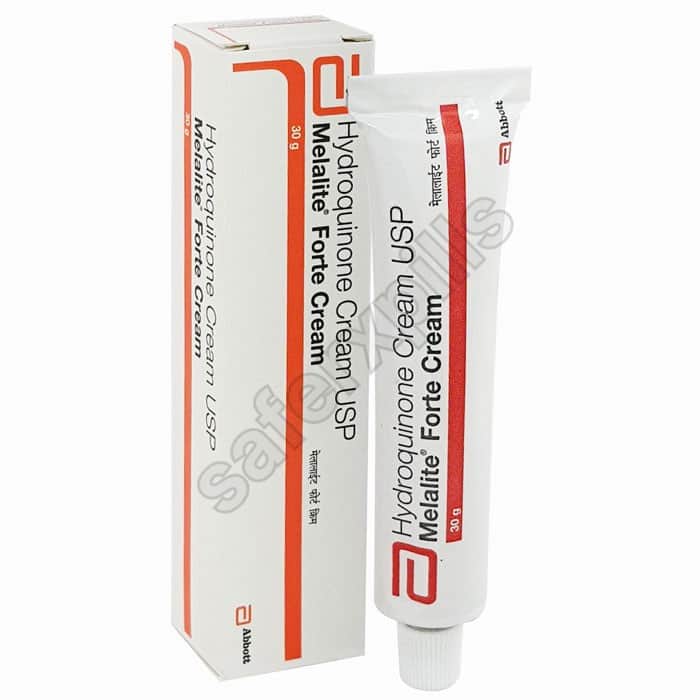
About Melacare Cream
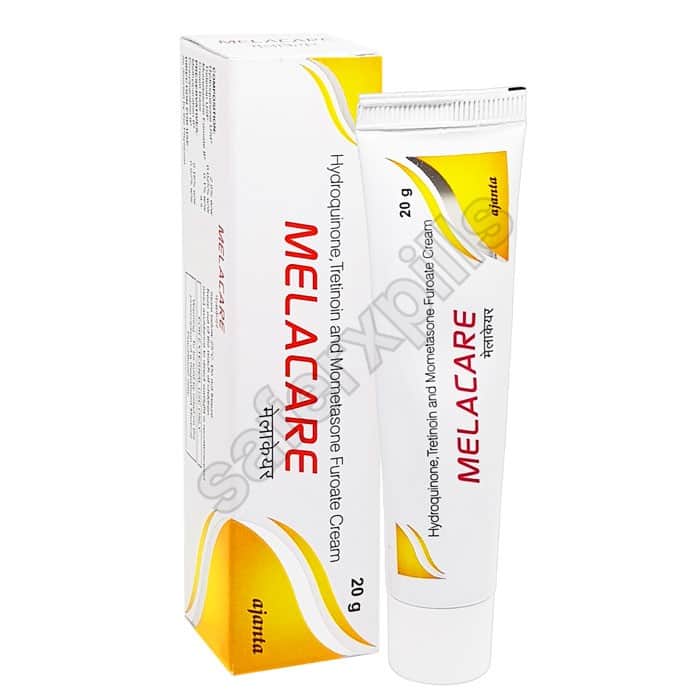
Melacare Cream is Ajanta Pharma's triple combination cream for melasma, the patchy brown pigmentation that appears on the cheeks, forehead and upper lip. One gram holds 20 mg of hydroquinone (2% w/w), 0.25 mg of tretinoin (0.025% w/w) and 1 mg of the corticosteroid mometasone furoate (0.1% w/w). Our tubes are 20 g, and you can buy 1, 3, 6 or 12 tubes; the lowest price is $8.42 a tube in the 12 pack, before shipping.
We sell Melacare, but we want buyers to know where it stands before they order. No regulator in the US, UK, Australia or Canada has approved a cream with these three ingredients. The steroid in it, mometasone, is a medium potency steroid whose own US label says to avoid using it on the face. And in 2017 a consensus of the Indian Pigmentary Expert Group stated that "Mometasone or fluticasone containing creams should be totally discouraged" for melasma. If you use Melacare at all, it should be for one short course that a doctor has agreed, not as a regular face cream.
Melacare Cream at a glance
| What is in it | Hydroquinone 2% w/w (blocks melanin production), tretinoin 0.025% w/w (a retinoid) and mometasone furoate 0.1% w/w (a corticosteroid); methylparaben and propylparaben as preservatives (Tata 1mg listing) |
| Brand and maker | Melacare, Ajanta Pharma Ltd. PharmEasy gives Ajanta's Baddi, Himachal Pradesh address; Apollo Pharmacy and Tata 1mg give Ajanta House, Mumbai. |
| Approved use (India) | India's approval wording: short term, intermittent treatment of moderate to severe melasma of the face, with sun avoidance and sunscreen |
| Regulatory status | Not approved by the FDA, MHRA, TGA or Health Canada. Approved as a combination in India (2008); Tata 1mg and Apollo Pharmacy list it as a prescription medicine. |
| How it is used | A thin layer once a day at night, on the melasma patches only (Tata 1mg and Apollo Pharmacy listings) |
| Longest course without review | 6 to 8 weeks: Tata 1mg and Apollo Pharmacy say not to use it longer than that without your doctor's advice |
| Storage | Below 25 °C (Tata 1mg, Apollo Pharmacy); dry place, do not freeze (PharmEasy) |
| Packs | 1, 3, 6 or 12 tubes of 20 g |
| Price per tube | $10.00 (1 tube) to $8.42 (12 pack), before shipping |
| Delivery | 7 to 14 business days to the US, UK, Australia and Canada; $25 shipping under $149, free from $149 |
Price per tube
Prices are as of October 2026; the pack selector shows the current price.
| Pack | Price | Per 20 g tube | Shipping | Per tube with shipping |
|---|---|---|---|---|
| 1 tube | $10.00 | $10.00 | $25 | $35.00 |
| 3 tubes | $28.00 | $9.33 | $25 | $17.67 |
| 6 tubes | $51.00 | $8.50 | $25 | $12.67 |
| 12 tubes | $101.00 | $8.42 | $25 | $10.50 |
No Melacare pack reaches the $149 free shipping threshold, so the $25 shipping applies to every order of Melacare alone, and it is a large share of the cost of a single tube. Before shipping the cream costs $0.42 to $0.50 a gram; with shipping it is $1.75 a gram for one tube and about 53 cents a gram in the 12 pack.
Think about how much you will use before choosing a pack. Neither the Indian listings nor the Tri-Luma label give an amount in grams; they say a thin layer on the patches. Our own rough estimate is 0.25 to 0.5 g a night for patches on both cheeks. Over a 6 to 8 week course that comes to about 10 to 28 g, so one 20 g tube covers a course for small patches and two tubes cover larger ones. The 12 pack holds 240 g, many times what one course uses, and every tube has an expiry date. For a single supervised course, the 1 or 3 tube pack is the sensible choice, even though it costs more per tube. Spare tubes are not a reason to carry on past the course your doctor sets.
Melacare compared with Tri-Luma and licensed options
The only approved triple cream we know of in our four delivery countries is Tri-Luma in the US. It is not the same formula as Melacare.
| Melacare (Ajanta, India) | Tri-Luma (Galderma, US) | |
|---|---|---|
| Hydroquinone | 2% (20 mg per g) | 4% (40 mg per g) |
| Tretinoin | 0.025% (0.25 mg per g) | 0.05% (0.5 mg per g) |
| Steroid | Mometasone furoate 0.1%, medium potency | Fluocinolone acetonide 0.01% |
| Regulator approval | India only (2008) | FDA, 2002 |
| Trials of the product itself | None found | Two 8 week controlled trials, 641 adults |
| Tube and storage | 20 g; below 25 °C (Indian listings) | 30 g; refrigerator, 2 to 8 °C |
| Cost per gram | $0.42 to $0.50 before shipping; $0.53 to $1.75 with shipping | $7.83 US pharmacy acquisition cost (NADAC, effective 21 October 2026), about $234.88 for the 30 g tube (our arithmetic) |
NADAC is the average price US pharmacies pay for a medicine, not what you would pay at the counter. Tri-Luma costs far more per gram, but it has trial data and an FDA label behind it, and Melacare does not. If you live where a licensed option exists, start there:
- US: Tri-Luma, on prescription. Check your insurance and pharmacy cash prices before you order from abroad.
- Canada: Health Canada's Drug Product Database lists one marketed hydroquinone product, a 4% prescription product (checked 21 October 2026).
- Australia: hydroquinone at 2% or less for the skin is a Schedule 2 pharmacy medicine, so a pharmacist can advise on a hydroquinone product without a steroid.
- UK: we found no licensed hydroquinone medicine on the emc database, so ask a dermatologist what they can prescribe.
Melacare or Melacare Forte
Ajanta sells two strengths under the Melacare name. The only difference is the hydroquinone.
| Product | Hydroquinone | Tretinoin | Mometasone | Our view |
|---|---|---|---|---|
| Melacare Cream (this page) | 2% | 0.025% | 0.1% | Matches the combination India approved in 2008 |
| Melacare Forte Cream | 4% | 0.025% | 0.1% | Same steroid, twice the hydroquinone. We did not find this strength in the lists of approved fixed dose combinations published by India's drug regulator that we checked, so we would not suggest it over the standard cream. |
The Forte composition comes from the PharmEasy, Apollo Pharmacy and Tata 1mg listings, which all give hydroquinone 4% w/w. A stronger hydroquinone does not make the steroid any safer. Whichever cream a doctor chooses, the course rules below apply.
Skinlite (Zydus), Skinshine (Cadila Pharmaceuticals) and Eukroma Plus contain the same three ingredients at the same strengths as Melacare, according to Indian listings; Skinshine and Eukroma Plus come in 15 g tubes. Switching between these brands does not reset the course length.
How to use Melacare Cream
These steps come from the Indian listings and from the US label for Tri-Luma, the closest approved product. Melacare has no regulator-approved label of its own in our delivery countries.
Before the first night
- See a doctor to confirm the patches are melasma. The Tri-Luma label says the triple cream has not been studied for dark patches other than melasma of the face, and Tata 1mg's FAQ says Melacare is indicated only for melasma of the face. Do not use it on dark circles under the eyes, acne marks or scars, even though one Tata 1mg tip mentions them.
- Agree a stop date with your doctor. Write it down.
- If you use hormonal birth control, ask about other methods. The Tri-Luma label advises changing to non-hormonal birth control because hormonal methods can make melasma worse.
Each night
- Wash your face with a mild cleanser, rinse and pat dry. The Tri-Luma label says to apply at least 30 minutes before bedtime.
- Put a thin layer on the patches and rub it in gently. The Tri-Luma label covers about half an inch of normal skin around each patch; do not spread it over the whole face.
- Keep it away from the eyes, nostrils, corners of the mouth and any cuts. If it gets into your eyes, rinse with clean water (PharmEasy).
- Do not cover the treated skin with a dressing or plastic film (PharmEasy and Tri-Luma labels). Wash your hands afterwards.
Every day
- Use a sunscreen of SPF 30 or more and a hat, and keep out of strong sun, sunlamps and tanning beds. The Tri-Luma label calls sunscreen "an essential aspect of melasma therapy, as even minimal sunlight sustains melanocytic activity". In one Indian clinic, the dermatologists found only two patients who had used a sunscreen with their triple cream (Godse and Zawar 2012).
- A moisturiser in the morning helps with dryness, and make-up is allowed (Tri-Luma label).
- Check other skin products with your doctor. Apollo Pharmacy says Melacare is not recommended with benzoyl peroxide or other peroxides (they may stain the skin), and that other steroid creams, other retinoids, peeling agents such as salicylic acid, glycolic acid and resorcinol, and other skin lighteners may add to side effects or irritation. The Tri-Luma label says to avoid medicated or abrasive soaps, drying cosmetics, and products high in alcohol or astringents. The US mometasone label says not to use other corticosteroid products with it without first consulting a doctor.
How long you can use it
This is the most important part of the page. The Indian listings set the limit: Tata 1mg says "Do not use it for longer than 6-8 weeks without consulting your doctor" and "Treatment should not be continued longer than advised, even if improvement is slow"; Apollo Pharmacy's FAQ says to avoid using it for more than 6 to 8 weeks without a doctor's advice; PharmEasy says not to use it more than your doctor advises, because prolonged use can thin the skin. Indian dermatologists Godse and Zawar wrote in 2012 that the advice to stop the combination after about 4 to 8 weeks "is followed rarely at all by the patients".
For comparison, Tri-Luma's US label says it is "NOT indicated for the maintenance treatment of melasma", that therapy "should be discontinued when control is achieved", and that melasma "usually recurs" when the cream is stopped. That is why the stop date matters more than the start date: the patches are likely to come back, and the answer is sun protection and a different maintenance plan from your doctor, not another long run of a steroid cream.
The Indian expert consensus (Sarkar 2017) says that even the approved fluocinolone triple cream, used daily for more than 6 months, "is invariably associated with AEs such as atrophy and telangiectasia" (thin skin and visible small blood vessels), although the rate was low in the studies it reviewed. For mometasone based creams it says they lighten pigment within 3 weeks "but the relapse is also very fast". If you have been using Melacare or a similar cream for months, do not keep going, and do not stop suddenly without advice either: Indian dermatologists describe redness for about 2 weeks followed by peeling when a long-used steroid cream is stopped (Lahiri 2016). A dermatologist can plan how to come off it.
What the evidence shows
We found no controlled trial of Melacare itself. Two kinds of evidence are relevant.
Trials of the approved triple cream. In the Tri-Luma trials, adults used the cream nightly for 8 weeks with SPF 30 sunscreen. The label's breakdown by starting severity shows that most people improved but did not clear:
| Melasma at the start | People | Cleared at day 56 | Mild | Moderate | Severe | No assessment |
|---|---|---|---|---|---|---|
| Moderate | 124 | 36 (29%) | 63 (51%) | 18 (15%) | 0 | 7 (6%) |
| Severe | 37 | 6 (16%) | 19 (51%) | 9 (24%) | 2 (5%) | 1 (3%) |
Tri-Luma prescribing information, section 14, Table 3 (both trials combined; people who cleared before day 56 are not counted as cleared). These are results for Tri-Luma's formula, not Melacare's.
Reports from Indian clinics on mometasone triple creams. Godse and Zawar (2012, PMID 22837578) looked at 50 people who came to a dermatologist with melasma. The letter describes the Indian combination as hydroquinone 2%, tretinoin 0.025% and mometasone 0.1%, the same strengths as Melacare. Most of the patients who had used mometasone triple creams saw the melasma clear and then come back; 15 of 23 patients had red skin after using triple creams, and on examination 8 of 23 had visible small blood vessels and 4 of 23 had thinning of the skin. The authors noted that most patients had been advised the products they used before seeing a doctor by friends, parents or beauticians, and suggested that mometasone triple creams "should be prescribed after thorough counseling with the patient". In an earlier study of 60 people with melasma who had used a mometasone triple cream for at least 3 weeks, Majid (2010, PMID 21430890) found steroid side effects on examination in 26 (43.3%).
How people get these creams is part of the problem. In a study of 410 people at an Indian hospital who had used steroid creams on the face for at least four weeks, 124 (30.2%) had used creams that combine a steroid, hydroquinone and tretinoin, and only 10.2% had been told to use a steroid cream by a dermatologist.

Side effects
The Indian listings name these side effects for Melacare: peeling, redness, dryness, burning, itching, stinging and acne (Apollo Pharmacy); itching, redness, burning, irritation, thinning of the skin and skin sensitivity (PharmEasy); and dryness, redness and stinging (Tata 1mg). None of them gives frequencies. The nearest figures come from Tri-Luma's 8 week trials, where 102 of 161 people (63%) had at least one side effect the investigators linked to the cream, mostly mild to moderate:
| Side effect | People (of 161) | Share |
|---|---|---|
| Redness (erythema) | 66 | 41% |
| Peeling (desquamation) | 61 | 38% |
| Burning | 29 | 18% |
| Dryness | 23 | 14% |
| Itching (pruritus) | 18 | 11% |
| Acne | 8 | 5% |
| Visible small blood vessels (telangiectasia) | 5 | 3% |
Selected rows from Tri-Luma prescribing information, section 6, Table 1, which lists 17 events reported in at least 1% of people. Tri-Luma's formula is not Melacare's.
Some effects belong to one ingredient. Hydroquinone can cause exogenous ochronosis, a gradual blue-black darkening of the skin (Tri-Luma label, 5.2). Steroid creams can thin the skin and cause stretch marks, acne-like spots, perioral dermatitis, lighter patches and skin infections (Tri-Luma and mometasone labels). Small amounts pass into the body: the mometasone label says about 0.4% of a dose enters the circulation after 8 hours on normal skin, and inflamed skin may absorb more. Too much absorbed steroid can suppress the adrenal glands and cause features of Cushing's syndrome and raised blood sugar (both labels; PharmEasy also warns of Cushing's syndrome with prolonged use), and the mometasone label says steroid creams may raise the risk of cataracts and glaucoma.
The Tri-Luma label also records animal findings that are a reason to keep courses short and the skin out of the sun: hydroquinone has shown some evidence of cancer in animal studies, and its cancer potential in humans is unknown; studies in mice suggest tretinoin may increase the tumour-causing potential of strong ultraviolet light. The label says that, although the significance for humans is not clear, patients should minimise exposure to sunlight and artificial ultraviolet light.
When to stop and get help
- Allergic reaction: swelling of the face, eyes, lips, tongue or throat, trouble breathing, severe itching, a rash or hives. The Tri-Luma patient leaflet says to stop using the cream and call your doctor to get medical help right away. If breathing is difficult, call emergency services (our advice).
- Blue-black or bluish-black darkening of the skin: stop using it and tell your doctor (Tri-Luma patient leaflet; Apollo Pharmacy also says to stop and consult a doctor).
- Severe burning, swelling, blistering or crusting of the skin, or irritation of the eyes, nose or mouth: stop and call your doctor (Tri-Luma patient leaflet; Apollo Pharmacy names severe burning and swelling).
- Blurred vision or other changes in sight: tell your doctor (US mometasone label).
- Signs of steroid damage (thin or shiny skin, new red streaks or small blood vessels, persistent redness, acne-like bumps, or redness that flares whenever you stop): see a dermatologist before using any more. This advice is ours, based on the studies above.
Who should not use Melacare Cream
Do not use it if:
- You are allergic to hydroquinone, tretinoin, mometasone or any other ingredient. This is the contraindication in the Tri-Luma and mometasone labels, and PharmEasy lists it too.
- You are pregnant or planning a pregnancy. In the UK and EU, topical retinoids are contraindicated in pregnancy and in women planning a pregnancy (European Medicines Agency, 2018). The Tri-Luma patient leaflet says the cream "may cause birth defects or death of the baby if used during pregnancy"; the US label itself says use in pregnancy only if the potential benefit justifies the potential risk to the fetus, and records that 13 women became pregnant during its trials, even though participants had to use effective birth control. Tata 1mg calls Melacare "highly unsafe during pregnancy". The listings differ here: PharmEasy says use only if a doctor recommends it, and Apollo Pharmacy says it should generally not be used in pregnancy unless your doctor specifically advises it.
- The skin to be treated has eczema, rosacea, perioral dermatitis, a viral or fungal infection, an ulcer, a cut or other damage, or you have tuberculosis, a skin tumour or a family history of skin tumours, or prolonged sun exposure you cannot avoid. PharmEasy lists all of these as reasons not to use Melacare.
- You want to lighten normal skin. Melacare is approved in India only for melasma of the face.
It is not recommended for: children under 12 (Apollo Pharmacy; Tata 1mg says safety has not been established below 12). Tri-Luma's safety in children has not been established, and the US mometasone label does not recommend that cream under 2 years and says safety for longer than 3 weeks in children has not been established.
Talk to a doctor first if: you are breastfeeding (the listings disagree: PharmEasy says it is not recommended, Tata 1mg says it may be safe, and the Tri-Luma label advises caution and avoiding contact between the baby and treated skin); you have dark brown or black skin (the Tri-Luma label says skin types V and VI were not studied and excessive bleaching cannot be excluded); you work outdoors (the Tri-Luma label asks people consistently exposed to sunlight to take particular caution); or you use any other steroid medicine.
Prescription and legal status
- US: In 2022 the FDA said Tri-Luma was "the only FDA-approved drug containing hydroquinone", and Drugs@FDA still lists no other (checked 22 October 2026). The same 2022 FDA page says that since the CARES Act there are no FDA-approved or otherwise legally marketed over-the-counter skin lightening products. In the US both tretinoin and mometasone creams need a prescription. The FDA says personal importation of unapproved medicines is illegal in most circumstances.
- UK: Hydroquinone is banned from cosmetic skin creams under the cosmetics rules the UK kept from EU law, and we found no hydroquinone medicine on the emc database (emc is not the full MHRA register). Tretinoin creams are prescription only medicines (POM) there.
- Australia: In the Poisons Standard of October 2026 (in force from 1 October 2026), tretinoin is Schedule 4 (prescription only). Hydroquinone for the skin is Schedule 2 at 2% or less and Schedule 4 above that. Mometasone for the skin is Schedule 3 only when it is the sole active ingredient at 0.1% or less in a pack of 15 g or less; otherwise it is Schedule 4. We found no Australian product combining all three, but we could not search the TGA's register directly.
- Canada: Hydroquinone above 2% for the skin has been prescription only since 30 June 2019, and tretinoin creams are prescription only. We found no product in Health Canada's database that combines hydroquinone, tretinoin and a steroid.
- India: The drug regulator approved hydroquinone 2% + tretinoin 0.025% + mometasone 0.10% on 31 January 2008 "for short term intermittent treatment of moderate to severe melasma of the face in the presence of measures for sun avoidance including use of sun screen" (the approval list calls it a gel). Tata 1mg marks Melacare "Prescription required". In 2018 India added 14 topical steroids to Schedule H, which requires a prescription; mometasone was not one of them, and we could not confirm its own schedule. We found no ban on this combination.
Check the rules in your country and get a doctor's advice before starting. Our guides to tretinoin rules in the UK and getting a tretinoin prescription in Australia cover the local routes.
Buying genuine Melacare Cream
Melacare is not authorised for sale in the UK, so the MHRA's warning applies to it: "Any medicine not authorised for sale in the UK can be unsafe or ineffective and there is no way of knowing what is in them or the negative health effects they can have." The MHRA tells UK buyers: "Only use UK-registered pharmacies, including online pharmacies displaying the official green cross logo".
When your parcel arrives, look for the Ajanta name and the Melacare brand on the carton and tube, the composition panel listing hydroquinone, tretinoin and mometasone furoate with their strengths, a 20 g net content, a batch number, an expiry date and a sealed tube. These checks cannot prove a tube is genuine, because packaging can be copied. Apollo Pharmacy says not to use the cream if it has turned dark brown or its consistency has changed a lot; hydroquinone darkens on exposure to air (Tri-Luma label). Our parcels are not temperature controlled, so put the tubes somewhere below 25 °C as soon as they arrive and keep the cap closed. If a tube causes unexpected symptoms, stop using it, get medical advice, and report it to the MHRA Yellow Card scheme, FDA MedWatch, the TGA or Health Canada, as well as to us.
Delivery
We send Melacare Cream to the US, UK, Australia and Canada in plain packaging with tracking. Standard delivery takes 7 to 14 business days to most addresses. Shipping is a flat $25 on orders under $149 and free from $149. Read our shipping page and refund policy before you order.
Other options for melasma
The Indian expert group recommends triple creams with low potency steroids rather than mometasone, and describes azelaic acid as a good option for people who cannot tolerate a triple cream. Products we sell along those lines:
- A Ret HC 15g: hydroquinone and tretinoin with hydrocortisone, a low potency steroid, in place of mometasone (our listing).
- Ezanic 20g Cream: azelaic acid, with no hydroquinone or steroid (our listing).
- Melalite Forte Cream: hydroquinone 4% alone, with no steroid or retinoid (our listing).
- A Ret Gel 0.025%: tretinoin 0.025% alone.
Creams with the same formula as Melacare carry the same cautions: Skinlite Cream, Skinshine Cream and Eukroma Plus Cream. Ask a dermatologist which approach suits your skin.
Related guides
Sources
- Indian listings for Melacare Cream (composition, preservatives, maker and address, tube sizes, prescription status, storage, directions, course length, warnings, side effects): Tata 1mg (15 g page), Apollo Pharmacy (20 g page) and PharmEasy (20 g page), checked 22 October 2026. Melacare Forte composition: PharmEasy (20 g), Apollo Pharmacy (20 g) and Tata 1mg (15 g), checked 22 October 2026.
- TRI-LUMA (fluocinolone acetonide, hydroquinone and tretinoin) cream 0.01%/4%/0.05%, US prescribing information and patient information, sections 1, 2, 3, 4, 5, 6, 8, 11, 13, 14, 16 and 17. Galderma, DailyMed setid a35fa709-5eb5-4429-b38f-f1e0019bf0ee, version 18, October 2024 (current on 22 October 2026).
- Mometasone furoate cream USP 0.1%, US prescribing information and patient information, sections 2, 4, 5, 6, 8, 12 and 17 (Taro, DailyMed setid ce61920d-65df-4423-925d-091e624ea32e, version 6, July 2025).
- Central Drugs Standard Control Organisation (India). Fixed dose combinations approved by DCG(I) since 1961, entry 800 (31.01.08), and the later FDC approval lists we hold, up to March 2025 with some gaps (no hydroquinone 4% + tretinoin + mometasone entry found).
- Ministry of Health and Family Welfare (India). Drugs and Cosmetics (Second Amendment) Rules, 2018: 14 topical steroids added to Schedule H.
- Sarkar R, et al. Medical management of melasma: a review with consensus recommendations by Indian Pigmentary Expert Group. Indian J Dermatol 2017. PMID 29263529.
- Godse KV, Zawar V. Mometasone menace in melasma. Indian J Dermatol 2012;57(4):324 to 326. PMID 22837578.
- Majid I. Mometasone-based triple combination therapy in melasma: is it really safe? Indian J Dermatol 2010. PMID 21430890.
- Lahiri K, Coondoo A. Topical steroid damaged/dependent face (TSDF): an entity of cutaneous pharmacodependence. Indian J Dermatol 2016. PMID 27293246.
- Jha AK, et al. Misuse of topical corticosteroids on the face: a cross-sectional study among dermatology outpatients. Indian Dermatol Online J 2016. PMID 27559498.
- US Food and Drug Administration. FDA works to protect consumers from potentially harmful OTC skin lightening products, 19 April 2022. FDA. Drugs@FDA (openFDA), hydroquinone, checked 22 October 2026.
- Therapeutic Goods (Poisons Standard, October 2026) Instrument 2026 (F2026L01327, from 1 October 2026), entries for hydroquinone, mometasone and tretinoin. legislation.gov.au.
- Health Canada. Prescription Drug List notice: hydroquinone, effective 30 June 2019; Drug Product Database, hydroquinone products, checked 21 October 2026.
- Cosmetic, Toiletry and Perfumery Association. Hydroquinone in eyelash extension adhesives, 2017 (hydroquinone banned from cosmetic skin creams). emc (medicines.org.uk) search for hydroquinone, 21 October 2026.
- European Medicines Agency. Retinoid-containing medicinal products, Article 31 referral, European Commission decision 21 June 2018. EMA
- Centers for Medicare and Medicaid Services. National Average Drug Acquisition Cost (NADAC), Tri-Luma cream NDC 00299595030, effective 21 October 2026. data.medicaid.gov
- MHRA. 20 million illegal erectile dysfunction pills seized as MHRA warns against risky online buys, 13 February 2026. GOV.UK.
- US Food and Drug Administration. Personal Importation. FDA
This page is for information and is not medical advice. Melacare Cream contains a steroid and tretinoin and is listed as a prescription medicine in India; see a doctor before using it.
Frequently asked questions
What is Melacare Cream?
Melacare Cream is a melasma cream made in India by Ajanta Pharma. Each gram contains hydroquinone 2%, tretinoin 0.025% and the corticosteroid mometasone furoate 0.1% w/w. India approved this combination in 2008 for short term, intermittent treatment of moderate to severe melasma of the face, together with sun avoidance and sunscreen. It is not a cream for lightening normal skin.
How is Melacare different from Tri-Luma?
Tri-Luma, the FDA approved triple cream, has twice as much hydroquinone (4%) and tretinoin (0.05%) and a different steroid, fluocinolone acetonide 0.01%. Melacare uses mometasone, a medium potency steroid whose US label says to avoid use on the face. Tri-Luma has two 8 week trials in its label; we found no controlled trial of Melacare. Melacare is not approved by the FDA, MHRA, TGA or Health Canada.
How much does Melacare Cream cost?
As of October 2026, a 20 g tube costs $10.00 on its own, $9.33 in the 3 pack, $8.50 in the 6 pack and $8.42 in the 12 pack, before shipping. No Melacare pack reaches $149, so shipping is $25, which makes it $35.00, $17.67, $12.67 and $10.50 a tube. The pack selector shows the current price.
How do I apply Melacare Cream?
Once a day at night, rub a thin layer into the melasma patches only (Tata 1mg and Apollo Pharmacy). The Tri-Luma label adds washing the face with a mild cleanser first, applying it at least 30 minutes before bed and covering about half an inch of normal skin around each patch. Keep it away from the eyes, nostrils and mouth, do not cover the skin, and use SPF 30 or higher sunscreen every day.
Should I choose Melacare or Melacare Forte?
Melacare Forte has hydroquinone 4% instead of 2%, with the same tretinoin and mometasone, according to PharmEasy, Apollo Pharmacy and Tata 1mg. Melacare's strengths match the combination India approved in 2008; we did not find the Forte strength in the regulator's published approval lists we checked, so we would not suggest it over the standard cream. Both carry the same steroid cautions.
How long can I use Melacare Cream?
Tata 1mg and Apollo Pharmacy say not to use it for longer than 6 to 8 weeks without your doctor's advice. Tri-Luma's label says Tri-Luma is not for maintenance treatment and should be stopped when control is achieved. Melasma usually returns after stopping, so continue sun protection. If you have used it for months, our advice is to see a dermatologist rather than carrying on or stopping suddenly.
How many tubes do I need?
The labels give no amount in grams. Our rough estimate is 0.25 to 0.5 g a night, or about 10 to 28 g for a 6 to 8 week course, which is one or two 20 g tubes. For one supervised course, the 1 or 3 tube pack makes the most sense. Larger packs cost less per tube, but they are not a reason to use the cream for longer.
What are the side effects of Melacare Cream?
Indian listings name peeling, redness, dryness, burning, itching, stinging and acne. In the Tri-Luma trials, redness affected 41%, peeling 38% and burning 18%. The steroid labels and Indian studies say longer steroid use can thin the skin and cause visible small blood vessels, acne-like spots and stretch marks. Stop and see a doctor if the skin turns blue-black, or if you get severe burning, swelling or blistering.
Who should not use Melacare Cream?
Do not use it if you are allergic to any ingredient, pregnant or planning a pregnancy (topical retinoids are contraindicated in pregnancy in the UK and EU), or on normal skin, broken skin, eczema, rosacea, perioral dermatitis or a viral or fungal skin infection. Apollo Pharmacy says it is not recommended for children under 12. Talk to a doctor first if you are breastfeeding or have dark brown or black skin.
Do I need a prescription for Melacare Cream?
Tata 1mg marks it prescription required in India. No cream combining these three ingredients is approved in the US, UK, Australia or Canada, and tretinoin creams are prescription only in all four. The FDA says personal importation of unapproved medicines is illegal in most circumstances. Get a doctor's advice first and check the rules in your country.
How long does delivery take?
We ship Melacare to the US, UK, Australia and Canada in plain packaging with tracking, and standard delivery takes 7 to 14 business days to most addresses. Shipping is $25 on orders under $149 and free from $149. Parcels are not temperature controlled, so store the tubes below 25 °C with the cap closed once they arrive.
Medical References
- 1.DailyMed (U.S. National Library of Medicine)
- 2.PubMed (NCBI) (PMID: 32653074) — 2020
- 3.PubMed (NCBI) (PMID: 39549290) — 2024
- 4.PubMed (NCBI) (PMID: 29677015) — 2018
- 5.PubMed (NCBI) (PMID: 39233460) — 2024
- 6.PubMed (NCBI) (PMID: 34356362) — 2021
- 7.PubMed (NCBI) (PMID: 18046911) — 2006
- 8.PubMed (NCBI) (PMID: 40707570) — 2025
- 9.DailyMed (U.S. National Library of Medicine)
- 10.PubMed (NCBI) (PMID: 31802394) — 2020
- 11.PubMed (NCBI) (PMID: 40534872) — 2025
- 12.PubMed (NCBI) (PMID: 38850450) — 2024
- 13.PubMed (NCBI) (PMID: 30674002) — 2019
Sources: U.S. National Library of Medicine (DailyMed, PubMed), openFDA
Related articles
Hydroquinone Cream Guide: Complete Safety, Usage & Results Guide
This comprehensive hydroquinone cream guide provides everything you need to know about this powerful skin-lightening treatment. Learn about proper usage, expected results, potential side effects, and safety precautions for treating hyperpigmentation, melasma, age spots, and other skin discoloration conditions effectively and safely.
Read article
Tretinoin Gel vs Cream: What the Base Changes, From the Labels, Trials and Pharmacy Prices
Tretinoin gel and cream carry the same drug in different bases. This guide compares the label ingredients and strengths of Retin-A gel and cream, microsphere and water-based gels, what irritation trials found, which form suits which skin, and why a tube of gel costs US pharmacies about four times the same-strength cream.
Read article
Epiduo vs Epiduo Forte: How Adapalene and Benzoyl Peroxide Gel Works, Results Timeline, Side Effects and Cost
Epiduo combines adapalene with benzoyl peroxide 2.5% in one once-daily acne gel, in 0.1% and 0.3% (Forte) strengths. This guide covers how the two strengths differ in the trials, how to apply the gel, what to expect week by week, the irritation rates from the US labels, bleaching of fabric and hair, the exact pregnancy wording, the over-the-counter Differin Epiduo, and what US pharmacies pay for brand and generic versions.
Read articleCustomer Reviews
No reviews yet. Bought Melacare Cream? Tell other buyers how it went.