
Renolog Tablet
Generic: Alpha Ketoanalogueby La Renon Healthcare
Select pack size
Similar medicines
View all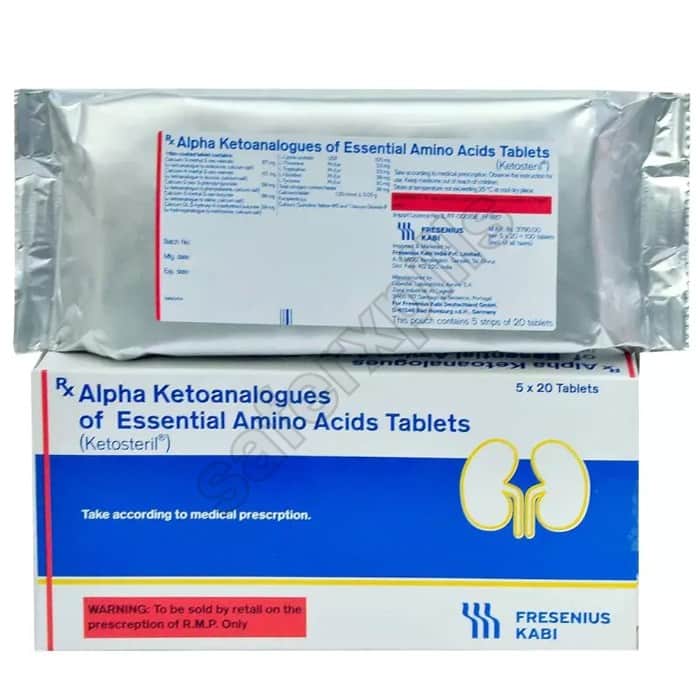
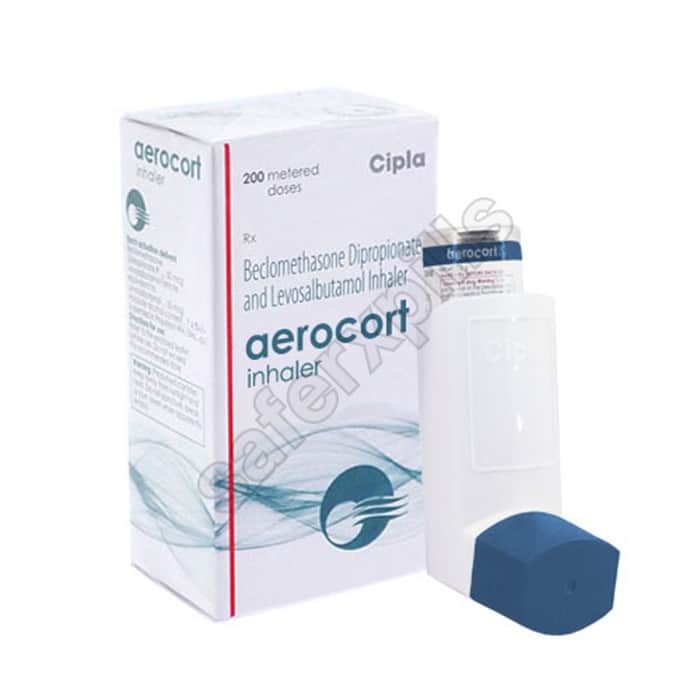
About Renolog Tablet
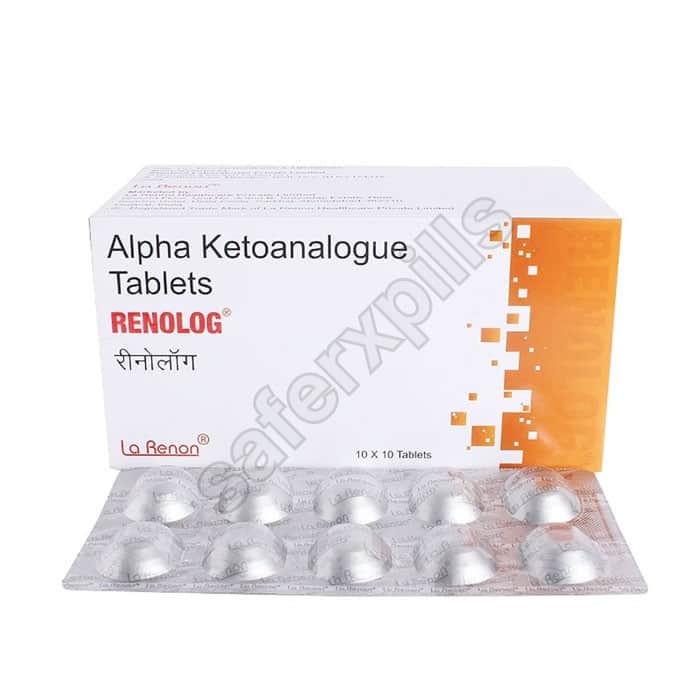
Renolog is a ketoanalogue tablet from La Renon Healthcare, an Ahmedabad company, made for the Indian market. Each tablet combines the calcium salts of four keto analogues and one hydroxy analogue of essential amino acids with five amino acids, and the amounts printed on the Indian listings match Ketosteril, the original Fresenius Kabi product, milligram for milligram. Doctors use these tablets for chronic kidney disease before dialysis, always together with a strict low protein diet. We sell Renolog in packs of 30, 60 and 90 tablets, from $1.17 a tablet in the 90 pack before shipping.
Before you read further, three things you should know. First, Renolog is not a supplement for self-treatment: the kidney guidelines that support ketoanalogues only do so as part of a very low protein diet run by a kidney specialist and a renal dietitian, with blood tests that include calcium. Second, the dose in the Ketosteril labels is 4 to 8 tablets three times a day for a 70 kg adult, so even our largest pack lasts only 4 to 7.5 days, and our 30 pack 1 to 2.5 days (our arithmetic). Third, no ketoanalogue medicine is approved in the US or listed in Canada, and we found no UK or Australian licence, so there is no local generic to compare with. La Renon does not publish a prescribing leaflet we could find, so the dose and warnings below come from the European Ketosteril labels for the same listed composition, which is our reading, and we say where Indian listings for Renolog add to them.
Renolog at a glance
| Active ingredients | Per tablet, as listed by PharmEasy and Truemeds: calcium 3-methyl-2-oxovalerate 67 mg, calcium 4-methyl-2-oxovalerate 101 mg, calcium 2-oxo-3-phenylpropionate 68 mg, calcium 3-methyl-2-oxobutyrate 86 mg, calcium DL-2-hydroxy-4-methylthiobutyrate 59 mg, L-lysine 105 mg, L-threonine 53 mg, L-tryptophan 23 mg, L-histidine 38 mg and L-tyrosine 30 mg |
| Brand and maker | Renolog, La Renon Healthcare Pvt Ltd, Ahmedabad (Tata 1mg, Apollo, PharmEasy, Truemeds). PharmEasy gives the manufacturing site as Stanford Laboratories Pvt Ltd, Mehatpur, Una, Himachal Pradesh |
| Regulatory status | No ketoanalogue product in the FDA databases and no Renolog or Ketosteril in the Health Canada Drug Product Database (checked 11 November 2026). We found no MHRA or TGA licence. This Indian pack is not approved by the FDA, MHRA, TGA or Health Canada |
| Usual dose (Ketosteril labels) | 4 to 8 tablets three times a day during meals for a 70 kg adult, swallowed whole: 12 to 24 tablets a day (German and Dutch Ketosteril labels 4.2) |
| Timing | No half-life in the labels. In healthy people blood keto acid levels rise within 10 minutes and are back to baseline within 90 minutes (Ketosteril 5.2), which is why the dose is split over three meals (our reading) |
| Packs | 30, 60 and 90 tablets. Indian strips hold 10 tablets (Tata 1mg, Apollo, PharmEasy, Truemeds) or 15 (PharmEasy, Medibuddy) |
| Price per tablet | $1.40 (30), $1.32 (60) and $1.17 (90) before shipping |
| Delivery | 7 to 14 business days; $25 shipping under $149, free from $149 |
Our listing shows the strength as "400 mg", and one Apollo page address says "200mg". Neither figure appears in any composition we found. The ten listed amounts add up to 630 mg of ingredients per tablet (our arithmetic), the same total as Ketosteril. Go by the composition on the strip, not a single strength figure.
Renolog and Ketosteril, ingredient by ingredient
Most people searching for Renolog want to know whether it is the same as Ketosteril. On paper the amounts match. The table puts the Renolog figures from two Indian listings next to section 2 of the German Ketosteril label.
| Ingredient (what it becomes in the body) | Renolog per tablet (PharmEasy, Truemeds) | Ketosteril per tablet (German label 2) |
|---|---|---|
| Keto analogue of isoleucine, calcium salt | 67 mg | 67 mg |
| Keto analogue of leucine, calcium salt | 101 mg | 101 mg |
| Keto analogue of phenylalanine, calcium salt | 68 mg | 68 mg |
| Keto analogue of valine, calcium salt | 86 mg | 86 mg |
| Hydroxy analogue of methionine, calcium salt | 59 mg | 59 mg |
| Lysine | "L-Lysine" 105 mg | Lysine acetate 105 mg, equal to 75 mg lysine |
| Threonine | 53 mg | 53 mg |
| Tryptophan | 23 mg | 23 mg |
| Histidine | 38 mg | 38 mg |
| Tyrosine | 30 mg | 30 mg |
| Calcium per tablet | Not stated on the listings | 1.25 mmol (50 mg) |
| Total nitrogen per tablet | Not stated on the listings | 36 mg |
Two gaps remain. The Indian listings print "L-Lysine 105 mg"; Ketosteril's 105 mg is lysine acetate, so either the listings shorten the salt name or Renolog holds more lysine, and we cannot tell which from the listings. And no listing gives the calcium content; with the same calcium salts in the same amounts, it is likely to be close to Ketosteril's 50 mg, but that is our inference, not a printed figure. Matching numbers on a listing are not proof of equal quality or absorption: we found no published study comparing Renolog with Ketosteril.
La Renon also sells Renolog DS, which Truemeds lists at exactly double each amount (for example 202 mg of the leucine analogue). We do not stock it. If your prescription says Renolog DS, one DS tablet carries the listed contents of two Renolog tablets, so check the strip and your dose with your kidney team before swapping (our arithmetic). A Bangladeshi tablet also sold as "Renolog 600 mg" (Radiant Pharmaceuticals, per MedEx) is a different company's product.
What ketoanalogue tablets are for
When kidneys fail, the nitrogen left over from eating protein builds up as urea and other waste. Cutting protein hard reduces that load but risks running short of essential amino acids. A keto analogue is an essential amino acid without its nitrogen group; once absorbed it picks up nitrogen from the body's own spare amino acids and turns into the essential amino acid it mimics, so the body gets the building block with less nitrogen to clear (Ketosteril 5.1).
The German Ketosteril label covers damage from faulty or deficient protein metabolism in chronic kidney failure in adults whose dietary protein is held at 40 g a day or less, which in general applies to patients with a glomerular filtration rate (GFR) below 25 mL/min (4.1, our translation). Fresenius Kabi's Indian page describes use up to a GFR of 15 mL/min, "stages II, III & IV of CKD". Indian listings for Renolog describe it for chronic kidney disease before dialysis. Ketoanalogue tablets are not a protein supplement for healthy people or for low-carb diets, and they do not replace dialysis or the blood pressure and kidney medicines your specialist prescribes.
Price per tablet
Prices as of November 2026; the pack selector shows the current price.
| Pack | Price | Per tablet | Shipping | Per tablet with shipping |
|---|---|---|---|---|
| 30 tablets | $42 | $1.40 | $25 | $2.23 |
| 60 tablets | $79 | $1.32 | $25 | $1.73 |
| 90 tablets | $105 | $1.17 | $25 | $1.44 |
All three packs are under the $149 free shipping line on their own. Shipping is worked out on the order total, so two 90 packs ($210) ship free and come to $1.17 a tablet (our arithmetic). The 90 pack is the cheapest per tablet before shipping too, so its lower price is not only a shipping effect.
How long a pack lasts
This is the real issue with Renolog's pack sizes. The figures below use the Ketosteril label range for a 70 kg adult and the Fresenius Kabi Hong Kong rule of 1 tablet per 5 kg of body weight a day; all of them are our arithmetic.
| Pack | 12 a day (label low end) | 14 a day (1 per 5 kg at 70 kg) | 24 a day (label high end) |
|---|---|---|---|
| 30 tablets | 2.5 days | about 2 days | about 1 day |
| 60 tablets | 5 days | about 4 days | 2.5 days |
| 90 tablets | 7.5 days | about 6 days | about 4 days |
A month at 14 tablets a day is 420 tablets: four 90 packs and two 30 packs come to $504, or five 90 packs (450 tablets) to $525, both with free shipping (our arithmetic). Delivery takes 7 to 14 business days, longer than any single pack lasts at the label dose. If your specialist has prescribed ketoanalogues, work out a month's supply from your own daily tablet count and order it in one go, well before you run out. Do not cut the dose to stretch a pack: the tablets are only meant to make up for protein you are no longer eating.
Compared with Ketosteril and with US options
| Renolog (ours) | Ketosteril (ours, Indian pack) | United States | |
|---|---|---|---|
| Maker | La Renon Healthcare; site per PharmEasy: Stanford Laboratories, Himachal Pradesh | Fresenius Kabi; PharmEasy names Labesfal, Portugal | No approved product |
| Listed composition | Same amounts as Ketosteril (lysine salt not stated) | Label composition (German and Dutch labels 2) | Not applicable |
| Regulator review we can point to | None found | Licensed in Germany and the Netherlands (European pack) | None: no FDA-approved ketoanalogue |
| Price per tablet before shipping | $1.17 to $1.40 | $1.27 to $1.65 | No NADAC row |
NADAC, the US Medicaid survey of pharmacy purchase prices, only covers FDA-approved medicines, so there is no US price to compare. Before shipping, Renolog is a little cheaper per tablet than our Ketosteril; a single Renolog pack pays $25 shipping while Ketosteril's 200 and 300 packs ship free, so order a month's supply of Renolog at once to keep its lower price (our arithmetic). The Ketosteril page covers the brand's European labels and the trial evidence in more depth. Ketosteril has a European licence behind its formula; Renolog is an Indian product with no regulator document we could find outside India. Which brand to use, and whether one may replace the other tablet for tablet, is a question for your kidney team.
How many tablets a day
There is one Renolog strength we sell, so the choice is the tablet count, and that is for your nephrologist to set. The Ketosteril labels give 4 to 8 tablets three times a day for a 70 kg adult. The Hong Kong rule of 1 tablet per 5 kg gives these totals (our arithmetic):
| Body weight | Tablets a day | Per meal (three meals) | Days from one 90 pack |
|---|---|---|---|
| 50 kg | 10 | 3 to 4 | 9 |
| 60 kg | 12 | 4 | 7.5 |
| 70 kg | 14 | 4 to 5 | about 6 |
| 80 kg | 16 | 5 to 6 | about 5.5 |
| 90 kg | 18 | 6 | 5 |
If each tablet holds about 50 mg of calcium, as Ketosteril does, 12 to 24 tablets add roughly 600 to 1,200 mg of calcium a day before any calcium-based phosphate binder or supplement (our estimate). That is the reason for regular calcium checks.
How to take Renolog
- Use it only on a kidney specialist's prescription, alongside the low or very low protein diet set by a renal dietitian (Ketosteril 4.1, 4.2).
- Take the tablets during meals, spread over the day's three meals. The German label says this allows proper absorption and conversion into the matching amino acids (4.2, our translation). The Renolog listings disagree: Apollo says "with meals", Truemeds "with or just after meals", and Tata 1mg and PharmEasy "with or without food" (both then advise a meal). Follow the label: during meals.
- Swallow each tablet whole with water; do not chew, crush or break it (Apollo, Tata 1mg). The Dutch Ketosteril label gives the reason: the bad smell of the tablet contents (4.2, our translation).
- Keep at least 2 hours between Renolog and tetracycline or quinolone antibiotics (such as ciprofloxacin or norfloxacin) and iron products; the Ketosteril labels add fluoride and estramustine (4.5). Calcium binds them and stops them being absorbed.
- Eat enough calories. The German label says adequate calorie intake must be watched (4.4); too few calories on a low protein diet means the body breaks down muscle.
- Go to every blood test. Calcium should be checked regularly (Ketosteril 4.4), and phosphate too if you take aluminium hydroxide.
- If you miss a dose, do not take a double dose to make up for it (Dutch Ketosteril leaflet). Do not stop without speaking to your doctor.
The diet comes first
Ketoanalogues are an add-on to a diet, not a stand-alone treatment. Two kidney guidelines set out when they fit:
- KDOQI 2020 (National Kidney Foundation with the Academy of Nutrition and Dietetics), for adults with CKD 3 to 5 who are metabolically stable and do not have diabetes: "we recommend, under close clinical supervision, protein restriction with or without keto acid analogs, to reduce risk for ESKD/death (1A) and improve quality of life (2C)". A very low protein diet of 0.28 to 0.43 g per kg a day is paired "with additional keto acid/amino acid analogs to meet protein requirements (0.55 to 0.60 g /kg body weight/day)". For adults with diabetes, KDOQI suggests 0.6 to 0.8 g per kg a day and does not mention keto acid analogues.
- KDIGO 2024: the core advice is 0.8 g protein per kg a day for adults with CKD G3 to G5 (2C). For adults "who are willing and able, and who are at risk of kidney failure", a very low protein diet of 0.3 to 0.4 g per kg a day with ketoacid analogs or essential amino acids, up to 0.6 g per kg a day in total, may be considered "under close supervision" (practice point 3.3.1.2). It advises against low or very low protein diets in metabolically unstable people (3.3.1.3) and against restricting protein in children (3.3.1.4).
For a 70 kg adult, 0.3 g per kg is about 21 g of protein a day (our arithmetic). KDIGO reminds readers that grams of protein are not grams of food: 100 g of meat holds only about 25 g of protein. A diet this strict needs a renal dietitian.
What the evidence says
The trials tested ketoanalogues as part of a supervised diet, mostly Ketosteril, not Renolog. A Cochrane review (Hahn 2020) found that a very low protein diet, compared with a low protein one, probably reduces the number of non-diabetic adults with CKD 4 or 5 who reach kidney failure (risk ratio 0.65; moderate certainty), with little or no effect on deaths, and said more data on harms are needed. In the Garneata 2016 trial, a vegetarian 0.3 g per kg diet with ketoanalogues at 1 tablet per 5 kg delayed dialysis compared with a 0.6 g per kg diet, but only 14% of screened patients were randomised; the trial took only well nourished patients who kept to the diet in a run-in phase. A 2024 meta-analysis (Chen, 16 trials, 1,344 people) found better kidney function markers and higher calcium with ketoanalogues added to a restricted diet, with a "marginally lower risk of ESKD in participants without diabetes". None of this tells you what the tablets do without the diet, and most of it leaves out people with diabetes. The Ketosteril page sets these studies out in more detail.
Side effects
The only side effect in the Ketosteril labels is high blood calcium (hypercalcaemia), listed as very rare (fewer than 1 in 10,000). The labels say to reduce vitamin D first and, if calcium stays high, to lower the dose of the tablets and of any other calcium source (4.8). Apollo and Truemeds list nausea, vomiting, diarrhoea and stomach pain for Renolog; those are not in the European labels, so we report them as listing text. Taking many large tablets a day is hard for some people; tell your kidney team rather than skipping doses (our advice).
When to get urgent help
Get medical help straight away, or call emergency services (911 in the US and Canada, 999 in the UK, 000 in Australia), if you have:
- Signs of high calcium: great thirst and passing much more urine, feeling or being sick, constipation, stomach pain, muscle weakness, drowsiness or confusion, or a racing or irregular heartbeat (symptoms from the NHS Kent and Medway hypercalcaemia guideline, 2025). High calcium makes the heart more sensitive to digoxin and similar medicines, with a risk of arrhythmia (Ketosteril 4.5).
- An allergic reaction: swelling of the face, lips, tongue or throat, difficulty breathing or swallowing, hives or a spreading rash.
- Kidney failure getting worse: much less urine, breathlessness, new swelling of legs or face, severe tiredness, itching or confusion (our advice).
- Taking far more than prescribed: no overdose cases are reported in the labels (4.9), but contact a doctor or pharmacist straight away (Dutch Ketosteril leaflet; Apollo). US Poison Control: 1-800-222-1222; Australia Poisons Information Centre: 13 11 26.
Who should not take Renolog
Never take it if (German Ketosteril label 4.3, our translation; repeated on PharmEasy and Apollo for Renolog): you are allergic to any ingredient, you have high blood calcium, or you have a disorder of amino acid metabolism.
Groups that need a specialist's decision:
- Phenylketonuria: the Ketosteril labels say to take into account that the product contains phenylalanine (4.4).
- Children: no experience in children (Ketosteril 4.4); KDIGO 2024 says not to restrict protein in children with CKD because of the risk to growth.
- Pregnancy and breastfeeding: no clinical data in pregnancy (German label; the Dutch label says no adequate data), animal studies do not indicate direct or indirect harmful effects, and caution is advised when prescribing in pregnancy; no experience in breastfeeding (4.6).
- Diabetes: KDOQI does not mention ketoanalogues for people with diabetes, and the main trials left them out.
- On dialysis: the labels tie use to a GFR below 25 and a protein-restricted diet, while KDOQI 2020 recommends 1.0 to 1.2 g protein per kg a day for stable adults on haemodialysis. Ask your nephrologist whether you still need Renolog once dialysis starts.
- Older adults with frailty or sarcopenia (muscle loss): KDIGO 2024 says to consider higher protein and calorie targets (3.3.1.5).
Medicines that interact (Ketosteril 4.5): calcium-containing medicines and vitamin D (risk of high calcium); tetracyclines, quinolones, iron, fluoride and estramustine (2 hour gap); digoxin and other cardiac glycosides (more sensitive if calcium rises); aluminium hydroxide (dose may need lowering and phosphate checking). If you need a phosphate binder, a calcium-free one such as sevelamer (Renvela 800mg) adds no calcium, but the choice of binder is your nephrologist's.
Prescription and legal status
- United States: no ketoanalogue medicine is approved by the FDA, so there is no US prescription version. The FDA says importing unapproved medicines for personal use is illegal in most circumstances.
- Canada: no Renolog or Ketosteril in the Health Canada Drug Product Database (checked 11 November 2026).
- United Kingdom and Australia: we found no MHRA licence and no ARTG listing for any ketoanalogue tablet. Neither register could be fully searched by machine, so treat this as our finding, not a ruling.
- India: Tata 1mg and Truemeds mark Renolog "Prescription required", Apollo calls it a prescription medicine, and Medibuddy marks it Rx. In Germany, Ketosteril is prescription only (German label 11).
Whatever the rules where you live, use Renolog only on a nephrologist's prescription with a monitoring plan.
Buying genuine Renolog
The MHRA warns that "Any medicine not authorised for sale in the UK can be unsafe or ineffective and there is no way of knowing what is in them or the negative health effects they can have", and advises UK buyers to "Only use UK-registered pharmacies, including online pharmacies displaying the official green cross logo". That warning covers Renolog, which has no UK authorisation. When your order arrives, check that the strips say Renolog, name La Renon Healthcare, list the ten ingredients above and show a batch number and expiry date. These checks cannot prove the tablets are genuine, because packaging can be copied. If a batch causes unusual symptoms, seek medical advice and report it to the MHRA Yellow Card scheme, FDA MedWatch, the TGA or Health Canada, as well as to us.
Storage: below 30 C (Tata 1mg, Apollo, Truemeds), in the original pack away from moisture (PharmEasy). No refrigeration is needed. Keep out of the reach of children.
Delivery
We ship Renolog to the US, UK, Australia and Canada in plain packaging with tracking. Delivery takes 7 to 14 business days. Shipping is $25 on orders under $149 and free from $149. Because one pack lasts days rather than weeks at the label dose, order your full prescribed quantity at once. See our shipping page and refund policy.
Related guides
- Jardiance vs Farxiga (includes the EMPA-KIDNEY and DAPA-CKD kidney trials)
- Januvia vs Tradjenta (dosing in kidney disease)
- How to check an online pharmacy before you buy
Related products: Ketosteril (the original ketoanalogue brand), Renvela 800mg, Jardiance 10mg and Forxiga 10mg.
Sources
- Ketosteril-Tabletten, Filmtabletten. German Fachinformation, Fresenius Kabi Deutschland GmbH, Zulassungsnummer 299.00.00, Stand September 2014: sections 2, 4.1 to 4.9, 5.1, 5.2, 11. fachinfo.de
- Ketosteril filmomhulde tabletten. Dutch SmPC, Fresenius Kabi Nederland BV, RVG 124798, renewed 22 December 2025: sections 2, 4.2 to 4.9; patient leaflet NOTBE726. CBG SmPC; CBG leaflet
- Fresenius Kabi Ketosteril product pages, India and Hong Kong, read 30 October 2026. India; Hong Kong
- Indian listings for Renolog, read 11 November 2026: PharmEasy (10), PharmEasy (15), Truemeds, Truemeds (Renolog DS), Apollo, Tata 1mg, Medibuddy
- Ikizler TA, et al. KDOQI Clinical Practice Guideline for Nutrition in CKD: 2020 Update. Am J Kidney Dis. 2020;76(3 Suppl 1):S1 to S107. PMID 32829751. andeal.org
- KDIGO 2024 Clinical Practice Guideline for the Evaluation and Management of CKD. Kidney Int. 2024;105(4S):S117 to S314, section 3.3.1. KDIGO
- Hahn D, et al. Low protein diets for non-diabetic adults with chronic kidney disease. Cochrane Database Syst Rev. 2020. PMID 33118160. PubMed
- Garneata L, et al. Ketoanalogue-supplemented vegetarian very low-protein diet and CKD progression. J Am Soc Nephrol. 2016. PMID 26823552. PubMed
- Chen, et al. Ketoanalogue supplementation combined with protein-restricted diets in advanced CKD: systematic review and meta-analysis. J Nephrol. 2024. PMID 39340710. PubMed
- NHS Kent and Medway. Treatment of acute hypercalcaemia in adults, 2025. kentandmedwayformulary.nhs.uk
- openFDA (Drugs@FDA and NDC directory) and the Health Canada Drug Product Database, searched 11 November 2026 for Renolog, Ketosteril and keto analogue ingredients: no records.
- MedEx Bangladesh, Renolog 600 mg (Radiant Pharmaceuticals). medex.com.bd
- MHRA, 13 February 2026, warning on medicines bought online. GOV.UK
- US Food and Drug Administration. Personal Importation. FDA
This page is information, not medical advice. Renolog is a prescription nutrition treatment for chronic kidney disease. Use it only as part of a protein-restricted diet prescribed and monitored by a kidney specialist and a renal dietitian, with regular calcium checks, and do not start, stop or change it on your own.
Frequently asked questions
What is Renolog?
Renolog is a ketoanalogue tablet from La Renon Healthcare, India. Each tablet holds the calcium salts of four keto analogues and one hydroxy analogue of essential amino acids plus five amino acids (lysine, threonine, tryptophan, histidine and tyrosine), as listed by PharmEasy and Truemeds. Kidney specialists use these tablets in chronic kidney disease before dialysis, together with a very low protein diet. It is not an asthma medicine and not a protein supplement for healthy people.
Is Renolog the same as Ketosteril?
On paper the amounts match: the Renolog listings give the same milligram figures for all ten ingredients as section 2 of the German Ketosteril label. Two details are not confirmed: the listings say "L-Lysine 105 mg" where Ketosteril has lysine acetate 105 mg (75 mg lysine), and no listing states the calcium per tablet (Ketosteril has 50 mg). Ketosteril is made by Fresenius Kabi and licensed in Germany and the Netherlands; we found no regulator review of Renolog outside India and no study comparing the two. Ask your kidney team before switching brands.
How much does Renolog cost per tablet?
As of November 2026: $1.40 a tablet in the 30 pack ($42), $1.32 in the 60 pack ($79) and $1.17 in the 90 pack ($105), before shipping. Each pack alone is under $149, so $25 shipping applies; with shipping that is $2.23, $1.73 and $1.44 a tablet. Orders of $149 or more ship free, so two 90 packs ($210) come to $1.17 a tablet (our arithmetic). The pack selector shows the current price.
How many Renolog tablets a day?
La Renon does not publish a leaflet we could find. The European Ketosteril labels, for the same listed composition, give 4 to 8 tablets three times a day for a 70 kg adult (12 to 24 a day), and Fresenius Kabi Hong Kong gives 1 tablet per 5 kg of body weight a day (14 at 70 kg). Your nephrologist sets your count from your weight, kidney function and diet.
How long does a pack of Renolog last?
Not long. At 14 tablets a day, a 30 pack lasts about 2 days, a 60 pack about 4 days and a 90 pack about 6 days; at the label maximum of 24 a day, a 90 pack lasts about 4 days (our arithmetic). Delivery takes 7 to 14 business days, so order a full month's prescribed quantity at once rather than one pack at a time. A month at 14 a day is 420 tablets.
How should I take Renolog?
Take the tablets during meals, split across three meals, swallowed whole with water and not chewed or crushed (German and Dutch Ketosteril labels 4.2; Apollo and Tata 1mg for Renolog). Keep at least 2 hours between Renolog and tetracycline or quinolone antibiotics, iron, fluoride or estramustine. Follow the low protein diet and calorie target your renal dietitian sets, and do not take a double dose after a missed one.
Can I take Renolog without a low protein diet?
That is not how it is meant to be used. KDOQI 2020 and KDIGO 2024 support keto acid analogues only as part of a protein-restricted or very low protein diet under close supervision, and the trials tested the diet and tablets together. We know of no evidence that the tablets protect the kidneys on their own, and without the diet they add calcium and cost without a shown benefit (our view).
What are the side effects of Renolog?
The only side effect in the Ketosteril labels is high blood calcium, listed as very rare. The labels say to cut vitamin D first, then reduce the tablets and other calcium sources if calcium stays high. Apollo and Truemeds also list nausea, vomiting, diarrhoea and stomach pain for Renolog. Get urgent help for strong thirst, passing much more urine, vomiting, constipation, confusion, muscle weakness or an irregular heartbeat.
Who should not take Renolog?
Never take it if you are allergic to any ingredient, have high blood calcium, or have a disorder of amino acid metabolism (Ketosteril 4.3; PharmEasy and Apollo for Renolog). People with phenylketonuria, children, pregnant or breastfeeding women, people with diabetes, people on dialysis and frail older adults need a specialist's decision. Calcium supplements, vitamin D and digoxin need care alongside it.
Do I need a prescription for Renolog?
In India, Tata 1mg, Truemeds, Apollo and Medibuddy list Renolog as a prescription medicine. In the US no ketoanalogue medicine is FDA approved, and the FDA says importing unapproved medicines for personal use is illegal in most circumstances. Health Canada lists no Renolog or Ketosteril, and we found no MHRA or TGA licence. Use it only on a nephrologist's prescription with regular blood tests.
How long does delivery of Renolog take?
Delivery to the US, UK, Australia and Canada takes 7 to 14 business days, in plain packaging with tracking. Shipping is $25 on orders under $149 and free from $149. Because a pack lasts days at the label dose, plan your order around your prescribed tablet count and order well before you run out.
Medical References
- 1.Ketosteril-Tabletten, Filmtabletten. German Fachinformation, Fresenius Kabi Deutschland GmbH, Zulassungsnummer 299.00.00, Stand September 2014: sections 2, 4.1 to 4.9, 5.1, 5.2, 11
- 2.Ketosteril filmomhulde tabletten. Dutch SmPC, Fresenius Kabi Nederland BV, RVG 124798, renewed 22 December 2025: sections 2, 4.2 to 4.9; patient leaflet NOTBE726. CBG SmPC; CBG lea
- 3.Ketosteril filmomhulde tabletten. Dutch SmPC, Fresenius Kabi Nederland BV, RVG 124798, renewed 22 December 2025: sections 2, 4.2 to 4.9; patient leaflet NOTBE726. CBG SmPC; CBG lea
- 4.Fresenius Kabi Ketosteril product pages, India and Hong Kong, read 30 October 2026. India; Hong Kong
- 5.Fresenius Kabi Ketosteril product pages, India and Hong Kong, read 30 October 2026. India; Hong Kong
- 6.Indian listings for Renolog, read 11 November 2026: PharmEasy (10), PharmEasy (15), Truemeds, Truemeds (Renolog DS), Apollo, Tata 1mg, Medibuddy
- 7.Indian listings for Renolog, read 11 November 2026: PharmEasy (10), PharmEasy (15), Truemeds, Truemeds (Renolog DS), Apollo, Tata 1mg, Medibuddy
- 8.Indian listings for Renolog, read 11 November 2026: PharmEasy (10), PharmEasy (15), Truemeds, Truemeds (Renolog DS), Apollo, Tata 1mg, Medibuddy
- 9.Indian listings for Renolog, read 11 November 2026: PharmEasy (10), PharmEasy (15), Truemeds, Truemeds (Renolog DS), Apollo, Tata 1mg, Medibuddy
- 10.Indian listings for Renolog, read 11 November 2026: PharmEasy (10), PharmEasy (15), Truemeds, Truemeds (Renolog DS), Apollo, Tata 1mg, Medibuddy
- 11.Indian listings for Renolog, read 11 November 2026: PharmEasy (10), PharmEasy (15), Truemeds, Truemeds (Renolog DS), Apollo, Tata 1mg, Medibuddy
- 12.Indian listings for Renolog, read 11 November 2026: PharmEasy (10), PharmEasy (15), Truemeds, Truemeds (Renolog DS), Apollo, Tata 1mg, Medibuddy
- 13.Ikizler TA, et al. KDOQI Clinical Practice Guideline for Nutrition in CKD: 2020 Update. Am J Kidney Dis. 2020;76(3 Suppl 1):S1 to S107. PMID 32829751. andeal.org
- 14.KDIGO 2024 Clinical Practice Guideline for the Evaluation and Management of CKD. Kidney Int. 2024;105(4S):S117 to S314, section 3.3.1. KDIGO
- 15.Hahn D, et al. Low protein diets for non-diabetic adults with chronic kidney disease. Cochrane Database Syst Rev. 2020. PMID 33118160. PubMed (PMID: 33118160)
- 16.Garneata L, et al. Ketoanalogue-supplemented vegetarian very low-protein diet and CKD progression. J Am Soc Nephrol. 2016. PMID 26823552. PubMed (PMID: 26823552)
- 17.Chen, et al. Ketoanalogue supplementation combined with protein-restricted diets in advanced CKD: systematic review and meta-analysis. J Nephrol. 2024. PMID 39340710. PubMed (PMID: 39340710)
- 18.NHS Kent and Medway. Treatment of acute hypercalcaemia in adults, 2025. kentandmedwayformulary.nhs.uk
- 19.MedEx Bangladesh, Renolog 600 mg (Radiant Pharmaceuticals). medex.com.bd
- 20.MHRA, 13 February 2026, warning on medicines bought online. GOV.UK
- 21.US Food and Drug Administration. Personal Importation. FDA
Sources: U.S. National Library of Medicine (DailyMed, PubMed), openFDA
Related articles
How to Take Sildenafil Safely: Nitrates, Alpha Blockers, Alcohol and Dose Limits
A deeper safety guide to sildenafil: the full checklist from the FDA and EU labels, the alpha blocker and alcohol blood pressure data, interacting medicines, why doses above 100 mg add side effects without benefit, and how to spot counterfeit tablets.
Read article
Brand vs Generic Drug Prices: What US Pharmacies Pay for Viagra, Cialis, Latisse and More (NADAC, October 2026)
CMS NADAC data for the week of 28 October 2026 shows what US pharmacies pay for brand and generic versions of Viagra, Cialis, Propecia, Latisse, Lumigan and Stromectol. Generic ED and hair loss tablets cost under 2% of the brand price, while eye and lash generics cost 42% to 65%. Includes 2026 trends, supplier counts and the full method.
Read article
Buy Amaryl (Glimepiride) Online: Dosing, Hypoglycaemia Risk and What to Verify First
Amaryl is brand name glimepiride, a sulfonylurea that lowers blood sugar effectively and cheaply but carries real hypoglycaemia risk. Dosing, the CAROLINA trial evidence, interactions, and what to verify before ordering online.
Read articleCustomer Reviews
No reviews yet. Bought Renolog Tablet? Tell other buyers how it went.