
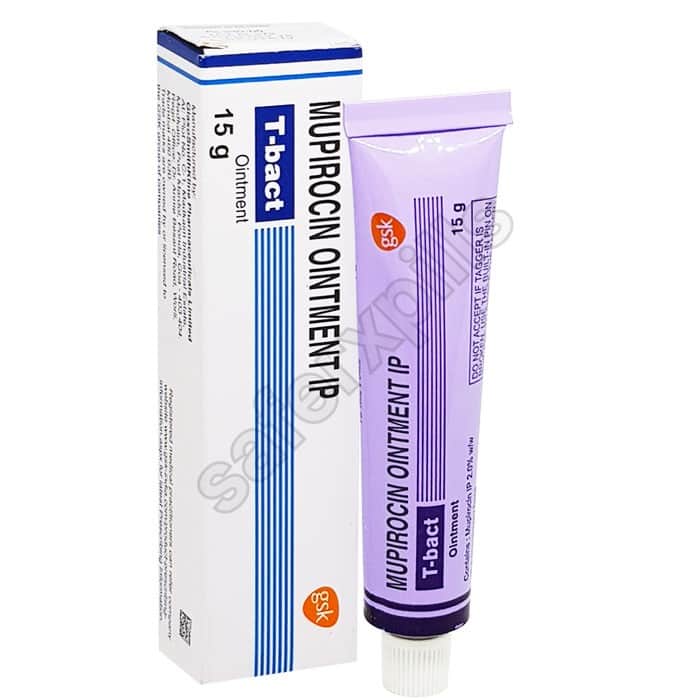
T-Bact 15g Ointment
Generic: Mupirocin
Select pack size
1 ointment
About T-Bact 15g Ointment
T-Bact Ointment is GSK India's mupirocin 2% w/w antibiotic ointment for bacterial skin infections such as impetigo, folliculitis and infected cuts, grazes and minor burns. Mupirocin is the same antibiotic as in Bactroban, GSK's original brand. The tube we sell is the Indian 15 g pack: the carton and tube in our product photo read "T-bact", "MUPIROCIN OINTMENT IP", "15 g" and "Mupirocin IP 2.0% w/w" with the GSK logo. Tata 1mg and PharmEasy name GlaxoSmithKline Pharmaceuticals Ltd as the maker. We sell it as 1, 3 or 6 tubes, from $11.00 a tube in the 6 pack before shipping.
Please read this before you order. Mupirocin ointment is a prescription medicine in the US, the UK and Australia. It is meant for a short course on a diagnosed infection: the US label says three times a day "for up to 10 days", and for impetigo NICE in the UK recommends it for 5 days only as the alternative when fusidic acid resistance is suspected or confirmed. The UK and GSK India labels also say "Any product remaining at the end of treatment should be discarded", so a tube is not meant to be kept for next time. Our delivery takes 7 to 14 business days, which is longer than a whole course. In our view, anyone with a skin infection now should see a pharmacist or doctor locally, and in the US a generic mupirocin ointment costs a pharmacy far less than our tube (see the price comparison below).
T-Bact Ointment at a glance
| Active ingredient | Mupirocin 2% w/w, which is 20 mg in each gram (GSK India prescribing information; Tata 1mg: "Mupirocin (2% w/w)"; PharmEasy: "Mupirocin(2.0 %)"). A 15 g tube holds about 300 mg of mupirocin (our arithmetic). |
| Base | Polyethylene glycol 3350 and polyethylene glycol 400 (GSK India prescribing information). The US and UK mupirocin ointments use the same polyethylene glycol (PEG) base, which matters for the kidney warning below. |
| Brand and maker | GSK India. Tata 1mg names Glaxo SmithKline Pharmaceuticals Ltd, Mumbai, as marketer and a GSK plant in Nashik as manufacturer; PharmEasy gives the Nashik address for the 5 g tube and a Ponda, Goa address for the 15 g tube. Apollo names GlaxoSmithKline Consumer Healthcare Ltd. |
| Used for | GSK India label 4.1: primary skin infections (impetigo, folliculitis, furunculosis, ecthyma), infected eczema, and infected abrasions, insect bites and minor wounds and burns. The US label is narrower: "the topical treatment of impetigo". GSK India also lists prophylaxis of small wounds and cuts; NICE and the US label do not, and NICE warns repeated use drives resistance. |
| Regulatory status | Mupirocin 2% ointment is licensed in the US (generics; the Bactroban brand ointment is listed as discontinued in Drugs@FDA), the UK (Bactroban, POM), Australia (Bactroban, Schedule 4) and Canada (Taro-Mupirocin). This Indian tube is not registered with the FDA, MHRA, TGA or Health Canada. |
| Usual use | US label: a small amount 3 times daily for up to 10 days. UK and GSK India labels: 2 to 3 times a day for up to 10 days, depending on the response. NICE NG153 for impetigo: 3 times a day for 5 days. |
| When to review | US label: "Re-evaluate patients not showing a clinical response within 3 to 5 days." |
| Prescription | Prescription only in the US, the UK (POM) and Australia (Schedule 4). In Canada, Health Canada's Drug Product Database lists marketed mupirocin under non-prescription drugs, but NAPRA's National Drug Schedules, used by most provinces, place mupirocin in Schedule I, which requires a prescription. In India the GSK prescribing information is "For the use only of Registered Medical Practitioners or a Hospital or a Laboratory"; PharmEasy and Apollo show no prescription tag, and Tata 1mg accepts orders against a doctor's prescription. |
| Packs | 1, 3 and 6 tubes. Our product photo shows a 15 g tube. Indian pharmacies also sell a 5 g tube (PharmEasy, Apollo), so read the carton when it arrives. |
| Price per tube | $16.00 (1 tube), $11.67 (3 tubes) and $11.00 (6 tubes), before shipping |
| Storage | GSK India: "Store protected from direct sunlight at a temperature not exceeding 25°C. Do not freeze." Tata 1mg: below 25 °C. It does not need a fridge. |
| Delivery | 7 to 14 business days to the US, UK, Australia and Canada; $25 shipping under $149, free from $149 |
Price per tube
Prices below are as of October 2026; the pack selector shows the current price.
| Pack | Price | Per tube | Shipping | Per tube with shipping |
|---|---|---|---|---|
| 1 tube | $16.00 | $16.00 | $25 | $41.00 |
| 3 tubes | $35.00 | $11.67 | $25 | $20.00 |
| 6 tubes | $66.00 | $11.00 | $25 | $15.17 |
All three packs are under the $149 free shipping threshold, so every order pays the flat $25 shipping; on a single tube the shipping costs more than the ointment. If each tube is 15 g, as in our product photo, the ointment costs $0.73 to $1.07 a gram before shipping and $1.01 to $2.73 a gram with shipping (our arithmetic). In India the listed maximum retail price is Rs 327.13 for the 15 g tube (Tata 1mg, PharmEasy) and Rs 108.36 for the 5 g tube (PharmEasy).
How much is one course? No label gives grams per course. The US label works out its animal safety margins against a human topical dose of "approximately 60 mg mupirocin per day", which is about 3 g of ointment a day (our arithmetic). Even at that amount, the label maximum of 10 days uses about 30 g, or two 15 g tubes; a small patch of impetigo treated for NICE's 5 days needs far less (our estimate). So for one person and one infection, the 6 pack (about 90 g) is several times more than the label course, and the UK and GSK India labels say leftover ointment should be thrown away at the end of treatment. Please do not buy tubes to keep at home: see the resistance section below.
Compared with what you can get locally
| Where | What is available | Cost |
|---|---|---|
| US | Generic mupirocin 2% ointment, prescription only, in 15 g, 22 g and 30 g tubes (Teva, Glenmark, Padagis, Sun, Encube and others; FDA NDC directory). Drugs@FDA lists the Bactroban brand ointment (GSK, first approved in 1987) as discontinued, so there is no brand NADAC row. | NADAC (the US pharmacy acquisition cost survey), effective 21 October 2026: $0.29301 a gram for 15 g tubes (about $4.40 a tube) and $0.14519 a gram for 22 g tubes (about $3.19 a tube). These are pharmacy acquisition costs, not shelf prices. |
| UK | Bactroban 2% Ointment (GSK, PL 00038/0319), prescription only, 15 g tube. The NHS says "A pharmacist can give the same medicines as a GP to treat impetigo." | Ask a UK pharmacist or GP |
| Canada | Taro-Mupirocin 2% ointment (DIN 02279983), marketed; federally non-prescription, but Schedule I (prescription) in NAPRA's National Drug Schedules. Bactroban ointment (DIN 01916947) was cancelled post market on 24 July 2020. | Ask a Canadian pharmacist |
| Australia | Bactroban 2% ointment, Schedule 4, 15 g tube; listed on the Repatriation PBS for veterans (item 4350Y) | Ask an Australian pharmacist |
| SafeRxPills | Indian T-Bact Ointment (mupirocin 2%), 15 g tube in our photo | $41.00 for one tube down to $15.17 a tube in the 6 pack, with shipping |
Said plainly: before shipping, one of our tubes costs about 2.5 to 3.6 times what a US pharmacy pays for a 15 g generic mupirocin tube, and with shipping the gap is wider (our arithmetic from NADAC). A US reader needs a prescription for mupirocin anyway, and a US pharmacy can usually fill it the same day (our view). In the UK, Canada and Australia, a local pharmacist or prescriber will also be faster than our 7 to 14 business days.
What NICE says about impetigo treatment
NICE guideline NG153, Impetigo: antimicrobial prescribing (published 26 February 2020), sets this order for people who are not systemically unwell or at high risk of complications:
- Localised non-bullous impetigo: "Consider hydrogen peroxide 1% cream" first (1.1.2). If it is unsuitable, "offer a short course of a topical antibiotic" (1.1.3).
- First-choice topical antibiotic: fusidic acid 2%, three times a day for 5 days (Tables 1 and 2).
- Mupirocin 2% is the alternative "if fusidic acid resistance is suspected or confirmed", also three times a day for 5 days. So in the UK, mupirocin is not the first antibiotic NICE reaches for.
- Course length: "A 5-day course is usually appropriate but can be increased to 7 days based on clinical judgement, depending on the severity and number of lesions."
- MRSA: "If meticillin-resistant Staphylococcus aureus is suspected or confirmed: Consult a local microbiologist".
- Bullous impetigo, or anyone systemically unwell or at high risk of complications: a short course of an oral antibiotic, not a topical one (1.1.5). NICE also says "Do not offer combination treatment with a topical and oral antibiotic to treat impetigo" (1.1.6).
- If it does not work: for impetigo that is worsening or has not improved after a topical course, NICE says offer a short course of an oral antibiotic and consider a skin swab (1.1.11), not a second tube.
The NHS says impetigo "stops being contagious 48 hours after you start using hydrogen peroxide cream or antibiotics prescribed by a pharmacist or GP". That is another reason to start treatment locally rather than wait for a parcel.
Resistance: why courses are short
- NICE NG153: "As with all antibiotics, extended or recurrent use of topical fusidic acid or mupirocin may increase the risk of developing antimicrobial resistance."
- US label 12.4: "High-level plasmid-mediated resistance (MIC ≥512 mcg/mL) has been reported in increasing numbers of isolates of S. aureus and with higher frequency in coagulase-negative staphylococci. Mupirocin resistance occurs with greater frequency in methicillin-resistant than methicillin-susceptible staphylococci."
- Labels on overgrowth: prolonged use "may result in overgrowth of nonsusceptible microorganisms, including fungi" (US 5.5; UK 4.4 and GSK India 4.4 say "prolonged use may result in overgrowth of non-susceptible organisms").
- New Zealand (Upton 2003, PMID 12615862): mupirocin resistance in S. aureus rose steadily through the 1990s and averaged 28% by 1999. The authors postulated that this "may be due, at least in part, to the over the counter availability of mupirocin from 1991 to 2000".
A separate mupirocin nasal ointment exists for intranasal use (US label 5.6), and NICE mentions nasal decolonisation for impetigo that keeps coming back (1.1.13), so resistance would cost more than one skin cream. In our view, using the skin ointment for every scratch, or keeping tubes for repeat self-treatment, is exactly the pattern that wears this antibiotic out. Use it only for an infection a pharmacist or doctor has confirmed, for the course they set, and not on rashes, acne or wounds that are not infected.
How to use T-Bact Ointment
These steps come from the GSK India prescribing information, the US mupirocin ointment label (2 Dosage and Administration, 17 and Patient Information) and the UK Bactroban ointment label. Follow the directions of the doctor or pharmacist who diagnosed the infection.
- Wash your hands before and after applying it (US Patient Information). Tata 1mg says clean and dry the affected area first.
- Apply a small amount to cover the affected area only. The US label says use "a cotton swab or gauze pad". US: 3 times daily for up to 10 days. UK and GSK India: 2 to 3 times a day for up to 10 days, depending on the response.
- A dressing is optional. "The treated area may be covered by a dressing" (UK 4.2; GSK India 4.2).
- Do not mix it with other creams or ointments. US label: "Do not apply mupirocin ointment concurrently with any other lotions, creams, or ointments." UK label: mixing risks "dilution, resulting in a reduction of the antibacterial activity and potential loss of stability".
- Skin only. Do not put it in the eyes, nose, mouth or vagina (US Patient Information). If it gets in an eye, rinse well with water (US 5.2; UK 4.4).
- Not for the nose. This skin ointment "is not suitable for ... intranasal use" (UK 4.4; GSK India 4.4). The US label says "A separate formulation, mupirocin nasal ointment, is available for intranasal use" (5.6). Apollo's listing mentions nasal use, but the GSK India label says T-Bact Ointment is not suitable for intranasal use.
- Check progress at 3 to 5 days. US Patient Information: "Talk to your healthcare provider if your skin does not improve after 3 to 5 days of treatment." Tata 1mg: "Do not use it for more than 10 days unless your doctor directs you to do so."
- Finish the course you were given, then stop. The US Patient Information says not to stop early. The UK and GSK India labels say "Any product remaining at the end of treatment should be discarded."
To help stop impetigo spreading, the NHS advises washing flannels, towels and bedding at a high temperature, not sharing them, not touching or scratching the sores, and staying away from work, school or nursery until no longer contagious.
Side effects
US label 6.1: in clinical trials of mupirocin ointment, "burning, stinging, or pain in 1.5% of subjects; itching in 1% of subjects". "Rash, nausea, erythema, dry skin, tenderness, swelling, contact dermatitis, and increased exudate were reported in less than 1% of subjects."
| How often (UK Bactroban ointment label 4.8) | Side effect |
|---|---|
| Common (1 in 100 to 1 in 10) | Burning where it is applied |
| Uncommon (1 in 1,000 to 1 in 100) | Itching, redness, stinging and dryness where it is applied; skin sensitisation to mupirocin or the ointment base |
| Very rare (reporting rate, mostly post-marketing) | Systemic allergic reactions, including anaphylaxis, generalised rash, hives (urticaria) and angioedema |
The UK common and uncommon figures come from pooled data on 1,573 patients in 12 clinical studies (UK 4.8). The GSK India label lists the same reactions. Both the US and UK labels also warn about diarrhoea after antibiotic use (C. difficile or pseudomembranous colitis); the UK label says this is less likely with mupirocin on the skin.
When to get urgent help
- Severe allergy: the US Patient Information says stop using it and "call your healthcare provider or go to the nearest emergency room right away" for hives, trouble breathing or wheezing, swelling of your face, lips, mouth or tongue, dizziness, fast heartbeat or pounding in your chest, or a rash over your whole body. With throat swelling or trouble breathing, call emergency services: 911 in the US and Canada, 999 in the UK, 000 in Australia (our advice).
- Diarrhoea during or after treatment: US Patient Information: "Call your healthcare provider or go to the nearest emergency room right away if you have diarrhea while using or after you stop using mupirocin ointment." UK 4.4: with prolonged or significant diarrhoea or abdominal cramps, "treatment should be discontinued immediately".
- Signs of a deeper or spreading infection: NICE says refer to hospital people with impetigo and signs of a more serious illness such as cellulitis, and people with widespread impetigo who are immunocompromised (1.1.15). Spreading redness, a hot, swollen or very painful area, a high temperature or feeling unwell need same-day medical care, not more ointment (our advice).
- Babies: NICE says consider specialist advice for bullous impetigo, "particularly in babies (aged 1 year and under)" (1.1.16). The US label says safety in babies under 2 months is not known.
- Swallowed ointment: the UK label says experience with overdose is limited and treatment is supportive (4.9). In the US call Poison Control on 1-800-222-1222; in Australia the Poisons Information Centre on 13 11 26 (our advice).
Who should not use T-Bact Ointment
Do not use it (the label each item comes from is named):
- if you are allergic to mupirocin or any ingredient, including polyethylene glycol (US label 4; UK 4.3; GSK India 4.3)
- in the eyes or the nose: "not suitable for ophthalmic use, intranasal use" (GSK India 4.4; UK 4.3 and 4.4); US: "not for intranasal, ophthalmic, or other mucosal use" (2)
- with intravenous cannulae or at central line sites: the US label says it "should not be used" there "because of the potential to promote fungal infections and antimicrobial resistance" (5.8); UK and GSK India 4.4 say "not suitable"
- in conditions where "absorption of large quantities of polyethylene glycol is possible, especially if there is evidence of moderate or severe renal impairment" (US 5.7; UK 4.4; GSK India 4.4). The US Patient Information adds: "You should not apply mupirocin ointment to open skin wounds or damaged skin, especially if you have kidney problems." It also says polyethylene glycol "in large amounts can cause kidney damage".
- mixed with, or at the same time as, other creams or ointments on the same area (US 2; UK 4.2)
- without a confirmed or strongly suspected bacterial infection, or for longer than the course you were given (our advice, based on the resistance warnings above)
Ask a doctor first:
- Kidney problems: the US Patient Information says tell your healthcare provider if you have kidney problems before using it.
- Pregnancy: UK 4.6: "As there is no clinical experience on its use during pregnancy, Bactroban should only be used in pregnancy when the potential benefits outweigh the possible risks of treatment." US 8.1: there are insufficient human data, and absorption through intact skin is minimal. GSK India 4.6: "Adequate human data on use during pregnancy are not available."
- Breastfeeding: if a cracked nipple is treated, "it should be thoroughly washed prior to breast feeding" (UK 4.6; GSK India 4.6). The US label says the same for a treated breast or nipple (8.2).
- Babies: the US label established safety and effectiveness from 2 months to 16 years (8.4); under 2 months it is not known.
- Impetigo that keeps coming back, bullous impetigo, widespread infection or a weakened immune system (NICE 1.1.5, 1.1.13, 1.1.15).
Other medicines: the UK label says "No drug interactions have been identified" (4.5). The US label says the effect of using it alongside other skin products has not been studied (12.3), which is why it says not to apply other products at the same time.
What the evidence shows
- US label section 14: in a placebo-controlled impetigo trial (3 times daily for 8 to 12 days), clinical efficacy at the end of therapy was 71% with mupirocin ointment (n = 49) against 35% with the vehicle (n = 51). In a second, unblinded trial against oral erythromycin for 8 days, efficacy at follow up was 93% (n = 29) against 78.5% (n = 28). Both were small trials.
- Koning 2012, Cochrane (PMID 22258953): 68 trials, 5,578 participants. Topical antibiotics cured more people than placebo (risk ratio 2.24, 6 studies, 575 participants). In 4 studies with 440 participants there was "no clear evidence" that mupirocin or fusidic acid was more effective than the other, and in 10 studies with 581 participants topical mupirocin was slightly better than oral erythromycin (risk ratio 1.07).
Our reading: mupirocin works well for small areas of impetigo when the bacteria are sensitive. The main risk is not side effects but resistance from overuse, which is why guideline bodies keep it for short, supervised courses.
Other mupirocin and impetigo products we sell
| Product | What it is |
|---|---|
| T-Bact Ointment (this product) | Mupirocin 2% ointment, GSK India, 15 g tube in our photo |
| T-Bact Cream | Mupirocin 2% in a cream base, GSK India |
| Mupiheal Ointment and Mupinase Cream | Other Indian mupirocin 2% brands (Healing Pharma and Cipla) |
| Fucidin Ointment and Fucidin Cream | Fusidic acid 2%, a different antibiotic; NICE's first choice topical antibiotic for impetigo when hydrogen peroxide is unsuitable |
| Flutibact Ointment | Mupirocin 2% with fluticasone, a steroid; a different product with its own label limits |
None of these is a substitute for seeing someone about an infection now, and none should be kept at home for repeated self-treatment (our view).
Prescription and legal status
- India: the GSK India prescribing information is headed "For the use only of Registered Medical Practitioners or a Hospital or a Laboratory". PharmEasy and Apollo show no prescription tag, and Tata 1mg says orders are accepted against a doctor's prescription. We did not confirm the drug schedule printed on the Indian carton.
- US: mupirocin ointment is a prescription medicine (US Patient Information; all current Drugs@FDA mupirocin ointments are marked Prescription). This Indian tube is not registered with the FDA. The FDA says personal importation of drugs is illegal in most circumstances.
- UK: Bactroban 2% Ointment is a prescription only medicine (POM, emc). This Indian tube is not registered with the MHRA.
- Canada: the Health Canada Drug Product Database lists Taro-Mupirocin ointment and Stramucin cream as marketed under non-prescription drugs, but NAPRA's National Drug Schedules list mupirocin in Schedule I (prescription required) in the provinces that use them (NAPRA, checked 31 October 2026). This Indian tube is not registered with Health Canada.
- Australia: mupirocin is in Schedule 4 (prescription only) of the Poisons Standard October 2026 (F2026L01327), and Bactroban is Schedule 4 on healthdirect. This Indian tube is not registered with the TGA.
Check the rules where you live before you order.
Buying genuine T-Bact Ointment
The MHRA warns: "Any medicine not authorised for sale in the UK can be unsafe or ineffective and there is no way of knowing what is in them or the negative health effects they can have." It advises UK buyers: "Only use UK-registered pharmacies, including online pharmacies displaying the official green cross logo". That warning covers this Indian tube, which is not authorised in the UK. When your order arrives, check that the carton and tube say T-bact and mupirocin 2% w/w, show the tube size (15 g in our photo; a 5 g tube also exists in India), name GSK, carry a batch number and an expiry date, and that the tube seal is intact. These checks cannot prove a tube is genuine, because counterfeiters copy packaging. If a tube causes unusual symptoms, stop using it, seek medical advice, and report it to your medicines regulator (the MHRA Yellow Card scheme in the UK, FDA MedWatch in the US, the TGA in Australia or Health Canada) as well as to us. Store it at or below 25 °C away from direct sunlight, do not freeze it (GSK India), and keep it out of the reach of children.
Delivery
We ship T-Bact Ointment to the US, UK, Australia and Canada in plain packaging with tracking. Standard delivery takes 7 to 14 business days to most countries, which is longer than a NICE impetigo course: an infection you have now should be treated with what you can get locally. Shipping costs a flat $25 on orders under $149 and is free from $149. See our shipping page and refund policy.
Related guides
- Antibiotic resistance: when antibiotics don't work
- Is it safe to buy medicine online?
- How to verify a legitimate online pharmacy in the USA
Sources
- T-BACT Ointment (Mupirocin Ointment I.P.) prescribing information, GlaxoSmithKline Pharmaceuticals Limited, Mumbai, version TBACO/PI/IN/2025/01, revised 20 June 2025, sections 4.1 to 4.8 and storage. GSK India
- Mupirocin Ointment USP 2% US label and Patient Information (Glenmark Pharmaceuticals; relabeled by Preferred Pharmaceuticals), DailyMed setid 06a4ee22-d8f8-4a8a-8666-82b14f2d8476, version 3, published 30 July 2026, label text revised August 2021, sections 1, 2, 4, 5.1 to 5.8, 6, 8.1, 8.2, 8.4, 12.3, 12.4, 14, 17. DailyMed
- Bactroban 2% Ointment, Summary of Product Characteristics, Beecham Group plc trading as GlaxoSmithKline UK, PL 00038/0319, text revised 6 November 2024, sections 4.2 to 4.9, 6.1, 6.4 to 6.6; legal category POM. emc
- US Food and Drug Administration: Drugs@FDA entries for Bactroban (NDA 050591, ointment, discontinued) and current mupirocin ointment ANDAs (prescription); openFDA NDC directory for mupirocin tube sizes; checked 31 October 2026.
- NADAC (National Average Drug Acquisition Cost), data.medicaid.gov, as of 28 October 2026: mupirocin 2% ointment rows effective 21 October 2026 (15 g NDCs $0.29301 per gram; 22 g NDCs $0.14519 per gram); no Bactroban row.
- Health Canada Drug Product Database: Bactroban DIN 01916947 (cancelled post market 24 July 2020), Taro-Mupirocin DIN 02279983 and Stramucin DIN 02483459 (marketed, non-prescription drugs), checked 31 October 2026.
- PBS item 4350Y, mupirocin 2% ointment 15 g (Repatriation Pharmaceutical Benefits; brands Bactroban, APO-Mupirocin, Medicianz, Mupirocin-WGR), checked 31 October 2026. PBS
- healthdirect Australia, Bactroban (mupirocin), Schedule 4, data updated 1 October 2026; Poisons Standard October 2026 (F2026L01327, in force 1 October 2026), Schedule 4 entry "MUPIROCIN". healthdirect
- NAPRA. National Drug Schedules: mupirocin listed in Schedule I, checked 31 October 2026. NAPRA
- NICE. Impetigo: antimicrobial prescribing (NG153), published 26 February 2020, recommendations 1.1.2 to 1.1.16 and Tables 1 and 2. NICE
- NHS. Impetigo, read 28 October 2026. NHS
- Indian listings for T-Bact Ointment (composition, maker, tube sizes, price, storage, prescription status): Tata 1mg, PharmEasy (5 g and 15 g) and Apollo Pharmacy (5 g and 15 g), checked 31 October 2026; our product photo of the Indian carton and tube.
- Koning S, et al. Interventions for impetigo. Cochrane Database Syst Rev 2012. PMID 22258953.
- Upton A, Lang S, Heffernan H. Mupirocin and Staphylococcus aureus: a recent paradigm of emerging antibiotic resistance. J Antimicrob Chemother 2003. PMID 12615862.
- MHRA. 20 million illegal erectile dysfunction pills seized as MHRA warns against risky online buys, 13 February 2026. GOV.UK.
- US Food and Drug Administration. Personal Importation. FDA
This page is for information and is not medical advice. A skin infection that is spreading, blistering, near the eyes, in a baby or in someone who feels unwell needs a doctor or pharmacist now; do not wait for a delivery.
Key Information
- ✓Active Ingredient: Mupirocin
- ✓Category: Skin Care
- ✓Form: Ointment
- ✓Brand: GlaxoSmithKline Pharmaceuticals Ltd
- ✓Manufacturer: GlaxoSmithKline Pharmaceuticals Ltd
Frequently Asked Questions
What is T-Bact ointment?
T-Bact Ointment is GSK India's mupirocin 2% w/w antibiotic ointment in a polyethylene glycol base. The GSK India label lists impetigo, folliculitis, furunculosis, infected eczema and infected minor wounds, bites and burns. Our product photo shows a 15 g tube; a 5 g tube is also sold in India (PharmEasy, Apollo), so read the carton when it arrives.
Is T-Bact the same as Bactroban?
Both contain mupirocin 2% in a polyethylene glycol ointment base, and both come from GSK: Bactroban is the brand licensed in the UK and Australia, T-Bact is GSK India's brand. The GSK India and UK Bactroban labels give the same dose and warnings. We have seen no study comparing the two packs directly. In the US the Bactroban brand ointment is listed as discontinued and generic mupirocin is sold instead.
How much does T-Bact ointment cost per tube?
As of October 2026: $16.00 for one tube, $11.67 a tube in the 3 pack ($35) and $11.00 in the 6 pack ($66), before shipping. Shipping is $25 on orders under $149, so with shipping it is $41.00, $20.00 and $15.17 a tube. The pack selector shows the current price. A US pharmacy pays about $4.40 for a 15 g generic mupirocin tube (NADAC, effective 21 October 2026), so US generics are far cheaper.
How do I use T-Bact ointment?
Wash your hands, then apply a small amount to cover the infected area only. The US label says 3 times daily for up to 10 days; the UK and GSK India labels say 2 to 3 times a day for up to 10 days, depending on the response. You may cover it with a dressing. Do not mix it with other creams or ointments, keep it out of the eyes, nose and mouth, and wash your hands afterwards.
How long should I use it?
No longer than your prescriber says, and not more than 10 days under the US, UK and GSK India labels. For impetigo, NICE recommends 5 days, up to 7 on clinical judgement. The US label says patients not responding within 3 to 5 days should be re-evaluated. The UK and GSK India labels say any ointment left at the end of treatment should be discarded.
Can I put T-Bact ointment in my nose?
No. The GSK India and UK labels say this ointment is not suitable for intranasal use, and the US label says it is not for intranasal, ophthalmic or other mucosal use. A separate mupirocin nasal ointment exists for the nose, and it is a different product used under a doctor's direction.
Is it safe with kidney problems or on large wounds?
Ask a doctor first. The ointment base is polyethylene glycol, which can be absorbed from open wounds and damaged skin and is removed by the kidneys. The US, UK and GSK India labels say it should not be used where large amounts could be absorbed, especially with moderate or severe kidney impairment. It should also not be used at intravenous cannula or central line sites. The US patient information says not to apply it to open skin wounds or damaged skin, especially if you have kidney problems.
What are the side effects?
The US label reports burning, stinging or pain in 1.5% and itching in 1% of trial subjects. The UK label lists burning as common, and itching, redness, stinging, dryness and skin sensitisation as uncommon. Very rarely, serious allergic reactions such as hives, angioedema and anaphylaxis occur: get emergency help for swelling of the face or throat or trouble breathing. If you get diarrhoea during or after use, the US patient information says call your healthcare provider or go to the nearest emergency room right away.
Is T-Bact ointment approved in the US, UK, Australia or Canada?
Mupirocin 2% ointment is licensed in all four: generics in the US, Bactroban in the UK and Australia, and Taro-Mupirocin in Canada. This Indian T-Bact tube is not registered with the FDA, MHRA, TGA or Health Canada. Mupirocin ointment is prescription only in the US, the UK and Australia; In Canada it is federally non-prescription, but NAPRA's National Drug Schedules, used by most provinces, list mupirocin in Schedule I, which needs a prescription.
Why does the page say not to keep spare tubes?
Because resistance is the main risk with mupirocin. NICE says extended or recurrent use of topical mupirocin may increase the risk of antimicrobial resistance, the US label reports rising high-level resistance in S. aureus, and the UK and GSK India labels say leftover ointment should be discarded at the end of treatment. A label course of up to 10 days fits in one or two 15 g tubes (our estimate).
Do I need a prescription, and how long does delivery take?
The GSK India label is for registered medical practitioners, and Tata 1mg accepts orders against a doctor's prescription, though PharmEasy and Apollo show no prescription tag. Rules where you live may differ: mupirocin ointment is prescription only in the US, UK and Australia, and Schedule I (prescription) under NAPRA's schedules used by most Canadian provinces, and the FDA says personal importation is illegal in most circumstances. We ship in plain packaging with tracking in 7 to 14 business days, which is longer than a treatment course.
Medical References
- 1.DailyMed (U.S. National Library of Medicine)
- 2.PubMed (NCBI) (PMID: 40773220) — 2025
- 3.PubMed (NCBI) (PMID: 19673644) — 2009
- 4.PubMed (NCBI) (PMID: 22258953) — 2012
- 5.PubMed (NCBI) (PMID: 2112164) — 1990
- 6.PubMed (NCBI) (PMID: 26142407) — 2015
Sources: U.S. National Library of Medicine (DailyMed, PubMed), openFDA
Related Products
View all

Customer Reviews
No reviews yet. Be the first to review T-Bact 15g Ointment.
Related Articles
Health guides about Mupirocin, written by pharmacists
Epiduo vs Epiduo Forte: How Adapalene and Benzoyl Peroxide Gel Works, Results Timeline, Side Effects and Cost
Epiduo combines adapalene with benzoyl peroxide 2.5% in one once-daily acne gel, in 0.1% and 0.3% (Forte) strengths. This guide covers how the two strengths differ in the trials, how to apply the gel, what to expect week by week, the irritation rates from the US labels, bleaching of fabric and hair, the exact pregnancy wording, the over-the-counter Differin Epiduo, and what US pharmacies pay for brand and generic versions.
Dapsone Gel (Aczone) 5% vs 7.5%: How to Use It, Results, Side Effects, Warnings and Cost
Dapsone gel (Aczone) is a prescription acne gel in two strengths: 5% twice daily and 7.5% once daily. This guide covers how to apply each, who it is approved for, what the four label trials showed against vehicle, side effects with label rates, the methemoglobinemia and G6PD warnings, the orange staining with benzoyl peroxide, pregnancy and breastfeeding, generic approvals and what US pharmacies pay per gram.
Generic Otezla (Apremilast): Is It Available in the US, What It Costs, Dosing and Side Effects
The FDA has approved generic apremilast from 13 companies, but none is on sale in US pharmacies as of October 2026. This guide covers the patent dates, what apremilast treats, the 5-day starting schedule, kidney dosing, trial results, side effects and warnings, and what a month of Otezla costs pharmacies compared with Indian apremilast.
Related Health Guide
Understanding Acne & Skin Care: Complete Guide