Desowen Lotion
Generic: Desonideby Galderma India Pvt Ltd
Select pack size
Similar medicines
View all
About Desowen Lotion
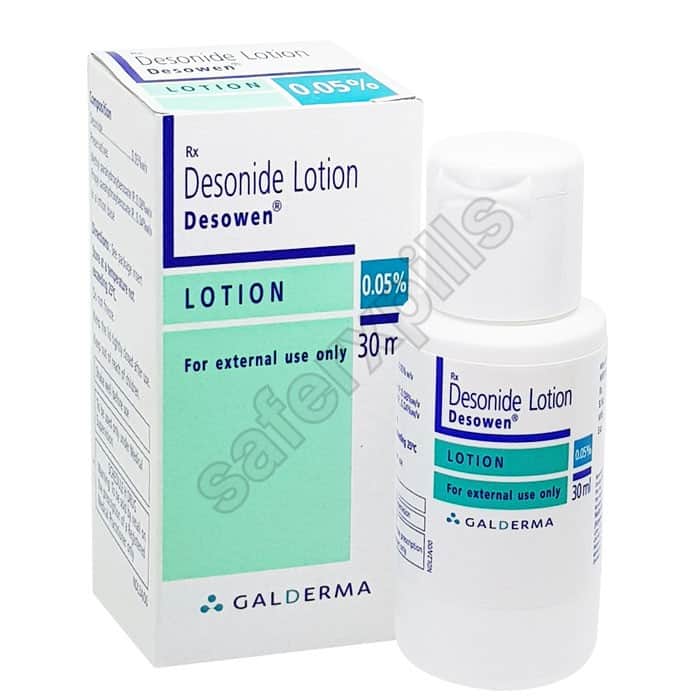
Desowen Lotion is Galderma's desonide 0.05% lotion, a mild steroid for red, itchy, inflamed skin such as eczema and dermatitis. The US label for desonide lotion calls it "a low to medium potency corticosteroid indicated for the relief of the inflammatory and pruritic manifestations of corticosteroid responsive dermatoses". The bottle we sell is the Indian 30 ml pack from Galderma India Pvt Ltd: PharmEasy, Medkart and Clinikally all list Desowen lotion 30 ml from Galderma India, and the carton and bottle in our product photo read "Rx", "Desonide Lotion", "Desowen", "0.05%", "30 ml" and "Galderma". We sell packs of 3, 6 and 12 bottles, from $5.94 a bottle before shipping.
Please read this before you order. Desonide is a low to medium potency steroid (US label), but it is still a steroid: the US label warns that steroids absorbed through the skin can suppress the body's own steroid hormones (the HPA axis), and that children are at greater risk. The US label says safety and effectiveness in children "have not been established", and the Australian Desowen label says it "should not be administered to children under the age of two years". It is not for acne, rosacea, the red spotty rash around the mouth (perioral dermatitis) or skin infections. The Galderma DesOwen lotion brand is discontinued in the US, where generic desonide lotion is a prescription medicine. In our view, a doctor should confirm what the rash is before you use it, and if it is not better within 2 weeks you should go back to them, as the US label advises.
Desowen Lotion at a glance
| Active ingredient | Desonide 0.05% (0.5 mg per gram in the US and Australian labels), a nonfluorinated corticosteroid (steroid). PharmEasy lists "Desonide(0.05 %W/V)"; Medkart and Clinikally list desonide 0.05% w/w. |
| Brand and maker | Desowen is a Galderma brand. Indian listings name Galderma India Pvt Ltd (PharmEasy "Made by"; Medkart "By GALDERMA INDIA PRIVATE LIMITED"; Clinikally). Our product photo shows the Galderma name on the carton and bottle. |
| Used for | US label: "relief of the inflammatory and pruritic manifestations of corticosteroid responsive dermatoses" (inflamed, itchy skin conditions that respond to steroids). Australian label: the same, "for adults and children aged 2 years and older". |
| Strength (potency) | US label: "low to medium potency". Australian label: a group VI (mild) steroid on the US seven point scale, and "ranked 3, a mid-potent topical corticosteroid" on the European four point scale. |
| Regulatory status | Generic desonide lotion 0.05% is FDA approved and prescription only in the US; Galderma's DesOwen lotion is listed as discontinued on Drugs@FDA. Desowen lotion is registered in Australia (ARTG 67182, prescription medicine, Schedule 4). We found no desonide lotion marketed in Canada and no desonide product on the UK emc. This Indian bottle is not registered with the FDA, MHRA, TGA or Health Canada. |
| Usual use | US label: a thin film "two or three times daily depending on the severity of the condition"; shake well; stop when control is achieved; "If no improvement is seen within 2 weeks, reassessment of diagnosis may be necessary." Australian label: continuous treatment "should not exceed 8 weeks in adults or children". |
| Children | US: "Safety and effectiveness in pediatric patients have not been established." Australia: not for children under 2 years. |
| Prescription | "Rx" on our product photo; Medkart "Prescription Required"; Clinikally "Rx - Prescription Required". Prescription only in the US ("Rx only") and Australia (S4). |
| Bottle size | 30 ml (our product photo; PharmEasy, Medkart and Clinikally) |
| Packs | 3, 6 and 12 bottles |
| Price per bottle | $6.25 (3 bottles) down to $5.94 (12 bottles), before shipping |
| Storage | Australian label: "Store below 25°C. Avoid freezing." US generic: 20 to 25 °C. It does not need a fridge. |
| Delivery | 7 to 14 business days to the US, UK, Australia and Canada; $25 shipping under $149, free from $149 |
Desowen Lotion price per bottle and per ml
Prices below are as of November 2026; the pack selector shows the current price.
| Pack | Price | Per bottle | Per ml | Shipping | Per bottle with shipping | Per ml with shipping |
|---|---|---|---|---|---|---|
| 3 bottles (90 ml) | $18.75 | $6.25 | $0.21 | $25 | $14.58 | $0.49 |
| 6 bottles (180 ml) | $36.25 | $6.04 | $0.20 | $25 | $10.21 | $0.34 |
| 12 bottles (360 ml) | $71.25 | $5.94 | $0.20 | $25 | $8.02 | $0.27 |
All three packs are under the $149 free shipping threshold, so every order pays $25 shipping, which is more than the lotion itself in the 3 pack. The per ml figures are our arithmetic, assuming 30 ml bottles. In India, PharmEasy and Clinikally list a maximum retail price of Rs 318 for one 30 ml bottle.
Even our smallest pack holds 90 ml, more than the smaller US bottle (59 ml). Neither label gives an amount per application, so we cannot say how long a bottle lasts; that depends on the area treated. Please do not order a larger pack to keep for later flare ups or to share: the labels tie use to a doctor's review, and the Australian label says that treating large skin areas "requires monitoring of the number of tubes used".
Compared with what you can get locally
| Where | What is available | Cost |
|---|---|---|
| US | Generic desonide lotion 0.05% (for example the Taro lotion listed on DailyMed under Sun Pharmaceutical Industries, in 59 ml and 118 ml bottles), prescription only. Galderma's DesOwen lotion is discontinued. Desonide cream and ointment 0.05% are also available as generics. | NADAC, effective 21 October 2026: desonide 0.05% lotion $0.60557 a ml (59 ml bottle, about $35.73) and $0.51410 a ml (118 ml bottle, about $60.66). Desonide 0.05% cream $0.20369 to $0.29946 a gram. These are pharmacy acquisition costs, not shelf prices. |
| UK | We found no desonide product on the UK emc (checked 4 November 2026). | Not checked |
| Canada | Desonide cream and ointment 0.05% (PDP-Desonide, Pendopharm) are marketed and prescription only. Galderma's Desocort lotion was cancelled in 2016, and we found no desonide lotion marketed in the Drug Product Database (checked 4 November 2026). | Not checked |
| Australia | Desowen lotion 0.05% (Galderma Australia, ARTG 67182), prescription medicine (Schedule 4), in 10, 30, 60 and 100 ml bottles. | Not checked |
| SafeRxPills | Indian Desowen lotion, 30 ml bottles | $0.20 to $0.21 a ml before shipping; $0.27 to $0.49 a ml with shipping |
Per ml, all three of our packs cost less than a US pharmacy pays for generic desonide lotion, before and after shipping, although the 3 pack with shipping ($0.49 a ml) is close to the 118 ml bottle rate ($0.51) (our arithmetic). If a cream suits your skin, US generic desonide cream costs a pharmacy $0.20 to $0.30 a gram (NADAC), which is less than our 3 and 6 packs with shipping and about the same as our 12 pack ($0.27 a ml) (our arithmetic). NADAC is not what you pay at the counter: if you are in the US and have a prescription, compare local cash prices and your insurance copay first, because a US generic may well cost you less. We have not found a published study comparing the Indian Desowen bottle with the US generic.
What the evidence shows
- Facial dermatitis trial: in an Australian double blind trial, 81 adults with atopic or seborrhoeic dermatitis of the face used desonide 0.05% lotion (Desowen) or the lotion base alone twice daily for 3 weeks. In the desonide group, 88% had their skin "cleared or almost cleared"; the abstract reports that only two patients had skin side effects (rash and itching) (Freeman 2002, PMID 12121395). The abstract does not give the result in the lotion base group.
- Indian surveillance study: in an open label study by Galderma India authors of Desowen cream and lotion in 1,789 people at 229 Indian centres, 98.5% of the 1,483 who completed 3 weeks improved, and no side effects were noted (Bhankharia 2004, PMID 17642640). It had no comparison group, so it cannot show how much of the change was due to desonide.
- Labels: the US desonide lotion label reports that adverse reactions in controlled trials totalled about 8%. The Australian label's clinical trials section says "No data available", although its side effects section includes a table of adverse events from clinical studies of Desowen cream, lotion and ointment.
Which steroid strength to choose
Doctors match the steroid's strength to the skin and the problem. NICE groups topical steroids by potency (mild, moderate, potent, very potent); desonide is not in its list, so we use the labels for Desowen. Our listings:
| Product | Steroid and strength | Potency |
|---|---|---|
| Cutisoft Cream | Hydrocortisone 1% | Mild (NICE) |
| Desowen Lotion (this page) | Desonide 0.05% | US label: low to medium. Australian label: mild on the US scale, mid-potent (3 of 4) on the European scale |
| Eumosone Cream | Clobetasone butyrate 0.05% | Moderate (NICE) |
| Betnovate 20g | Betamethasone valerate 0.1% | Potent (NICE) |
| Elocon 30g Cream | Mometasone furoate 0.1% | Potent (NICE) |
| Flutivate Cream | Fluticasone propionate 0.05% | Potent (NICE) |
| Clostaf Cream | Clobetasol propionate 0.05% | Very potent (NICE) |
For a rash that may be infected, Fucibet Cream adds an antibiotic to a potent steroid; desonide has no anti-infective. A lotion spreads thinly and is easier on hairy skin than a cream (our view). Which one, if any, is a decision for the doctor who has seen the skin.
How to use Desowen Lotion
The steps below come from the current US label for generic desonide lotion and, where it says more, the Australian Desowen label (revised 10 August 2023). Where they differ, we say so. Follow the directions of the doctor who prescribed it.
- Shake well. US and Australian labels: shake the lotion well before using.
- Skin only. US label: "It is for external use only. Avoid contact with the eyes." The Australian label contraindicates application to the eyelids "(risk of glaucoma)".
- Thin film, two or three times a day. US: "applied to the affected areas as a thin film two or three times daily depending on the severity of the condition." Australian label: more applications "may exacerbate the adverse effects without enhancing the therapeutic effects."
- Do not cover it unless your doctor says so. US: "Desonide lotion should not be used with occlusive dressings", and the treated skin "should not be bandaged or otherwise covered or wrapped so as to be occlusive unless directed by the physician." The Australian label is less strict: an occlusive dressing "may be used for the management of psoriasis or recalcitrant conditions". Nappies and skin folds can act as a covering (Australian label).
- Use it only for the problem it was prescribed for (US label).
- Stop when the skin is controlled. US: "therapy should be discontinued when control is achieved. If no improvement is seen within 2 weeks, reassessment of diagnosis may be necessary."
- Not more than 8 weeks without a break. Australian label: "Periods of continuous treatment should not exceed 8 weeks in adults or children." The US label gives no maximum.
- If it stings or irritates, the US label says it "should be discontinued and appropriate therapy instituted"; report any local reactions to your doctor.
- Missed application: apply it when you remember, but do not apply extra to make up for it (our advice).
HPA axis suppression: steroid effects in the body
- What the US label says: "Systemic absorption of topical corticosteroids can produce reversible hypothalamic-pituitary-adrenal (HPA) axis suppression with the potential for glucocorticosteroid insufficiency after withdrawal of treatment. Manifestations of Cushing's syndrome, hyperglycemia, and glucosuria can also be produced in some patients". In plain terms, enough steroid absorbed through the skin can slow the body's own steroid production, and can raise blood sugar (our wording).
- What raises the risk: the US label says people applying a steroid "to a large surface area or to areas under occlusion should be evaluated periodically for evidence of HPA axis suppression". The Australian label lists more potent steroids, large areas, prolonged use and occlusive dressings.
- Recovery: US: "Recovery of HPA axis function is generally prompt and complete upon discontinuation"; infrequently, people need steroid tablets for a time.
- Other steroids: the Australian label says steroid tablets, drops or injections used at the same time "may intensify the side effects". Tell your doctor about any steroid inhaler, tablet or other steroid cream you use (our advice).
- Diabetes: because the label lists high blood sugar and sugar in the urine, people with diabetes should tell their doctor before using it on large areas (our advice).
Face, skin folds, children and stopping
- Children. US: "Safety and effectiveness in pediatric patients have not been established. Because of a higher ratio of skin surface area to body mass, pediatric patients are at a greater risk than adults of HPA axis suppression". The US label adds that "HPA axis suppression, Cushing's syndrome, linear growth retardation, delayed weight gain and intracranial hypertension have been reported in children receiving topical corticosteroids". Australia: "should not be administered to children under the age of two years", and use in children "should be limited to the least amount compatible with an effective therapeutic regimen." Do not use it for nappy rash or on a baby without a doctor's advice (our advice).
- Face. Australian label 4.4: "Prolonged use of corticosteroids of medium potency on the face is associated with a risk of occurrence of corticosteroid-related dermatitis that is, paradoxically, corticosteroid-responsive, with a rebound after each treatment discontinuation. Gradual withdrawal by tapering is then required." It also lists thin skin and small visible blood vessels "(particularly on the face)" with prolonged use.
- Skin folds and nappy area. Australian label: "Particular attention must be paid to avoid spontaneous occlusive phenomena, which occur in skin folds or under diapers."
- Stopping. The MHRA says topical steroid withdrawal reactions have been reported after long-term continuous or inappropriate use of topical steroids, particularly moderate to high potency ones: in adults after use at least daily for longer than a year, and in children after as little as 2 months of daily use. If you have used it daily for a long time, ask your doctor how to stop (our advice).
Not for acne, rosacea, infections or skin lightening
Steroid creams and lotions are widely misused in India and elsewhere. Desowen Lotion should not be used for:
- Acne and rosacea: contraindicated in the Australian label (4.3), which also says steroids on the face "may give rise to peri-oral dermatitis or exacerbate rosacea" (4.8).
- Perioral dermatitis: "not recommended" (Australian label 4.4).
- Viral skin infections (the label names vaccinia and herpes simplex, the virus behind cold sores) and skin tuberculosis: contraindicated (Australian label 4.3).
- Skin infected with bacteria, fungi or parasites, and ulcers: the Australian label says it "should not be applied on skin areas affected by bacterial and mycobacterial, viral, fungal, parasitic infections or ulcerous wounds", and application to ulcerated lesions is contraindicated. The US label says that if a skin infection is present or develops, an antifungal or antibacterial should be used, and if it does not respond promptly desonide "should be discontinued until the infection has been adequately controlled." A steroid on ringworm can make it look better while it spreads (our advice).
- Skin lightening or as a general purpose cream. In a 12 centre Indian study of 433 people using steroid creams on the face, use as a fairness or general purpose cream or aftershave was the most common reason (29%), and 90.5% had side effects, acne most often (Saraswat 2011, PMID 21393945). Desonide does not lighten skin; the US label lists loss of skin colour (hypopigmentation) among steroid side effects.

| Who recommended the steroid face cream (410 patients) | Share |
|---|---|
| Bought over the counter themselves | 42.9% |
| Friends, family or neighbours | 20.0% |
| A non-dermatologist practitioner | 18.2% |
| A dermatologist | 10.2% |
| A beautician | 8.5% |
Desowen Lotion side effects
The US desonide lotion label says that in controlled clinical trials "the total incidence of adverse reactions associated with the use of desonide was approximately 8%":
| How often (US desonide lotion label) | Side effect |
|---|---|
| About 3% | Stinging and burning |
| Each under 2% | Irritation, contact dermatitis, condition worsened, peeling of skin, itching, intense short lived redness, dryness or scaliness |
| Reported infrequently with other topical steroids, more often under occlusion | Folliculitis, acne-like spots, loss of skin colour, perioral dermatitis, secondary infection, skin thinning, stretch marks and prickly heat (miliaria) |
The Australian label adds post-marketing reports: allergic reaction "including facial oedema and application site reaction" (uncommon), flare up of the original condition (rare), and blurred vision. It says prolonged use "may induce cutaneous atrophy, telangiectasia (particularly on the face), striae atrophicae" and "cutaneous fragility" (thin, fragile skin with small visible blood vessels and stretch marks). It also says: "If a patient presents with symptoms such as blurred vision or other visual disturbances, the patient should be considered for referral to an ophthalmologist", for possible cataract, glaucoma or central serous chorioretinopathy. The lotion contains parabens (methyl and propyl hydroxybenzoate) and propylene glycol in both labels' ingredient lists.
When to get urgent help
- Allergy: swelling of the face, lips, tongue or throat, trouble breathing or swallowing, or a widespread rash or hives. Stop the lotion and call emergency services: 911 in the US and Canada, 999 in the UK, 000 in Australia (our advice; the Australian label lists allergic reaction including facial oedema).
- Eye symptoms: blurred vision or other visual disturbance, or eye pain after lotion got into an eye: see a doctor promptly (our advice, based on the Australian label 4.4).
- Spreading infection: spreading redness, a hot, swollen or very painful area, pus, a high temperature or feeling generally unwell need same day medical care, not more lotion (our advice; the US label says stop desonide until an infection is controlled).
- A child with headaches or a bulging soft spot on the head after using steroid on the skin: the US label lists "bulging fontanelles, headaches, and bilateral papilledema" as signs of raised pressure in the head reported in children. Get medical help the same day (our advice).
- After stopping long use on large areas: severe weakness, dizziness, vomiting or confusion could be a sign of low steroid levels, which the US label calls glucocorticosteroid insufficiency. Get urgent medical help and say you used a steroid on the skin (our advice).
- Swallowed lotion: in the US, call Poison Control on 1-800-222-1222; in Australia, the Poisons Information Centre on 13 11 26 (the Australian label gives this number for overdose). One 30 ml bottle holds about 15 mg desonide (our arithmetic from 0.5 mg per gram, treating a ml as about a gram).
Who should not use Desowen Lotion
Do not use it:
- if you have had an allergic reaction to desonide or any ingredient of the lotion (US and Australian labels: contraindicated)
- for most viral skin infections (vaccinia, herpes simplex), skin tuberculosis, acne or rosacea (Australian label 4.3)
- on ulcerated skin or on the eyelids (Australian label 4.3)
Should not be used, or not recommended (Australian label 4.4): children under 2 years ("should not be administered"); perioral dermatitis; skin affected by bacterial, mycobacterial, viral, fungal or parasitic infections.
Ask a doctor first:
- Pregnancy: US: "Desonide lotion should be given to a pregnant woman only if clearly needed." Australian label (Pregnancy Category B3): use only if potential benefit justifies the potential risk to the foetus, and steroids of this class "should not be used extensively, in large amounts, or for prolonged periods."
- Breastfeeding: US: "caution should be exercised when desonide lotion is administered to a nursing woman." Australian label: "Do not apply the product to the breasts during lactation, due to the risk of product ingestion by the neonate."
- Children of any age (see above), and anyone using it on a large area, under a covering or for longer than 2 weeks.
- Other steroids (tablets, injections, inhalers or creams) and diabetes (see the HPA axis section).
Prescription and legal status
- India: the carton in our photo is marked "Rx", and Medkart and Clinikally say a prescription is required. We could not confirm its drug schedule from the listings.
- US: generic desonide lotion 0.05% is FDA approved and "Rx only" (US label). Galderma's DesOwen lotion (ANDA 072354) is listed as discontinued on Drugs@FDA. This Indian bottle is not registered with the FDA. The FDA says personal importation of drugs is illegal in most circumstances.
- UK: we found no desonide product on the UK emc. This Indian bottle is not registered with the MHRA.
- Canada: desonide cream and ointment are marketed as prescription drugs; we found no desonide lotion marketed. This Indian bottle is not registered with Health Canada.
- Australia: Desowen lotion is a prescription medicine (S4) on the ARTG (67182). This Indian bottle is not registered with the TGA.
Check the rules where you live before you order.
Buying genuine Desowen Lotion
The MHRA warns: "Any medicine not authorised for sale in the UK can be unsafe or ineffective and there is no way of knowing what is in them or the negative health effects they can have." It advises UK buyers: "Only use UK-registered pharmacies, including online pharmacies displaying the official green cross logo". That warning covers this Indian bottle, which is not authorised in the UK. When your order arrives, check that the carton and bottle say Desowen and Desonide Lotion 0.05%, show 30 ml and Galderma, carry a batch number and an expiry date, and that the seal is intact. These checks cannot prove a bottle is genuine, because counterfeiters copy packaging. If a bottle causes unusual symptoms, stop using it, seek medical advice, and report it to your medicines regulator (the MHRA Yellow Card scheme in the UK, FDA MedWatch in the US, the TGA in Australia or Health Canada) as well as to us. Store it below 25 °C, not frozen (Australian label), and out of the reach of children.
Delivery
We ship Desowen Lotion to the US, UK, Australia and Canada in plain packaging with tracking. Standard delivery takes 7 to 14 business days to most countries, so a rash you have now should be seen locally. The labels say store below 25 °C, and we cannot control temperatures in transit; if a bottle arrives separated in a way that shaking does not fix, or looks or smells unusual, contact us before using it (our advice). Shipping costs a flat $25 on orders under $149 and is free from $149. See our shipping page and refund policy.
Related guides
Sources
- Desonide Lotion 0.05%, US prescribing information, Taro Pharmaceutical Industries (distributed by Taro Pharmaceuticals U.S.A.), DailyMed setid af607c32-3da9-4fbe-99e7-4934a5c8d8f0, SPL version 5, published 15 July 2026 (text revised February 2021): description, clinical pharmacology, indications, contraindications, precautions (general, information for patients, pregnancy, nursing mothers, pediatric use), adverse reactions, overdosage, dosage and administration, how supplied, storage. DailyMed
- Desonide Lotion USP 0.05%, US prescribing information, Alembic Pharmaceuticals, DailyMed setid 90f27c9b-5c9e-4152-9ddf-659231ca993a, SPL version 10, published 26 January 2026 (same warnings). DailyMed
- Desowen (desonide 0.05%) Australian Product Information, Galderma Australia, date of first approval 21 December 1998, revised 10 August 2023, sections 2, 4.1 to 4.9, 5.1, 6.1, 6.4, 6.5 and 7. Galderma Australia
- Therapeutic Goods Administration. ARTG 67182, DESOWEN desonide 0.5 mg/g lotion bottle, checked 4 November 2026. TGA
- US Food and Drug Administration: openFDA Drugs@FDA search for desonide (DesOwen lotion, ANDA 072354, Galderma, discontinued; generic desonide lotions from Taro, Fougera and Alembic, prescription), checked 4 November 2026. FDA, Personal Importation. FDA
- Health Canada Drug Product Database: products containing desonide, with status and schedule, checked 4 November 2026.
- emc (UK electronic medicines compendium) search for desonide: no results, 4 November 2026.
- NADAC (National Average Drug Acquisition Cost), data.medicaid.gov, desonide 0.05% lotion (NDCs 51672-4079-04, 51672-4079-08, 00472-0803-02, 00472-0803-04, 62332-0550-59, 62332-0550-18) and desonide 0.05% cream, latest rows as of 4 November 2026 (effective 21 October 2026). data.medicaid.gov
- Indian listings for Desowen lotion 30 ml (composition, maker, bottle size, prescription status, price): PharmEasy, Medkart and Clinikally, checked 4 November 2026; SafeRxPills product photo.
- NICE. Tacrolimus and pimecrolimus for atopic eczema (TA81), appendix: topical corticosteroids for the treatment of atopic eczema, grouped by potency. NICE
- MHRA Drug Safety Update. Topical corticosteroids: information on the risk of topical steroid withdrawal reactions, 15 September 2021. GOV.UK
- MHRA press release, 13 February 2026 (unlicensed medicines bought online). GOV.UK
- Freeman S, et al. Efficacy, cutaneous tolerance and cosmetic acceptability of desonide 0.05% lotion (Desowen) versus vehicle in the short-term treatment of facial atopic or seborrhoeic dermatitis. Australas J Dermatol 2002. PMID 12121395.
- Bhankharia DA, et al. Efficacy of desonide 0.05% cream and lotion in steroid-responsive dermatoses in Indian patients: a post-marketing surveillance study. Indian J Dermatol Venereol Leprol 2004. PMID 17642640.
- Saraswat A, et al. Topical corticosteroid abuse on the face: a prospective, multicenter study of dermatology outpatients. Indian J Dermatol Venereol Leprol 2011. PMID 21393945.
- Jha AK, et al. Misuse of topical corticosteroids on the face: a cross-sectional study among dermatology outpatients. Indian Dermatol Online J 2016. PMID 27559498.
Frequently asked questions
What is Desowen Lotion?
Desowen Lotion is Galderma's desonide 0.05% lotion, a steroid that the US desonide lotion label calls low to medium potency, used for red, itchy, inflamed skin conditions that respond to steroids, such as eczema and dermatitis. We sell the Indian 30 ml bottle, which PharmEasy, Medkart and Clinikally list from Galderma India Pvt Ltd.
Is Indian Desowen Lotion the same as US desonide lotion?
The active ingredient and strength match: desonide 0.05%, which the US and Australian labels give as 0.5 mg per gram. Galderma's DesOwen lotion brand is discontinued in the US, and generic desonide lotions (for example Taro, Fougera and Alembic) are prescription only there. We have not found a study comparing the Indian bottle with a US generic, and the Indian bottle is not registered with the FDA, MHRA, TGA or Health Canada.
How much does Desowen Lotion cost per bottle?
As of November 2026, $18.75 for 3 bottles ($6.25 a bottle), $36.25 for 6 ($6.04) and $71.25 for 12 ($5.94), before shipping; the pack selector shows the current price. Shipping is $25 on orders under $149, so with shipping a bottle costs $14.58, $10.21 or $8.02 (our arithmetic). A US pharmacy pays about $0.51 to $0.61 a ml for generic desonide lotion (NADAC, effective 21 October 2026); a US cash price or insurance copay may still cost you less, so compare first.
How do I use Desowen Lotion?
Shake it well, then apply a thin film to the affected skin two or three times a day, depending on how severe it is (US label). Keep it out of the eyes and off the eyelids. Do not bandage or wrap the skin unless your doctor tells you to. The Australian label says applying it more often may increase side effects without working better.
How long can I use Desowen Lotion?
The US label says stop when the skin is controlled, and if there is no improvement within 2 weeks, the diagnosis may need to be reassessed. The Australian Desowen label says continuous treatment should not exceed 8 weeks in adults or children. On the face, the Australian label warns that prolonged use of a medium potency steroid can cause a rebound rash that needs gradual tapering.
Is Desowen Lotion strong?
It is one of the milder prescription steroids. The US label calls desonide lotion low to medium potency. The Australian label says it is a group VI (mild) steroid on the US scale and ranked 3, mid-potent, on the European four point scale. It is stronger than hydrocortisone 1% and weaker than betamethasone valerate 0.1% or mometasone 0.1%, which NICE classes as potent (our comparison of the label and NICE groupings).
Can Desowen Lotion be used on children?
The US label says safety and effectiveness in children have not been established, and that children are at greater risk than adults of HPA axis suppression (the steroid slowing the body's own steroid production). The Australian label says it should not be given to children under 2 years. Use it on a child only if a doctor has advised it, on the smallest area for the shortest time.
What are the side effects of Desowen Lotion?
The US desonide lotion label reports adverse reactions of about 8% in controlled trials: stinging and burning about 3%, and irritation, contact dermatitis, worsening, peeling, itching, redness and dryness each under 2%. Prolonged use can thin the skin and cause stretch marks and small visible blood vessels. The Australian label also lists allergic reactions, including facial swelling, and blurred vision.
Who should not use Desowen Lotion?
Do not use it if you are allergic to desonide or any ingredient (US and Australian labels). The Australian label also contraindicates it for most viral skin infections, skin tuberculosis, acne, rosacea, ulcerated skin and the eyelids, and says it should not be given to children under 2 years. It is not recommended for perioral dermatitis or on infected skin. Ask a doctor first if you are pregnant or breastfeeding, have diabetes, or use other steroids.
Do I need a prescription for Desowen Lotion?
Desonide lotion is prescription only in the US and Australia, and the Indian carton is marked Rx. We found no desonide product on the UK emc, and in Canada only desonide cream and ointment are marketed, on prescription. The FDA says personal importation of drugs is illegal in most circumstances. Check the rules where you live before you order.
How long does delivery take?
Standard delivery takes 7 to 14 business days to the US, UK, Australia and Canada, in plain packaging with tracking. Shipping is a flat $25 on orders under $149 and free from $149. A rash you have now should be seen by a local doctor rather than waiting for a parcel.
Medical References
- 1.Desonide Lotion 0.05%, US prescribing information, Taro (DailyMed, SPL version 5, July 2026) — 2026
- 2.Desonide Lotion USP 0.05%, US prescribing information, Alembic (DailyMed, SPL version 10, January 2026) — 2026
- 3.Desowen (desonide 0.05%) Australian Product Information, Galderma Australia (revised 10 August 2023) — 2023
- 4.TGA ARTG 67182: DESOWEN desonide 0.5 mg/g lotion bottle
- 5.FDA: Personal Importation
- 6.NICE TA81: topical corticosteroids for atopic eczema grouped by potency
- 7.MHRA Drug Safety Update: Topical corticosteroids, risk of topical steroid withdrawal reactions (2021) — 2021
- 8.Freeman S, et al. Desonide 0.05% lotion (Desowen) versus vehicle in facial atopic or seborrhoeic dermatitis. Australas J Dermatol 2002 (PMID: 12121395) — 2002
- 9.Bhankharia DA, et al. Desonide 0.05% cream and lotion in Indian patients: a post-marketing surveillance study. Indian J Dermatol Venereol Leprol 2004 (PMID: 17642640) — 2004
- 10.Saraswat A, et al. Topical corticosteroid abuse on the face: a prospective, multicenter study. Indian J Dermatol Venereol Leprol 2011 (PMID: 21393945) — 2011
- 11.Jha AK, et al. Misuse of topical corticosteroids on the face: a cross-sectional study. Indian Dermatol Online J 2016 (PMID: 27559498) — 2016
Sources: U.S. National Library of Medicine (DailyMed, PubMed), openFDA
Related articles
Budesonide with Formoterol Inhalers: Doses, MART and What the Trials Show
Budesonide with formoterol is the only inhaled steroid and long-acting beta agonist combination that can serve as both preventer and reliever. SYGMA 1 cut severe exacerbations from 0.20 to 0.07 per year on 17 percent of the steroid dose, and the CARE trial in children reported 0.23 versus 0.41 attacks per year against salbutamol. This guide covers the trial numbers, strength conventions across Foracort and Symbicort, device choice and where the combination is the wrong answer.
Read article
Tretinoin Gel vs Cream: What the Base Changes, From the Labels, Trials and Pharmacy Prices
Tretinoin gel and cream carry the same drug in different bases. This guide compares the label ingredients and strengths of Retin-A gel and cream, microsphere and water-based gels, what irritation trials found, which form suits which skin, and why a tube of gel costs US pharmacies about four times the same-strength cream.
Read article
Epiduo vs Epiduo Forte: How Adapalene and Benzoyl Peroxide Gel Works, Results Timeline, Side Effects and Cost
Epiduo combines adapalene with benzoyl peroxide 2.5% in one once-daily acne gel, in 0.1% and 0.3% (Forte) strengths. This guide covers how the two strengths differ in the trials, how to apply the gel, what to expect week by week, the irritation rates from the US labels, bleaching of fabric and hair, the exact pregnancy wording, the over-the-counter Differin Epiduo, and what US pharmacies pay for brand and generic versions.
Read articleCustomer Reviews
No reviews yet. Bought Desowen Lotion? Tell other buyers how it went.