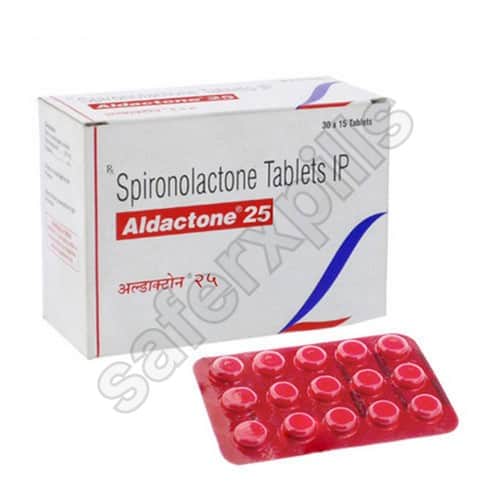
Aldactone 25mg
Generic: Spironolactone
Select pack size
60 tablets · $0.33 per tablet
About Aldactone 25mg
Aldactone 25mg is the Indian pack of Aldactone, spironolactone 25 mg tablets; the PharmEasy and Truemeds listings both name RPG Life Sciences Ltd as the maker. Spironolactone is an aldosterone antagonist, often called a potassium-sparing diuretic: it makes the kidneys pass more sodium and water while holding on to potassium (US Aldactone label 12.1). In the US it is labelled for severe heart failure with reduced ejection fraction, as an add-on for high blood pressure, for fluid build-up (oedema) in liver cirrhosis or nephrotic syndrome, and for primary hyperaldosteronism. We sell Aldactone 25mg in packs of 60, 90 and 180 tablets, from $0.31 a tablet in the largest pack before shipping.
Three points first. Spironolactone raises blood potassium, and the US label says it "can cause hyperkalemia"; the UK label warns that high potassium "can cause cardiac irregularities which may be fatal". That is why both labels tie it to blood tests, and why it is a prescription medicine that needs a doctor checking your potassium and kidney function. Second, many people search for spironolactone 25 mg for acne or hair loss. Neither use is on the US, UK or Australian label; some dermatologists prescribe it off-label, and we explain what the guidelines and labels say below, but this page gives no self-treatment dosing. And on price, plainly: US generic spironolactone 25 mg costs US pharmacies about 4 cents a tablet, so if you are in the US with a prescription, a local generic will almost always cost you less than our tablets. This page sets out the doses, warnings and prices from the current US Aldactone label, the UK Aldactone SmPC and the Australian Aldactone product information, listed at the end.
Aldactone 25mg at a glance
| Active ingredient | Spironolactone 25 mg per tablet, an aldosterone antagonist (potassium-sparing diuretic) |
| Brand and maker | Aldactone, RPG Life Sciences Ltd, Mumbai (PharmEasy and Truemeds listings). Aldactone is a Pfizer brand in the US, UK and Australia |
| Regulatory status | Spironolactone is licensed in the US (Aldactone and generics), the UK (Aldactone, POM), Australia (Aldactone, S4) and Canada (generics, prescription; Aldactone itself was cancelled there in July 2026). This Indian Aldactone pack is not registered with the FDA, MHRA, TGA or Health Canada |
| Usual dose from the label | US heart failure: start 25 mg once daily, may go to 50 mg once daily (2.2). US high blood pressure: 25 to 100 mg a day, single or divided doses (2.3). Oedema and hyperaldosteronism doses are higher (US 2.4, 2.5) |
| Half-life | Spironolactone itself about 1.4 hours; its active metabolite canrenone about 16.5 hours (US 12.3). The UK label says the kidney effect of one dose peaks after 7 hours and lasts at least 24 hours (5.2) |
| Packs | 60, 90 and 180 tablets (Indian strips hold 15 tablets per PharmEasy and Truemeds) |
| Price per tablet | $0.33 (60 and 90 packs) down to $0.31 (180 pack), before shipping |
| Delivery | 7 to 14 business days to the US, UK, Australia and Canada; $25 shipping under $149, free from $149 |
What spironolactone 25 mg is used for
US label (section 1). Aldactone is indicated for:
- NYHA class III to IV heart failure and reduced ejection fraction, "to increase survival, manage edema, and reduce the need for hospitalization for heart failure", usually with other heart failure medicines (1.1)
- add-on therapy for high blood pressure, "to lower blood pressure in patients who are not adequately controlled on other agents" (1.2)
- oedema in liver cirrhosis when it does not respond to fluid and sodium restriction, and in nephrotic syndrome when other measures, including other diuretics, give an inadequate response (1.3)
- primary hyperaldosteronism: short-term before surgery, and long-term for people with an aldosterone-producing adenoma who are not candidates for surgery or with bilateral adrenal hyperplasia (1.4)
UK label (section 4.1). Congestive cardiac failure, hepatic cirrhosis with ascites and oedema, malignant ascites, nephrotic syndrome, and diagnosis and treatment of primary aldosteronism. The UK Aldactone SmPC does not list high blood pressure as an indication.
Australian label (section 4.1). Essential hypertension, adjunctive therapy in malignant hypertension, diuretic-induced low potassium and prevention of low potassium in people taking digitalis when other measures are inadequate, oedema and ascites in heart failure, cirrhosis and nephrotic syndrome, diagnosis and treatment of primary hyperaldosteronism, and hirsutism (excess facial and body hair) in women.
Acne and hair loss are not indications in any of these three labels. Excess facial and body hair in women (hirsutism) is an indication only in the Australian label, which says use should be considered only after non-drug options have been explored (4.1). The US and UK labels do not list it.
Price per tablet
Prices below are as of October 2026; the pack selector shows the current price.
| Pack | Price | Per tablet | Shipping | Per tablet with shipping |
|---|---|---|---|---|
| 60 tablets | $20 | $0.33 | $25 | $0.75 |
| 90 tablets | $30 | $0.33 | $25 | $0.61 |
| 180 tablets | $55 | $0.31 | $25 | $0.44 |
All three packs are under the $149 free shipping line, so a single pack carries $25 shipping, which more than doubles the cost of the 60 pack. Before shipping, the 60 and 90 packs cost the same per tablet; the 180 pack is slightly cheaper.
How long a pack lasts. At one 25 mg tablet a day, the usual US heart failure starting dose, the 60 pack lasts 60 days, the 90 pack 90 days and the 180 pack 180 days. At 25 mg every other day (the US reduced dose for people who develop high potassium) a pack lasts twice as long. At 100 mg a day, the top of the usual US blood pressure range, you would need four tablets a day and the 60 pack would last 15 days (all our arithmetic). Your dose can change after the first potassium test, which the US label sets within 1 week of starting or of a dose change (5.1), so agree the dose with your doctor before buying a large pack, and check that the expiry date on the strips covers the months you need.
Compared with Aldactone and US generic spironolactone
| Aldactone 25mg (ours, Indian pack) | US Aldactone 25 mg | US generic spironolactone 25 mg | |
|---|---|---|---|
| Maker | RPG Life Sciences (India) | Pfizer | Many US generic makers |
| FDA status | Not registered with the FDA (Indian pack) | Approved (NDA 012151) | Approved generics |
| Cost per tablet | $0.31 to $0.33 before shipping | No row in the 2026 NADAC file | NADAC $0.04260 |
| Cost of 100 tablets | About $31 to $33 before shipping (our arithmetic) | Not available from NADAC | About $4.26 at NADAC |
NADAC is the average price US pharmacies pay to buy a medicine, published by the US Medicaid programme. It is not the price a patient pays at the counter. In the NADAC file of 28 October 2026, all 34 generic spironolactone 25 mg tablet NDC rows are at $0.04260 a tablet, effective 21 October 2026. We found no row for brand Aldactone, by name or by its US NDC (0025-1001-31), in the 2026 NADAC file, so we cannot give a brand acquisition cost.
Say it plainly: US generics are far cheaper than ours. Our tablet costs about 7 to 8 times what US pharmacies pay for generic spironolactone 25 mg, before our shipping (our arithmetic). If you live in the US and have a prescription, compare local cash prices for generic spironolactone before you order from us.
Is the Indian Aldactone the same as US or UK Aldactone? It carries the same brand name and the same active ingredient at the same strength. We have not seen bioequivalence data comparing the Indian tablet with the US or UK tablet, and the Indian pack is not registered with any of the four regulators above, so we cannot point to a regulator review of it. Even the Pfizer tablets differ between countries: the US 25 mg tablet is round, light yellow and marked SEARLE 1001 (US 3), while the UK and Australian 25 mg tablets are buff and marked SEARLE 39 (UK 3; AU 3).
Which strength to choose
| Daily dose | Product | How it fits the labels |
|---|---|---|
| 25 mg every other day | Aldactone 25mg (this product) | US: for heart failure patients who develop high potassium on 25 mg daily, and a starting dose to consider when eGFR is 30 to 50 (2.2). UK: for people who do not tolerate 25 mg daily (4.2) |
| 25 mg once daily | Aldactone 25mg (this product) | US and UK starting dose for severe heart failure, if potassium is 5.0 mEq/L or less (US also needs eGFR above 50; UK serum creatinine 2.5 mg/dL or less). The bottom of the US blood pressure range (2.3) |
| 50 mg once daily | Aldactone 50mg, or two 25 mg tablets | US and UK heart failure: the step up for people who tolerate 25 mg daily, "as clinically indicated" (US 2.2; UK 4.2) |
| 25 to 100 mg a day | 25, 50 or 100 mg tablets | US high blood pressure: initial daily dose 25 to 100 mg; titrate at two-week intervals; doses above 100 mg a day "generally do not provide additional reductions in blood pressure" (2.3) |
| 100 to 400 mg a day | Aldactone 100mg | Oedema (US: start 100 mg, range 25 to 200 mg, 2.4) and primary hyperaldosteronism before surgery (100 to 400 mg, US 2.5; UK 4.2). UK cirrhosis and malignant ascites doses go up to 400 mg a day (4.2). These are specialist doses, and cirrhosis treatment starts in hospital (US 2.4) |
Aldactone 50mg and Aldactone 100mg from the same maker are also in our range. Never change the dose yourself: each step up needs a potassium and kidney check first.
How to take Aldactone 25mg
- Take it exactly as your doctor prescribes, usually once a day. The US label says it "can be taken with or without food, but should be taken consistently with respect to food" (2.1), because food raised absorption by about 95% (12.3). The UK label recommends once daily with a meal (4.2). Pick one routine and keep to it.
- Expect blood tests. The US label says monitor serum potassium "within 1 week of initiation or titration" and regularly after that, more often with other medicines that raise potassium or with kidney impairment (5.1). For severe heart failure, the UK label recommends potassium and creatinine checks 1 week after starting or increasing the dose, monthly for the first 3 months, quarterly for a year and then every 6 months (4.4).
- Avoid potassium supplements and foods high in potassium, including salt substitutes, unless your doctor tells you otherwise (US 17).
- Do not take painkillers such as ibuprofen or naproxen (NSAIDs) regularly without asking your doctor: they can raise potassium and blunt the effect of the diuretic (US 7.1, 7.3).
- Be careful driving until you know how it affects you; sleepiness and dizziness have been reported (UK 4.7).
- Tell any doctor, surgeon or anaesthetist that you take spironolactone. The UK label advises caution with regional or general anaesthesia (4.5).
- If you miss a dose, the US prescribing information and UK SmPC give no missed-dose rule; ask your pharmacist. Do not take two doses together to catch up (our caution).
Lower doses and extra care for some groups
- Kidney impairment. US: people with kidney impairment "are at increased risk of hyperkalemia. Monitor potassium closely" (8.6). With an eGFR of 30 to 50, "consider initiating therapy at 25 mg every other day" for heart failure (2.2). UK: acute renal insufficiency, significant renal compromise and anuria are contraindications (4.3).
- Liver cirrhosis. US: spironolactone "can cause sudden alterations of fluid and electrolyte balance which may precipitate impaired neurological function, worsening hepatic encephalopathy and coma" in cirrhosis with ascites; start it in hospital, at the lowest dose, and titrate slowly (8.7, 2.4). UK: reversible hyperchloraemic metabolic acidosis has been reported in decompensated cirrhosis, even with normal kidney function (4.4).
- Age 65 and over. Older people are more likely to have reduced kidney function, so the US label says monitor renal function (8.5). The UK label recommends starting with the lowest dose and titrating upwards (4.2).
- Dehydration and low blood pressure. Excessive diuresis may cause dehydration, low blood pressure and worse kidney function, "particularly in salt-depleted patients or those taking angiotensin converting enzyme inhibitors and angiotensin II receptor blockers" (US 5.2). Vomiting, diarrhoea or poor fluid intake are reasons to call your doctor (our advice).
- Diabetes and gout. Spironolactone can cause high blood sugar, and raised uric acid that "rarely" brings on gout; the US label says monitor electrolytes, uric acid and blood glucose periodically (5.3).
- Children. US: safety and effectiveness in children are not established (8.4). UK: children should only be treated under a paediatric specialist (4.1); it is contraindicated in children with moderate to severe kidney impairment (4.3).
High potassium: the warning to read twice
The US label says: "ALDACTONE can cause hyperkalemia. This risk is increased by impaired renal function or concomitant potassium supplementation, potassium-containing salt substitutes or drugs that increase potassium, such as angiotensin converting enzyme inhibitors and angiotensin receptor blockers" (5.1). "If hyperkalemia occurs, decrease the dose or discontinue ALDACTONE and treat hyperkalemia" (5.1).
The UK label lists hyperkalaemia as very common (1 in 10 people or more) in its side effect table (4.8), and says "Hyperkalaemia may be fatal. It is critical to monitor and manage serum potassium in patients with severe heart failure receiving spironolactone" (4.4). For severe heart failure it advises: "Avoid using oral potassium supplements in patients with serum potassium >3.5 mEq/L", and "Discontinue or interrupt treatment for serum potassium >5 mEq/L or for serum creatinine >4 mg/dL" (4.4).
Medicines that raise potassium. The US label names ACE inhibitors, angiotensin receptor blockers, NSAIDs, heparin and low molecular weight heparin, and trimethoprim; with potassium supplements or these drugs, use "may lead to severe hyperkalemia" (7.1). The UK label adds that trimethoprim/sulfamethoxazole (co-trimoxazole) "may result in clinically relevant hyperkalaemia" (4.5), and that ACE inhibitors "should not routinely be used with Aldactone, particularly in patients with marked renal impairment" (4.5). The Australian label says combining spironolactone with these drugs, potassium supplements, a potassium-rich diet or salt substitutes containing potassium "is not recommended as it may lead to severe hyperkalaemia" (4.4).
What high potassium can feel like. The UK label describes paraesthesia (tingling), weakness, flaccid paralysis or muscle spasm, and says the earliest specific signs are changes on an ECG (4.9). Often there are no symptoms, which is why blood tests matter.
Breast swelling and hormone effects
Spironolactone has anti-androgen effects. The US label says it "can cause gynecomastia" (breast enlargement in men): in the RALES heart failure trial, at a mean dose of 26 mg a day, about 9% of men developed it; the risk rises with dose, onset "varies widely from 1 to 2 months to over a year", and it "is usually reversible" (5.4). The UK label reports gynaecomastia or breast pain in 10% of men on spironolactone against 1% on placebo in RALES (5.1), and says it is normally reversible on stopping, although "In rare instances some breast enlargement may persist" (4.8).
Other hormone-related effects reported after approval include decreased libido, trouble getting or keeping an erection, irregular or absent periods, bleeding after the menopause, and breast and nipple pain (US 6). The UK label lists menstrual disorder and breast pain in women as uncommon (4.8).
Side effects
| How often (UK label 4.8) | Side effects |
|---|---|
| Very common (1 in 10 or more) | High potassium (hyperkalaemia) |
| Common (1 in 100 to 1 in 10) | Confusion, dizziness, nausea, itching, rash, muscle spasms, acute kidney injury, gynaecomastia, breast pain in men, malaise |
| Uncommon (1 in 1,000 to 1 in 100) | Benign breast lump in men, electrolyte imbalance, abnormal liver function, urticaria (hives), menstrual disorder, breast pain in women |
| Frequency not known | Agranulocytosis, low white cell count, low platelets, libido disorder, stomach and bowel disorders, toxic epidermal necrolysis, Stevens-Johnson syndrome, DRESS, hair loss (alopecia), excess hair growth (hypertrichosis), pemphigoid |
The US label gives no frequency table. It lists reactions from trials and post-marketing reports, including stomach bleeding, ulceration, gastritis, diarrhoea and cramping, nausea and vomiting; leg cramps; lethargy, mental confusion, ataxia, dizziness, headache and drowsiness; "A very few cases of mixed cholestatic/hepatocellular toxicity, with one reported fatality"; kidney dysfunction including kidney failure; and low sodium, magnesium and calcium (6, 5.3).
The US Aldactone label used to carry a boxed warning that it "has been shown to be a tumorigen in chronic toxicity studies in rats" and that "Unnecessary use of this drug should be avoided" (FDA label 2014). The March 2018 revision has no boxed warning, and the rat tumour findings now sit in section 13.1 of the current label. The Australian product information still says "It should be used only for approved indications. Unnecessary use of this drug should be avoided" (5.3), and the UK label says the significance of the rat findings for clinical use "is not known" (5.3).
Spironolactone for acne and hair loss
Spironolactone 25 mg is widely searched for acne and for female-pattern hair loss. Here is what the sources say, and no more:
- Not a labelled use. Acne and hair loss are not indications in the US, UK or Australian Aldactone labels. Use for them is off-label, a decision for a prescriber.
- Acne. The American Academy of Dermatology's 2024 acne guideline (Reynolds et al., PMID 38300170) makes "conditional recommendations" for several treatments, including combined oral contraceptive pills and spironolactone. It makes strong recommendations for benzoyl peroxide, topical retinoids, topical antibiotics and oral doxycycline, and strongly recommends oral isotretinoin for severe, scarring or treatment-resistant acne.
- Hair loss. We have not found hair loss as an indication in any label we checked. The US and UK labels list alopecia (hair loss) and the UK label lists hypertrichosis (excess hair growth) as reported side effects (US 6; UK 4.8).
- Hirsutism. The Australian label is the only one of the three that lists hirsutism in women as an indication, and says use "should be considered only after all other alternatives of non-drug therapy has been explored" (4.1). The same label says "The safety of ALDACTONE for the treatment of hirsutism in women of child-bearing age has not been established by specific long-term clinical trials" (4.4).
- Pregnancy. Women who could become pregnant are the main group using it for skin and hair, and the pregnancy warnings below apply in full.
If a dermatologist or doctor prescribes spironolactone for acne or hair, the dose, the potassium checks and contraception are for them to set. We do not give doses for these uses, and we would not recommend starting it on your own.
When to get urgent help
Get medical help straight away, or call emergency services, if you have:
- Signs of high potassium: muscle weakness, tingling, paralysis or muscle spasms (UK 4.9), or an irregular heartbeat. High potassium "can cause cardiac irregularities which may be fatal" (UK 4.4).
- Signs of a serious allergic or skin reaction: swelling of your face, lips, tongue or throat, trouble breathing or swallowing, hives, or a blistering, peeling or widespread rash with fever. Anaphylactic reactions have been reported (US 6), and Stevens-Johnson syndrome, toxic epidermal necrolysis and DRESS are listed in both labels (US 6; UK 4.8).
- Fainting or severe dizziness, which can follow dehydration or low blood pressure (US 5.2).
- New confusion, drowsiness or unusual behaviour if you have liver cirrhosis: the US label warns of worsening hepatic encephalopathy and coma (8.7).
- Taking too much: call your doctor or Poison Control on 1-800-222-1222 (US); in Australia the Poisons Information Centre is on 13 11 26. Overdose may cause drowsiness, confusion, rash, nausea, vomiting, dizziness or diarrhoea, and there is no specific antidote (US 10; UK 4.9).
Contact your doctor the same day (our advice) if you notice yellowing of the skin or eyes or dark urine (liver injury has been reported, US 6), or fever, sore throat, mouth ulcers or unusual bruising or bleeding (agranulocytosis and low platelets have been reported, US 6; UK 4.8).
Tell the medical staff that you take spironolactone, how much and when you last took it, and every other medicine you take, especially ACE inhibitors, ARBs, potassium, NSAIDs, trimethoprim, lithium and digoxin.
Who should not take Aldactone 25mg
Never take it if (US label 4): you have hyperkalaemia (high potassium), Addison's disease, or you take eplerenone.
The UK label lists more contraindications (4.3): acute renal insufficiency, significant renal compromise or anuria (no urine); hypersensitivity to spironolactone or any excipient; and eplerenone "or other potassium sparing diuretics" (for example amiloride or triamterene). It adds that potassium supplements "should not be given routinely with Aldactone as hyperkalaemia may be induced".
The Australian label (4.3) lists acute renal insufficiency, significant impairment of renal function and anuria; Addison's disease or other conditions associated with hyperkalaemia; hyperkalaemia; pregnancy; hypersensitivity to spironolactone; and eplerenone.
Pregnancy: the labels differ.
- US: spironolactone "may affect sex differentiation of the male during embryogenesis"; rat studies "report feminization of male fetuses". The label says to "avoid spironolactone in pregnant women or advise a pregnant woman of the potential risk to a male fetus" (8.1).
- UK: "Spironolactone should not be used during pregnancy, unless the potential benefit justifies the potential risk" (4.6).
- Australia: pregnancy is a contraindication (4.3). "Women of child-bearing potential should employ adequate contraception (i.e., oral contraceptives or IUDs) during administration of spironolactone, and the drug should be stopped if pregnancy occurs or is suspected" (4.6).
If you are pregnant, could be pregnant or are planning a pregnancy, talk to your doctor before ordering. Do not decide this yourself.
Breastfeeding. US: low amounts of the metabolite canrenone were found in breast milk in one case; weigh the benefits of breastfeeding against the mother's need and possible effects on the child (8.2). UK: "Spironolactone should not be used during breast-feeding" (4.6). Australia: if the drug is essential, "an alternative method of infant feeding should be instituted" (4.6).
Not recommended or only with care:
- Abiraterone (prostate cancer): spironolactone may raise PSA; use together "is not recommended" (US 7.7; UK 4.5).
- Mitotane: US: "Avoid concomitant use" (7.8). UK: spironolactone "should not be used concomitantly with mitotane" (4.5).
- Lithium: spironolactone raises the risk of lithium toxicity; lithium levels should be monitored (US 7.2; UK 4.5).
- Digoxin: spironolactone interferes with some digoxin blood tests; the US label says use an assay that does not interact (7.4), and the UK label says spironolactone has been reported to increase digoxin levels (4.5).
- Cholestyramine: hyperkalaemic metabolic acidosis has been reported (US 7.5).
- Aspirin and other NSAIDs: may reduce the effect of spironolactone (US 7.3, 7.6; UK 4.5).
- Carbenoxolone: UK: "concurrent use should be avoided" (4.5).
- Other blood pressure medicines: their effect is increased, and their dose may need to be reduced (UK 4.5).
Tell your doctor or pharmacist about every medicine, supplement and salt substitute you use.
Prescription and legal status
In the US, spironolactone is a prescription medicine (Aldactone, marked "Rx only", and many generics), and the FDA says personal importation of unapproved medicines is illegal in most circumstances. In the UK, Aldactone 25 mg film-coated tablets (Pfizer, PL 00057/0928) are a prescription-only medicine (POM). In Australia, Aldactone 25 mg is a Schedule 4 Prescription Only Medicine and is on the PBS (healthdirect, verified 1 October 2026). In Canada, Aldactone 25 mg (DIN 00028606) was cancelled post market on 17 July 2026; generic spironolactone 25 mg (Teva, Mint, JAMP) is marketed as a prescription medicine. In India, PharmEasy and Truemeds mark Aldactone 25 as a prescription medicine. Check the rules where you live.
Buying genuine Aldactone
The MHRA warns that "Any medicine not authorised for sale in the UK can be unsafe or ineffective and there is no way of knowing what is in them or the negative health effects they can have", and it advises UK buyers to "Only use UK-registered pharmacies, including online pharmacies displaying the official green cross logo". That warning covers this Indian Aldactone pack. When your order arrives, read the strip: it should say Aldactone and spironolactone 25 mg, name RPG Life Sciences, and carry a batch number and expiry date. We have not confirmed what the Indian tablet looks like, and it will not match the US or UK Pfizer tablet markings above. These checks cannot prove that tablets are genuine, because counterfeiters copy packaging. If a batch causes unusual symptoms, seek medical advice and report it to your medicines regulator (the MHRA Yellow Card scheme in the UK, FDA MedWatch in the US, the TGA in Australia or Health Canada) as well as to us.
Storage. The US label says store below 25°C (16); the UK label says do not store above 30°C (6.4). Truemeds gives "Store Below 30° C" and "Protect it from light and moisture" for the Indian pack, and PharmEasy says store at room temperature, protected from sunlight, heat or moisture. No refrigeration is needed. Keep it out of the reach of children.
Delivery
We ship Aldactone 25mg to the US, UK, Australia and Canada in plain packaging with tracking. Standard delivery takes 7 to 14 business days. Shipping costs a flat $25 on orders under $149 and is free from $149. If you already take spironolactone, order well before your current supply runs out, and do not stop or ration your tablets while you wait. See our shipping page and refund policy.
Related guides
- Blood pressure medicines: types and side effects
- Acne treatment costs, with and without a prescription (includes US spironolactone prices)
- Isotretinoin for acne (covers the 2024 AAD acne guideline)
Sources
- ALDACTONE (spironolactone) tablets, US prescribing information, Pfizer, revised 11/2025 (NDA 012151, supplement 080; DailyMed setid 0fed2822-3a03-4b64-9857-c682fcd462bc, SPL version 25, published 1 December 2025): sections 1, 2.1 to 2.5, 3, 4, 5.1 to 5.4, 6, 7.1 to 7.8, 8.1, 8.2, 8.4 to 8.7, 10, 12.1, 12.3, 13.1, 14.1, 16, 17. DailyMed
- Aldactone US labels on Drugs@FDA: 2014 label (supplement 072) with the boxed tumorigenicity warning, and the March 2018 label (supplement 075) without it. FDA 2018 label
- Aldactone 25 mg Film-coated Tablets, UK Summary of Product Characteristics, Pfizer Limited, PL 00057/0928, POM, text revised 01/2026 (emc 1619, last updated 2 February 2026): sections 3, 4.1 to 4.9, 5.1 to 5.3, 6.4. emc
- Aldactone Australian Product Information, Pfizer Australia, version pfpaldat10625, revised 18 June 2025, Schedule 4: sections 3, 4.1, 4.3, 4.4, 4.6, 5.3, 7. Medicines Information; healthdirect Aldactone listing (PBS verified 1 October 2026). healthdirect
- Health Canada Drug Product Database: Aldactone 25 mg, DIN 00028606, cancelled post market 17 July 2026; Teva, Mint and JAMP spironolactone 25 mg marketed, prescription; checked 28 October 2026. Health Canada
- Centers for Medicare and Medicaid Services. National Average Drug Acquisition Cost (NADAC) 2026, file as of 28 October 2026: generic spironolactone 25 mg tablet $0.04260 (34 NDC rows), effective 21 October 2026; no Aldactone row. data.medicaid.gov
- Reynolds RV, et al. Guidelines of care for the management of acne vulgaris. J Am Acad Dermatol. 2024. PMID 38300170. PubMed
- Indian pharmacy listings for Aldactone 25 (PharmEasy and Truemeds), checked 28 October 2026.
- MHRA. 20 million illegal erectile dysfunction pills seized as MHRA warns against risky online buys, 13 February 2026. GOV.UK
- US Food and Drug Administration. Personal Importation. FDA
This page is for information and is not medical advice. Spironolactone is a prescription medicine that can raise blood potassium to dangerous levels. Take it only as prescribed by a doctor who checks your potassium and kidney function, and do not start, stop or change the dose without your doctor.
Key Information
- ✓Active Ingredient: Spironolactone
- ✓Category: Heart & Blood Pressure
- ✓Form: Tablet
- ✓Brand: Aldactone
- ✓Manufacturer: RPG Life Sciences Ltd
Frequently Asked Questions
What is Aldactone 25mg?
Aldactone 25mg is the Indian pack of Aldactone, spironolactone 25 mg tablets, made by RPG Life Sciences Ltd according to the PharmEasy and Truemeds listings. Spironolactone is an aldosterone antagonist (a potassium-sparing diuretic). The US label lists severe heart failure with reduced ejection fraction, add-on treatment for high blood pressure, oedema in cirrhosis or nephrotic syndrome, and primary hyperaldosteronism.
Is the Indian Aldactone the same as US or UK Aldactone?
It has the same brand name, active ingredient and strength. We have not seen bioequivalence data comparing the Indian tablet with the Pfizer tablets sold in the US or UK, and the Indian pack is not registered with the FDA, MHRA, TGA or Health Canada. The tablets also look different: the US 25 mg tablet is light yellow and marked SEARLE 1001, the UK one buff and marked SEARLE 39.
How much does spironolactone 25 mg cost per tablet?
As of October 2026, our Aldactone 25mg costs $0.33 a tablet in the 60 and 90 packs and $0.31 in the 180 pack, before $25 shipping on orders under $149; the pack selector shows the current price. US pharmacies pay about $0.04 a tablet for generic spironolactone 25 mg (NADAC, effective 21 October 2026), so US buyers with a prescription will usually pay less locally.
How do I take Aldactone 25mg?
Exactly as your doctor prescribes, usually once a day. The US label says take it with or without food but consistently with respect to food, because food raises absorption; the UK label recommends taking it with a meal. Your potassium should be checked within 1 week of starting or changing the dose (US label 5.1). Avoid potassium supplements and potassium salt substitutes unless your doctor says otherwise.
Is 25 mg a low dose of spironolactone?
25 mg once daily is the US and UK starting dose for severe heart failure, and the lowest dose in the US blood pressure range (25 to 100 mg a day). Some heart failure patients take 25 mg every other day if potassium rises. Doses for oedema and hyperaldosteronism are higher, up to 400 mg a day under specialist care. Your doctor decides the dose from your potassium and kidney tests.
How long does spironolactone take to work?
The UK label says the kidney effect of a single dose peaks after 7 hours and lasts at least 24 hours. For blood pressure, the US label says the dose can be adjusted at two-week intervals, and for oedema it says give it for at least five days before increasing the dose. Do not change the dose yourself.
Can spironolactone 25 mg be used for acne or hair loss?
Acne and hair loss are not indications on the US, UK or Australian Aldactone labels, so any such use is off-label and a prescriber's decision. The American Academy of Dermatology's 2024 acne guideline makes a conditional recommendation for spironolactone. The labels list hair loss as a reported side effect. Pregnancy warnings apply in full. We give no doses for these uses.
What are the side effects of spironolactone?
The UK label lists high potassium as very common, and confusion, dizziness, nausea, itching, rash, muscle spasms, acute kidney injury, breast enlargement and breast pain in men as common. In the RALES heart failure trial about 9% of men developed breast enlargement at a mean 26 mg a day (US label 5.4). Muscle weakness, tingling or an irregular heartbeat can be signs of high potassium: get help straight away.
Who should not take Aldactone 25mg?
The US label says never with high potassium, Addison's disease or eplerenone. The UK label adds acute renal insufficiency, significant kidney impairment or anuria, allergy to spironolactone, and other potassium-sparing diuretics. Australia makes pregnancy a contraindication; the US label says avoid it in pregnancy because of the risk to a male fetus. With abiraterone, use is not recommended, and with mitotane the US label says avoid use together.
Do I need a prescription for spironolactone?
Yes, in all four countries we ship to. It is prescription-only in the US (Aldactone and generics), the UK (Aldactone, POM), Australia (Aldactone, Schedule 4, on the PBS) and Canada (generic spironolactone; Aldactone was cancelled there in July 2026). This Indian pack is not registered with the FDA, MHRA, TGA or Health Canada, and the FDA says personal importation is illegal in most circumstances.
How long does delivery of Aldactone 25mg take?
Orders usually arrive in 7 to 14 business days in plain packaging, with tracking. Shipping is $25 on orders under $149 and free from $149. If you already take spironolactone, order well before your supply runs out and do not stop your tablets while you wait.
Related Products
View all
Customer Reviews
No reviews yet. Be the first to review Aldactone 25mg.
Related Articles
Health guides about Spironolactone, written by pharmacists
Brand vs Generic Drug Prices: What US Pharmacies Pay for Viagra, Cialis, Latisse and More (NADAC, October 2026)
CMS NADAC data for the week of 14 October 2026 shows what US pharmacies pay for brand and generic versions of Viagra, Cialis, Propecia, Latisse, Lumigan and Stromectol. Generic ED and hair loss tablets cost under 2% of the brand price, while eye and lash generics cost 41% to 65%. Includes 2026 trends, supplier counts and the full method.
Buy Amaryl (Glimepiride) Online: Dosing, Hypoglycaemia Risk and What to Verify First
Amaryl is brand name glimepiride, a sulfonylurea that lowers blood sugar effectively and cheaply but carries real hypoglycaemia risk. Dosing, the CAROLINA trial evidence, interactions, and what to verify before ordering online.

Generic vs Branded Medicines: What You Really Need to Know
Many patients assume branded drugs are superior to generics. The truth, backed by decades of FDA research, is more nuanced.