
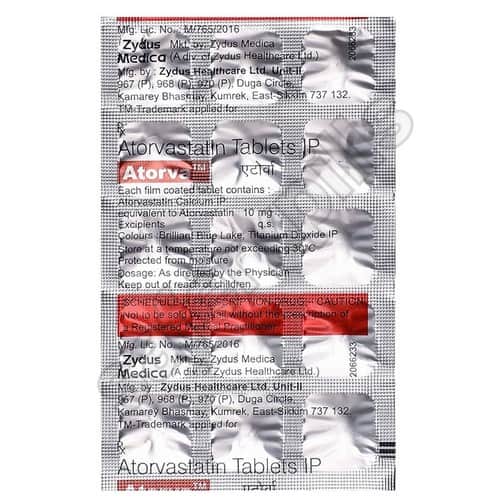
Atorva 10mg
Generic: Atorvastatin
Select pack size
60 tablets · $0.40 per tablet
About Atorva 10mg
Atorva 10mg is Zydus's Indian brand of atorvastatin 10 mg, the lowest strength in the Atorva range and the dose many people start on. Lipitor contains the same active ingredient. PharmEasy and Truemeds list Atorva 10 under Zydus Healthcare Ltd in strips of 10 tablets. The US label gives 10 mg to 20 mg once daily as the recommended adult starting dose, and the UK label says the usual starting dose is 10 mg once a day and that "The majority of patients are controlled with Lipitor 10 mg once a day". We sell Atorva 10mg in packs of 60, 90 and 120 tablets, from $0.36 a tablet in the 120 pack before shipping.
Before you order, three honest points. A low strength is not a reason to start a statin on your own: the dose comes from your LDL cholesterol, your heart risk and a blood test your doctor arranges. A low strength also does not get around the interaction warnings: the US label says use with cyclosporine, gemfibrozil and some HIV and hepatitis C medicines "is not recommended", and it gives no lower dose that makes them acceptable. And on price: US pharmacies pay about 2 cents a tablet for generic atorvastatin 10 mg, so a US buyer with a prescription will almost always pay less locally than here. The doses and warnings below come from the current US Lipitor label, the UK Lipitor 10 mg product information and NICE guidance, listed at the end.
Atorva 10mg at a glance
| Active ingredient | Atorvastatin 10 mg per tablet (as atorvastatin calcium), a statin that blocks HMG-CoA reductase, the enzyme the liver uses to make cholesterol (US label 12.1) |
| Brand and maker | Atorva, Zydus. PharmEasy and Truemeds name Zydus Healthcare Ltd; our product listing says Zydus Cadila Pharma |
| Regulatory status | Atorvastatin is licensed in the US (Lipitor and generics), the UK (Lipitor, POM), Australia (Lipitor, S4) and Canada (Lipitor, prescription). This Indian Atorva pack is not registered with the FDA, MHRA, TGA or Health Canada |
| Usual dose from the label | US: adults start at 10 mg to 20 mg once daily, range 10 mg to 80 mg (US label 2.2). UK: usual starting dose 10 mg once a day, maximum 80 mg (UK label 4.2) |
| Half-life | About 14 hours for atorvastatin itself and 20 to 30 hours for its cholesterol-lowering activity; peak blood levels within 1 to 2 hours (US label 12.3) |
| Packs | 60, 90 and 120 tablets. Indian strips hold 10 tablets (PharmEasy, Truemeds); Truemeds also lists packs of 15 and 30 |
| Price per tablet | $0.40 (60 pack) down to $0.36 (120 pack), before shipping |
| Delivery | 7 to 14 business days to the US, UK, Australia and Canada; $25 shipping under $149, free from $149 |
Why 10 mg is often the first dose
US label. "The recommended starting dosage of LIPITOR is 10 mg to 20 mg once daily. The dosage range is 10 mg to 80 mg once daily" (2.2). For children aged 10 and over with heterozygous familial hypercholesterolemia (an inherited form of high cholesterol), the recommended starting dose is 10 mg once daily (2.3). In the two pooled US dose-response trials, LDL cholesterol fell by about 39% on 10 mg, against 43% on 20 mg, 50% on 40 mg and 60% on 80 mg (US label Table 8; about 20 people per group).
UK label. "The usual starting dose is 10 mg once a day", and for primary high cholesterol and mixed hyperlipidaemia "The majority of patients are controlled with Lipitor 10 mg once a day. A therapeutic response is evident within 2 weeks, and the maximum therapeutic response is usually achieved within 4 weeks" (4.2). For heterozygous familial hypercholesterolaemia, adults "should be started with Lipitor 10 mg daily" (4.2). On preventing heart disease, it says: "In the primary prevention trials the dose was 10 mg/day. Higher doses may be necessary in order to attain (LDL-) cholesterol levels according to current guidelines" (4.2).
Guidelines. NICE (NG238, December 2023) counts atorvastatin 10 mg as medium intensity and 20 mg to 80 mg as high intensity, and offers 20 mg for primary prevention to people with a 10-year QRISK3 score of 10% or more (1.6.7). It says to "Offer a lower dose of atorvastatin" if it could react with other drugs, if there is a high risk of adverse effects, or if the person would prefer a lower dose (1.7.3). Harvard Health, summarising the 2026 ACC/AHA dyslipidemia guideline, lists atorvastatin 10 mg and 20 mg as moderate intensity (an expected LDL reduction of 30% to 49%). So in UK practice, 10 mg is often the lower dose NICE allows for, rather than the NICE starting dose (our reading of NG238, not a NICE statement).
Whichever label or guideline your doctor follows, the dose is set and checked with blood tests. Do not raise it yourself if your cholesterol is still high; ask your doctor.
Price per tablet
Prices below are as of October 2026; the pack selector shows the current price.
| Pack | Price | Per tablet | Shipping | Per tablet with shipping |
|---|---|---|---|---|
| 60 tablets | $24 | $0.40 | $25 | $0.82 |
| 90 tablets | $34 | $0.38 | $25 | $0.66 |
| 120 tablets | $43 | $0.36 | $25 | $0.57 |
All three packs are under the $149 free shipping line, so a single pack carries $25 shipping, and on a small order the shipping costs more than the tablets. The larger packs are slightly cheaper per tablet before shipping too.
How long a pack lasts. At one tablet a day, the packs last 60, 90 and 120 days (our arithmetic). Even the smallest pack is two months of treatment. A first dose is often reviewed: the US label says to assess LDL as early as 4 weeks after starting and adjust the dose if necessary (2.1), and NICE advises a lipid profile and liver test 2 to 3 months after starting or changing treatment (1.11.1). If you are just starting, the 60 pack is the safer buy until your doctor confirms that 10 mg is your dose, and check that the expiry date on the strips covers the months you need.
If your doctor raises the dose to 20 mg. Two Atorva 10mg tablets a day cost $0.72 to $0.80 before shipping, against $0.51 to $0.70 for one Atorva 20mg tablet (our arithmetic from current prices). Take the new strength as one tablet rather than doubling up on the old one.
Compared with Lipitor and US generic atorvastatin
| Atorva 10mg (ours, Indian pack) | US Lipitor 10 mg | US generic atorvastatin 10 mg | |
|---|---|---|---|
| Maker | Zydus (India) | Viatris | Many US generic makers |
| FDA status | Not registered with the FDA (Indian pack) | Approved | Approved generics |
| Cost per tablet | $0.36 to $0.40 before shipping | NADAC $13.41820 | NADAC $0.02301 |
| Cost of 60 tablets | $24 before shipping | About $805.09 at NADAC | About $1.38 at NADAC |
NADAC is the average price US pharmacies pay to buy a medicine, published by the US Medicaid programme; it is not the price a patient pays at the counter. In the NADAC file of 28 October 2026, all 70 generic atorvastatin 10 mg NDC rows are at $0.02301 a tablet, and the one Lipitor 10 mg row (NDC 58151015577) is at $13.41820, all with an effective date of 21 October 2026.
Plainly: US generics are far cheaper than ours. Our tablet costs about 16 to 17 times what US pharmacies pay for generic atorvastatin 10 mg, before our shipping (our arithmetic). If you live in the US and have a prescription, compare local cash prices before you order from us. US pharmacies pay about 34 to 37 times our tablet price for brand Lipitor 10 mg (our arithmetic), but very few people need the brand.
Is Atorva the same as Lipitor? It contains the same active ingredient at the same strength. We have not seen bioequivalence data comparing Atorva with Lipitor, and the Indian pack is not registered with any of the four regulators above, so we cannot point to a regulator review of it.
Which strength to choose
| Daily dose | Product | How it fits the labels and guidance |
|---|---|---|
| 10 mg once daily | Atorva 10mg (this product) | US adult starting dose (10 mg to 20 mg, 2.2) and children's starting dose for heterozygous familial hypercholesterolemia (2.3). UK usual starting dose (4.2). The dose used in the ASCOT-LLA and CARDS outcome trials (US 14). NICE: medium intensity |
| 20 mg once daily | Atorva 20mg | US starting dose (2.2). NICE starting dose for primary prevention (NG238 1.6.7). The most the US label allows with clarithromycin, itraconazole and several HIV and hepatitis C medicines (2.5) |
| 40 mg once daily | Atorva 40mg | US: may be the starting dose when LDL needs to fall by more than 45% (2.2). The most the US label allows with nelfinavir (2.5) |
| 80 mg once daily | Atorva 80mg | The labelled maximum (US 2.2; UK 4.2). NICE dose for people with cardiovascular disease (NG238 1.7.2). The high dose in the TNT trial (US 14) |
| Above 80 mg | None | Above the labelled maximum |
The UK label says dose changes should be made at intervals of 4 weeks or more (4.2), and the US label says the dose, rather than the blood level, matches the LDL reduction better (12.2).
How to take Atorva 10mg
- Once a day, any time. One tablet, morning or evening, with or without food (US label 2.1; UK 4.2). An evening dose gives blood levels about 30% lower, yet the LDL reduction is the same (US 12.3), so pick the time you will remember.
- Diet still counts. The UK label says the cholesterol-lowering diet should continue during treatment (4.2).
- First check-up. LDL can be assessed as early as 4 weeks after starting (US 2.1). NICE suggests a full lipid profile and a liver transaminase test 2 to 3 months after starting or changing treatment, then a liver test at 12 months (NG238 1.11.1, 1.11.2).
- Missed dose. Leave it out and take the next dose at the usual time; never take 2 doses together (US 2.1; Patient Information).
- Grapefruit. No more than 1.2 litres of grapefruit juice a day (US 7.1).
- Changes. Do not stop or change the dose without your doctor, and mention atorvastatin to anyone who prescribes you something new, including dentists and hospital doctors.
Medicines that limit the dose, even at 10 mg
Several medicines raise atorvastatin levels. At 10 mg you are at the lowest strength, but the labels still set limits, and for some combinations the lowest strength is the most allowed or is not advised at all:
- Cyclosporine (ciclosporin): US: concomitant use "is not recommended" (5.1, 7.1). In a US label study of 10 mg a day, cyclosporine raised atorvastatin exposure (AUC) 8.7 times (12.3). The UK label's interaction table says: "In cases where co-administration with atorvastatin is necessary, do not exceed 10 mg atorvastatin daily. Clinical monitoring of these patients is recommended" (4.5, Table 1). The UK label also says atorvastatin use "is not recommended" with letermovir given together with ciclosporin (4.5).
- Tipranavir plus ritonavir: US: not recommended (7.1); exposure rose 9.4 times after a single 10 mg dose (12.3). UK: the same "do not exceed 10 mg atorvastatin daily" line applies to tipranavir/ritonavir and to telaprevir (4.5, Table 1).
- Glecaprevir plus pibrentasvir (a hepatitis C medicine): US: not recommended (7.1); exposure rose 8.3 times with 10 mg a day (12.3). UK: a contraindication (4.3).
- Gemfibrozil: US: not recommended (5.1, 7.1). UK: "Lower starting dose and clinical monitoring of these patients is recommended" (4.5, Table 1).
- Clarithromycin, itraconazole and some HIV, hepatitis C and CMV antivirals: with clarithromycin, itraconazole, saquinavir plus ritonavir, darunavir plus ritonavir, fosamprenavir (with or without ritonavir), elbasvir plus grazoprevir or letermovir (a cytomegalovirus medicine), the US label says "do not exceed LIPITOR 20 mg once daily" (2.5). Atorva 10mg is within that limit, but your doctor may still pause or change treatment. For lopinavir plus ritonavir and for clarithromycin, the UK table says "lower maintenance doses of atorvastatin are recommended" (4.5); with lopinavir plus ritonavir or simeprevir, the US label says consider the risk and benefit (7.1).
- UK label, potent CYP3A4 inhibitors. "a lower starting dose of atorvastatin should be considered and appropriate clinical monitoring of these patients is recommended", and "If possible, alternative (non-interacting) therapies should be considered instead of these medicinal products" (4.4).
Being on the lowest strength does not make these combinations safe (our reading of the labels above). If you are prescribed any of these medicines, even a short antibiotic course, tell the prescriber you take atorvastatin before you start it.
Extra care for some groups
- Children. For children aged 10 and over with heterozygous familial hypercholesterolemia, the US label starts at 10 mg once daily with a range of 10 mg to 20 mg (2.3). The UK label also starts at 10 mg from age 10 and allows increases up to 80 mg "according to the response and tolerability", and says paediatric use "should only be carried out by physicians experienced in the treatment of paediatric hyperlipidaemia" (4.2). Under 10, safety and effectiveness are not established (US 8.4). A child's dose is for a specialist to set, not for a parent to buy (our advice).
- Older people. The US label treats advanced age as a myopathy risk factor and asks for cautious dose selection (8.5); in healthy people aged 65 and over, exposure (AUC) was about 30% higher (12.3). The UK label suggests measuring CK before treatment in people over 70 who have other risk factors (4.4).
- Kidneys. No dose change is needed for kidney impairment (US 8.6; UK 4.2), though it raises the risk of myopathy (US 5.1). NICE offers atorvastatin 20 mg in chronic kidney disease and says higher doses should be agreed with a kidney specialist when eGFR is below 30 (NG238 1.8.1, 1.8.3).
- Liver and alcohol. In chronic alcoholic liver disease, blood levels were about 4 times higher in Child-Pugh A and up to 16 times higher (Cmax) in Child-Pugh B (US 8.7). Heavy drinkers and people with past liver disease may be at increased risk of liver injury (US 5.3), and the UK label says use with caution (4.4).
- Thyroid and muscle history. Uncontrolled hypothyroidism raises the risk of myopathy (US 5.1). The UK label names hypothyroidism, inherited muscle disorders and earlier muscle problems on a statin or fibrate as reasons to check CK before starting (4.4).
- Diabetes. Statins have been linked with rises in HbA1c and fasting glucose (US 5.4), but the UK label says this risk "is outweighed by the reduction in vascular risk with statins and therefore should not be a reason for stopping statin treatment" (4.4). CARDS, one of the 10 mg outcome trials below, was run in people with type 2 diabetes.
Muscle, liver and blood sugar warnings
These warnings apply at every strength, including 10 mg.
Muscle damage. In the US label's words, atorvastatin "may cause myopathy (muscle pain, tenderness, or weakness associated with elevated creatine kinase [CK]) and rhabdomyolysis", and "acute kidney injury secondary to myoglobinuria and rare fatalities have occurred as a result of rhabdomyolysis in patients treated with statins" (5.1). The label names these risk factors: "age 65 years or greater, uncontrolled hypothyroidism, renal impairment, concomitant use with certain other drugs (including other lipid-lowering therapies), and higher LIPITOR dosage" (5.1). Being on 10 mg takes care of the last item only.
Your part is simple: "Promptly report any unexplained muscle pain, tenderness or weakness, particularly if accompanied by malaise or fever" (US 5.1, 17). Your doctor's part, per the US label, is to stop atorvastatin if CK is markedly raised or myopathy is diagnosed or suspected, and to pause it during an acute serious illness with a high risk of kidney failure from rhabdomyolysis, for example sepsis, shock, severe hypovolemia, major surgery or trauma (5.1). The UK label stops treatment if CK is above 5 times the upper limit of normal (4.4); NICE says that below that level the symptoms are unlikely to be due to the statin and other causes should be explored (NG238 1.11.4). A rare form, immune-mediated necrotizing myopathy, causes weakness of the shoulder and hip muscles with a raised CK "that persists despite discontinuation of statin treatment", and may need immunosuppressive treatment (US 5.2).
Liver. In the pooled trials, 0.2% of people on 10 mg had persistent liver enzyme rises above 3 times the upper limit of normal, against 2.3% on 80 mg; in TNT the figures were 0.2% on 10 mg and 1.3% on 80 mg (US 6.1). Rare post-marketing reports of fatal and non-fatal liver failure have occurred with statins, and the label says to stop promptly if serious liver injury with symptoms, raised bilirubin or jaundice occurs (US 5.3).
Blood sugar. "Increases in HbA1c and fasting serum glucose levels have been reported with statins, including LIPITOR" (US 5.4). The label's advice is regular exercise, a healthy body weight and healthy food choices (5.4, 17).
Side effects
| Side effect | Placebo (7,311 people) | 10 mg (3,908 people) | Any dose (8,755 people) |
|---|---|---|---|
| Nasopharyngitis (cold symptoms) | 8.2% | 12.9% | 8.3% |
| Joint pain (arthralgia) | 6.5% | 8.9% | 6.9% |
| Pain in arm or leg | 5.9% | 8.5% | 6.0% |
| Diarrhoea | 6.3% | 7.3% | 6.8% |
| Urinary tract infection | 5.6% | 6.9% | 5.7% |
| Indigestion (dyspepsia) | 4.3% | 5.9% | 4.7% |
| Musculoskeletal pain | 3.6% | 5.2% | 3.8% |
| Muscle spasms | 3.0% | 4.6% | 3.6% |
| Throat pain (pharyngolaryngeal pain) | 2.1% | 3.9% | 2.3% |
| Nausea | 3.5% | 3.7% | 4.0% |
| Muscle pain (myalgia) | 3.1% | 3.6% | 3.5% |
| Insomnia | 2.9% | 2.8% | 3.0% |
Source: US Lipitor label Table 1, which pools seventeen placebo-controlled trials and lists reactions reported in at least 2% of people on any dose and more often than on placebo; median treatment was 53 weeks. The table shows the placebo, 10 mg and any-dose columns; the label also gives 20 mg, 40 mg and 80 mg columns. The 10 mg group is the second largest in the table (after 80 mg), so its rates rest on more people than the 20 mg and 40 mg columns, but the trials pooled in each column differ, so the columns cannot be compared as a dose ladder (our reading). The UK label says 5.2% of people on atorvastatin stopped because of side effects, against 4.0% on placebo (4.8), and myalgia was the most common reason for stopping in the US trials (0.7%) (US 6.1).
Reports after approval (US 6.2, no reliable frequency): pancreatitis, fatigue, liver failure, anaphylaxis, tendon rupture, rhabdomyolysis, myositis, dizziness, peripheral neuropathy, depression, interstitial lung disease, angioneurotic oedema and blistering rashes including Stevens-Johnson syndrome and toxic epidermal necrolysis; rare reports of memory problems and confusion, "generally nonserious, and reversible upon statin discontinuation", and of new or worsening myasthenia gravis. The UK label says statins should be stopped if interstitial lung disease is suspected (4.4).
What the outcome trials showed at 10 mg
10 mg is the strength with the most outcome trial evidence in the US label: two placebo-controlled trials tested it, and a third used it as the comparison dose.
| Trial (US label section 14) | Who took part | Main result |
|---|---|---|
| ASCOT-LLA | 10,305 adults aged 40 to 80 with high blood pressure and at least 3 other risk factors, no previous heart attack; 10 mg vs placebo; median 3.3 years | Fatal coronary heart disease or non-fatal heart attack 1.9% vs 3.0%, a 36% relative risk reduction. No significant difference in cardiovascular or non-cardiovascular death |
| CARDS | 2,838 adults aged 40 to 75 with type 2 diabetes and at least one other risk factor, no previous cardiovascular disease; 10 mg vs placebo; median 3.9 years | Major cardiovascular events 83 vs 127 (HR 0.63, a 37% relative reduction); stroke HR 0.52; heart attack HR 0.58 |
| TNT | 10,001 adults with coronary heart disease; 80 mg vs 10 mg; median 4.9 years | Major cardiovascular events 434 on 80 mg vs 548 on 10 mg (HR 0.78, a 22% relative reduction); more serious adverse reactions (1.8% vs 1.4%) and stopping for adverse reactions (9.9% vs 8.1%) on 80 mg (6.1). No significant difference in deaths from any cause (284 on 80 mg vs 282 on 10 mg) |
ASCOT-LLA and CARDS were in people without known heart disease. TNT shows that people who already have coronary heart disease had fewer events on 80 mg than on 10 mg, and NICE offers 80 mg to people with cardiovascular disease (NG238 1.7.2). If you have had a heart attack or stroke, 10 mg may not be the dose your doctor intends for you long term.
When to get urgent help
| If you notice | What to do |
|---|---|
| Swelling of your face, lips, tongue or throat, problems breathing or swallowing, fainting or feeling dizzy, very rapid heartbeat, severe skin rash or itching | Stop taking it and get medical help right away (US Patient Information). A blistering or peeling rash can be a sign of Stevens-Johnson syndrome or toxic epidermal necrolysis (US 4, 6.2) |
| Unexplained muscle pain, tenderness or weakness, especially with a fever or more tiredness than usual | Tell your healthcare provider right away; rarely, muscle breakdown can cause kidney damage that can lead to death (US Patient Information) |
| Muscle problems that continue after your doctor has told you to stop taking it | Tell your healthcare provider right away (US Patient Information) |
| Tiredness or weakness, nausea or vomiting, loss of appetite, upper belly pain, dark amber urine, or yellow skin or whites of the eyes | These can be signs of liver problems: call your healthcare provider right away (US Patient Information) |
| You took too much | Call your healthcare provider or Poison Control on 1-800-222-1222 (US), or go to the nearest emergency room right away (US Patient Information). In Australia, call the Poisons Information Centre on 13 11 26 (our addition). There is no specific antidote (US 10) |
When you get help, say that you take atorvastatin 10 mg, when your last dose was, and what else you take; many interactions raise the risk of muscle damage.
Who should not take Atorva 10mg
Contraindications in the US label (4). Acute liver failure or decompensated cirrhosis, and hypersensitivity to atorvastatin or any ingredient of the tablet (reported reactions include anaphylaxis, angioneurotic oedema, erythema multiforme, Stevens-Johnson syndrome and toxic epidermal necrolysis).
Extra contraindications in the UK label (4.3). Active liver disease or unexplained persistent transaminase rises above 3 times the upper limit of normal; pregnancy, breastfeeding, and women of childbearing potential not using appropriate contraception; and treatment with glecaprevir/pibrentasvir.
Pregnancy, where the two labels part ways.
- US: in July 2021 the FDA asked for "removing the contraindication against using these medicines in all pregnant patients", adding that "most patients should stop statins once they learn they are pregnant". The current Lipitor label says: "Discontinue LIPITOR when pregnancy is recognized. Alternatively, consider the ongoing therapeutic needs of the individual patient" (8.1). The Patient Information says: "If you become pregnant, stop taking LIPITOR and call your healthcare provider right away."
- UK: "Lipitor is contraindicated during pregnancy", and it "should not be used in women who are pregnant, trying to become pregnant or suspect they are pregnant" (4.6). Women of childbearing potential "should use appropriate contraceptive measures during treatment" (4.6).
Speak to your doctor before ordering if you are pregnant, might be, or are planning a pregnancy.
Breastfeeding. US: breastfeeding "is not recommended during treatment with LIPITOR" (8.2). UK: atorvastatin "is contraindicated during breast-feeding" (4.6).
Combinations and conditions the labels warn about (beyond the interaction list above):
- Systemic fusidic acid: UK: atorvastatin "must not be co-administered with systemic formulations of fusidic acid or within 7 days of stopping fusidic acid treatment" (4.4).
- Daptomycin: UK: consider a temporary pause in atorvastatin unless the benefit outweighs the risk (4.4).
- Fibrates, niacin at more than 1 g a day, colchicine, ledipasvir plus sofosbuvir: US: weigh the benefit against the increased risk of myopathy and rhabdomyolysis (5.1, 7.1).
- A previous bleeding stroke: in a post-hoc analysis of the SPARCL trial of 80 mg after a recent stroke or TIA, haemorrhagic stroke was more common than on placebo (2.3% vs 1.4%) (US 5.5). Tell your doctor about any past stroke.
- Rare sugar intolerances: Lipitor contains lactose, and the UK label says people with galactose intolerance, total lactase deficiency or glucose-galactose malabsorption "should not take this medicine" (4.4). We have not confirmed the Indian Atorva excipients, so check the strip.
Other medicines and drinks that interact
| Medicine or drink | What the label says |
|---|---|
| Grapefruit juice | "Avoid intake of large quantities of grapefruit juice, more than 1.2 liters daily" (US 7.1) |
| Diltiazem, verapamil, amiodarone, erythromycin, fluconazole | UK: may raise atorvastatin levels; a lower maximum dose and clinical monitoring should be considered (4.5) |
| Rifampin (rifampicin) | Take atorvastatin at the same time as rifampin; a delayed dose lowers atorvastatin levels significantly (US 7.2; UK 4.5) |
| Oral contraceptives | Atorvastatin raised norethindrone and ethinyl estradiol levels (US 7.3) |
| Digoxin | Levels rose; monitor (US 7.3) |
| Warfarin and other coumarins | UK: check prothrombin time before starting and often enough early on (4.5) |
Prescription and legal status
In the US, atorvastatin is a prescription medicine, and the FDA says personal importation of unapproved medicines is illegal in most circumstances. In the UK, Lipitor 10 mg film-coated tablets (Viatris, PL 46302/0298) are a prescription-only medicine (POM). In Australia, Lipitor 10 mg is registered (AUST R 168338) as a Schedule 4, prescription-only medicine. In Canada, Lipitor 10 mg (DIN 02230711) is marketed as a prescription medicine. In India, Truemeds marks Atorva 10 as "Prescription required". Check the rules where you live.
Buying genuine Atorva
The MHRA's warning covers this Indian pack: "Any medicine not authorised for sale in the UK can be unsafe or ineffective and there is no way of knowing what is in them or the negative health effects they can have". Its advice to UK buyers is: "Only use UK-registered pharmacies, including online pharmacies displaying the official green cross logo".
What to check on arrival. The strip should name Atorva, atorvastatin 10 mg and Zydus, with a batch number and an expiry date. For comparison, US Lipitor 10 mg is a white, elliptical tablet marked "10" and "VLE 155" (US label 3), and UK Lipitor 10 mg is white, round and marked "10" and "ATV" (UK label 3). Atorva is a different product and will carry neither marking; we have not confirmed what the Indian tablet looks like. None of these checks can prove a tablet is genuine, because packaging can be copied.
If a batch seems wrong. If tablets cause unusual symptoms, seek medical advice, and report it to your medicines regulator (the MHRA Yellow Card scheme in the UK, FDA MedWatch in the US, the TGA in Australia or Health Canada) as well as to us.
Storage. US label: 20 to 25°C (16). PharmEasy: below 25°C in a cool, dry place. Truemeds: "Store Below 30° C". Below 25°C satisfies all three (our advice), no fridge needed, and keep it away from children.
Delivery
Atorva 10mg ships to the US, UK, Australia and Canada in plain, tracked packaging and usually arrives in 7 to 14 business days. Orders under $149 pay a flat $25 for shipping; from $149, shipping is free. Reorder while you still have a few weeks of tablets left, and keep taking your usual dose while the parcel is on its way. Details are on our shipping page and in our refund policy.
Related guides
- Atorva 20mg: the NICE starting dose for primary prevention, and the next step if your doctor raises the dose
- Atorva 40mg: when 40 mg is used, and the interactions that rule it out
- Type 2 diabetes treatment options compared (the CARDS trial above tested 10 mg in people with type 2 diabetes)
Sources
- LIPITOR (atorvastatin calcium) tablets, US prescribing information and Patient Information, Viatris Specialty LLC, revised April 2024 (DailyMed setid a60cc18b-0631-4cf0-b021-9f52224ece65, SPL version 8, published 15 July 2026): sections 2.1 to 2.5, 3, 4, 5.1 to 5.5, 6.1, 6.2, 7.1 to 7.3, 8.1, 8.2, 8.4 to 8.7, 10, 12.1 to 12.3, 14 (including Table 8), 16, 17. DailyMed
- Lipitor 10 mg film-coated tablets, UK Summary of Product Characteristics, Viatris, PL 46302/0298, POM, text revised August 2026 (emc 1059, last updated 21 October 2026): sections 3, 4.2 to 4.6, 4.8. emc
- NICE. Cardiovascular disease: risk assessment and reduction, including lipid modification (NG238), published 14 December 2023: recommendations 1.6.7, 1.7.2, 1.7.3, 1.8.1, 1.8.3, 1.11.1, 1.11.2, 1.11.4 and the definitions of statin intensity. NICE
- Harvard Health Publishing. Understanding statin intensity (updated 13 April 2026), citing the 2026 ACC/AHA/multisociety guideline on the management of dyslipidemia (Blumenthal RS et al., J Am Coll Cardiol 2026, doi:10.1016/j.jacc.2025.11.016; also published in Circulation, 13 March 2026). Harvard Health
- US Food and Drug Administration. FDA requests removal of strongest warning against using cholesterol-lowering statins during pregnancy. Drug Safety Communication, 20 July 2021. FDA
- Centers for Medicare and Medicaid Services. NADAC 2026, file as of 28 October 2026: generic atorvastatin 10 mg tablet $0.02301 (70 NDC rows); Lipitor 10 mg tablet $13.41820 (NDC 58151015577); all effective 21 October 2026. data.medicaid.gov
- Health Canada Drug Product Database: Lipitor 10 mg, DIN 02230711, BGP Pharma ULC, marketed, prescription; checked 27 October 2026. Health Canada
- Australian Commission on Safety and Quality in Health Care, Medicine Finder: Lipitor 10 mg, AUST R 168338, S4, Aspen Pharmacare Australia; checked 31 October 2026. Medicine Finder
- Trials: Sever PS et al. ASCOT-LLA. Lancet 2003 (PMID 12686036); Colhoun HM et al. CARDS. Lancet 2004 (PMID 15325833); LaRosa JC et al. TNT. N Engl J Med 2005 (PMID 15755765).
- Indian pharmacy listings for Atorva 10 (PharmEasy and Truemeds), checked 31 October 2026.
- MHRA. 20 million illegal erectile dysfunction pills seized as MHRA warns against risky online buys, 13 February 2026. GOV.UK
- US Food and Drug Administration. Personal Importation. FDA
This page is for information and is not medical advice. Atorvastatin is a prescription medicine for lowering cholesterol and heart and stroke risk. Take it only as prescribed by a doctor who checks your cholesterol and liver tests, and do not start, stop or change the dose without your doctor.
Key Information
- ✓Active Ingredient: Atorvastatin
- ✓Category: Heart & Blood Pressure
- ✓Form: Tablet
- ✓Brand: Atorva
- ✓Manufacturer: Zydus Cadila Pharma
Frequently Asked Questions
What is Atorva 10mg?
Atorva 10mg is Zydus's Indian brand of atorvastatin 10 mg, the active ingredient in Lipitor. PharmEasy and Truemeds list it under Zydus Healthcare Ltd in strips of 10 tablets. It is a statin, taken once a day to lower LDL cholesterol and the risk of heart attack and stroke, at a dose set by your doctor.
Is Atorva 10 the same as Lipitor 10 mg?
It has the same active ingredient at the same strength. We have not seen bioequivalence data comparing Atorva with Lipitor, and this Indian pack is not registered with the FDA, MHRA, TGA or Health Canada, so we cannot point to a regulator review of it. The US Lipitor 10 mg tablet is marked "10" and "VLE 155" and the UK one "10" and "ATV"; Atorva will look different.
How much does atorvastatin 10 mg cost per tablet?
Ours costs $0.40 a tablet in the 60 pack, $0.38 in the 90 pack and $0.36 in the 120 pack, before $25 shipping on orders under $149 (as of October 2026; the pack selector shows the current price). US pharmacies pay about $0.02 a tablet for generic atorvastatin 10 mg (NADAC, effective 21 October 2026), so US buyers with a prescription will almost always pay less locally.
Is 10 mg the normal starting dose of atorvastatin?
Often, yes. The US label gives 10 mg to 20 mg once daily as the recommended adult starting dose, and the UK label says the usual starting dose is 10 mg once a day and that for primary high cholesterol and mixed hyperlipidaemia "The majority of patients are controlled with Lipitor 10 mg once a day". NICE in the UK offers 20 mg for primary prevention when the 10-year QRISK3 risk is 10% or more, with a lower dose if there is an interaction risk, a high risk of side effects or the person prefers it. Your doctor decides.
How much does 10 mg lower LDL cholesterol, and how fast?
In the two pooled US dose-response trials, LDL fell by about 39% on 10 mg (US label Table 8, about 20 people per group). The UK label says a response is evident within 2 weeks and the maximum response is usually reached within 4 weeks. The US label says to check LDL as early as 4 weeks after starting; NICE advises a lipid and liver test at 2 to 3 months.
How do I take atorvastatin 10 mg?
One tablet once a day, at any time of day, with or without food. Keep to your cholesterol-lowering diet. If you miss a dose, skip it and take the next one at the usual time; do not take 2 doses together. Avoid more than 1.2 litres of grapefruit juice a day.
Can I take 10 mg with cyclosporine or HIV medicines because it is a low dose?
Not on your own. The US label says cyclosporine, gemfibrozil, tipranavir plus ritonavir and glecaprevir plus pibrentasvir are not recommended with atorvastatin (US label 7.1). The UK label says that with ciclosporin, tipranavir/ritonavir or telaprevir, if the combination is necessary, do not exceed 10 mg a day with clinical monitoring, and it contraindicates glecaprevir/pibrentasvir. Ask the prescriber of the other medicine before you combine them.
How long does a pack last?
At one tablet a day, the 60, 90 and 120 packs last 60, 90 and 120 days (our arithmetic). If you are just starting, your doctor may review the dose after the first blood test at 4 weeks to 3 months, so the 60 pack is the safer first buy. If the dose goes up to 20 mg, one Atorva 20mg tablet costs less than two Atorva 10mg tablets.
What are the side effects of atorvastatin 10 mg?
In the US label's pooled trials, the 10 mg group (3,908 people) reported cold symptoms (12.9% vs 8.2% on placebo), joint pain, pain in the arms or legs, diarrhoea, urinary tract infection and indigestion more often than placebo. The serious warnings are muscle damage (rhabdomyolysis) and liver injury: report unexplained muscle pain, tenderness or weakness promptly.
Who should not take Atorva 10mg?
Anyone with acute liver failure or decompensated cirrhosis, or an allergy to atorvastatin or any ingredient (US label). The UK label adds active liver disease, pregnancy, breastfeeding, women who could become pregnant without contraception, and glecaprevir/pibrentasvir. The US label says to stop it when pregnancy is recognised, or to consider the ongoing need for treatment, and that breastfeeding is not recommended.
Do I need a prescription, and how long does delivery take?
Atorvastatin is prescription-only in the US, UK (POM), Australia (Schedule 4) and Canada, and Truemeds marks Atorva 10 as prescription required in India. The FDA says personal importation of unapproved medicines is illegal in most circumstances. We deliver in 7 to 14 business days in plain packaging with tracking; shipping is $25 under $149 and free from $149.
Related Products
View all
Customer Reviews
No reviews yet. Be the first to review Atorva 10mg.
Related Articles
Health guides about Atorvastatin, written by pharmacists
Brand vs Generic Drug Prices: What US Pharmacies Pay for Viagra, Cialis, Latisse and More (NADAC, October 2026)
CMS NADAC data for the week of 28 October 2026 shows what US pharmacies pay for brand and generic versions of Viagra, Cialis, Propecia, Latisse, Lumigan and Stromectol. Generic ED and hair loss tablets cost under 2% of the brand price, while eye and lash generics cost 42% to 65%. Includes 2026 trends, supplier counts and the full method.
Buy Amaryl (Glimepiride) Online: Dosing, Hypoglycaemia Risk and What to Verify First
Amaryl is brand name glimepiride, a sulfonylurea that lowers blood sugar effectively and cheaply but carries real hypoglycaemia risk. Dosing, the CAROLINA trial evidence, interactions, and what to verify before ordering online.
Generic vs Branded Medicines: What You Really Need to Know
Many patients assume branded drugs are superior to generics. The truth, backed by decades of FDA research, is more nuanced.