
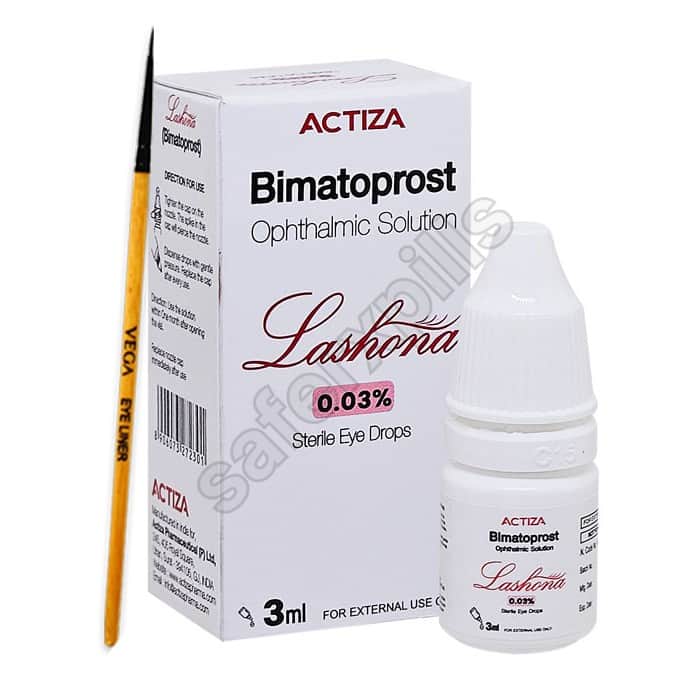
Lashona 3ml
Generic: Generic Latisse
Select pack size
5 bottles · $8.00 per bottle
About Lashona 3ml
Lashona is a 3 mL bottle of bimatoprost 0.03% solution from Actiza Pharmaceutical, a drug company in Surat, India. It is sold for the eyelashes because bimatoprost at the same 0.03% strength is the active ingredient in Latisse, the FDA-approved treatment for thin or short lashes (hypotrichosis of the eyelashes). The carton in our product photo calls it "Bimatoprost Ophthalmic Solution", "Sterile Eye Drops" and "For external use". Packs of 5 to 100 bottles cost from $5.00 a bottle before shipping.
Disclosure: Actiza Pharmaceutical is connected to SafeRxPills, so we have a direct interest in this brand. That is one more reason this page sticks to the Latisse label and published studies, listed at the end.
We list Lashona as a "generic Latisse", but it is not an FDA-approved generic. The FDA-approved generic eyelash solutions in the US are other products (for example from Sandoz and Alembic). This page covers the price per bottle, how Lashona compares with Latisse and US generics, how to apply it following the Latisse label as closely as possible, what the trials found, side effects, who should not use it, and delivery. Clinical figures come from the US prescribing information for Latisse.
Lashona at a glance
| Active ingredient | Bimatoprost 0.03%, 3 mL bottle, per the carton in our product photo (0.03% is 0.3 mg per mL) |
| Brand and maker | Lashona. The carton reads "Manufactured in India for Actiza Pharmaceutical (P) Ltd., Surat"; it does not name the plant that made it. |
| Regulatory status | Bimatoprost 0.03% is FDA approved for lashes as Latisse and its generics, and Latisse is licensed in Canada. This Indian pack is not registered with the FDA, MHRA, TGA or Health Canada. |
| Usual use (Latisse label) | One drop on a sterile single-use applicator, drawn along the upper eyelid margin at the base of the lashes, once nightly; a new applicator for each eye |
| Timing | Gradual. The Latisse label says the effect is not significant in most patients until 2 months; the main trial result was measured at week 16 |
| Applicators | Not confirmed. Our product photo shows the carton next to an eyeliner brush; we have not confirmed that a brush or sterile applicators come in the pack |
| Packs | 5, 10, 20, 40, 60, 80 or 100 bottles |
| Price per bottle | $5.00 to $8.00 before shipping |
| Delivery | 7 to 14 business days to the US, UK, Australia and Canada; $25 shipping under $149, free from $149 |
Price per bottle
Prices below are as of October 2026; the pack selector shows the current price.
| Pack | Price | Per bottle | Per mL | Shipping | Per bottle with shipping | Lasts at one bottle a month (our estimate) |
|---|---|---|---|---|---|---|
| 5 bottles | $40 | $8.00 | $2.67 | $25 | $13.00 | About 5 months |
| 10 bottles | $70 | $7.00 | $2.33 | $25 | $9.50 | About 10 months |
| 20 bottles | $120 | $6.00 | $2.00 | $25 | $7.25 | About 20 months |
| 40 bottles | $230 | $5.75 | $1.92 | Free | $5.75 | About 40 months |
| 60 bottles | $325 | $5.42 | $1.81 | Free | $5.42 | About 5 years |
| 80 bottles | $420 | $5.25 | $1.75 | Free | $5.25 | About 6 to 7 years |
| 100 bottles | $500 | $5.00 | $1.67 | Free | $5.00 | About 8 years |
Larger packs are cheaper per bottle before shipping as well as after it. The last column is our own arithmetic. The carton in our product photo says to use the solution within one month after opening, so one bottle a month is the rule we used. For comparison, the US Latisse 3 mL pack comes with 70 applicators, which is 35 nights at two applicators a night (our arithmetic). At that rate, or at one bottle a month, the 16 weeks of the main Latisse trial would need 4 bottles (our arithmetic).
For one person, packs of 40 bottles or more are more than three years of nightly use. We have not confirmed the shelf life printed on Lashona cartons, so check the expiry dates before you buy a large supply, and do not buy more than you will use before they expire.
Compared with Latisse and US generics
| Product | Maker | FDA approved | Cost per mL | Cost per bottle |
|---|---|---|---|---|
| Lashona 3 mL (this page) | Actiza Pharmaceutical, India | No | $1.67 to $2.67 from us, before shipping | $5.00 to $8.00 before shipping |
| Latisse 0.03% eyelash solution | AbbVie (Allergan) | Yes, for eyelash hypotrichosis (2008) | About $40.97 (3 mL) or $31.53 (5 mL) (NADAC) | About $122.91 (3 mL with 70 applicators) or $157.65 (5 mL with 140 applicators) |
| Generic bimatoprost 0.03% eyelash solution | Sandoz, Alembic | Yes, for eyelash hypotrichosis | About $26.63 (3 mL) or $20.57 (5 mL) (NADAC) | About $79.88 (3 mL) or $102.85 (5 mL) |
| Generic bimatoprost 0.03% glaucoma eye drops | Several makers | Yes, for eye pressure only; use on lashes is off label | About $3.82 to $7.75 (NADAC) | About $16.42 (2.5 mL), $38.74 (5 mL), $28.69 (7.5 mL) |
The US figures are what US pharmacies paid per mL in the Medicaid NADAC survey (rates effective 21 October 2026), multiplied by each bottle size. They are acquisition costs, not shelf prices; the price at the counter is higher, and Latisse is usually not covered by insurance because it is a cosmetic treatment. Before shipping, Lashona from us costs less per mL than any of these. With $25 shipping on the 5 bottle pack it works out at about $4.33 per mL (our arithmetic), more than the NADAC rate for the 7.5 mL generic glaucoma bottle ($3.82 per mL), though NADAC is what pharmacies pay, not the price at the counter. What it does not have is a US, UK, Canadian or Australian registration, the Latisse trial data for its own product, or confirmed sterile applicators. If you are in the US and have a prescription, compare local cash prices for a generic bimatoprost eyelash solution, which comes as an FDA-approved product. Our Latisse cost guide has more detail.
Lashona, Latisse and the other bimatoprost products we stock
All of these contain bimatoprost. Latisse (Allergan, now AbbVie) was approved by the FDA on 24 December 2008 for hypotrichosis of the eyelashes. Lashona is not the product used in the Latisse trials; what it shares is the active ingredient and its strength, which is why following the Latisse method as closely as possible is the nearest you can get to the conditions behind the published results. We have not found a published study of Lashona itself.
| Product | Strength | For lashes? |
|---|---|---|
| Lashona 3 mL (this page), Actiza | 0.03% | Sold for lashes; same strength as Latisse |
| Careprost 3 mL, Sun Pharma | 0.03% | Same strength as Latisse; sold in India as a glaucoma drop |
| Lashisma, Intas | Bimatoprost | Sold for lashes |
| Lumigan 0.03%, Allergan | 0.03% | A glaucoma drop at the Latisse strength |
| Lumigan 0.01%, Allergan | 0.01% | No. The Latisse trials used 0.03% |
| Careprost Plus, Sun Pharma | Bimatoprost with timolol | No. A glaucoma combination with a beta blocker |
Use one bimatoprost product at a time, never two. See Latisse vs bimatoprost and Careprost vs Latisse for the full comparison.
How to apply Lashona to your lashes
These steps follow the Latisse label (section 2 and the patient information). Lashona's own carton gives only bottle directions.
- At night, wash your face, remove all makeup and take out contact lenses. Lenses can go back in 15 minutes after applying.
- Hold a new sterile single-use applicator level and put one drop on it, close to the tip but not on the tip. Do not let the bottle nozzle touch anything.
- Draw the applicator along the skin of the upper eyelid margin, where the lashes meet the skin, from the inner corner to the outer corner. The lid should feel lightly moist without runoff.
- Blot any solution beyond the lid margin with a tissue.
- Throw the applicator away and use a new one for the other eye.
- Upper lid only. The Latisse label says do not apply it to the lower eyelash line or in the eye.
- Once a night. "Additional applications of LATISSE will not increase the growth of eyelashes" (label section 2).
- Applicators. The Latisse label says: "Do not reuse applicators and do not use any other brush/applicator to apply LATISSE." It allows only the sterile applicators supplied with Latisse, and we have not confirmed that any sterile applicator comes with Lashona. A sealed sterile single-use applicator for each eye each night is the nearest substitute, but that is outside the label. Never use a reusable eyeliner or makeup brush, and never share an applicator between eyes or people.
- If some gets in the eye: the Latisse patient information says it is not expected to cause harm and the eye should not be rinsed.
- Missed night: do not try to catch up; apply as usual the next evening.
- After opening: the carton in our product photo says to use the solution within one month after opening. Write the opening date on the box.
Our step by step application guide explains the reason behind each rule; it is written for Careprost but the method is the same.
How long until you see results
The Latisse label says the onset of effect "is gradual but is not significant in the majority of patients until 2 months". In the 278 patient trial behind the Latisse approval, the share of people with at least a 1 grade improvement on the Global Eyelash Assessment was:
| Week | Bimatoprost 0.03% (137 people) | Vehicle (141 people) |
|---|---|---|
| Week 1 | 5% | 2% |
| Week 4 | 15% | 8% |
| Week 8 | 50% | 15% |
| Week 12 | 69% | 20% |
| Week 16 (main result) | 78% | 18% |
| Week 20 (4 weeks after treatment stopped) | 79% | 21% |

At week 16, average lash length rose by 25% (1.4 mm) against 2% on vehicle, fullness by 106% against 12%, and darkness by 18% against 3% (label Table 3). These are averages from the Latisse trial, not from Lashona; some people see more and some see little. Our results week by week guide covers what to expect.
What happens when you stop
The change is not permanent. The Latisse label says eyelash growth "is expected to return to its pre-treatment level" when treatment stops, and the patient information says lashes return to their previous appearance "over several weeks to months". In a 12 month randomised trial (Glaser 2015, PMID 25296533), treatment effects were maintained for about 2 months but had markedly diminished 4 to 6 months after stopping in people with idiopathic hypotrichosis.
Side effects
In the 4 month Latisse trial, the most common adverse reactions were itchy eyes, red eyes, skin darkening, eye irritation, dry eye symptoms and redness around the eye, each in less than 4% of patients. A feeling of something in the eye, unwanted hair growth and darkening of the iris were also seen. The label warns about:
- Brown darkening of the iris (the coloured part of the eye), which the label says is "likely to be permanent". It may not be noticeable for several months to years.
- Darkening of the eyelid skin. The label says it has been reported to be reversible after stopping "in most patients" (5.3), and the patient information says it "may be reversible" and is expected to reverse after several weeks to months.
- Hair growth outside the treatment area where the solution repeatedly touches the skin, such as the cheek. Blot runoff.
- Uneven lashes between the eyes in length, thickness, colour, number or direction of growth; the patient information says these differences usually go away if you stop.
- Infection from a contaminated bottle tip or a reused applicator. The label says serious infections may result from using contaminated solutions or applicators, and that bacterial keratitis has been reported with multiple dose eye products.
- Lower eye pressure. Latisse lowered eye pressure in trials, though the label says not to a level that will cause clinical harm.
Reports since approval include dry skin of the eyelid, eye and eyelid swelling, styes, watery eyes, temporary loss or breakage of lashes, fat loss around the eye that deepens the lid crease or causes a drooping lid, rash, peeling eyelid skin, ingrowing lashes, blurred vision and local allergic reactions (label 6.2). Our lash serum safety guide covers these in more depth.
When to get urgent help
- A sudden drop in vision, eye pain or any new change in your sight.
- Signs of an eye infection, such as a painful red eye or discharge, or any injury to the eye.
- Swelling of the eyelids, a rash on the eyelids or around the eye, or marked redness and itching after applying: possible signs of an allergic reaction. Stop using it and get medical advice (our advice; the Latisse label says to seek your doctor's advice immediately about continuing).
The Latisse label tells patients who develop a new eye condition (such as trauma or infection), have a sudden decrease in vision, have eye surgery, or develop any eye reaction, particularly conjunctivitis and eyelid reactions, to seek their doctor's advice immediately about continuing treatment.
Who should not use Lashona
Never use it (contraindication, Latisse label section 4):
- if you are allergic to bimatoprost or any ingredient of the solution. We have not confirmed Lashona's preservative; Latisse contains benzalkonium chloride.
Only with your eye doctor's agreement:
- Glaucoma or eye pressure drops, or a history of abnormal eye pressure. The Latisse label says that in people using Lumigan or other prostaglandin drops for eye pressure, Latisse "may interfere with the desired reduction in IOP", and that patients on eye pressure lowering medicines should not use it without first consulting their doctor. The patient information says to use it only under the close supervision of your physician, and the label says pressure should be monitored. Tell your eye doctor if you use glaucoma drops.
- Active inflammation inside the eye, such as uveitis: the label says use with caution because the inflammation may get worse.
- Risk of macular oedema (swelling at the back of the eye): the label says use with caution after cataract surgery without a lens implant, with a lens implant and a torn posterior capsule, or with other known risk factors.
- Pregnancy: there are no adequate studies in pregnant women, and the label says use it during pregnancy "only if the potential benefit justifies the potential risk to the fetus".
- Breastfeeding: it is not known whether it passes into breast milk; the label says to weigh the benefits of breastfeeding against the mother's need for the drug.
- Children and teenagers: the Latisse label reports a 16 week study in ages 5 to 17 with no new safety issues. We recommend that anyone under 18 uses it only with a doctor's advice (our advice).
Tell your doctor and anyone who checks your eye pressure that you use bimatoprost on your lashes, and tell your eye surgeon before any eye operation.
Prescription and legal status
In the US, Latisse is a prescription medicine ("Rx only"), and FDA-approved generic bimatoprost 0.03% eyelash solutions are sold; the FDA says personal importation of unapproved medicines is illegal in most circumstances. In Canada, Latisse (AbbVie, DIN 02350939) is marketed as a prescription product. In the UK, the electronic medicines compendium lists bimatoprost only as glaucoma eye drops, all prescription only medicines, and has no Latisse or eyelash product; it is not the full MHRA register. In Australia, Latisse was entered on the ARTG in July 2016 after an appeal, and the sponsor took it off the ARTG in August 2017; the TGA says it is no longer registered; bimatoprost glaucoma drops such as Lumigan 0.03% are Schedule 4, prescription only. This Indian Lashona pack is not registered with the FDA, MHRA, TGA or Health Canada. We have not confirmed Lashona's prescription status in India. We recommend seeing a doctor or optometrist before you start, especially if you have any eye condition. See Is Careprost legal in the USA? for the US rules in more detail.
Buying genuine Lashona
The MHRA warns: "Any medicine not authorised for sale in the UK can be unsafe or ineffective and there is no way of knowing what is in them or the negative health effects they can have." Lashona is not authorised for sale in the UK, so this applies to it. The MHRA also advises: "Only use UK-registered pharmacies, including online pharmacies displaying the official green cross logo." When your order arrives, check that the carton names Actiza and Lashona and shows bimatoprost 0.03%, 3 mL, a batch number, a manufacturing date and an expiry date, that the bottle seal is unbroken, and that the solution is clear. These checks cannot prove a bottle is genuine, because counterfeiters copy packaging. If a bottle causes unusual symptoms, stop using it, seek medical advice, and report it to your medicines regulator (the MHRA Yellow Card scheme in the UK, FDA MedWatch in the US, the TGA in Australia or Health Canada) as well as to us.
Delivery
We ship Lashona to the US, UK, Australia and Canada in plain packaging with tracking. Standard delivery takes 7 to 14 business days to most countries. The Latisse label allows storage between 2°C and 25°C, and Actiza's product page says to keep Lashona at room temperature away from light and heat, so it does not need a fridge. Shipping costs a flat $25 on orders under $149 and is free from $149. See our shipping page for times by region.
Related guides
- Latisse vs bimatoprost: what US patients need to know
- How to apply bimatoprost to your eyelashes, step by step
- Bimatoprost lash results week by week
- Are lash growth serums safe?
- Is Latisse covered by insurance?
- Bimatoprost for eyebrows
Sources
- LATISSE (bimatoprost ophthalmic solution) 0.03%, US prescribing information and patient information, AbbVie, SPL version 25 (published 23 December 2025), sections 1, 2, 4, 5, 6, 8, 11, 14, 16 and 17. DailyMed
- Drugs@FDA: LATISSE, NDA 022369, approved 24 December 2008, prescription. openFDA NDC directory: Sandoz bimatoprost eyelash solution (ANDA 202719) and Alembic (ANDA 210515), 3 mL and 5 mL.
- Glaser DA et al. Long-term safety and efficacy of bimatoprost solution 0.03% application to the eyelid margin for the treatment of idiopathic and chemotherapy-induced eyelash hypotrichosis: a randomized controlled trial. Br J Dermatol 2015;172(5):1384-94. PMID 25296533.
- Centers for Medicare and Medicaid Services. National Average Drug Acquisition Cost (NADAC), 2026 file, rates effective 21 October 2026. data.medicaid.gov
- Health Canada Drug Product Database: LATISSE, DIN 02350939, AbbVie Corporation, marketed, prescription (checked 21 October 2026).
- Therapeutic Goods Administration. Australian Public Assessment Report for bimatoprost (Latisse), final 18 June 2014, updated August 2017, with notes on AAT decision, ARTG entry and cancellation.
- Electronic medicines compendium (emc) searches for "latisse" and "bimatoprost", 21 October 2026. emc
- healthdirect Australia: Lumigan 0.03% eye drops, Schedule 4.
- Actiza Pharmaceutical, Lashona product page, checked 21 October 2026, and the Lashona carton in our product photo.
- MHRA warning on medicines bought online, 13 February 2026.
- US Food and Drug Administration. Personal Importation. FDA
This page is for information and is not medical advice. Bimatoprost is a prescription medicine in the US, UK, Canada and Australia; talk to a doctor, optometrist or pharmacist before using it.
Key Information
- ✓Active Ingredient: Generic Latisse
- ✓Category: Eye Care
- ✓Form: Bottle
- ✓Brand: Actiza Pharmaceutical Pvt. Ltd.
- ✓Manufacturer: Actiza Pharmaceutical Pvt. Ltd.
Frequently Asked Questions
What is Lashona 3ml?
Lashona is a 3 mL bottle of bimatoprost 0.03% solution from Actiza Pharmaceutical, Surat, India. It is sold for the eyelashes because Latisse, the FDA-approved eyelash treatment, contains bimatoprost at the same 0.03% strength. Actiza Pharmaceutical is connected to SafeRxPills.
Is Lashona the same as Latisse?
It contains the same active ingredient at the same strength. It is not the same product: Latisse is FDA approved for eyelash hypotrichosis and comes with sterile applicators, while this Indian Lashona pack is not registered with the FDA, MHRA, TGA or Health Canada, has no trial data of its own, and we have not confirmed that applicators come with it. It is also not an FDA-approved generic.
How much does Lashona cost per bottle?
As of October 2026, from $8.00 a bottle in the 5 bottle pack down to $5.00 in the 100 bottle pack, before shipping; the pack selector shows the current price. Shipping is $25 under $149 and free from $149. In October 2026 US pharmacies paid about $122.91 for 3 mL of Latisse and $79.88 for 3 mL of a generic eyelash solution (NADAC).
How do I apply Lashona to my eyelashes?
Following the Latisse label: once a night on a clean face with makeup and contact lenses removed, put one drop on a sterile single-use applicator and draw it along the upper eyelid margin at the base of the lashes. Blot any runoff, then use a new applicator for the other eye. Never apply it to the lower lash line, and do not apply more than once a night.
Does Lashona come with an applicator brush?
We have not confirmed it. Our product photo shows the carton next to an eyeliner brush. The Latisse label says do not reuse applicators and do not use any other brush or applicator. Never use a reusable eyeliner or makeup brush; a sealed sterile single-use applicator for each eye each night is the nearest substitute, but it is outside the label.
How long does Lashona take to work?
The Latisse label says the effect is gradual and not significant in most patients until 2 months. In the trial behind the Latisse approval, 15% improved by week 4, 50% by week 8 and 78% by week 16, against 8%, 15% and 18% on the inactive solution. These are Latisse results, not Lashona results.
What happens if I stop using Lashona?
The Latisse label says lashes are expected to return to their previous appearance over several weeks to months. In a 12 month trial (Glaser 2015), effects held for about 2 months and had markedly diminished 4 to 6 months after stopping in people with idiopathic hypotrichosis.
What are the side effects of Lashona?
In the Latisse trial the most common were itchy eyes, red eyes, skin darkening, eye irritation, dry eye symptoms and redness around the eye, each in under 4%. The label also warns of brown darkening of the iris, which is likely to be permanent, eyelid skin darkening, which the label says has been reported to be reversible after stopping in most patients, hair growth where the solution touches skin, uneven lashes, and infection from contaminated solution or applicators.
Who should not use Lashona?
Anyone allergic to bimatoprost or any ingredient must not use it. People using glaucoma or eye pressure drops, or with a history of abnormal eye pressure, should use it only with their eye doctor's agreement; in people using prostaglandin drops such as Lumigan, the Latisse label says it may interfere with the pressure lowering. The Latisse label also advises caution with inflammation inside the eye or a risk of macular oedema, and use in pregnancy only if the benefit justifies the risk to the fetus.
Do I need a prescription for Lashona?
Latisse and bimatoprost are prescription medicines in the US and Canada, and bimatoprost eye drops are prescription only in the UK and Australia. This Indian pack is not registered with the FDA, MHRA, TGA or Health Canada, and the FDA says personal importation of unapproved medicines is illegal in most circumstances. We recommend seeing a doctor or optometrist first.
How long does delivery take?
Standard delivery takes 7 to 14 business days to the US, UK, Australia and Canada, in plain packaging with tracking. Bimatoprost does not need a fridge; the Latisse label allows 2 to 25 degrees C. Shipping is a flat $25 on orders under $149 and free from $149.
Medical References
- 1.DailyMed (U.S. National Library of Medicine)
- 2.PubMed (NCBI) (PMID: 37615697) — 2024
- 3.PubMed (NCBI) (PMID: 38475901) — 2024
- 4.PubMed (NCBI) (PMID: 26526633) — 2016
Sources: U.S. National Library of Medicine (DailyMed, PubMed), openFDA
Related Products
View all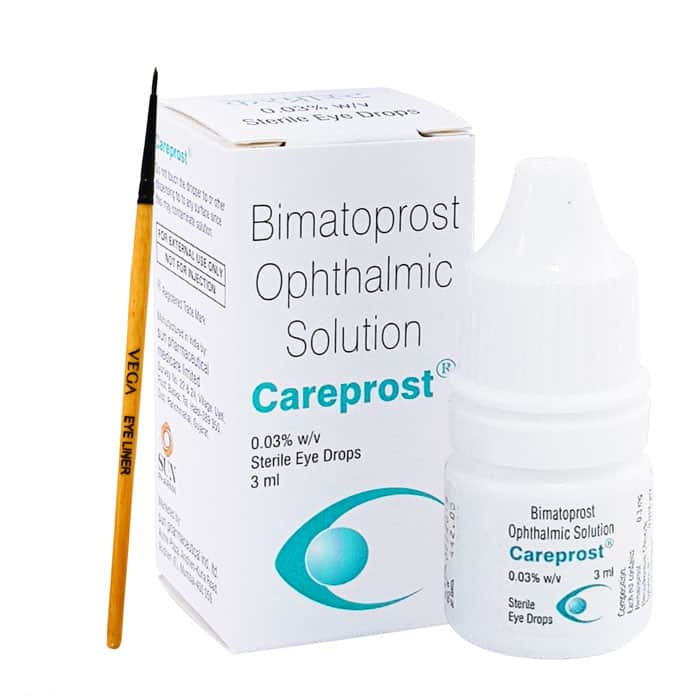

Customer Reviews
No reviews yet. Be the first to review Lashona 3ml.
Related Articles
Health guides about Generic Latisse, written by pharmacists
Generic Janumet (Sitagliptin and Metformin): Now in US Pharmacies, Strengths, Doses and Cost
Generic sitagliptin and metformin tablets from Sandoz, Apotex and Par Health went on sale in the US in 2026. This guide covers who makes them, what the strength numbers mean, Janumet vs Janumet XR, how much the combination lowered A1C in the label's trials, the lactic acidosis and kidney rules, and what a month of each option costs US pharmacies.
What Are Generic Drugs? Generic Name vs Brand Name, FDA Approval, Patents and the Orange Book
A generic drug is an FDA-approved copy of a brand medicine with the same active ingredient, strength, form, route and label, shown to be bioequivalent. This guide explains generic names vs brand (trade) names, the ANDA approval route, Hatch-Waxman patents and 180-day exclusivity, Orange Book AB ratings, authorized generics, FDA approval counts and how much of US prescribing generics account for.

Generic vs Brand Name Drugs: What Is the Same, What Differs and When It Matters
Generic and brand name drugs share the active ingredient, strength, form and route, and FDA data from 2,070 bioequivalence studies show an average absorption difference of 3.56% to 4.35%. This comparison covers what can differ (inactive ingredients, look, label, price), the cases where a switch deserves care such as warfarin, levothyroxine, antiseizure drugs, extended release tablets and inhalers, and how to check what you were given with Orange Book codes and DailyMed.

Erectile Dysfunction Treatment in Perth: Medicine Options, Prescriptions, PBS Status and Costs
What Perth and WA men can use for erectile dysfunction: the four PDE5 inhibitor tablets and other options, why every ED tablet is Schedule 4, why ED medicines are only on the veterans' RPBS, what WA public services do and do not offer, the TGA import rules including the eScript problem, label side effects and warnings, and generic sildenafil and tadalafil prices as of 2 November 2026.
Brand vs Generic Drug Prices: What US Pharmacies Pay for Viagra, Cialis, Latisse and More (NADAC, October 2026)
CMS NADAC data for the week of 28 October 2026 shows what US pharmacies pay for brand and generic versions of Viagra, Cialis, Propecia, Latisse, Lumigan and Stromectol. Generic ED and hair loss tablets cost under 2% of the brand price, while eye and lash generics cost 42% to 65%. Includes 2026 trends, supplier counts and the full method.
Tretinoin Price in the US: What a Tube Costs by Strength, Brand vs Generic, and Buying Online
Tretinoin prices depend on form, strength and tube size. Using the federal NADAC survey of 28 October 2026, this guide shows what US pharmacies pay for generic tretinoin cream, gel and microsphere gel per gram and per tube, which brands and generics the FDA lists, why tretinoin needs a prescription while adapalene 0.1% does not, what the FDA says about importing, and what the India-made tretinoin gels we sell cost.
Related Health Guide
Understanding Eyelash Growth & Eye Conditions: Complete Guide